1. Introduction: Why People Search “LYK Meaning in Text”
Every year, thousands of new slang terms, abbreviations, and shortcut phrases appear inside chats, DMs, gaming lobbies, and workplace tools like Slack and WhatsApp. One of the most confusing among them is LYK.
People search “LYK meaning in text” because they see it in messages that don’t clearly explain what it means:
“I’ll send it later, lyk.”
“Talk to him and lyk what he says.”
“I’ll lyk when I’m done.”
In 2026, most digital conversations happen in fast, informal, mobile-first environments. People no longer write full sentences. They write in compressed intent — small groups of letters that carry full meanings.
LYK looks simple, but it causes confusion because:
- It has more than one possible interpretation
- It appears in both casual and professional messages
- It doesn’t behave like traditional abbreviations
This guide will explain:
- What LYK really means
- Where it came from
- How people use it in 2026
- Whether it is polite, rude, or professional
- When you should (and shouldn’t) use it
You’ll walk away knowing exactly how to interpret and use LYK with confidence.
2. What Does “LYK Meaning in Text” Actually Mean?
Primary Meaning
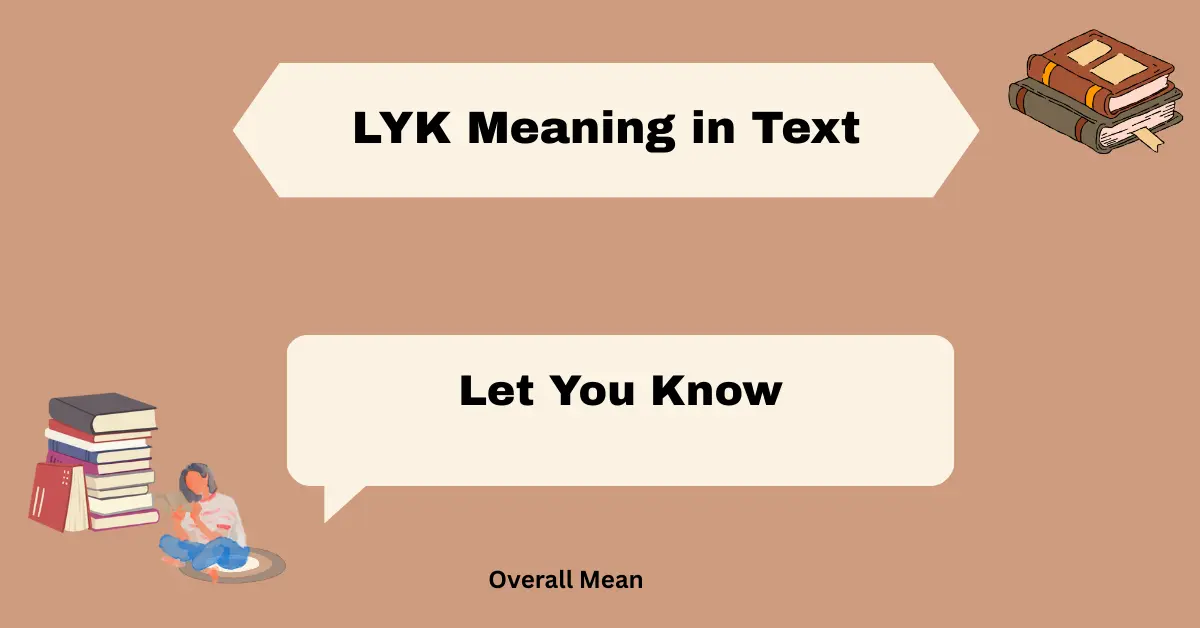
In modern digital communication, LYK most commonly means:
“Let You Know”
So when someone writes:
“I’ll lyk later”
They mean:
“I will let you know later.”
Implied Meaning
LYK doesn’t just mean information will come. It also implies:
- A future update
- A pending decision
- A follow-up
It signals ongoing communication, not a finished thought.
When It Does NOT Mean “Let You Know”
Some people think LYK means:
- “Like you know”
- “Look you know”
- “Love you, okay”
These are wrong in texting culture.
While LYK can look like those phrases, context almost always reveals that it means “let you know.”
3. Is “LYK” Slang, a Typo, or Intentional Usage?
It is not a typo
LYK is intentionally typed. It appears across:
- Snapchat
- Discord
- Work chat tools
It is now part of functional digital language.
Is it slang?
Yes — but not playful slang.
LYK is utility slang: it exists to save time.
Why people type LYK instead of “let you know”
Typing behavior in 2026 is influenced by:
- One-handed mobile typing
- Predictive keyboards
- Voice-to-text trimming
- Fast-response culture
LYK uses three keystrokes instead of 12.
How to tell if it’s intentional
If it appears:
- At the end of a sentence
- After a future action
- In updates or promises
…it is intentional.
4. Origin and Evolution of “LYK” in Digital Communication
Early SMS culture (2000–2010)
Text messages were limited to 160 characters.
People shortened:
- BRB
- FYI
- LOL
- LYK
LYK meant “let you know” even back then.
Messenger apps and social platforms (2010–2020)
As chat apps replaced SMS, abbreviations became stylistic habits, not technical limits.
LYK stayed because it was:
- Useful
- Neutral
- Understood
Gen Z and Gen Alpha influence (2020–2026)
Younger users prefer:
- Short replies
- Low effort messages
- Casual tone
LYK fits that culture perfectly.
Why LYK still exists in 2026
Because people want to:
- Avoid long typing
- Sound relaxed
- Keep conversations open-ended
5. Real-World Usage Scenarios
a) Casual Friend Conversations
Tone: relaxed, friendly
Examples:
“I’m not sure yet, I’ll lyk later.”
“I’ll ask him and lyk.”
“Still waiting — I’ll lyk when I hear back.”
Here, LYK feels warm and natural.
b) Workplace & Professional Chat
Tone: neutral to semi-formal
Examples:
“I’m waiting for approval. I’ll lyk once I receive it.”
“Let me confirm the schedule and lyk.”
In professional spaces, LYK works best when the team is:
- Familiar
- Digital-first
- Not overly corporate
c) Social Media, Gaming, and Communities
Tone: quick, informal
Examples:
“Running a raid rn, lyk when free.”
“I’ll lyk if I join.”
Here, LYK signals availability updates.
6. Emotional Tone and Intent Behind “LYK”
LYK itself is emotionally neutral.
Tone comes from punctuation, emojis, and context.
Warm and friendly
“I’ll lyk 😊”
“I’ll lyk soon!”
Neutral
“I’ll lyk.”
Cold or distant
“lyk”
Capitalization, punctuation, and emoji change how the word feels.
7. Cultural and Regional Differences in Usage
Native English speakers
Use LYK naturally as a shortcut.
Non-native English speakers
May misunderstand it as:
- “Like you know”
- A typo
Regional differences
- US, UK, Canada, Australia → LYK common
- South Asia → growing usage in WhatsApp
- Europe → more formal alternatives preferred
Cross-platform English has made LYK global by 2026.
8. “LYK” Compared With Similar Texting Terms
| Term | Meaning | Tone | Formality | Best Use |
|---|---|---|---|---|
| LYK | Let you know | Neutral | Medium | Updates |
| FYI | For your information | Informative | Medium-high | Sharing info |
| BRB | Be right back | Casual | Low | Pauses |
| LMK | Let me know | Direct | Medium | Asking for response |
| ASAP | As soon as possible | Urgent | Medium | Deadlines |
LYK is about giving information later.
LMK is about asking for it.
9. Common Misunderstandings and Mistakes
Mistake 1: Thinking it means “like you know”
It doesn’t.
Mistake 2: Autocorrect confusion
Some phones try to expand or change it. Always read context.
Mistake 3: Overuse
If every message ends with LYK, it feels lazy.
How to avoid confusion
If clarity matters, write:
“I’ll let you know.”
10. Is “LYK” Polite, Rude, or Unprofessional?
In friendships
Totally normal and polite.
In work
Acceptable in:
- Slack
- Teams
- Startup culture
Avoid in:
- Client emails
- Legal or formal writing
In relationships
LYK can feel:
- Caring if followed up
- Dismissive if never updated
11. Expert Linguistic Insight (Text Language in 2026)
Digital language evolves toward:
- Efficiency
- Emotional signaling
- Low cognitive load
LYK survives because:
- It is short
- It is neutral
- It carries clear intent
Abbreviations don’t replace grammar — they replace typing effort.
12. How and When You Should Use “LYK”
Use LYK when:
- You plan to give an update
- The tone is casual
- Speed matters
Avoid LYK when:
- Writing formal emails
- Talking to strangers
- The message could be misunderstood
Safer alternatives
- “I’ll update you.”
- “I’ll let you know.”
13. FAQs About “LYK Meaning in Text”
1. What does LYK stand for?
Let you know.
2. Is LYK slang?
Yes, modern digital slang.
3. Is LYK rude?
No, unless used without follow-up.
4. Can I use LYK at work?
Yes, in casual team chats.
5. Is LYK the same as LMK?
No. LYK gives info. LMK asks for it.
6. Do people still use LYK in 2026?
Yes, especially in fast messaging.
7. Is LYK professional?
Semi-professional only.
14. Final Summary and Key Takeaways
LYK means “Let You Know.”
It is:
- A digital shortcut
- A promise of future information
- A neutral, efficient text expression
Used correctly, it keeps conversations smooth.
Used poorly, it creates confusion.
Now when you see LYK in text, you know exactly what it means — and how to use it like a native digital speaker.