1. Introduction: Why People Search “Mhm Meaning in Text”
People search “Mhm meaning in text” because the word looks simple but feels confusing. It appears short, casual, and harmless—yet its meaning changes dramatically depending on tone, context, and relationship.
In modern digital communication (especially after 2024), texting has become less about grammar and more about micro-signals. Short responses like mhm, ok, or sure now carry emotional weight. A single word can signal agreement, boredom, passive resistance, or emotional distance.
Users often encounter mhm in:
- Chat messages that feel vague
- Replies that seem emotionally flat
- Conversations where tone is unclear
This creates curiosity and sometimes anxiety. Readers want to know:
- Is mhm positive or dismissive?
- Is it rude?
- Can it be used professionally?
- Why do people still use it in 2026?
This article explains exactly what “mhm” means in text, how it evolved, and how to interpret or use it correctly—without guessing.
2. What Does “Mhm Meaning in Text” Mean?
Clear Definition
“Mhm” in text means acknowledgment or agreement, similar to saying:
- Yes
- I understand
- I hear you
However, unlike “yes,” mhm is non-committal. It confirms receipt of information rather than enthusiasm.
Literal Meaning
At its core, mhm is a written representation of a vocal sound people make when they acknowledge something verbally without speaking fully.
Example (spoken):
“Mhm.” (nods head)
Example (text):
“Mhm, that makes sense.”
Implied Meaning
The implied meaning depends on context:
- Neutral agreement
- Passive acknowledgment
- Low-effort confirmation
- Emotional distance
When It Does NOT Mean Agreement
Mhm does not always mean approval. In many cases, it simply means:
- “I read this.”
- “I don’t have more to add.”
- “I’m not fully engaged.”
This ambiguity is why people search for its meaning.
3. Is “Mhm” a Slang, Typo, or Intentional Usage?
Is “Mhm” Slang?
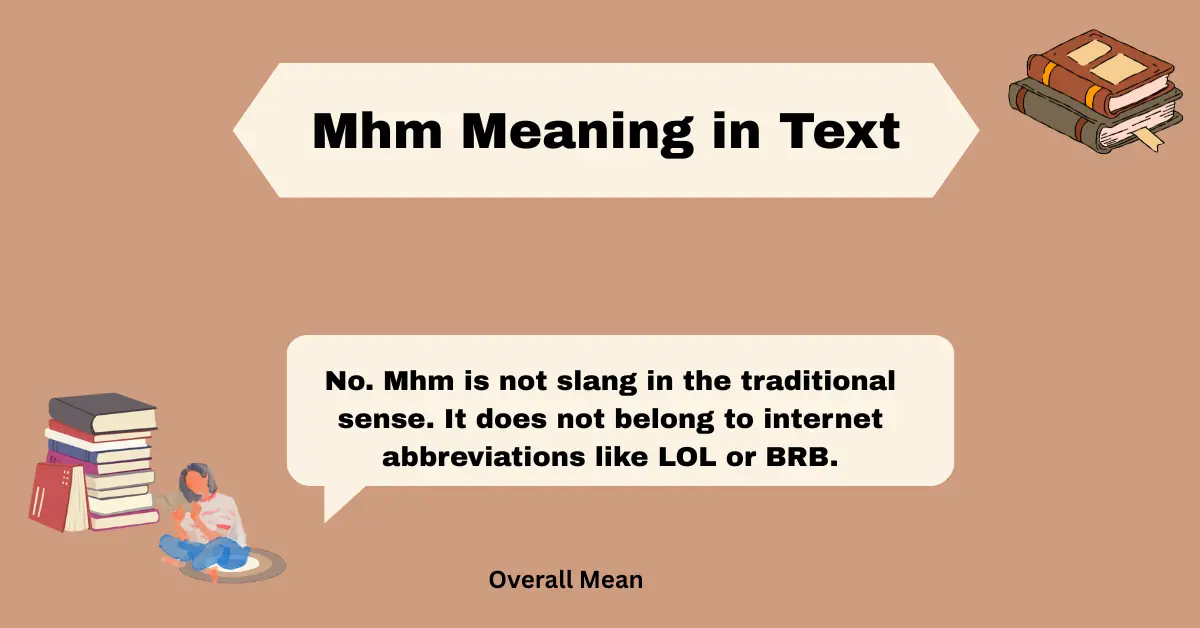
No. Mhm is not slang in the traditional sense. It does not belong to internet abbreviations like LOL or BRB.
It is classified as:
- Paralinguistic text (written speech sounds)
Is It a Typo?
No. Mhm is intentionally typed. It is not autocorrected and not accidental.
Why People Intentionally Use “Mhm”
- Faster than typing “yes”
- Emotionally neutral
- Avoids commitment
- Mimics real speech
How to Tell Intent Using Context
Check:
- Message length
- Punctuation
- Relationship
- Follow-up messages
Example:
“Mhm.” → closed, minimal
“Mhm 🙂” → friendly
“Mhm, sure.” → uncertain
4. Origin and Evolution of “Mhm” in Digital Communication
Early Chat and SMS Influence
Mhm originated in spoken English, not the internet. It existed long before texting as a vocal acknowledgment sound.
Early SMS (2000s):
- Character limits encouraged shorter responses
- Spoken sounds became text
Social Media & Messaging Apps
Platforms like:
- MSN Messenger
- Facebook Messenger
normalized speech-like typing.
Gen Z and Gen Alpha Influence
Younger users:
- Prefer tone-light communication
- Avoid emotional overstatement
- Use minimal words intentionally
Why “Mhm” Still Exists in 2026
- Voice-note culture reinforced speech sounds
- Neutral responses feel safer
- Emotional ambiguity is sometimes intentional
5. Real-World Usage Scenarios (Detailed Examples)
a) Casual Friend Conversations
Tone: Neutral to friendly
Example:
Friend: “I’ll be late tonight.”
You: “Mhm, no problem.”
Meaning:
- Understood
- No emotional urgency
b) Workplace & Professional Chat
Tone: Risky if used incorrectly
Example:
Manager: “Please review the document.”
Reply: “Mhm.”
Interpretation:
- Sounds careless
- Lacks professionalism
Better alternative:
“Got it. I’ll review it.”
c) Social Media, Gaming, and Online Communities
Tone: Casual, often disengaged
Example:
“Mhm, whatever.”
Meaning:
- Low interest
- Emotional detachment
In gaming chats, mhm often signals:
- Agreement without discussion
- Acceptance of group decision
6. Emotional Tone and Intent Behind “Mhm”
Friendly Tone
- Paired with emojis
- Follow-up explanation
Example:
“Mhm 😊 that sounds good.”
Neutral Tone
- Standalone word
- No punctuation
Example:
“mhm”
Awkward or Cold Tone
- Short reply in emotional conversation
Example:
“Mhm.”
How Emojis and Punctuation Change Meaning
| Version | Tone |
|---|---|
| mhm | neutral |
| mhm 🙂 | friendly |
| mhm… | hesitant |
| mhm. | closed / distant |
7. Cultural and Regional Differences in Usage
Native English Speakers
- Use mhm casually
- Understand tone shifts instinctively
Non-Native English Speakers
- Often misinterpret it as rude
- May see it as lazy or unclear
Regional Differences
- US, UK, Canada: Common
- Asia & Europe: Less common in professional chat
Cross-Platform Differences
- WhatsApp: Casual acceptance
- Slack: Often discouraged
- Discord: Normal
8. “Mhm Meaning in Text” Compared With Similar Texting Terms
| Term | Meaning | Tone | Formality | Best Use |
|---|---|---|---|---|
| mhm | acknowledgment | neutral | low | casual chat |
| yes | agreement | clear | medium | all contexts |
| ok | acceptance | neutral | medium | general |
| yeah | informal yes | casual | low | friends |
| sure | conditional | polite | medium | work + casual |
| got it | understanding | professional | high | workplace |
9. Common Misunderstandings and Mistakes
Misinterpretation
People assume:
- mhm = yes (not always true)
- mhm = rude (context matters)
Autocorrect Issues
Some keyboards replace mhm with:
- hmm
- mm
This changes meaning entirely.
Overuse Problems
Using mhm repeatedly:
- Makes you sound disengaged
- Reduces clarity
How to Avoid Confusion
- Add context
- Use full sentences when needed
- Avoid it in emotional or professional messages
10. Is “Mhm” Polite, Rude, or Unprofessional?
Relationship-Based Analysis
- Friends: Acceptable
- Family: Neutral
- Partner: Risky if emotional
- Boss: Often unprofessional
Context-Based Analysis
- Informational message: Fine
- Emotional discussion: Avoid
- Workplace instruction: Avoid
Professional Etiquette Guidance
In work settings:
- Replace mhm with understood, acknowledged, or yes
11. Expert Linguistic Insight: Text Language in 2026
Digital language evolves toward:
- Speed
- Efficiency
- Emotional neutrality
Abbreviated responses survive because:
- They reduce cognitive load
- They mirror speech
- They avoid over-commitment
Grammar matters less than intent clarity in modern communication.
12. How and When You Should Use “Mhm”
Do’s
- Use with friends
- Use in casual chats
- Add emoji if warmth is needed
Don’ts
- Avoid in professional emails
- Avoid during serious conversations
- Avoid as a final response when clarity is required
Safer Alternatives
- “Yes, I understand”
- “That works”
- “Sounds good”
13. FAQs About “Mhm Meaning in Text”
Q1: Does mhm mean yes?
Sometimes. It usually means acknowledgment, not strong agreement.
Q2: Is mhm rude in texting?
Not inherently, but it can feel dismissive in serious conversations.
Q3: Can mhm be used professionally?
It’s better avoided in professional communication.
Q4: What’s the difference between mhm and hmm?
Mhm acknowledges; hmm signals thinking or doubt.
Q5: Why do people reply with mhm only?
To confirm receipt without engaging deeply.
Q6: Is mhm passive-aggressive?
It can feel that way if context is emotional.
Q7: Should I respond to mhm?
Yes, if clarity or continuation is needed.
14. Final Summary and Key Takeaways
- “Mhm” in text means acknowledgment, not enthusiasm
- Tone depends on context, punctuation, and relationship
- It’s intentional, not slang or a typo
- Safe in casual chats, risky in professional settings
- Understanding digital tone is essential in 2026 communication
Used correctly, mhm is efficient. Used poorly, it creates confusion.