1. Introduction: Why People Search “WBY Meaning in Text”
Modern texting moves fast. People shorten sentences, remove vowels, and compress meaning into just a few letters. As messaging apps, social platforms, and online games dominate daily communication, abbreviations like WBY appear everywhere — often without explanation.
You might see “WBY?” at the end of a message and pause.
Is it slang?
Is it a typo?
Does it mean something different on Snapchat or WhatsApp?
Most people search “WBY meaning in text” because they encounter it in casual chats and want clarity before responding. Others want to use it themselves but worry about sounding rude, careless, or unprofessional.
In 2026, digital language prioritizes speed, efficiency, and emotional tone more than formal grammar. This guide explains exactly what WBY means, how people use it today, and when you should — or should not — use it.
By the end, you will understand:
- The precise meaning of WBY
- Its emotional tone and intent
- Where it fits in professional vs casual chats
- Cultural differences in usage
- Common mistakes to avoid
- Practical alternatives
- Expert insight into why abbreviations like WBY still thrive
Let’s break it down.
2. What Does “WBY” Mean in Text?
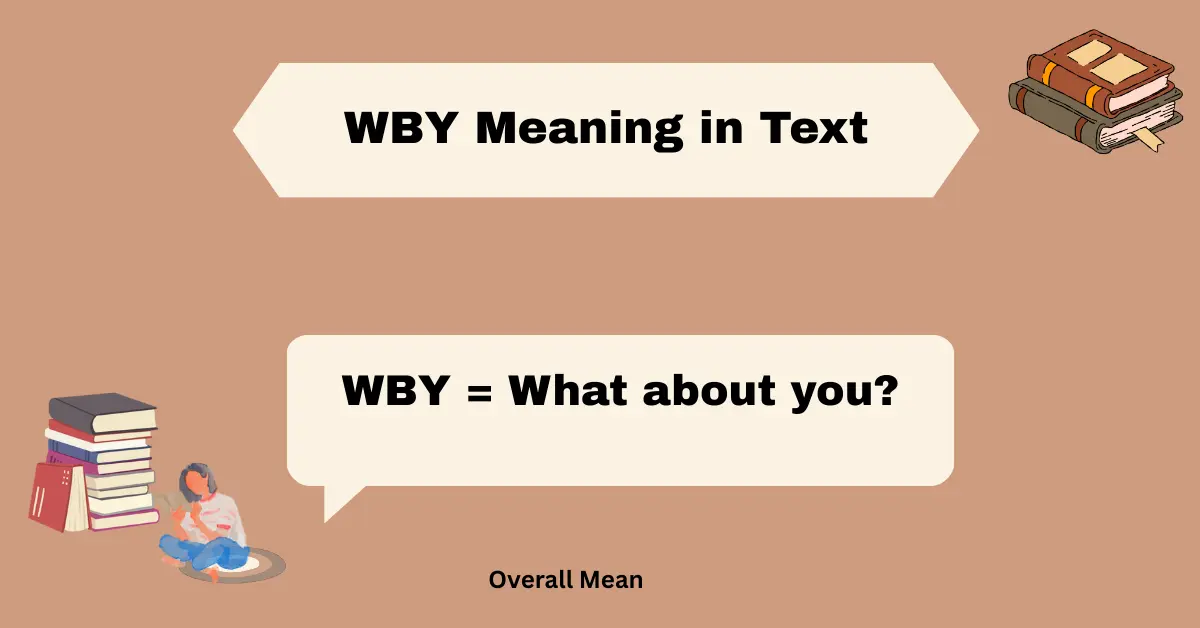
WBY stands for “What About You?”
It is a shortened follow-up question used after someone shares information about themselves.
Literal Meaning
WBY = What about you?
Implied Meaning
Beyond the literal words, WBY often implies:
- Interest in the other person
- Invitation to continue the conversation
- Reciprocity after answering a question
- Casual engagement
Example:
I’m doing great today, WBY?
Here, the sender already shared their status and now invites the recipient to respond.
When It Does NOT Mean What People Assume
WBY does not mean:
- “Why be you”
- “Who by you”
- Any emotional shortcut like “miss you”
It is simply a compressed conversational handoff.
No hidden meaning. No secret slang layer.
3. Is “WBY” a Slang, Typo, or Intentional Usage?
WBY is intentional shorthand, not a typo.
Let’s clarify the difference.
Slang Usage
WBY falls into functional slang — abbreviations designed to save time rather than express identity or humor. Unlike Gen Z slang such as “frfr” or “iykyk,” WBY focuses on conversational flow.
Typing Behavior & Keyboard Influence
Mobile keyboards and predictive text encourage short forms. Writing WBY requires three taps instead of twelve characters.
In fast chats, this matters.
People often type WBY because:
- They are multitasking
- They want quick replies
- They mirror the other person’s casual tone
Intentional Stylistic Usage
Some users prefer WBY because it feels:
- Friendly
- Efficient
- Informal
- Modern
It also signals relaxed conversation.
How to Tell the Difference Using Context
If WBY appears:
- After a statement → intentional
- At the end of a question → intentional
- Mid-sentence randomly → likely typing error
Context always tells you.
4. Origin and Evolution of “WBY” in Digital Communication
Early Chat & SMS Influence
WBY originated during early SMS days (late 1990s–2000s), when character limits forced users to shorten phrases aggressively.
“What about you?” became:
- wut bout u
- wat abt u
- wby
The shortest version survived.
Social Media and Instant Messaging Evolution
Platforms like MSN Messenger, Yahoo Chat, and later WhatsApp and Facebook Messenger normalized abbreviations. WBY spread because it fits naturally at the end of messages.
How Younger Generations Shaped Usage
Gen Z refined digital efficiency. They removed unnecessary letters, relied on context, and adopted minimalist messaging.
WBY became standard among younger users, then spread upward.
Why It Still Exists in 2026
Despite voice notes and AI suggestions, typing remains dominant.
WBY survives because:
- It feels natural
- It saves time
- Everyone understands it
- It maintains conversational rhythm
Efficiency beats formality.
5. Real-World Usage Scenarios (Detailed Examples)
a) Casual Friend Conversations
Friends use WBY constantly.
Examples:
Just finished work, WBY?
I’m staying home tonight lol WBY
Tone: relaxed, friendly, informal.
Here, WBY signals interest and keeps the chat moving.
b) Workplace & Professional Chat (Formal vs Informal Teams)
In relaxed workplaces (Slack, Teams):
I’ve completed the report. WBY — are you done with your part?
In formal environments, people avoid WBY and write:
What about you?
Tone shifts depending on company culture.
Use WBY only when:
- Your team already uses shorthand
- Conversations feel casual
- Hierarchy is flat
Avoid it with clients or executives unless they initiate informal language.
c) Social Media, Gaming, and Online Communities
Gamers and online communities use WBY freely.
Examples:
I main support WBY?
Playing ranked tonight WBY
Here, WBY acts as a quick social connector.
Tone: neutral-to-friendly.
6. Emotional Tone and Intent Behind “WBY”
WBY itself is emotionally neutral. Tone depends on context.
Friendly Tone
I loved that movie WBY 😊
Emoji adds warmth.
Neutral Tone
Busy today WBY
Straightforward.
Awkward or Cold Tone
ok wby
Lowercase + minimal effort can feel careless.
How Punctuation and Emojis Change Meaning
| Style | Emotional Effect |
|---|---|
| WBY? | Neutral |
| WBY 🙂 | Friendly |
| WBY!! | Energetic |
| wby | Casual / possibly lazy |
| WBY… | Uncertain |
Small details matter.
7. Cultural and Regional Differences in Usage
Native vs Non-Native English Speakers
Native speakers use WBY naturally.
Non-native users often learn it from social media and may overuse it or apply it in formal settings unintentionally.
Regional Texting Habits
- US/UK/Canada: very common
- South Asia: growing usage
- Europe: mixed adoption
- East Asia: less frequent; full phrases preferred
Cross-Platform Language Adoption
TikTok and gaming platforms accelerate global adoption. Once influencers use WBY, it spreads internationally.
8. “WBY” Compared With Similar Texting Terms
| Term | Meaning | Tone | Formality | Best Use |
|---|---|---|---|---|
| WBY | What about you? | Neutral-friendly | Low | Casual chats |
| HBU | How about you? | Friendly | Low | Texting |
| U? | You? | Abrupt | Very low | Quick replies |
| And you? | And you? | Polite | Medium | Semi-formal |
| What about yourself? | Same | Formal | High | Professional |
| WYD | What you doing | Casual | Low | Social |
WBY balances friendliness and efficiency better than most alternatives.
9. Common Misunderstandings and Mistakes
Misinterpretation
Some readers think WBY shows disinterest. In reality, it usually signals engagement.
Autocorrect Issues
Phones sometimes change WBY to “why.” Always check before sending.
Overuse Problems
Repeating WBY in every message makes conversations feel robotic.
Instead:
- Rotate with “and you?”
- Ask specific questions
How to Avoid Confusion
Match the other person’s style. If they use full sentences, do the same.
10. Is “WBY” Polite, Rude, or Unprofessional?
Relationship-Based Analysis
- Friends: polite
- Family: acceptable
- Dating: normal
- Boss: risky
- Clients: avoid
Context-Based Analysis
Casual conversation → fine
Formal communication → avoid
Professional Etiquette Guidance
Use full wording in emails:
What about you?
Reserve WBY for chat platforms only.
11. Expert Linguistic Insight (Text Language in 2026)
Digital language now prioritizes efficiency over structure.
Abbreviations persist because:
- Humans optimize effort
- Conversation speed matters
- Emotional tone comes from emojis, not grammar
WBY reflects linguistic compression: preserving meaning while reducing effort.
This is not laziness. It is adaptive communication.
Grammar evolves. Function remains.
12. How and When You Should Use “WBY”
Do’s
- Use with friends
- Use in casual chats
- Use after sharing information
- Match the other person’s tone
Don’ts
- Don’t use in formal emails
- Don’t overuse
- Don’t use with strangers in professional contexts
- Don’t rely on it exclusively
Safer Alternatives
- And you?
- How about you?
- What about yourself?
Choose based on audience.
13. FAQs About “WBY Meaning in Text”
1. What does WBY stand for in texting?
It stands for “What about you?”
2. Is WBY rude?
No. It is neutral and usually friendly in casual conversations.
3. Can I use WBY at work?
Only in informal team chats. Avoid it in emails or with clients.
4. Is WBY Gen Z slang?
Not exactly. It predates Gen Z but they helped popularize it.
5. Does WBY show interest?
Yes. It invites the other person to share.
6. Is WBY the same as HBU?
Yes. Both mean “What/How about you?”
7. Should I capitalize WBY?
Either works. Capitalized looks clearer; lowercase feels more casual.
14. Final Summary and Key Takeaways
WBY means “What about you?”
It is a practical, widely accepted texting abbreviation used to invite response and keep conversations flowing. Its tone depends entirely on context, punctuation, and relationship.
Use it in casual settings. Avoid it in formal communication. Match the style of the person you’re talking to.