The phrase abracadabra feels almost magical the moment you hear it. For some, it brings back childhood memories of magicians pulling rabbits out of hats. For others, it pops up in memes, captions, or playful conversations online.
But what does abracadabra actually mean today?
People often search for this term because they sense it carries more than just a “magic word” vibe. There’s curiosity around its origin, its deeper meaning, and how it fits into modern communication.
This article clears that confusion. You’ll discover not just the literal meaning, but how abracadabra has evolved into a cultural, emotional, and even psychological expression in everyday language.
Abracadabra Meaning – Quick Meaning
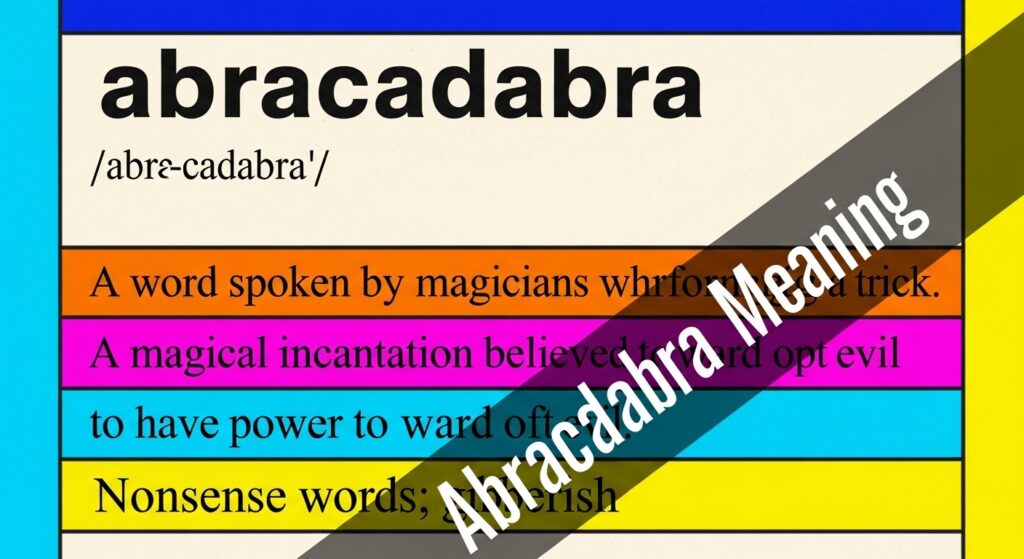
At its simplest, abracadabra is a word traditionally used by magicians while performing tricks. It signals transformation, surprise, or something seemingly impossible happening instantly.
Quick breakdown:
- A magic word used to create illusion or wonder
- Symbolizes instant change or transformation
- Often used playfully to suggest something happens “like magic”
Examples in everyday language:
- “I just cleaned my room—abracadabra, it’s spotless now.”
- “He fixed the bug in seconds. Abracadabra!”
- “I wish life worked like abracadabra sometimes.”
In modern use, it’s less about actual magic and more about expressing amazement, humor, or effortless results.
Origin & Background
The word abracadabra has a surprisingly deep and mysterious history.
It is believed to have originated from ancient times, possibly linked to Aramaic or Latin phrases. One popular theory suggests it comes from a phrase meaning “I create as I speak.” That idea alone explains why it became associated with magical power.
In ancient medicine, people even used abracadabra as a healing charm. It was written in a triangular pattern and worn as an amulet to ward off illness.
Over time, its meaning shifted.
By the 18th and 19th centuries, it became widely known as a magician’s catchphrase, especially in Western entertainment. Stage performers used it to build suspense before revealing tricks.
Today, thanks to social media and pop culture, abracadabra has taken on a lighter tone. It’s used in captions, jokes, and even sarcasm—often to highlight something that seems too easy or magically quick.
Real-Life Conversations
Here’s how abracadabra naturally appears in modern conversations:
WhatsApp Chat
Person A: I finished the entire project in one night.
Person B: What? Abracadabra or what 😄
Instagram DM
Person A: How did your skin clear up so fast?
Person B: Honestly? Water, sleep… and abracadabra 😂
TikTok Comments
Person A: This transition is ins*ne!
Person B: Editor said abracadabra and made magic happen
Text Message
Person A: I thought you were broke yesterday
Person B: Got paid today. Abracadabra 💸
These examples show how the word has become a playful way to describe sudden change or unexpected results.
Emotional & Psychological Meaning
At a deeper level, abracadabra expresses something we all secretly wish for—effortless transformation.
It reflects:
- A desire for quick solutions
- A sense of wonder or disbelief
- Playful acceptance that something feels “too easy”
In modern communication, people use it when they don’t want to over-explain something. Instead, they wrap it in humor.
Personal-style scenario:
Imagine you’ve been struggling with a problem for days. Then suddenly, everything clicks. When you explain it to a friend, you don’t go into technical detail. You just smile and say, “Honestly… abracadabra.”
That word carries relief, surprise, and a touch of pride—all at once.
Usage in Different Contexts
Social Media
On platforms like Instagram or TikTok, abracadabra is often used to highlight transformations.
- Before/after posts
- Glow-ups
- Editing effects
It adds a playful tone that keeps things light and engaging.
Friends & Relationships
Among friends, it’s used jokingly.
- “You disappeared all day and now you’re back? Abracadabra?”
- It can imply curiosity mixed with humor
Work / Professional Settings
Here, usage becomes tricky.
While it can work in creative environments, it may feel too casual in formal communication.
- Acceptable in brainstorming or creative teams
- Avoid in serious emails or presentations
Casual vs Serious Tone
- Casual: Fun, light, expressive
- Serious: Can feel dismissive or vague
Tone matters more than the word itself.
When NOT to Use It
There are situations where abracadabra may not land well:
- Serious discussions (health, finance, emotional topics)
- Professional reports or formal communication
- When someone expects a real explanation, not humor
It can come across as:
- Avoiding responsibility
- Oversimplifying something important
Common Misunderstandings
Many people misinterpret abracadabra in modern contexts.
1. Taking it literally
It’s rarely about actual magic anymore.
2. Assuming sarcasm
Sometimes it’s playful—not mocking.
3. Thinking it’s outdated
While old in origin, it’s still relevant in digital culture.
4. Tone confusion
Depending on context, it can sound funny, dismissive, or clever.
Comparison Table
| Expression | Meaning | Tone |
|---|---|---|
| Abracadabra | Sudden magical change | Playful |
| Voila | Here it is / done | Light, elegant |
| Magic | Something amazing or unexpected | Casual |
| Just like that | Instantly, without effort | Neutral |
| No way | Surprise or disbelief | Emotional |
| Reality check | Opposite of magic thinking | Serious |
Key Insight:
Abracadabra stands out because it blends imagination with reality. It doesn’t just describe change—it dramatizes it in a fun, memorable way.
Variations / Types
Here are different ways people use or adapt abracadabra:
- Abra kadabra – Casual spelling variation
- Abracadabra moment – A sudden breakthrough
- Say abracadabra – Suggesting instant change
- Digital abracadabra – Editing or tech magic
- Life isn’t abracadabra – Reality reminder
- Abracadabra fix – Quick solution
- Just abracadabra it – Playful exaggeration
- Abracadabra vibes – Magical or surreal feeling
- Money abracadabra – Sudden financial change
- Glow-up abracadabra – Transformation in appearance
Each version carries the same core idea—effortless transformation with a touch of wonder.
How to Respond When Someone Uses It
Casual Replies
- “Haha, I wish it was that easy.”
- “Teach me that trick.”
Funny Replies
- “Wait, where’s your magic wand?”
- “You forgot the spell instructions 😄”
Mature Replies
- “Nice, but I’m sure there’s a story behind it.”
- “That worked out faster than expected.”
Respectful Replies
- “That’s impressive—well done.”
- “Glad things worked out for you.”
Regional & Cultural Usage
Western Culture
Strongly tied to magic shows and entertainment. Often nostalgic and playful.
Asian Culture
Less traditional connection, but widely understood through media. Used more casually online.
Middle Eastern Culture
Sometimes linked to ancient language roots. Can carry a slightly deeper, historical tone.
Global Internet Usage
On the internet, abracadabra is universal.
- Memes
- Edits
- Quick transformations
It has become part of global digital humor.
Generational Differences
- Gen Z: Uses it ironically or humorously
- Millennials: Use it nostalgically or casually
The meaning stays similar, but the tone shifts.
Is It Safe for Kids?
Yes, abracadabra is completely safe for kids.
It’s often one of the first “magic words” children learn. It encourages imagination, creativity, and playful thinking.
However, context still matters. Kids may take it literally, so it’s helpful to explain that it’s symbolic, not real magic.
FAQs
1. What does abracadabra mean in simple words?
It means something happens quickly or magically, often without explanation.
2. Is abracadabra a real word?
Yes, it has historical roots and is recognized in English dictionaries.
3. Why do magicians say abracadabra?
To create suspense and signal that something magical is about to happen.
4. Can abracadabra be used in texting?
Yes, it’s commonly used in casual chats to describe quick results.
5. Does abracadabra have a deeper meaning?
Yes, it can symbolize transformation, belief, and the power of words.
6. Is abracadabra outdated?
No, it has evolved and remains popular in digital culture.
7. Can it sound rude?
Only if used in serious situations where a real answer is expected.
Conclusion
Abracadabra may have started as a mysterious ancient phrase, but today it lives on as a playful expression of transformation, surprise, and effortless change.
What makes it powerful isn’t just its history—it’s how naturally it fits into modern communication. Whether you’re joking with friends, reacting to a glow-up, or describing a sudden success, it captures a feeling that words often struggle to explain.
Use it lightly. Use it creatively. And most importantly, use it when the moment truly feels a little magical.
Discover more posts:
- GCA Full Form: Meaning in Chat, Business, Medical & 10 Languages
- DAC Full Form: Meaning, Uses, and Examples Across Industries
- NIFT Full Form: Meaning, Courses, and Multilingual Translations
- VTU Full Form: Meaning in Education, Chat & Across Languages
- MUV Full Form: Meaning in Chat, Text, and 10 Languages