Some words don’t just carry meaning—they carry emotion, relief, and a sense of inner calm. “Alhamdulillah” is one of those rare expressions that people say in happiness, stress, relief, and even silent reflection.
If you’ve ever heard someone say it after good news, or even during a difficult moment, you might have wondered what it truly means and why it feels so deeply meaningful.
People search for “Alhamdulillah meaning” because it’s more than a translation—it’s a feeling wrapped in language. It appears in conversations, social media posts, prayers, and everyday life, yet its depth is often misunderstood.
At its core, this word answers a simple human need: how to express gratitude when words feel too small.
Alhamdulillah Meaning – Quick Meaning
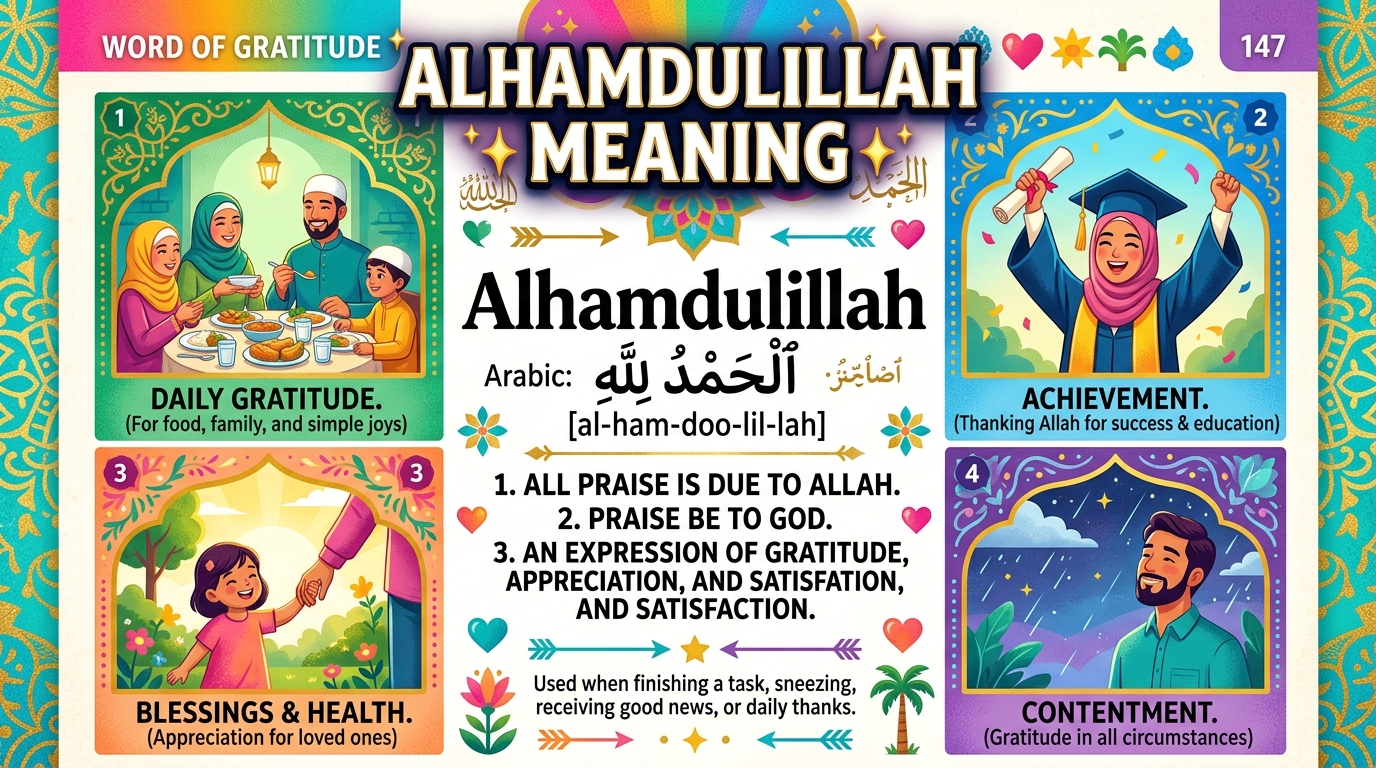
Alhamdulillah (ٱلْحَمْدُ لِلَّٰهِ) is an Arabic expression meaning:
“All praise and thanks belong to God.”
It is used to express gratitude for blessings, relief, or even acceptance during hardship.
Simple understanding:
- “I’m grateful for everything”
- “All praise is for God”
- “Thank God for this moment”
Example sentences:
- “I passed my exam, Alhamdulillah.”
- “Alhamdulillah, everything is fine now.”
- “It was a tough day, but Alhamdulillah I managed.”
Alhamdulillah in Arabic
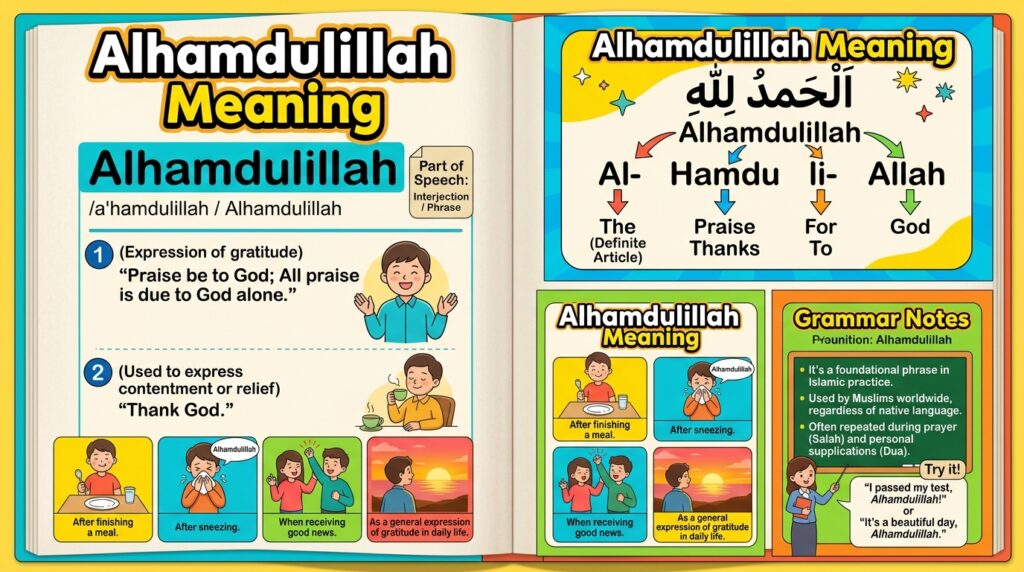
In Arabic, the phrase is written as: ٱلْحَمْدُ لِلَّٰهِ
It comes from three core parts:
- Al-Hamd → praise and gratitude
- Li-llah → for Allah (God)
So together, it becomes a complete expression of full praise directed toward God.
In Arabic-speaking cultures, it is not just a religious phrase—it is part of daily speech. People say it when they wake up, eat, recover from illness, or even when they narrowly escape danger.
It reflects a mindset of gratitude, not just a spoken phrase.
Alhamdulillah meaning in Urdu
In Urdu, Alhamdulillah is commonly translated as:
“تمام تعریفیں اللہ کے لیے ہیں”
Or more simply:
“اللہ کا شکر ہے”
It is used in almost the same emotional way as in Arabic and Urdu-speaking communities.
Everyday Urdu usage:
- “Alhamdulillah, sab theek hai.”
- “Alhamdulillah, kaam ho gaya.”
- “Alhamdulillah, Allah ne madad ki.”
In Urdu culture, the phrase carries warmth, relief, and emotional grounding. It is often said even before explaining a situation, showing gratitude first before anything else.
Hamdullah or Alhamdulillah meaning
Many people get confused between “Hamdullah” and “Alhamdulillah.”
The correct and complete phrase is Alhamdulillah.
- Alhamdulillah → complete and grammatically correct Arabic expression
- Hamdullah → informal, shortened version used in casual speech
While “Hamdullah” is widely used in spoken language (especially South Asia), “Alhamdulillah” remains the full and proper expression.
Think of it like:
- Formal: “I am doing well, thank you.”
- Casual: “I’m good.”
Both carry similar meaning, but one is more complete and respectful in structure.
Alhamdulillah pronunciation
Pronouncing it correctly helps preserve its meaning and respect.
Pronunciation:
Al-ham-du-lil-lah
Break it down:
- Al → soft “al”
- Ham → like “hum” but sharper
- Du → light “du”
- Lil → “lil”
- Lah → soft “lah”
Common mistake:
Many people say it too fast or merge sounds, but slow pronunciation gives it emotional weight.
When spoken properly, it feels calm and reflective, almost like a pause in the middle of life.
Alhamdulillah meaning Christianity
In Christianity, there is no direct equivalent word like Alhamdulillah, but the closest expressions are:
- “Thank God”
- “Praise the Lord”
- “Thanks be to God”
The emotional meaning is similar—gratitude toward God for blessings or relief.
However, Alhamdulillah is rooted specifically in Islamic language and theology, while Christian expressions vary across denominations and traditions.
What connects them is not the wording—but the shared human instinct to express gratitude toward a higher power.
Shukar Alhamdulillah meaning
“Shukar Alhamdulillah” is a combined expression commonly used in South Asia.
- Shukar → gratitude (from Urdu/Persian origin)
- Alhamdulillah → all praise to God
Together, it means:
“I am deeply grateful and thankful to God.”
It is often used when someone feels overwhelmed with relief or happiness.
Example:
- “You recovered from illness?”
- “Yes, Shukar Alhamdulillah.”
It adds emotional intensity to gratitude, making it feel more heartfelt and personal.
Just say Alhamdulillah meaning in Urdu
When someone says “just say Alhamdulillah,” it usually means:
“Simply be grateful and acknowledge God’s blessings.”
In Urdu, it can be understood as:
“بس الحمدللہ کہو”
It is often used when someone is overthinking or complaining. It gently reminds them to focus on gratitude instead of worry.
Example:
- “Everything is going wrong in my life…”
- “Just say Alhamdulillah, things will get better.”
It’s not dismissive—it’s grounding.
Alhamdulillah meaning in Islam
In Islam, Alhamdulillah is one of the most important expressions of faith and gratitude.
It appears in:
- Daily prayers
- Quranic teachings
- Everyday communication
Spiritual meaning:
- Acknowledging that all blessings come from God
- Expressing gratitude in both ease and hardship
- Accepting life with trust and patience
In Islamic belief, saying Alhamdulillah during good times shows gratitude, and saying it during hard times shows patience and faith.
It becomes a mindset—not just a word.
Real-Life Conversations
WhatsApp Chat:
Person A: “I finally got the job!”
Person B: “Alhamdulillah! So proud of you!”
Instagram DM:
Person A: “Recovered from fever today.”
Person B: “Shukar Alhamdulillah, take care now.”
TikTok Comment Section:
User 1: “Life was so hard this year but I’m still standing.”
User 2: “Alhamdulillah, that strength matters more than anything.”
Text Message:
Person A: “Exam result is out.”
Person B: “How was it?”
Person A: “Alhamdulillah, I passed.”
Emotional & Psychological Meaning
Alhamdulillah is not just religious—it is deeply psychological.
It helps people:
- Shift focus from stress to gratitude
- Accept situations beyond control
- Build emotional resilience
When someone says it during hardship, it reflects inner acceptance. When said during happiness, it reflects grounding.
Example scenario:
A person loses their job but later says, “Alhamdulillah, maybe something better is coming.”
This doesn’t deny pain—it reframes it.
That’s why the phrase feels calming even to listeners.
Usage in Different Contexts
Social media:
Used in captions to show gratitude or updates.
Friends & relationships:
Used to share good news or relief.
Work/professional settings:
Used after achievements or successful completion.
Casual vs serious tone:
- Casual: “Alhamdulillah, done!”
- Serious: “Alhamdulillah for everything we’ve been through.”
When NOT to Use It
- When mocking or joking about religion
- In disrespectful or sarcastic tone
- In contexts where gratitude would feel inappropriate or forced
- During arguments to dismiss someone’s feelings
Respect matters because the phrase carries spiritual depth for many people.
Common Misunderstandings
- Thinking it only means “thank you”
- Using it without understanding context
- Assuming it is only for Muslims (it’s culturally used, but rooted in Islam)
- Mispronouncing it as slang in casual chat
The biggest misunderstanding is treating it like a simple phrase rather than an emotional expression.
Comparison Table
| Aspect | Meaning | Usage | Example | Comparison |
|---|---|---|---|---|
| Alhamdulillah meaning | Gratitude to God | Daily life & prayer | “Alhamdulillah, I’m fine” | More spiritual than “thank you” |
| How to use Alhamdulillah | Expression of thanks | Formal & informal | After good news | Stronger emotional depth |
| Examples of Alhamdulillah | Real-life gratitude | Conversations | “Alhamdulillah, passed exam” | Broader than casual thanks |
| Alhamdulillah vs Thank you | Spiritual vs social | Context-based | “Alhamdulillah for everything” | Deeper religious meaning |
Key Insight:
Alhamdulillah is not just a phrase—it is a mindset of gratitude that transforms how people respond to both joy and struggle.
Variations / Types (8–10)
- Alhamdulillah meaning in text → used in messaging for gratitude
- Alhamdulillah slang → casual shortened emotional expression
- Alhamdulillah abbreviation → often written as “Alhamd” informally
- Alhamdulillah in chat → quick reply for good news
- Alhamdulillah meaning Urdu → “Allah ka shukar”
- Alhamdulillah meaning Arabic → full praise to God
- Alhamdulillah in social media → captions for gratitude posts
- Alhamdulillah emotional use → used in relief or stress
- Alhamdulillah religious meaning → Islamic expression of faith
- Alhamdulillah casual use → everyday conversation phrase
How to Respond When Someone Uses It
Casual replies:
- “That’s great!”
- “Happy for you!”
Funny replies:
- “Alhamdulillah party time!”
- “Big W, Alhamdulillah!”
Mature replies:
- “May you always stay blessed.”
- “Grateful to hear that.”
Respectful replies:
- “Alhamdulillah, truly grateful for you.”
- “May Allah keep you safe and happy.”
Regional & Cultural Usage
- Western culture: Often translated as “thank God”
- Asian culture: Widely used in Pakistan, India, Bangladesh
- Middle Eastern culture: Everyday spoken Arabic phrase
- Global internet: Used in captions, memes, and comments
- Gen Z: Casual, expressive usage in chats
- Millennials: More traditional and respectful usage
Is It Safe for Kids?
Yes, it is completely safe for kids. It is a respectful expression of gratitude and is often taught as part of cultural or religious learning.
FAQs
What is the meaning of Alhamdulillah?
Alhamdulillah means “All praise is due to Allah.” Muslims say it to express gratitude for blessings, good outcomes, or even during difficult times as a reminder that everything comes from Allah.
Do Muslims go to bed early?
Many Muslims try to sleep early, especially to wake up for Fajr (the pre-dawn prayer). However, sleep habits vary based on lifestyle, work, and culture.
What is the meaning of “لا حول ولا قوة إلا بالله”?
It means “There is no power nor strength except through Allah.” Muslims say it when feeling weak, stressed, or facing difficulties to show reliance on Allah.
Why do Muslims say Alhamdulillah?
Muslims say Alhamdulillah to show gratitude to Allah for everything—big or small. It helps them stay thankful and mindful in daily life.
What does InshaAllah mean?
InshaAllah means “If Allah wills.” It is used when talking about future plans, showing that nothing happens without Allah’s permission.
What does MashAllah mean?
MashAllah means “What Allah has willed has happened.” It is often said when appreciating something beautiful or good to show admiration without envy.
Why do Muslims say SubhanAllah?
SubhanAllah means “Glory be to Allah.” It is said when witnessing something amazing, surprising, or to praise Allah’s perfection.
What does Astaghfirullah mean?
Astaghfirullah means “I seek forgiveness from Allah.” Muslims say it when they feel they have made a mistake or want to repent.
Why is prayer important in Islam?
Prayer (Salah) is important because it is a direct connection between a Muslim and Allah. It is performed five times a day to maintain discipline and spirituality.
Do Muslims have a specific daily routine?
Many Muslims follow a routine centered around the five daily prayers, which structure their day along with work, family, and rest.
Conclusion
Alhamdulillah is more than a phrase; it is a quiet reminder to pause and notice life’s blessings, even in moments that feel ordinary or difficult. It teaches gratitude not as a reaction but as a way of living. When people say it, they are grounding themselves in appreciation and trust. Whether spoken in joy, relief, or patience, it carries emotional weight that words like “thank you” cannot fully capture. In everyday life, it becomes a soft strength that steadies the heart.