“Biota” is one of those words that feels simple at first glance, but the deeper you go, the more it opens up an entire world.
People often search biota meaning because they encounter it in biology classes, environmental articles, or scientific documentaries and suddenly realize—it’s not just a fancy word for “life.” It’s something broader, more interconnected, and surprisingly poetic.
At its core, biota refers to all living things in a particular region or ecosystem. But that simple definition doesn’t fully capture its emotional weight. It represents the invisible thread connecting plants, animals, fungi, microorganisms, and even humans within one shared environment.
In this article, you’ll understand biota not just as a term—but as a living idea that shapes how we see nature, balance, and survival.
Biota Meaning in English
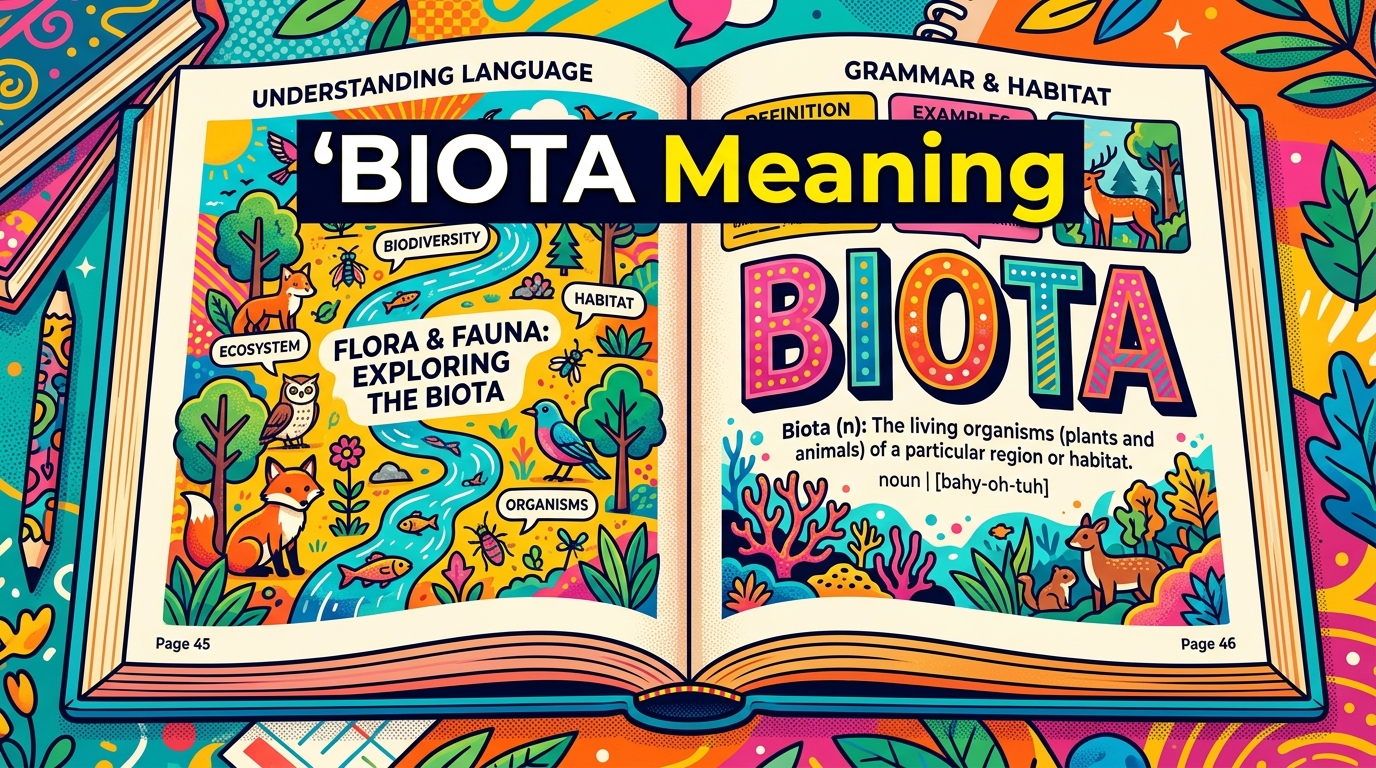
In English, biota meaning refers to all living organisms in a specific area or period of time.
It includes:
- Plants 🌱
- Animals 🐾
- Microorganisms 🦠
- Fungi 🍄
- Aquatic life 🌊
In simple words, biota means the complete set of life forms living together in one place.
Quick examples:
- “The Arctic biota is adapted to extreme cold.”
- “Human activity is affecting the marine biota.”
- “Forest biota includes trees, insects, birds, and fungi.”
It’s not about a single organism—it’s about everything living together as a system.
Biota Meaning in Biology
In biology, biota meaning becomes more technical but also more meaningful.
Biologists use the term to describe the total collection of organisms in a habitat or ecosystem, often studied to understand environmental balance.
Key biological points:
- Biota = living component of an ecosystem
- Includes producers, consumers, and decomposers
- Works in interaction with abiotic (non-living) factors
- Helps maintain ecological balance
Example in biology:
A pond ecosystem contains:
- Fish
- Algae
- Insects
- Bacteria
All of these together form the pond biota.
In biology, biota is not just a list—it is a network of survival relationships.
What is Biota in Ecology
In ecology, biota meaning becomes even more dynamic.
It refers to the entire living community interacting within an ecosystem.
Ecologists study biota to understand:
- Food chains 🍽️
- Energy flow ⚡
- Species interaction 🐝
- Environmental impact 🌍
Simple explanation:
Biota is the “living side” of nature, constantly interacting with air, water, soil, and climate.
For example:
A rainforest biota includes:
- Jaguars
- Monkeys
- Orchids
- Fungi
- Thousands of insects
All of them depend on each other in ways we often don’t notice until something breaks the balance.
Soil Biota Meaning
Soil biota meaning refers to all living organisms present in the soil.
This is one of the most fascinating ecosystems because it is hidden beneath our feet.
Soil biota includes:
- Earthworms 🪱
- Bacteria 🧫
- Fungi 🍄
- Protozoa
- Insects and larvae
Why it matters:
- Breaks down organic matter
- Improves soil fertility
- Supports plant growth
- Maintains nutrient cycles
Without soil biota, agriculture would collapse quietly but completely.
It’s often said that healthy soil is “alive,” and that life is the soil biota working silently.
Biota Japanese
In Japanese scientific usage, biota (生物相 – seibutsusō) is used in academic and ecological contexts.
It refers to:
- The living organisms of a region
- Often used in environmental studies and marine biology
Cultural note:
Japan places strong emphasis on environmental harmony, so the concept of biota aligns with the idea of living in balance with nature (自然との調和).
In marine research, for example:
- “Ocean biota” studies are crucial for fisheries and conservation.
So while the term is global, its use in Japanese science often connects deeply with environmental respect.
Biota Plural
The word biota is already a plural term.
It refers collectively to multiple living organisms.
So:
- ❌ “Biotas” is rarely correct in scientific writing
- ✔ “Biota” already means a collective group of life forms
Example:
- Correct: “The biota of the region is diverse.”
- Incorrect: “The biotas are diverse.”
Think of it like “flora” and “fauna”—already plural in meaning.
Abiota Meaning
Abiota meaning refers to all non-living components of an ecosystem.
It is the opposite of biota.
Abiotic (abiota) factors include:
- Sunlight ☀️
- Water 💧
- Air 🌬️
- Rocks 🪨
- Temperature 🌡️
Simple understanding:
- Biota = living things
- Abiota = non-living environment
Together, they create a complete ecosystem where life can exist.
Without abiota, biota cannot survive—and without biota, abiota becomes biologically inactive.
Biota Pronunciation
The pronunciation of biota is:
👉 /baɪˈoʊtə/
Breakdown:
- “bio” → sounds like bye-oh
- “ta” → sounds like tuh
Simple pronunciation:
bye-OH-tuh
It flows smoothly, often used in academic and scientific speech.
Origin & Background
The word biota comes from the Greek word “biotē”, meaning “life” or “way of living.”
It entered scientific language through biology and ecology as researchers needed a word that described all life collectively, not just individual species.
Over time, it became essential in:
- Environmental science
- Ecology
- Conservation studies
- Climate research
Modern evolution:
Today, “biota” is widely used in:
- Climate reports
- Biodiversity studies
- Environmental documentaries
- Academic research
Social media has also made it more visible, especially in climate awareness discussions.
Real-Life Conversations
WhatsApp Chat
Person A: “What does biota mean in your assignment?”
Person B: “It’s basically all living things in an area—plants, animals, everything together.”
Instagram DM
Person A: “Your caption said ‘forest biota’… sounds smart lol”
Person B: “It just means all life in the forest ecosystem 🌿”
TikTok Comment Section
User1: “Why do scientists always use big words like biota?”
User2: “It just means nature’s whole living system, nothing complicated actually.”
Text Message
Friend: “Is biota same as biodiversity?”
Reply: “Almost, but biota focuses on organisms, biodiversity focuses on variety.”
Emotional & Psychological Meaning
Biota isn’t just a scientific word—it reflects connection and interdependence.
It reminds us that:
- Nothing in nature exists alone
- Every organism has a role
- Life is deeply interconnected
Emotional insight:
People often feel a sense of grounding when they understand biota. It shifts thinking from “individual survival” to “shared existence.”
Personal-style scenario:
Standing in a quiet forest, you realize every sound—the birds, insects, rustling leaves—is part of a living system. That system is biota working silently around you.
Usage in Different Contexts
Social media:
Used in environmental posts, captions, and educational content.
Friends & relationships:
Rare, but used when discussing science or studies.
Work / professional settings:
Common in:
- Research papers
- Environmental reports
- Scientific discussions
Casual vs formal tone:
- Casual: “all living things in nature”
- Formal: “regional biota composition”
When NOT to Use It
- In casual conversations where simpler words work better
- When clarity is more important than technical accuracy
- In emotional conversations where scientific tone feels distant
- When speaking to non-academic audiences unfamiliar with the term
Using “biota” unnecessarily can sometimes confuse listeners.
Common Misunderstandings
Many people think:
- It means a single species ❌
- It means only animals ❌
- It is interchangeable with biodiversity ❌
Reality:
- It includes ALL life forms in a system
- It is a collective ecological term
- It is not about variety, but total life presence
Comparison Table
| Concept | Meaning Intent | Usage Intent | Example Intent | Comparison |
|---|---|---|---|---|
| Biota | All living organisms in an area | Scientific/ecological use | Forest biota includes all life forms | Broader than species |
| Biodiversity | Variety of life forms | Conservation studies | High biodiversity = many species | Focus on variety |
| Abiota | Non-living factors | Ecosystem balance | Sunlight and water are abiota | Opposite of biota |
| Ecosystem | Interaction system of biota + abiota | Ecology study | Pond ecosystem | Includes both |
Key Insight:
Biota focuses on life itself as a whole system, while related terms describe structure, variety, or environment.
Variations / Types (8–10)
- Biota meaning – total living organisms in a region
- Biota in text – rarely used in casual texting, mainly academic
- Biota abbreviation – not commonly abbreviated
- Biota slang – no slang usage; scientific term only
- Biota in chat – used in educational discussions
- Marine biota – ocean life forms
- Soil biota – organisms living in soil
- Freshwater biota – lake and river organisms
- Forest biota – all life in forests
- Global biota – all life on Earth collectively
How to Respond When Someone Uses It
Casual replies:
- “Oh, you mean all living things in that place!”
- “Got it, like nature’s full ecosystem.”
Funny replies:
- “So basically nature’s full guest list?” 😄
- “That’s a fancy way of saying ‘everything alive’!”
Mature replies:
- “Yes, biota refers to all organisms in an ecosystem.”
- “It’s the biological community of a region.”
Respectful replies:
- “Interesting term, I see how it connects ecology and life systems.”
Regional & Cultural Usage
Western culture:
Common in academic and environmental discussions.
Asian culture:
Used in scientific education and environmental awareness.
Middle Eastern culture:
Found mostly in academic or research contexts.
Global internet usage:
Seen in educational content and science communication.
Generational differences:
- Gen Z: encounters it via TikTok science content
- Millennials: more familiar through academic study
Is It Safe for Kids?
Yes, the term is completely safe for kids.
It is:
- Educational
- Non-sensitive
- Science-based
However, younger children may need simpler explanation like:
“Biota means all living things in nature.”
FAQs
What is the meaning of the word biota?
Biota means all living organisms found in a specific area or ecosystem, including plants, animals, and microorganisms.
What is an example of a biota?
A forest biota includes trees, birds, insects, fungi, and bacteria living together in the forest environment.
What does biota stand for?
Biota does not stand for an acronym. It is a scientific term derived from Greek, meaning “life” or “living things.”
What is a synonym for biota?
A close synonym for biota is “flora and fauna” or “living organisms of an ecosystem.”
Is biota the same as biodiversity?
No, biota refers to all living things in an area, while biodiversity refers to the variety and differences among those living things.
Where is the term biota used?
It is commonly used in biology, ecology, environmental science, and climate studies.
What is marine biota?
Marine biota refers to all living organisms found in oceans and seas, including fish, corals, algae, and plankton.
What is soil biota?
Soil biota includes all organisms living in the soil such as earthworms, bacteria, fungi, and insects.
Is biota a singular or plural word?
Biota is a collective term, so it already represents plural living organisms and is not usually pluralized as “biotas.”
Why is biota important in ecology?
Biota is important because it helps scientists understand how living organisms interact within ecosystems and maintain environmental balance.
Conclusion
Biota is more than just a scientific term—it is a reminder that life is never isolated. Every organism, from microscopic bacteria to towering trees, belongs to a shared system of existence. Understanding biota helps us see nature not as separate pieces but as one living network. Once you grasp its meaning, even a simple walk outside feels different. You start noticing how everything is connected, quietly shaping the balance of life around you.