You’ve probably heard someone say “bon appétit” before a meal. Maybe in a restaurant, a movie scene, or even a casual text. It sounds elegant, maybe even a little fancy. But what does it actually mean—and more importantly, how should you use it in real life?
Many people search for “bon appétit meaning” because they’re unsure about the tone. Is it formal? Is it outdated? Can you say it to friends? Or is it only for fine dining?
Here’s the truth: “bon appétit” is simple, warm, and surprisingly flexible. But like many borrowed phrases, its real power lies in context, culture, and intention.
Let’s break it down in a way that feels natural—not textbook.
Bon Appétit – Quick Meaning
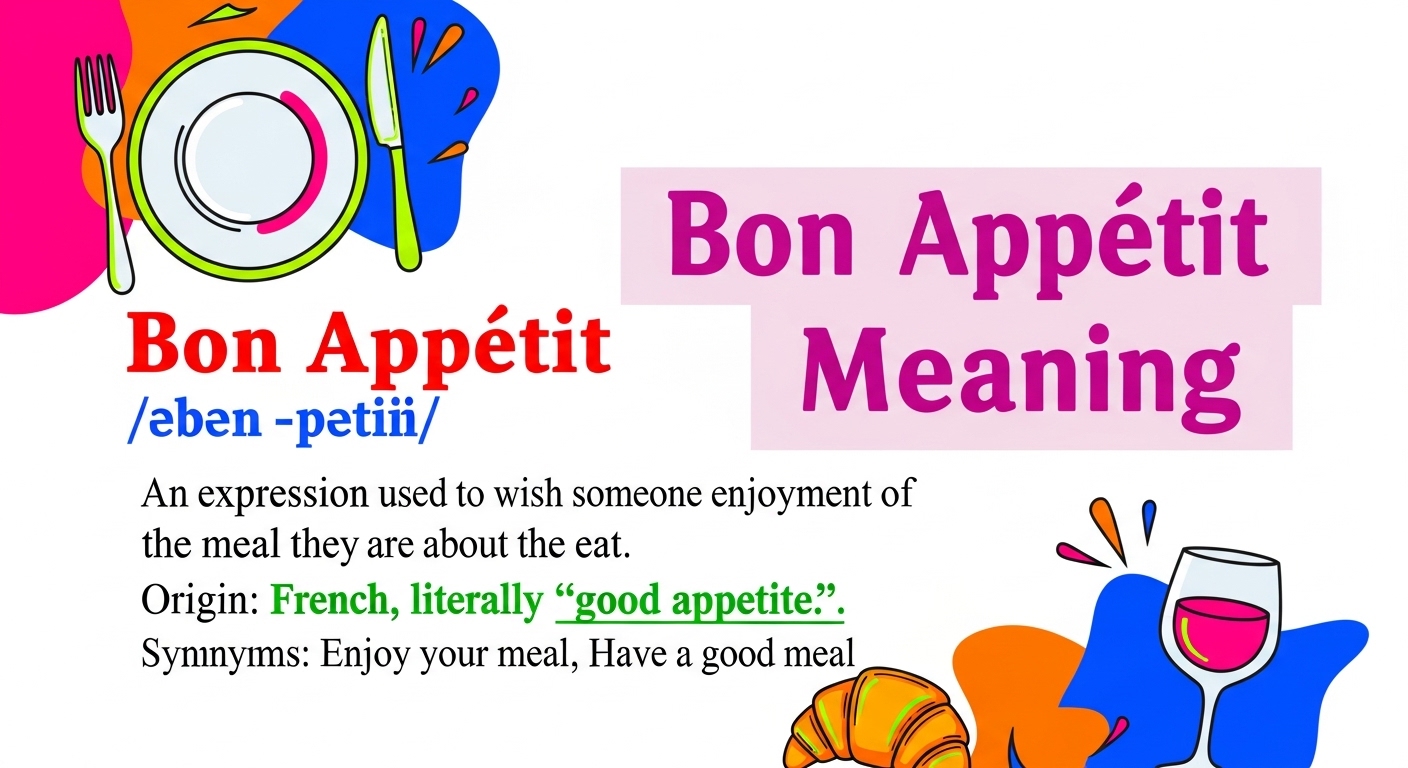
“Bon appétit” is a French phrase that means:
- “Enjoy your meal”
- “Have a good appetite”
- A polite way to start eating
Simple definition:
It’s a friendly expression used before eating to wish someone a pleasant dining experience.
Quick examples:
- “Dinner’s ready—bon appétit!”
- “Wow, that looks delicious. Bon appétit!”
- “Alright everyone, bon appétit—let’s eat!”
It’s not complicated. It’s just a kind, social signal that says: let’s enjoy this moment together.
Origin & Background
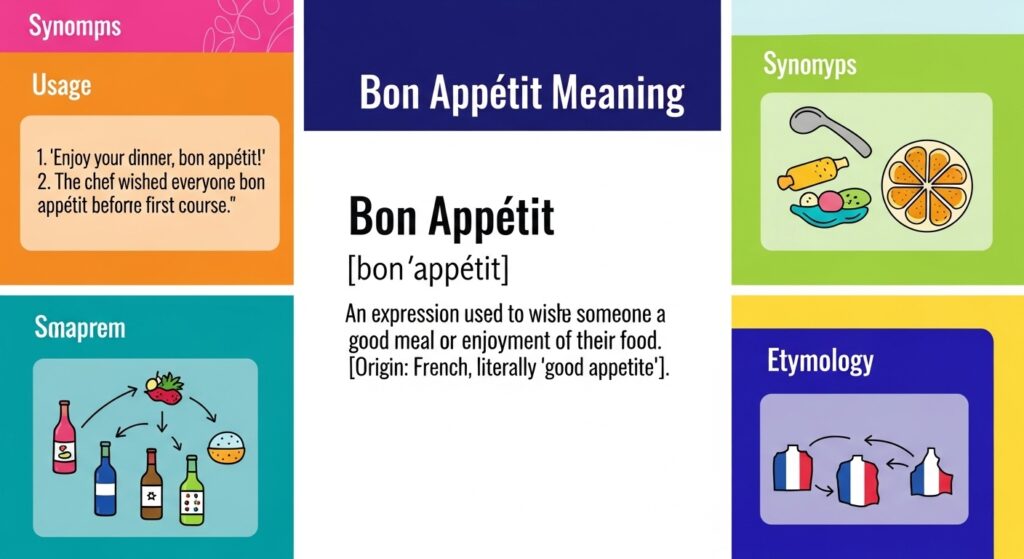
The phrase comes from French:
- “Bon” = good
- “Appétit” = appetite
So literally, it means “good appetite.”
Historically, it became popular in France as part of dining etiquette. Meals were—and still are—deeply social experiences in French culture. Saying “bon appétit” marked the beginning of a shared moment.
Over time, the phrase spread globally. It became associated with:
- Fine dining
- European sophistication
- Hospitality and politeness
Modern Evolution
Today, thanks to globalization and social media:
- It’s used casually, even jokingly
- People say it in texts, memes, and captions
- It no longer feels strictly formal
You’ll see it on Instagram food posts or TikTok cooking videos. Sometimes sincere, sometimes ironic.
Its meaning hasn’t changed—but its tone has become more relaxed.
Real-Life Conversations
WhatsApp Chat
Person A: Just made pasta 🍝
Person B: Omg send some
Person A: Wish I could 😂 bon appétit to me
Instagram DM
Person A: That steak looks in*ane
Person B: It was 🔥
Person A: Bon appétit… I’m jealous
TikTok Comments
User 1: Watching this while eating noodles
User 2: Same 😂 bon appétit to us
Text Message
Mom: Food is on the table
You: Coming!
Mom: Bon appétit ❤️
These examples show something important: the phrase adapts to emotion, not just situation.
Emotional & Psychological Meaning
At its core, “bon appétit” is about connection.
It signals:
- Care
- Warmth
- Shared experience
- Social bonding
When someone says it, they’re not just talking about food. They’re acknowledging a moment—you’re about to eat, and I want you to enjoy it.
Why people use it
- To sound polite
- To create a sense of occasion
- To express appreciation for food
- To connect socially
A real-life scenario
Imagine you cook dinner for friends. Everyone’s sitting around, phones down, food ready. You pause and say, “bon appétit.”
That small phrase does something subtle. It slows things down. It turns eating into a shared ritual.
That’s why it still matters.
Usage in Different Contexts
1. Social Media
Used in captions or comments:
- “Homemade pizza tonight 🍕 bon appétit”
- Can be sincere or slightly playful
2. Friends & Relationships
Very common and natural:
- Before meals
- In casual conversations
- Even jokingly
3. Work / Professional Settings
Acceptable but depends on tone:
- Safe in informal office meals
- Slightly formal in business dinners
- Rare in emails unless culturally appropriate
4. Casual vs Serious Tone
- Casual: “Bon appétit 😂 enjoy your ramen”
- Serious: “Bon appétit, I hope you enjoy the meal”
The phrase adapts to your delivery.
When NOT to Use It
Even simple phrases can feel awkward in the wrong moment.
Avoid using “bon appétit” when:
- There’s no food context
- Someone is upset or stressed
- In overly formal written communication (like corporate emails)
- When it feels forced or unnatural
Cultural sensitivity
In some cultures, people don’t say anything before eating. Using it there might feel unnecessary or performative.
Context always matters more than correctness.
Common Misunderstandings
1. It’s only for fancy restaurants
Not true. It works just as well at home.
2. It’s outdated
Still widely used—just more casually now.
3. It’s strictly French etiquette
It’s global now. People use it everywhere.
4. It must be pronounced perfectly
No one expects perfection. It’s about intention.
5. It’s formal
It can be—but doesn’t have to be.
Comparison Table
| Expression | Meaning | Tone | Usage Context |
|---|---|---|---|
| Bon appétit | Enjoy your meal | Polite/Friendly | Before eating |
| Enjoy your meal | Same meaning | Neutral | Universal |
| Dig in | Start eating | Casual | Friends, informal settings |
| Let’s eat | Start meal | Neutral | Everyday use |
| Save some for me | Playful jealousy | Funny | Social media, friends |
| I’m full | Opposite context | Neutral | After eating |
Key Insight
“Bon appétit” stands out because it blends politeness with warmth. It’s not just instruction—it’s a shared emotional cue.
Variations / Types
Here are common variations you’ll see:
- Bon appétit!
Standard, classic usage. - Bon appetittt 😋
Playful, exaggerated tone online. - Bon appétit, enjoy!
Slightly more expressive. - Bon appétit to me
Self-directed, often humorous. - Bon appétit everyone
Group setting. - Bon appétit ❤️
Warm, affectionate tone. - Bon appétit lol
Light sarcasm or humor. - Bon appétit, chef!
Complimenting someone’s cooking. - Virtual bon appétit
Used in online/shared experiences. - Late bon appétit 😂
Said after someone already started eating.
How to Respond When Someone Uses It
Casual Replies
- “Thanks, you too!”
- “Yesss, finally eating 😄”
Funny Replies
- “Already halfway done 😂”
- “Too late, I destroyed it”
Mature Replies
- “Thank you, I appreciate it”
- “That’s kind of you”
Respectful Replies
- “Thank you, bon appétit to you as well”
- “Much appreciated”
Your response doesn’t need to match the phrase—just the tone.
Regional & Cultural Usage
Western Culture
- Common in Europe and North America
- Seen as polite but not overly formal
- Often used casually
Asian Culture
- Less common in English form
- Local equivalents exist (e.g., expressions before meals)
- Using it may feel slightly foreign but acceptable
Middle Eastern Culture
- Hospitality is strong, but phrases differ
- Saying “bon appétit” may feel Westernized
- Still understood in urban/global settings
Global Internet Usage
- Used in memes, captions, and food content
- Often playful or ironic
- Widely understood regardless of language
Generational Differences
- Gen Z: Uses it humorously or ironically
- Millennials: Use it casually or sincerely
- Older generations: More likely to use it traditionally
Is It Safe for Kids?
Yes, completely.
It’s:
- Polite
- Positive
- Easy to understand
In fact, teaching kids to say “bon appétit” can encourage:
- Good manners
- Social awareness
- Appreciation for shared meals
FAQs
1. What does bon appétit mean in English?
It means “enjoy your meal” or “have a good appetite.”
2. Is bon appétit formal or casual?
It can be both. Today, it’s commonly used in casual settings.
3. Do French people still say bon appétit?
Yes, but sometimes less frequently than expected. Usage varies by region and situation.
4. Can I say bon appétit to friends?
Absolutely. It works perfectly in friendly conversations.
5. Is it okay to use it in text messages?
Yes. It’s widely used in chats and social media.
6. How do you pronounce bon appétit?
Roughly: bon ah-peh-tee
7. Is it rude not to say bon appétit?
Not at all. It’s polite—but not required.
Conclusion
“Bon appétit” is one of those rare phrases that carries both simplicity and depth.
On the surface, it just means “enjoy your meal.”
But underneath, it reflects something bigger—connection, culture, and shared human moments.
You don’t need a fancy setting to use it. You don’t need perfect pronunciation. All you need is the intention to make a moment feel just a little more meaningful.
So next time you sit down with food—alone or with others—try saying it naturally.
Not because it sounds elegant, but because it feels human.