Have you ever heard someone describe oysters, ocean air, or even a bowl of seafood soup as briny and wondered what they meant? You’re not alone. The word appears in restaurant menus, food reviews, novels, travel blogs, and everyday conversations, yet many people are unsure of its exact meaning.
At first glance, briny seems like a complicated English word, but its meaning is actually simple and surprisingly vivid. It describes the salty freshness associated with the sea, making it a favorite word among chefs, food lovers, writers, and travelers.
In this guide, you’ll learn the complete meaning of briny, where it comes from, how native English speakers use it, common misunderstandings, pronunciation, synonyms, and much more. By the end, you’ll feel confident using this expressive word in everyday conversations.
Briny Meaning – Quick Meaning
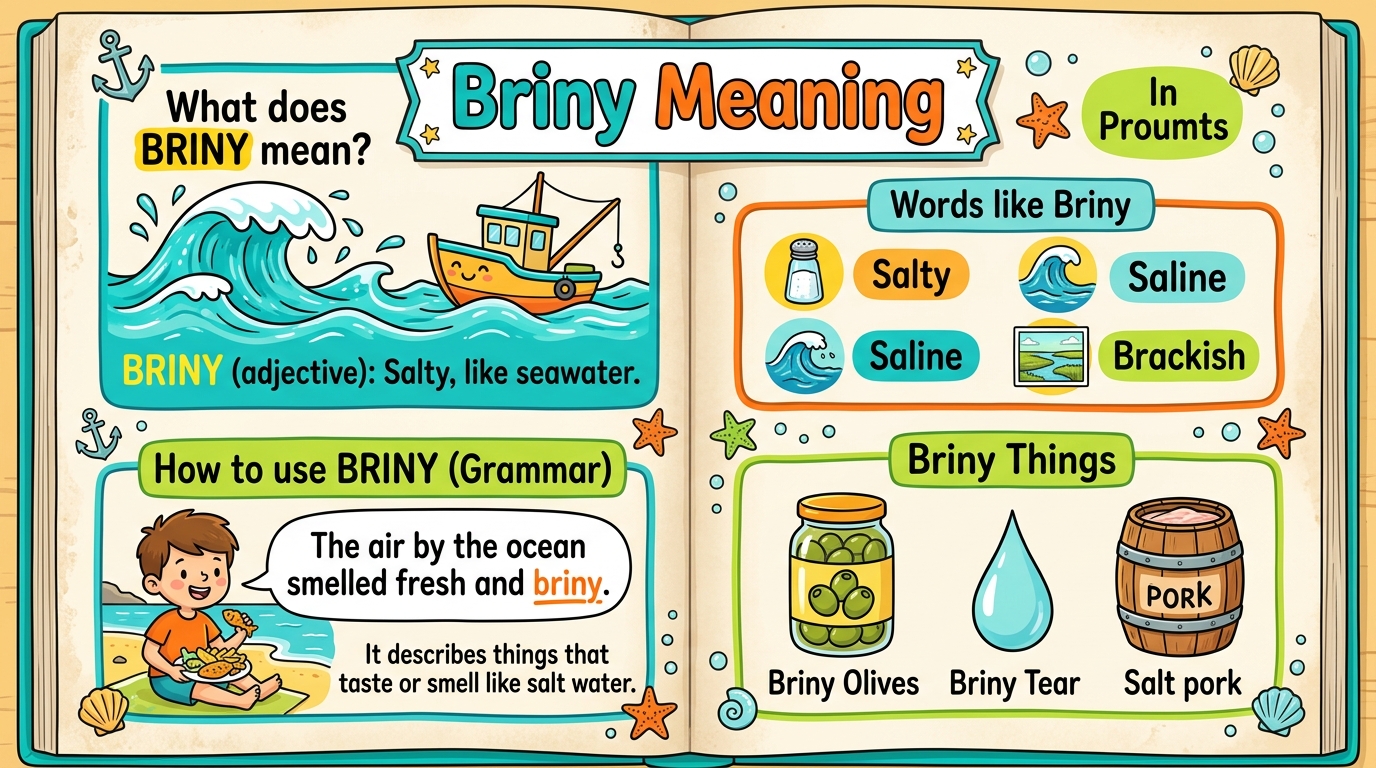
Briny is an adjective that describes something that tastes, smells, or reminds people of salty seawater.
Simple definition
- Having the taste or smell of the sea
- Salty in a fresh, natural way
- Resembling ocean water
- Rich in mineral-like saltiness
Quick examples
“These oysters have a wonderfully briny flavor.”
“The morning breeze carried a briny smell from the ocean.”
“I love the briny taste of fresh seaweed.”
Unlike plain salty food, briny usually suggests freshness rather than too much salt.
Origin & Background
The word briny comes from the noun brine, which means very salty water. The term has existed in English for hundreds of years and originally referred to seawater or strong saltwater solutions used for preserving food.
As English evolved, writers began using briny to paint vivid pictures of coastal life. Instead of simply saying “salty,” they described ocean winds, waves, and seafood as briny because the word carries a stronger connection to nature.
Today, chefs often use it when describing seafood, while travel writers use it to capture the feeling of standing near the sea. On social media, food influencers frequently describe oysters, clams, mussels, and seaweed dishes as having a pleasant briny flavor.
Briny Meaning in English
In everyday English, briny means something influenced by the sea because of its salty character.
It may describe:
- Taste
- Smell
- Air
- Water
- Food
- Coastal environments
For example:
“The beach had a fresh, briny scent after the rain.”
Here, the speaker isn’t saying the beach smelled unpleasant. Instead, they’re describing the refreshing scent of seawater.
Briny Meaning Food
One of the most common places you’ll encounter the word is in food.
When chefs say food is briny, they usually mean it has a clean, ocean-like saltiness rather than excessive seasoning.
Foods often described as briny include:
- Oysters
- Mussels
- Clams
- Seaweed
- Anchovies
- Caviar
- Certain cheeses preserved in brine
- Pickled vegetables
A briny flavor often suggests freshness because seafood loses this natural characteristic as it ages.
Many restaurant reviews praise seafood for having a “pleasant briny finish.”
Briny Synonym
Several English words are similar to briny, although each has a slightly different meaning.
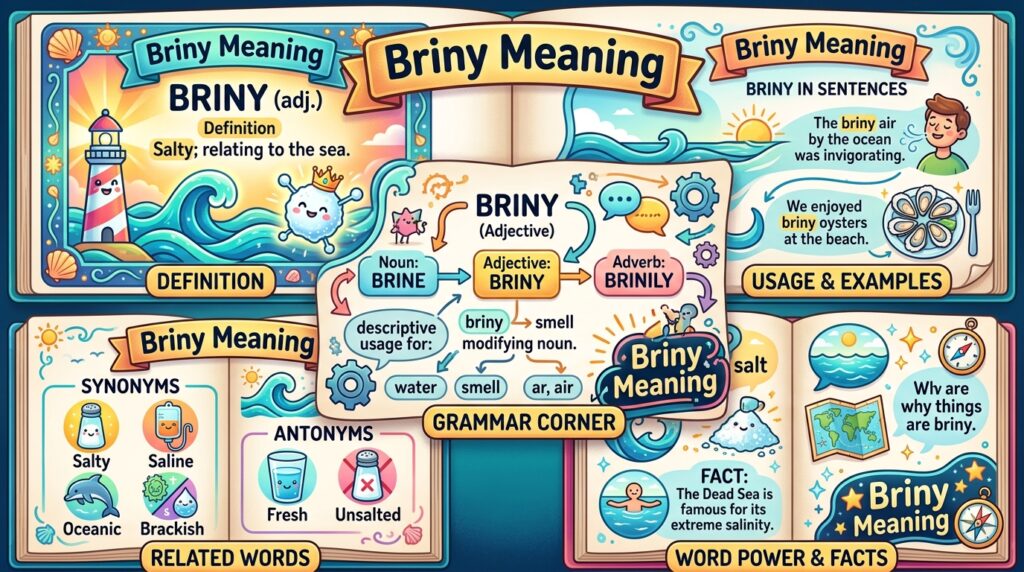
Common synonyms include:
- Salty
- Oceanic
- Seaside
- Marine
- Mineral-rich
- Saline
- Sea-like
- Coastal
Among these, salty is the closest synonym. However, briny usually sounds more elegant and descriptive.
Compare these:
“The soup is salty.”
“The soup has a pleasantly briny flavor.”
The second sentence sounds more refined and paints a clearer picture.
Briny Pronunciation
The pronunciation is simple:
BRY-nee
Phonetic spelling:
/ˈbraɪ.ni/
It rhymes with:
- Tiny
- Shiny
- Spiny
Practice sentence:
“The oysters tasted fresh and briny.”
After saying it a few times, the pronunciation becomes very natural.
Briny Meaning Oysters
If you’ve ever watched cooking shows or read seafood reviews, you’ve probably seen oysters described as briny.
Fresh oysters naturally filter seawater. Because of this, they develop a clean ocean flavor that many seafood lovers appreciate.
When someone says:
“These oysters are beautifully briny.”
they usually mean:
- Fresh
- Ocean-like
- Clean tasting
- Naturally salty
- High quality
For oyster enthusiasts, a briny taste is often considered a positive characteristic rather than a flaw.
Briny or Briney
Many people wonder whether the correct spelling is briny or briney.
The correct spelling is:
Briny ✅
The spelling briney is generally considered incorrect in standard English, although it occasionally appears as a misspelling online.
If you’re writing professionally or academically, always use briny.
Briny in French
There isn’t one perfect French equivalent because the meaning depends on context.
Common translations include:
- salé – salty
- goût marin – sea flavor
- saveur marine – marine taste
- iodé – having an iodine-like sea freshness
In French restaurants, seafood is often described as iodé, which closely matches the English feeling of briny.
Brine Meaning
To fully understand briny, it’s helpful to know the meaning of brine.
Brine is:
- Very salty water
- Water mixed with a high concentration of salt
- A liquid used to preserve food
People commonly brine foods like:
- Chicken
- Turkey
- Pickles
- Olives
- Cheese
Brining helps improve moisture, texture, and flavor.
Real-Life Conversations
Person A: I finally tried oysters today.
Person B: How were they?
Person A: Super fresh. Really briny, but surprisingly delicious.
Instagram DM
Person A: That seafood platter looks amazing.
Person B: It tasted even better. Everything had that fresh briny flavor.
TikTok Comments
Person A: Why does everyone keep saying these oysters are briny?
Person B: It means they taste naturally like fresh seawater.
Text Messages
Person A: How was the beach restaurant?
Person B: Incredible. The fish was fresh, slightly briny, and full of flavor.
Emotional & Psychological Meaning
Words often carry emotions beyond their dictionary definitions, and briny is no exception.
When people hear the word, they often imagine:
- Ocean vacations
- Fresh coastal air
- Peaceful beaches
- Seafood dinners with friends
- Relaxing summer evenings
The word creates sensory memories. Instead of simply describing saltiness, it evokes an entire atmosphere connected with the sea.
I remember visiting a coastal town where the morning air carried a gentle salty breeze. Later, when I heard someone describe it as “briny,” the word perfectly captured what I had experienced. It wasn’t just about salt—it was about freshness, nature, and the feeling of being close to the ocean.
Usage in Different Contexts
Social Media
Food bloggers frequently describe seafood as briny to highlight freshness and quality.
Example:
“These oysters have the perfect briny finish.”
Friends & Relationships
Friends may casually use the word while discussing food or travel.
Example:
“The beach smelled wonderfully briny this morning.”
Work or Professional Settings
Restaurant critics, chefs, and travel writers regularly use the word in professional writing.
Example:
“The shellfish delivers a clean, briny flavor with subtle sweetness.”
Casual vs Serious Tone
Casually, it describes food or ocean air.
Professionally, it adds precision and sophistication to restaurant reviews and culinary writing.
When NOT to Use It
Although briny is a useful word, it doesn’t fit every situation.
Avoid using it:
- To describe ordinary table salt.
- For sugary or sweet foods.
- When someone may not understand the word and a simpler term like “salty” works better.
- In technical scientific writing unless the context specifically involves seawater or marine characteristics.
- When describing unrelated smells that have nothing to do with the ocean.
Choosing the right word for your audience makes communication clearer.
Common Misunderstandings
Many people assume briny simply means “very salty,” but that’s not quite right.
Some common misconceptions include:
- Briny always means too salty. In reality, it usually suggests a pleasant, natural saltiness.
- Briny only refers to food. It can also describe ocean air, coastal scents, and seawater.
- Briny and briney are both correct. Standard English uses briny.
- Briny has a negative meaning. Most of the time, it has a positive or neutral tone, especially in food descriptions.
Understanding these differences helps you use the word more naturally.
Comparison Table
| Topic | Meaning / Intent |
|---|---|
| What Does Briny Mean? | Something tasting or smelling naturally like seawater. |
| How to Use Briny | Describe seafood, ocean air, coastal scents, or sea-inspired flavors. |
| Examples of Briny | “The oysters were briny.” “The breeze smelled briny.” |
| Briny vs Salty | Salty is general; briny specifically suggests fresh ocean-like saltiness. |
| Briny vs Brine | Brine is salty water; briny describes something having qualities of brine or the sea. |
Key Insight
The biggest difference between briny and salty is emotion. Salty describes a taste, while briny paints a picture. It immediately brings to mind waves, fresh seafood, and the refreshing character of the ocean.
Variations and Related Types
Briny meaning
A natural salty taste or smell associated with the sea.
Briny in text
Usually refers to seafood, coastal air, or ocean-inspired flavors.
Briny abbreviation
There is no standard abbreviation for briny.
Briny slang
It is not considered slang. It is a standard English adjective.
Briny in chat
People often use it while discussing restaurants, seafood, or travel experiences.
Briny flavor meaning
A fresh ocean-like taste commonly found in shellfish and sea vegetables.
Briny smell meaning
The refreshing scent of seawater or coastal air.
Briny water meaning
Water containing noticeable natural salt, especially seawater.
Briny taste meaning
A pleasant marine saltiness rather than excessive salt.
Briny sea meaning
A poetic way of referring to the salty ocean.
How to Respond When Someone Uses It
Casual Replies
- “That sounds delicious!”
- “Now I want seafood.”
- “Fresh seafood is the best.”
Funny Replies
- “Basically, it tastes like the ocean in the best way.”
- “Did Poseidon cook dinner?”
Mature Replies
- “Fresh seafood usually has that natural briny quality.”
- “That’s often a sign of high-quality shellfish.”
Respectful Replies
- “Thanks for explaining that.”
- “I didn’t know the difference between salty and briny.”
Regional & Cultural Usage
Western Culture
The word is commonly used in restaurants, seafood markets, and food magazines.
Asian Culture
Seafood-rich countries may use local expressions instead, but English-speaking chefs often use briny on international menus.
Middle Eastern Culture
The word appears mostly in English-language restaurants and culinary discussions rather than everyday conversation.
Global Internet Usage
Food bloggers, chefs, travel influencers, and seafood enthusiasts frequently use the term online.
Gen Z vs Millennials
Gen Z often encounters the word through TikTok food videos and restaurant reviews, while Millennials may recognize it from cooking shows, travel writing, and food blogs.
Is It Safe for Kids?
Yes. Briny is completely safe for children. It is a normal English vocabulary word with no offensive or inappropriate meaning. Kids may encounter it while reading books, learning about oceans, or discussing seafood and nature.
FAQs
What does it mean when something is briny?
When something is briny, it has the taste, smell, or quality of the sea. It usually describes a fresh, natural saltiness found in seawater, seafood, or coastal air.
What does briny mean in food?
In food, briny refers to a pleasant ocean-like salty flavor. Fresh oysters, clams, mussels, seaweed, and some pickled foods are often described as briny because they have a clean, marine taste.
What is a synonym for briny?
Common synonyms for briny include salty, saline, oceanic, marine, sea-like, and coastal. While “salty” is the closest synonym, “briny” specifically suggests the fresh taste or smell of the sea.
What is a synonym for brine?
Some common synonyms for brine are saltwater, saline solution, seawater, pickle solution, and salt solution. The exact synonym depends on whether you’re referring to the ocean or food preservation.
Is briny a positive or negative word?
Briny is generally a positive or neutral word. It is often used to compliment fresh seafood or describe the refreshing scent of the ocean.
Can air be described as briny?
Yes. Coastal air is often described as briny because it carries the fresh, salty scent of the sea.
Is briny the same as salty?
Not exactly. Salty is a broad term, while briny specifically refers to the clean, natural saltiness associated with seawater and fresh seafood.
Why are oysters described as briny?
Oysters are called briny because they naturally absorb the flavors of the seawater they live in, giving them a fresh and slightly salty taste.
Is briny a real English word?
Yes. Briny is a standard English adjective that comes from the word brine, meaning very salty water.
How do you pronounce briny?
Briny is pronounced BRY-nee (/ˈbraɪ.ni/), with the first syllable sounding like “bry” in “bright.”
Conclusion
The word briny is much more than another way to say “salty.” It captures the fresh, natural character of the sea and adds richness to conversations about food, travel, and coastal life. Whether you’re describing oysters, ocean breezes, or seaside memories, using briny makes your language more vivid and expressive. Once you understand its meaning and context, you’ll notice it everywhere—from restaurant menus to travel stories—and you’ll be able to use it with confidence and accuracy.