Have you ever felt trapped between two choices where neither option could solve your problem? Maybe you needed experience to get a job, but every job required experience first. Or perhaps you wanted to take a break from work, but couldn’t afford to because you needed the income. If so, you’ve experienced what many people call a Catch-22.
People search for catch 22 meaning because they hear the phrase in conversations, movies, books, social media posts, or news articles and wonder what it really means. Although it sounds like a simple expression, its meaning goes much deeper than just having a difficult decision.
A Catch-22 describes a situation where the rules or circumstances make success impossible because each solution creates another obstacle. It’s one of the most widely used English expressions for describing frustrating life dilemmas.
In this guide, you’ll discover where the phrase came from, how people use it today, and why it remains one of the most relatable expressions in modern English.
Catch-22 Meaning – Quick Meaning
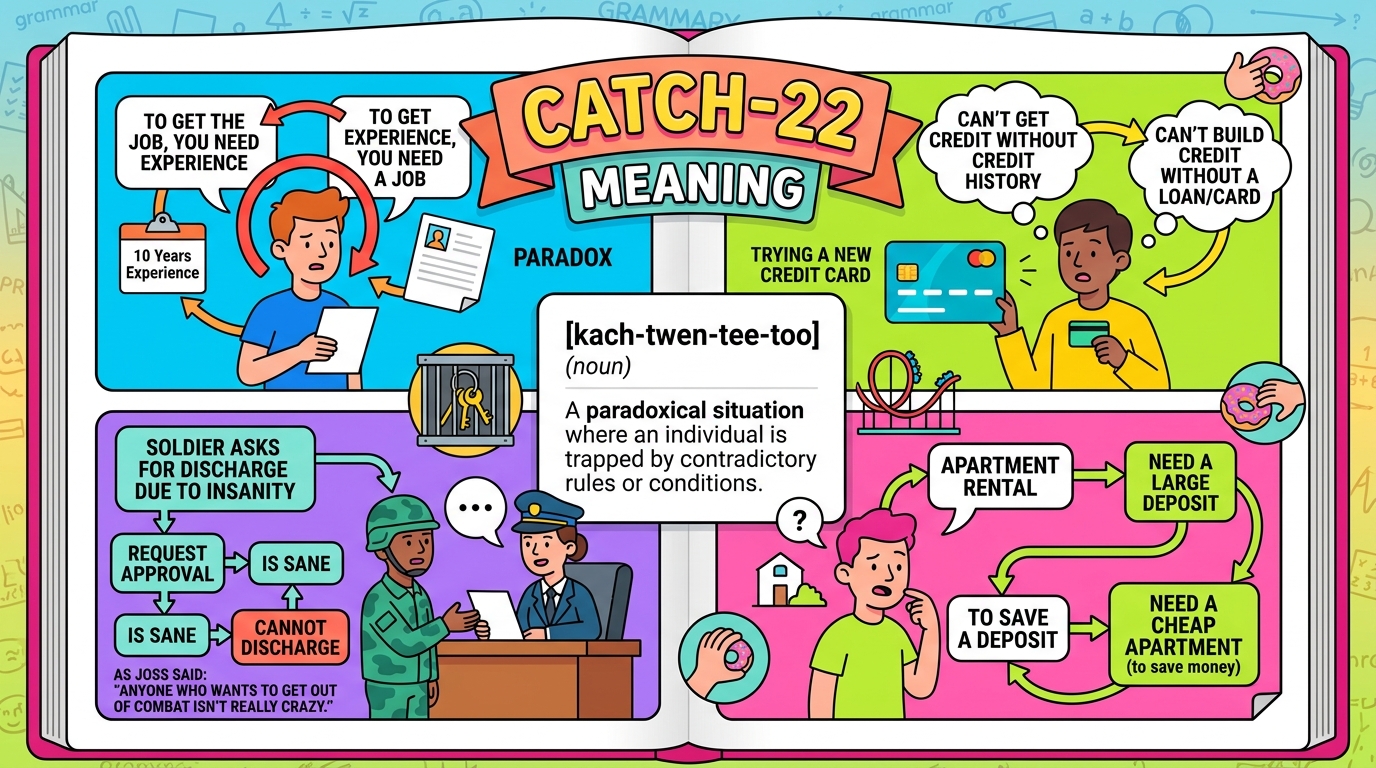
A Catch-22 is a situation where two or more conditions depend on each other, making it impossible to achieve the desired result.
In simple words:
- You’re trapped by conflicting rules.
- Every solution creates another problem.
- There seems to be no logical way out.
Simple examples
“I need a credit card to build credit, but I need good credit to get a credit card.”
“The company wants experienced workers, but nobody can gain experience without being hired first.”
“You can’t leave because you need money, and you can’t earn enough money because you can’t leave.”
The phrase is often used when people feel frustrated by unfair systems rather than personal mistakes.
Origin & Background
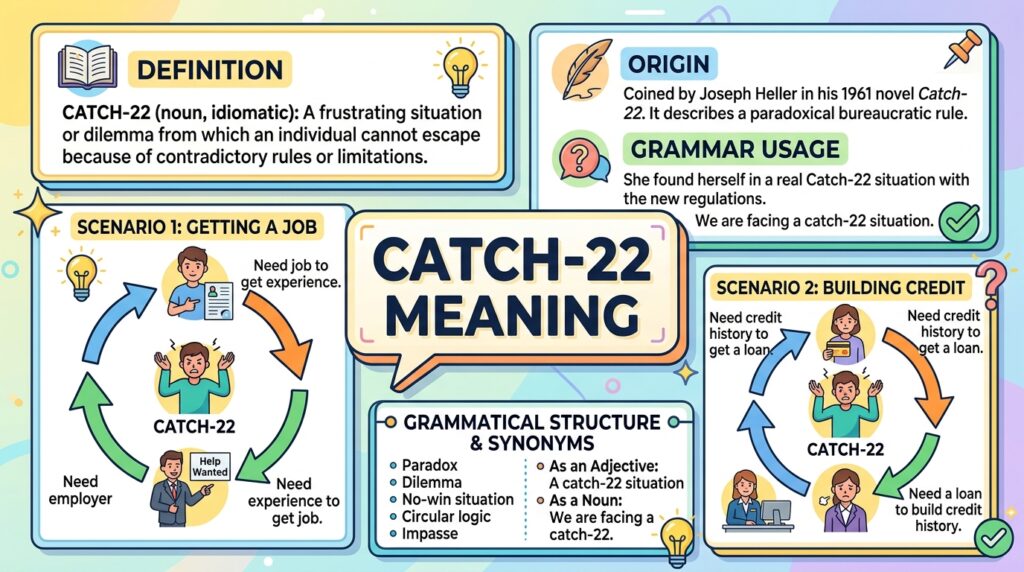
The phrase Catch-22 comes from the 1961 novel Catch-22 by American author Joseph Heller.
The story follows military pilots during World War II who desperately want to avoid dangerous combat missions. According to the military rules, pilots who are mentally unfit can request to stop flying. However, if a pilot requests to stop because the missions are dangerous, that request proves they are thinking rationally—not mentally unfit. Therefore, they must continue flying.
This impossible rule became known as the famous “Catch-22.”
Over time, the phrase left the pages of literature and entered everyday English. Today, people use it to describe frustrating situations involving bureaucracy, workplaces, education, relationships, healthcare, finances, and even social media.
The popularity of the internet has made the phrase even more common. People now describe everything from confusing app policies to complicated life choices as a Catch-22.
Catch-22 Meaning Example
Imagine you’re looking for your first full-time job.
Every company says:
“We only hire candidates with at least two years of experience.”
But without getting hired first, you can never gain those two years of experience.
That’s a perfect Catch-22.
Another example is trying to rent an apartment. A landlord may ask for proof of stable housing history, but you’re looking for an apartment because you don’t already have one.
These situations feel unfair because the requirements cancel each other out.
Catch 22 Meaning Medical
In healthcare, a Catch-22 often refers to medical situations where one treatment creates another problem.
For example:
A patient needs surgery, but doctors cannot perform it until the patient’s health improves. Unfortunately, the patient’s health cannot improve without the surgery.
Another common example involves insurance approvals where patients need treatment before qualifying for assistance, but cannot afford the treatment without that assistance.
Doctors may also casually describe certain clinical dilemmas as a Catch-22 because every available option carries significant drawbacks.
Catch 22 Meaning in English
In English, Catch-22 is an idiom.
It means:
“An impossible situation caused by contradictory rules or conditions.”
Unlike ordinary problems, a Catch-22 has no obvious solution because every choice leads back to the original obstacle.
Native English speakers commonly use it in everyday conversations, business meetings, journalism, and academic writing.
Catch-22 Meaning in a Relationship
Relationships sometimes create emotional Catch-22 situations.
For example:
One partner wants more communication before feeling emotionally close.
The other partner needs emotional closeness before opening up.
Neither person is wrong, yet both remain stuck.
Another example is someone wanting independence while also wanting constant reassurance from their partner. Meeting one need can unintentionally reduce the other.
Healthy communication often helps couples recognize these patterns before frustration grows.
Catch-22 Meaning Military
The military meaning comes directly from Joseph Heller’s novel.
In the story, pilots could avoid dangerous missions only if they were considered mentally unfit.
However:
Requesting to avoid danger proved they were mentally healthy enough to understand the risks.
As a result:
- Healthy pilots had to fly.
- Truly unstable pilots rarely requested exemption.
That circular rule became the original Catch-22.
Today, military personnel sometimes use the phrase to describe confusing regulations or administrative policies that seem impossible to satisfy.
Catch-22 Meaning Synonym
Several English expressions carry similar ideas, although none are exactly identical.
Common synonyms include:
- No-win situation
- Deadlock
- Dilemma
- Vicious cycle
- Double bind
- Impossible situation
- Circular problem
- Bureaucratic trap
- Lose-lose situation
- Paradoxical dilemma
Each emphasizes being trapped, but “Catch-22” specifically highlights contradictory rules.
Catch-22 Meaning Example in Real Life
Real life offers countless examples.
A student needs a scholarship to attend university.
The scholarship requires excellent grades.
The student must work long hours to pay bills, leaving little time to earn those grades.
Another example involves starting a business.
Banks may require proof that your business is profitable before approving a loan.
Without funding, growing the business becomes extremely difficult.
These situations explain why the phrase remains so relevant decades after it was first introduced.
Catch 22 Meaning DiGeorge Syndrome
Some people search “Catch 22 meaning DiGeorge syndrome” because of confusion surrounding the number 22.
However, these terms are unrelated.
DiGeorge syndrome is a genetic condition caused by a missing section of chromosome 22.
The number “22” refers to the chromosome involved, not the expression Catch-22.
Although both include the number 22, one is a medical diagnosis while the other is an English idiom describing an impossible situation.
Real-Life Conversations
Person A:
Every internship asks for experience.
Person B:
That’s such a Catch-22. How are students supposed to get experience without an internship?
Instagram DM
Person A:
My landlord wants proof I’ve rented before.
Person B:
Classic Catch-22. You need a place before you can prove you’ve had one.
TikTok Comments
User 1:
Why is adult life so complicated?
User 2:
Because everything is basically one giant Catch-22.
Text Messages
Alex:
My manager says I need leadership experience before becoming team lead.
Jordan:
But how do you get leadership experience without becoming team lead?
Alex:
Exactly. Total Catch-22.
Emotional & Psychological Meaning
A Catch-22 doesn’t simply describe a difficult situation—it captures the emotional exhaustion of feeling trapped.
People often use the phrase when logic fails them. Instead of expressing simple frustration, they’re acknowledging that the system itself seems unfair.
Many of us experience this feeling during different stages of life. I remember speaking with a recent graduate who kept applying for entry-level jobs. Every rejection cited a lack of experience, yet every opportunity required experience before hiring. After months of applications, they laughed and said, “It’s one big Catch-22.” That sentence perfectly captured months of disappointment in just two words.
Because of this emotional weight, the phrase has become more than an idiom. It represents the shared experience of facing problems that seem impossible to solve.
Usage in Different Contexts
Social Media
People frequently use Catch-22 when discussing student loans, housing, career struggles, or confusing online policies.
Example:
“This verification process is a Catch-22.”
Friends & Relationships
Friends often use it while discussing life challenges.
Example:
“I need confidence to date, but dating is how I build confidence.”
Work & Professional Settings
Managers and employees sometimes describe conflicting company policies as Catch-22 situations.
Example:
“We need approval before starting the project, but approval requires project results.”
Casual vs Serious Tone
In casual conversation, the phrase often adds humor to frustrating moments.
In serious discussions, it highlights genuine systemic problems that deserve attention.
When NOT to Use It
Avoid using Catch-22 when the problem actually has a clear solution.
It may also confuse listeners unfamiliar with English idioms.
Be careful when discussing sensitive personal struggles. Calling someone’s emotional situation a Catch-22 may unintentionally minimize their experience.
Similarly, not every difficult choice is a Catch-22. The phrase works best when contradictory rules create the obstacle.
Common Misunderstandings
One common mistake is thinking Catch-22 simply means “a hard decision.”
It doesn’t.
A difficult decision usually offers two possible outcomes.
A Catch-22 offers no workable outcome because each condition blocks the other.
Another misunderstanding involves confusing it with ordinary bad luck.
Bad luck happens by chance.
A Catch-22 happens because the rules themselves create an impossible loop.
Comparison Table
| Search Intent | Meaning |
|---|---|
| What Does Catch-22 Mean | An impossible situation caused by conflicting conditions. |
| How to Use Catch-22 | Use it when contradictory rules prevent success. |
| Examples of Catch-22 | Jobs requiring experience, loans needing financial history, impossible policies. |
| Catch-22 vs Dilemma | A dilemma offers difficult choices. A Catch-22 offers no true solution because every option blocks another. |
Key Insight
The reason Catch-22 has remained popular for decades is simple: almost everyone eventually encounters situations where the rules seem designed to prevent success. The phrase gives a name to that universal feeling, making frustrating experiences easier to describe and understand.
Variations / Types
Catch-22 meaning
A Catch-22 is an impossible situation where conflicting rules or conditions prevent you from finding a successful solution.
Catch-22 in text
In text messages or online chats, people use “Catch-22” to describe frustrating everyday situations, such as work, dating, school, or finances.
Example:
“I need experience to get hired, but I need a job to get experience. Total Catch-22.”
Catch-22 abbreviation
Catch-22 doesn’t have a widely accepted abbreviation. Most people write the complete phrase because it’s short, recognizable, and carries a specific meaning.
Catch-22 slang
Although it originated from literature, Catch-22 is now considered everyday slang in many English-speaking communities. It’s commonly used to describe situations where someone feels trapped by contradictory circumstances.
Catch-22 in chat
In chats, the phrase often appears when friends discuss life’s frustrating moments.
Example:
“This whole application process is a Catch-22.”
Catch-22 in business
Businesses use the expression when policies or procedures create unnecessary obstacles.
Example:
“We can’t launch until approval arrives, but approval requires launch data. It’s a Catch-22.”
Catch-22 in education
Students often use the phrase when academic requirements seem impossible to meet.
Example:
“The internship requires experience, but I need the internship to gain experience.”
Catch-22 in finance
Financial situations can easily become Catch-22 scenarios.
For example, someone may need a loan to improve their financial stability, but lenders require strong financial stability before approving the loan.
Catch-22 in everyday life
People use Catch-22 for countless daily frustrations, from renting apartments to renewing documents or dealing with complicated customer service policies.
Catch-22 in social media
On platforms like TikTok, X, Instagram, and Reddit, users describe confusing algorithms, account verification problems, or workplace struggles as Catch-22 situations because every solution seems to create another obstacle.
How to Respond When Someone Uses It
If someone says they’re stuck in a Catch-22, your response can acknowledge their frustration while keeping the conversation supportive.
Casual replies
- “Yeah, that’s a tough spot.”
- “I totally get what you mean.”
- “That sounds really frustrating.”
- “Life can be unfair sometimes.”
Funny replies
- “Looks like life forgot to read the instruction manual.”
- “Who designed these rules?”
- “Welcome to adulthood!”
- “That’s the definition of impossible.”
Mature replies
- “Let’s see if there’s another angle we haven’t considered.”
- “Sometimes these situations need a creative solution.”
- “Maybe there’s an exception to the rule.”
- “Don’t give up yet.”
Respectful replies
- “I’m sorry you’re dealing with that.”
- “I understand why you feel stuck.”
- “That really does sound like a Catch-22.”
- “I hope things become clearer soon.”
Regional & Cultural Usage
Western culture
In countries like the United States, Canada, the United Kingdom, and Australia, Catch-22 is a common expression. People use it in workplaces, schools, politics, healthcare, and everyday conversations.
Asian culture
Many English speakers across Asia understand the phrase, especially students, professionals, and people working in international companies. However, in everyday local languages, similar ideas are often explained without using the exact term.
Middle Eastern culture
The phrase is becoming more familiar through English education, international media, and social networking platforms. It is mostly used in English conversations rather than daily native-language discussions.
Global internet usage
Online communities have helped popularize Catch-22 around the world. Users frequently apply it to confusing platform rules, visa applications, job hunting, customer support, and bureaucracy.
Generational differences
Gen Z often uses Catch-22 in memes, TikTok videos, and humorous posts about work, dating, or adulthood.
Millennials tend to use it in discussions about careers, finances, housing, parenting, and workplace challenges.
Older generations may recognize it from Joseph Heller’s novel or the classic film adaptation, while younger users often know it simply as a popular English expression.
Is It Safe for Kids?
Yes. Catch-22 is a safe and non-offensive phrase.
It contains no inappropriate language and is commonly taught in English classes and literature courses. Younger children may not fully understand its figurative meaning, but teenagers and adults can learn to use it appropriately in conversations about school, work, or everyday life.
FAQs
What does Catch-22 mean in slang?
In slang, Catch-22 describes a frustrating situation where no matter what you do, you can’t succeed because the rules contradict each other. People use it when they’re stuck in a no-win situation, whether at work, school, or in everyday life.
Why do they call it a Catch-22?
The term comes from the novel Catch-22 by Joseph Heller. In the story, characters face impossible rules that trap them in endless contradictions. Over time, the phrase became a common expression for any situation where conflicting conditions make success impossible.
What does being in Catch-22 mean?
Being in a Catch-22 means you’re trapped by opposing requirements. One condition prevents you from meeting the other, leaving you with no practical way to solve the problem or move forward.
What is the meaning of Catch-22?
Catch-22 means an impossible dilemma created by contradictory rules or conditions. It refers to a situation where every available choice leads to the same frustrating outcome, making it difficult or impossible to escape.
Is Catch-22 used in everyday conversations?
Yes. People often use Catch-22 in everyday conversations to describe workplace problems, financial struggles, relationships, or any situation where every option seems blocked.
Is Catch-22 always about rules?
Not always. While it often involves rules or policies, Catch-22 can also describe personal dilemmas where two conflicting circumstances make finding a solution impossible.
Can Catch-22 have a positive meaning?
No. Catch-22 almost always has a negative meaning because it describes frustration, confusion, and situations where every possible choice creates another problem.
What is an example of a Catch-22?
A common example is needing work experience to get a job but needing a job to gain work experience. Both requirements depend on each other, making it difficult to get started.
Is Catch-22 an idiom?
Yes. Catch-22 is considered an idiom because its meaning goes beyond the literal words. It represents any impossible or self-defeating situation caused by conflicting conditions.
When should you use the phrase Catch-22?
Use Catch-22 when describing a situation where every available option is blocked by contradictory rules or circumstances, leaving no clear path to success.
Conclusion
Life doesn’t always present straightforward choices. Sometimes the rules themselves seem to work against us, creating situations where every solution leads to another obstacle. That’s exactly what a Catch-22 represents. Understanding this expression helps you recognize and describe frustrating experiences with greater clarity. Whether you’re talking about careers, relationships, education, healthcare, or everyday challenges, knowing the meaning of Catch-22 allows you to communicate naturally and confidently. It’s more than an idiom—it’s a timeless way to describe one of life’s most relatable frustrations.