You’ve probably come across the word copacetic and paused for a second. It sounds smooth, almost musical—but what does it actually mean?
People search for copacetic meaning because it’s one of those words that feels familiar yet unclear. It shows up in conversations, captions, or even songs, but not everyone is confident using it. Is it formal? Is it slang? Does it mean “perfect” or just “okay”?
This article clears that confusion. By the end, you’ll not only understand copacetic—you’ll feel comfortable using it in real conversations without second-guessing yourself.
Copacetic Meaning – Quick Meaning
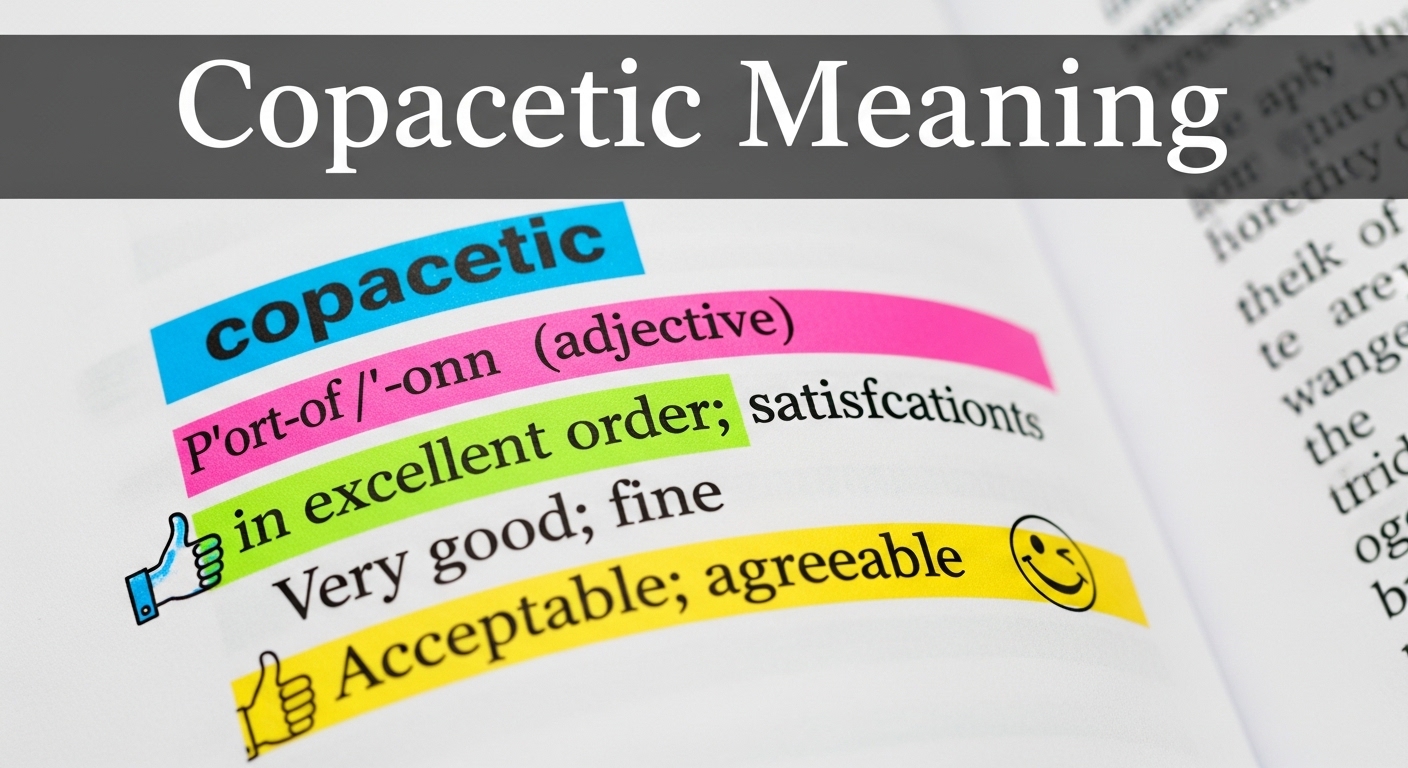
Copacetic (pronounced ko-pa-set-ik) simply means:
- Everything is fine
- All is in order
- Things are going smoothly
It carries a calm, reassuring tone—not overly excited, just quietly positive.
Examples:
- “Don’t worry, everything’s copacetic now.”
- “We fixed the issue—it’s all copacetic.”
- “Life isn’t perfect, but it’s copacetic.”
Origin & Background
The exact origin of copacetic is still debated, which adds to its charm.
Some believe it came from early 20th-century American slang, possibly rooted in African American vernacular English. Others suggest connections to Creole or even Yiddish influences. There’s no single confirmed source, but its meaning has remained surprisingly consistent.
What’s interesting is how the word quietly survived while many slang terms faded. It never became overused or cliché.
In modern times, copacetic has found new life online. You’ll see it in captions, tweets, or comments where people want to express calm satisfaction—something softer than “awesome” but more reassuring than “okay.”
It fits perfectly in today’s communication style: relaxed, understated, and emotionally aware.
Real-Life Conversations
Here’s how copacetic naturally appears in everyday digital conversations:
WhatsApp Chat:
- Person A: “Did you sort out the payment issue?”
- Person B: “Yeah, all copacetic now 👍”
Instagram DM:
- Person A: “You okay? You seemed off earlier.”
- Person B: “I’m good now. Everything’s copacetic.”
TikTok Comments:
- Person A: “After all that chaos, how are you feeling?”
- Person B: “Finally copacetic 😌”
Text Message:
- Person A: “Is the meeting still happening?”
- Person B: “Yep, everything’s copacetic. See you at 3.”
Notice the pattern: it often appears after tension, stress, or uncertainty—when things return to normal.
Emotional & Psychological Meaning
Copacetic isn’t just about things being “fine.” It carries emotional weight.
It reflects:
- Relief after stress
- Quiet confidence
- Emotional balance
- A sense of control returning
Unlike louder words like “amazing” or “perfect,” copacetic feels grounded. It suggests that things are stable—even if not flawless.
A real-life scenario:
Imagine you’ve had a stressful week—deadlines, misunderstandings, mental exhaustion. Then suddenly, things settle. No drama, no chaos. Just peace.
You text a friend:
“Finally, everything feels copacetic.”
That word captures a very specific emotional state—calm after turbulence.
Usage in Different Contexts
Social Media
On platforms like Instagram or TikTok, copacetic adds personality. It feels thoughtful and slightly unique.
Example:
- “Life’s not perfect, but it’s copacetic.”
Friends & Relationships
It works well when reassuring someone.
- “Don’t stress, we’re copacetic now.”
Work / Professional Settings
Use with caution. It’s informal but not unprofessional.
- “All tasks are copacetic and on track.”
Still, simpler alternatives like “everything is in order” may be safer in formal emails.
Casual vs Serious Tone
- Casual: “We’re copacetic 😎”
- Serious: “The situation is now copacetic.”
Tone depends on delivery, not just the word.
When NOT to Use It
Even good words can feel out of place.
Avoid copacetic when:
- The situation is serious or emotional (e.g., illness, loss)
- You’re speaking to someone unfamiliar with English slang
- You need absolute clarity (legal, medical, formal writing)
Example of misuse:
- “The surgery went well, everything’s copacetic.” ❌
(This may sound too casual for the situation.)
Common Misunderstandings
1. It means “perfect”
Not exactly. It means “fine” or “satisfactory,” not flawless.
2. It’s outdated slang
It’s actually timeless—rare, but still relevant.
3. It sounds too formal
It’s the opposite. It’s relaxed and conversational.
4. It always sounds positive
It’s mildly positive, not enthusiastic.
Comparison Table
| Expression | Meaning | Tone |
|---|---|---|
| Copacetic | Everything is fine | Calm, balanced |
| Okay | Acceptable | Neutral |
| Perfect | Flawless | Strong positive |
| Chill | Relaxed | Informal |
| All good | No problems | Casual |
| Messed up | Not okay | Negative |
Key Insight:
Copacetic sits in a unique middle ground—it reassures without exaggerating. That’s why it feels emotionally intelligent in conversation.
Variations / Types
- All copacetic
Everything is completely fine - Pretty copacetic
Mostly fine, with minor issues - Copacetic now
Things weren’t okay before, but they are now - Keep it copacetic
Stay calm and balanced - Not copacetic
Something is wrong - Feeling copacetic
Emotionally stable and okay - Things are copacetic again
Recovery from chaos - Copacetic vibes
Peaceful, drama-free energy - Stay copacetic
Encouragement to remain calm - Back to copacetic
Returning to normal after disruption
How to Respond When Someone Uses It
Casual Replies
- “Good to hear!”
- “Nice, glad it worked out.”
Funny Replies
- “Copacetic? Look at you using big words 😂”
- “As long as it stays that way 😄”
Mature Replies
- “That’s reassuring.”
- “I’m glad things are stable now.”
Respectful Replies
- “Happy to know everything is in order.”
- “That’s a relief, thank you for updating me.”
Regional & Cultural Usage
Western Culture
More commonly understood, especially in the U.S. It has a slightly vintage but cool feel.
Asian Culture
Less common. People may understand it from context but not use it naturally.
Middle Eastern Culture
Rare in everyday speech. Simpler phrases like “everything is fine” are preferred.
Global Internet Usage
Gaining popularity due to social media. It stands out as a “smart casual” word.
Generational Differences
- Gen Z: Uses it for aesthetic or uniqueness
- Millennials: Use it occasionally, often with irony or intention
Is It Safe for Kids?
Yes, copacetic is completely safe.
It’s a clean, neutral word with no hidden meanings. However, younger children may not understand it easily, so it’s more suitable for teens and above.
FAQs
1. Is copacetic a slang word?
Yes, but it’s mild and widely accepted in casual English.
2. Can I use copacetic in formal writing?
It’s better to avoid it in formal documents.
3. Does copacetic mean perfect?
No, it means “fine” or “satisfactory,” not flawless.
4. Is it commonly used today?
It’s not common, but it’s still relevant and appreciated.
5. How do you pronounce copacetic?
ko-pa-set-ik
6. Is copacetic positive or neutral?
It’s mildly positive with a calm tone.
7. Why do people use it instead of “okay”?
It adds personality and feels more expressive.
Conclusion
Copacetic is one of those rare words that feels both simple and meaningful. It doesn’t shout or exaggerate—it reassures.
In a world where communication often swings between extremes, this word offers balance. It says, “Things are okay,” but with a quiet confidence that feels genuine.
Use it when you want to sound thoughtful without trying too hard. Use it when things settle down after chaos. Most importantly, use it when you mean it.
Because sometimes, “copacetic” is exactly the right word.
Discover more posts:
- CSM Full Form: Meaning in Chat, Text & 10 Languages (2026 Guide)
- PRD Full Form: Meaning, Uses, Examples & Global Translations
- LWF Full Form Explained: Meaning, Uses, and 10-Language Guide
- BRD Full Form in Chat, Business & 10 Languages Explained
- CIDR Full Form, Meaning, Uses & Examples in 10 Languages