If you’ve ever heard someone say “that’s so corny,” you’ve probably felt a little confused. Is it an insult? A joke? Or something secretly sweet?
The word “corny” is one of those slang terms that people use every day but rarely stop to explain. It can sound rude, playful, or even affectionate depending on how it’s said. That’s exactly why so many people search for its meaning.
In simple terms, corny refers to something that feels overly cheesy, predictable, or emotionally exaggerated—but not always in a bad way. Sometimes it’s used with a smile, sometimes with eye-roll energy, and sometimes with genuine warmth.
In this guide, we’ll break down the corny meaning in real-life situations, relationships, jokes, memes, and even across different languages and cultures so you can finally understand how people really use it.
Corny Meaning – Quick Meaning
At its core, corny meaning slang refers to something that feels:
- Overly cheesy or predictable
- Emotionally exaggerated
- Old-fashioned or cliché
- Slightly awkward but often harmless
In modern texting and social media, it is commonly used to describe jokes, lines, or gestures that feel “too much” emotionally.
Quick Examples:
- “That pickup line is so corny 😭”
- “He sent me a corny love message but it was kinda sweet.”
- “This movie dialogue is corny but I love it.”
Corny is not always negative—it often depends on tone and relationship between people.
Corny Meaning Slang
In slang usage, corny is a playful criticism rather than a serious insult. It’s often used among friends when something feels overly dramatic or predictable.
When someone says “you’re corny,” they might actually be smiling while saying it.
In slang culture:
- It means “too cheesy to be cool”
- It can also mean “adorably cringe”
- Sometimes it means “emotionally try-hard”
For example:
- “Bro, that joke was corny but funny.”
- “Stop being corny, you’re embarrassing me 😂”
In Gen Z conversations, corny is often softened with emojis or laughter, turning it into a light-hearted comment instead of criticism.
Corny Meaning Examples
Here are some real-life situations where people use it naturally:
- “You wrote me a poem? That’s corny… but I liked it.”
- “That TikTok trend is kind of corny now.”
- “He still uses pickup lines? So corny.”
Corny usually shows up when something feels slightly outdated or overly emotional, but not offensive.
It sits between:
- Cute
- Cringe
- Funny
That’s why context matters so much.
Corny Meaning in Relationship
In relationships, corny meaning becomes surprisingly emotional.
Partners often call each other corny when one person expresses feelings in an overly sweet or dramatic way.
Examples:
- Sending long romantic texts
- Using cheesy nicknames
- Writing love notes or poems
For instance:
Partner A: “You’re my universe and my forever star ✨”
Partner B: “Ugh, you’re so corny… but I love it.”
Here, “corny” doesn’t mean rejection—it often means soft affection mixed with slight embarrassment.
In healthy relationships, corny moments often create emotional bonding because they show vulnerability.
Corny Meaning Jokes
Corny jokes are the heart of this word.
A corny joke is usually:
- A pun
- A predictable punchline
- A dad-style joke
Example:
- “Why did the scarecrow win an award? Because he was outstanding in his field.”
People often groan at corny jokes, but still laugh because they’re harmless and comforting.
In conversations:
- “That joke was so corny, I can’t stop laughing.”
- “Stop, your humor is painfully corny 😂”
Corny humor works because it doesn’t try too hard—it just exists in its simple, awkward charm.
Corny Meaning in English
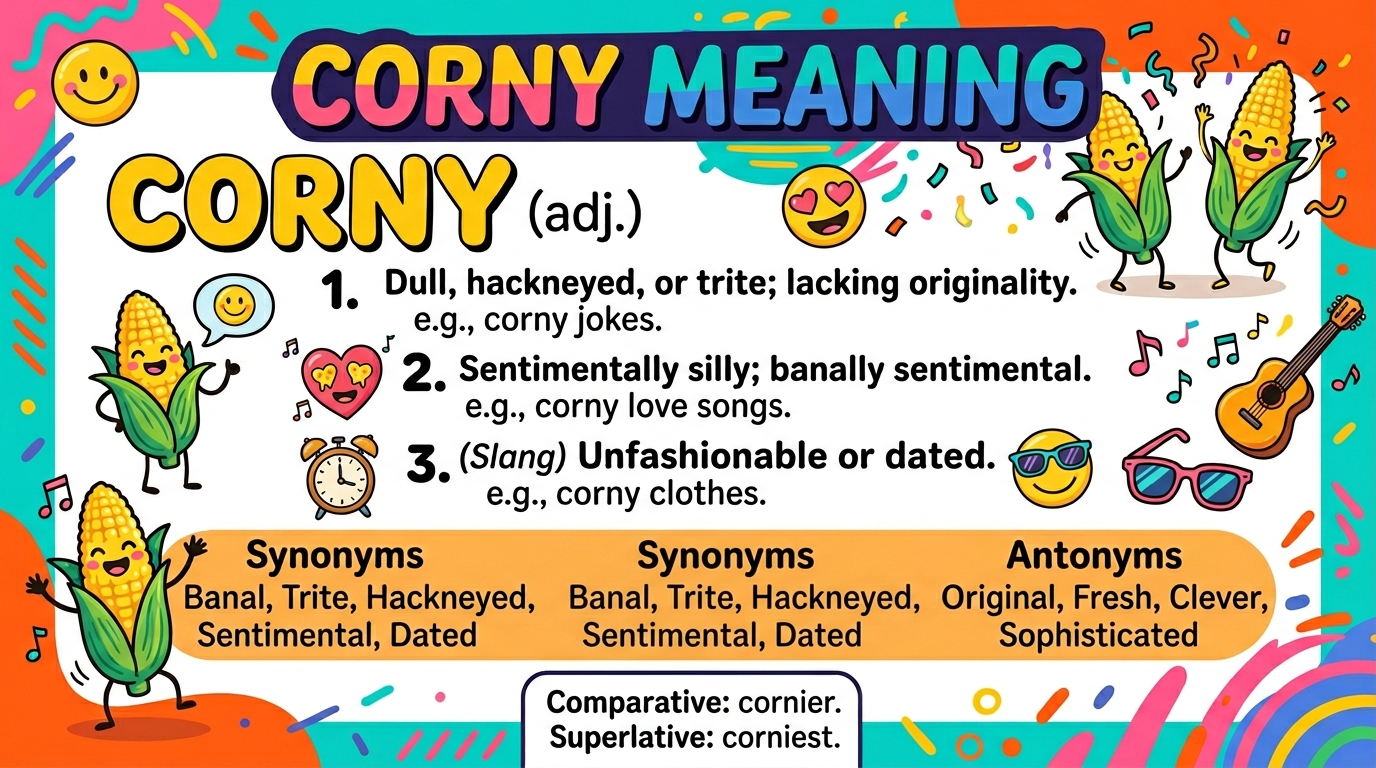
In standard English, corny means something that is:
- Old-fashioned
- Overused
- Lacking originality
- Predictable in emotion or expression
Originally, it was used in American English to describe sentimental entertainment that felt exaggerated or artificial.
Today, it has become more flexible:
- Positive: sweet, nostalgic, funny
- Negative: cringe, overly emotional
So the meaning depends heavily on tone and context.
Corny Meaning in French
In French, the closest translations of corny meaning include:
- cliché (clichéd)
- ringard (outdated or tacky)
- niais (silly or overly sentimental)
For example:
- “C’est un peu ringard.” (That’s a bit corny/outdated)
However, French usage tends to be slightly more critical than English slang. It often leans toward “outdated” rather than “playfully sweet.”
Corny Meaning Meme
On the internet, corny meaning meme culture has completely changed how the word is used.
Memes often exaggerate emotional or cheesy behavior:
- Overly romantic texts
- Dramatic love confessions
- Awkward pickup lines
Example meme caption:
- “Me trying to act cool but sending corny texts at 2 AM”
Corny memes usually:
- Make people laugh at emotional exaggeration
- Turn awkwardness into humor
- Celebrate cringe in a funny way
Instead of rejecting corny behavior, meme culture often embraces it.
Corny Meaning Spanish
In Spanish, corny meaning can be expressed as:
- cursi (overly sentimental or cheesy)
- empalagoso (too sweet or cloying)
Examples:
- “Es muy cursi.” (That’s very corny)
- “Qué mensaje tan empalagoso.” (What a corny/sugary message)
Spanish usage often leans toward emotional exaggeration, especially in romantic contexts.
Origin & Background
The word corny originated in American English in the early 20th century.
It was initially used in theater and entertainment circles to describe performances that felt overly sentimental or outdated.
Over time:
- It moved into everyday slang
- Became popular in youth culture
- Eventually evolved into internet slang
Social media platforms like TikTok, Instagram, and Twitter accelerated its spread, turning it into a flexible emotional expression.
Today, corny is less about judgment and more about emotional texture in communication.
Real-Life Conversations
WhatsApp Chat
Person A: “I wrote you a good morning paragraph ❤️”
Person B: “You’re so corny… but I smiled reading it.”
Instagram DM
Person A: “You complete my world 🌍”
Person B: “Okay that’s corny but lowkey sweet 😭”
TikTok Comment Section
Person A: “This edit made me cry fr”
Person B: “Why is it so corny but I can’t stop watching 😂”
Text Message
Person A: “I miss you like cr*zy every second”
Person B: “Corny… but I miss you too.”
Emotional & Psychological Meaning
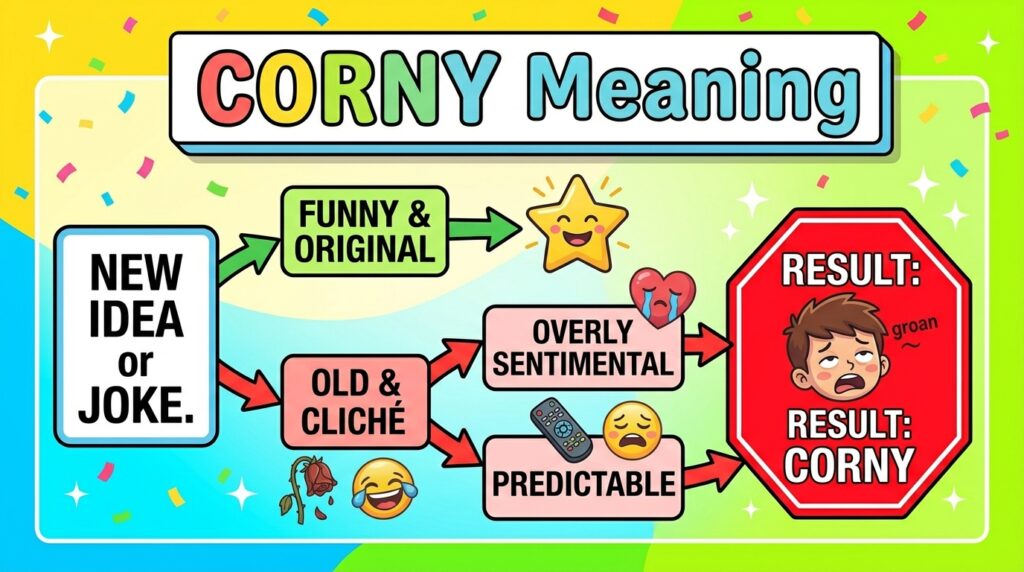
The word corny often reveals emotional discomfort mixed with affection.
People use it because:
- They feel something is too emotional to express directly
- They want to soften sincerity with humor
- They use sarcasm to avoid vulnerability
Psychologically, calling something corny is a way of saying:
“This feels emotional, and I don’t know how to react seriously.”
Example scenario:
A person receives a deeply emotional message. Instead of replying seriously, they say “you’re so corny” to mask their soft reaction.
Usage in Different Contexts
Social Media
Used for memes, captions, and viral jokes. Mostly playful.
Friends & Relationships
Used affectionately or teasingly when someone is being overly sweet.
Work / Professional Settings
Rarely used. Can sound unprofessional or dismissive.
Casual vs Serious Tone
- Casual: funny, affectionate
- Serious: can sound insulting if misused
When NOT to Use It
Avoid using “corny” when:
- Someone is being genuinely vulnerable
- You are in formal or professional communication
- The situation involves deep emotional pain
- Cultural sensitivity is required
In such cases, it may sound dismissive or rude.
Common Misunderstandings
Many people think “corny” always means:
- Insulting
- Cringe in a negative way
But that’s not true.
It can also mean:
- Cute in an awkward way
- Emotionally expressive
- Playfully exaggerated
Tone changes everything.
Comparison Table
| Aspect | Meaning | Usage Intent |
|---|---|---|
| Corny Meaning | Overly cheesy or sentimental | To describe emotional exaggeration |
| How to Use Corny | In jokes or playful teasing | Light emotional criticism |
| Examples of Corny | Pickup lines, love texts | Everyday expressions |
| Corny vs Cringe | Corny = playful, Cringe = uncomfortable | Emotional reaction difference |
Key Insight
Corny is not just an insult—it is a flexible emotional label that shifts depending on tone, relationship, and intent.
Variations / Types
- Corny meaning in text – used in messaging for cheesy tone
- Corny slang – playful exaggeration in conversations
- Corny abbreviation – no official short form, but used informally
- Corny jokes meaning – simple, predictable humor
- Corny in chat – teasing emotional messages
- Corny pickup lines – overly romantic or cheesy lines
- Corny memes meaning – exaggerated emotional humor online
- Corny love messages – overly sweet romantic texts
- Corny behavior – dramatic or sentimental actions
- Corny tone – emotionally exaggerated expression
How to Respond When Someone Uses It
Casual Replies
- “Yeah, I know I’m corny 😌”
- “Can’t help it lol”
Funny Replies
- “Corny but effective 😎”
- “I embrace my cringe era”
Mature Replies
- “I just like expressing myself openly.”
Respectful Replies
- “I didn’t mean to be cheesy, just honest.”
Regional & Cultural Usage
Western Culture
Often playful and humorous, widely used in slang.
Asian Culture
Used in social media and youth conversations, sometimes influenced by English slang.
Middle Eastern Culture
Less common in daily speech but understood through global media.
Global Internet Usage
Popular in memes and TikTok culture worldwide.
Generational Differences
- Gen Z: uses it humorously and ironically
- Millennials: use it more literally or critically
Is It Safe for Kids?
Yes, corny meaning is generally safe. It is not offensive or harmful. However, kids may not fully understand tone differences, so guidance is helpful in emotional situations.
FAQs
What does “so corny” mean?
“So corny” means something is very cheesy, overly sentimental, or predictably emotional in a way that feels a bit awkward. It’s often used in a playful tone rather than as a serious insult, especially in texting or casual conversations.
Is cringe the same as corny?
Not exactly. “Corny” is usually lighter and more playful, often used for cheesy jokes or sweet gestures. “Cringe” feels stronger and more uncomfortable, usually meaning something makes you second-hand embarrassed or uneasy.
What is slang for corny?
Common slang alternatives for “corny” include cheesy, l*me, cheesy AF (informal), tacky, basic, or cringe (in some contexts). Each one carries slightly different emotional weight depending on tone and situation.
How do you say someone is corny?
You can say things like “That’s so corny,” “You’re being corny,” or “That was a corny joke.” The tone matters—friendly teasing makes it playful, while a harsh tone can sound insulting.
Is corny a bad word?
No, “corny” is not a bad or offensive word. It’s more of a casual slang term used to describe something overly cheesy or emotionally exaggerated, often with humor or affection.
Why do people call jokes corny?
People call jokes corny when they are predictable, overly simple, or based on common puns. Even though they can feel cheesy, corny jokes often still make people laugh because of their simplicity.
Can corny be a compliment?
Yes, sometimes. In relationships or close friendships, calling something corny can actually be affectionate, meaning it’s sweet, emotional, or endearingly cheesy rather than annoying.
What is the opposite of corny?
The opposite of corny would be something like “original,” “cool,” “natural,” or “authentic.” These words describe expressions or behavior that feel fresh and not overly exaggerated.
Is corny used in formal English?
No, “corny” is mainly informal slang. It is commonly used in texting, social media, and casual speech, but it is not suitable for professional or academic writing.
Why do people use corny in relationships?
People use “corny” in relationships to tease each other playfully when someone is being overly romantic or emotional. It often creates fun, lighthearted bonding rather than criticism.
Conclusion
Corny is more than just a slang word—it is a reflection of how people balance emotion and humor in modern communication. It captures those moments when something feels too sweet, too dramatic, or too expressive, yet still oddly lovable. Whether used in jokes, relationships, or memes, corny adds personality to conversations. Understanding its tone helps you read emotions better and respond naturally. In the end, corny is not just awkward—it’s a softer way of being real.