If you’ve ever watched anime—especially Naruto—you’ve probably heard the energetic, punchy ending word: “dattebayo!”
At first, it sounds random. Almost like a catchy sound someone adds for style. But the moment you start noticing it, you realize it carries attitude, emotion, and personality all in one breath.
People search “dattebayo meaning” because they want clarity beyond subtitles. They hear it in emotional scenes, arguments, or moments of confidence and wonder: Is it slang? Is it grammar? Or just anime flavor?
The truth is simple but interesting—it’s not just a word. It’s a speech style that reflects identity, emotion, and cultural tone in Japanese communication.
Dattebayo Meaning – Quick Meaning
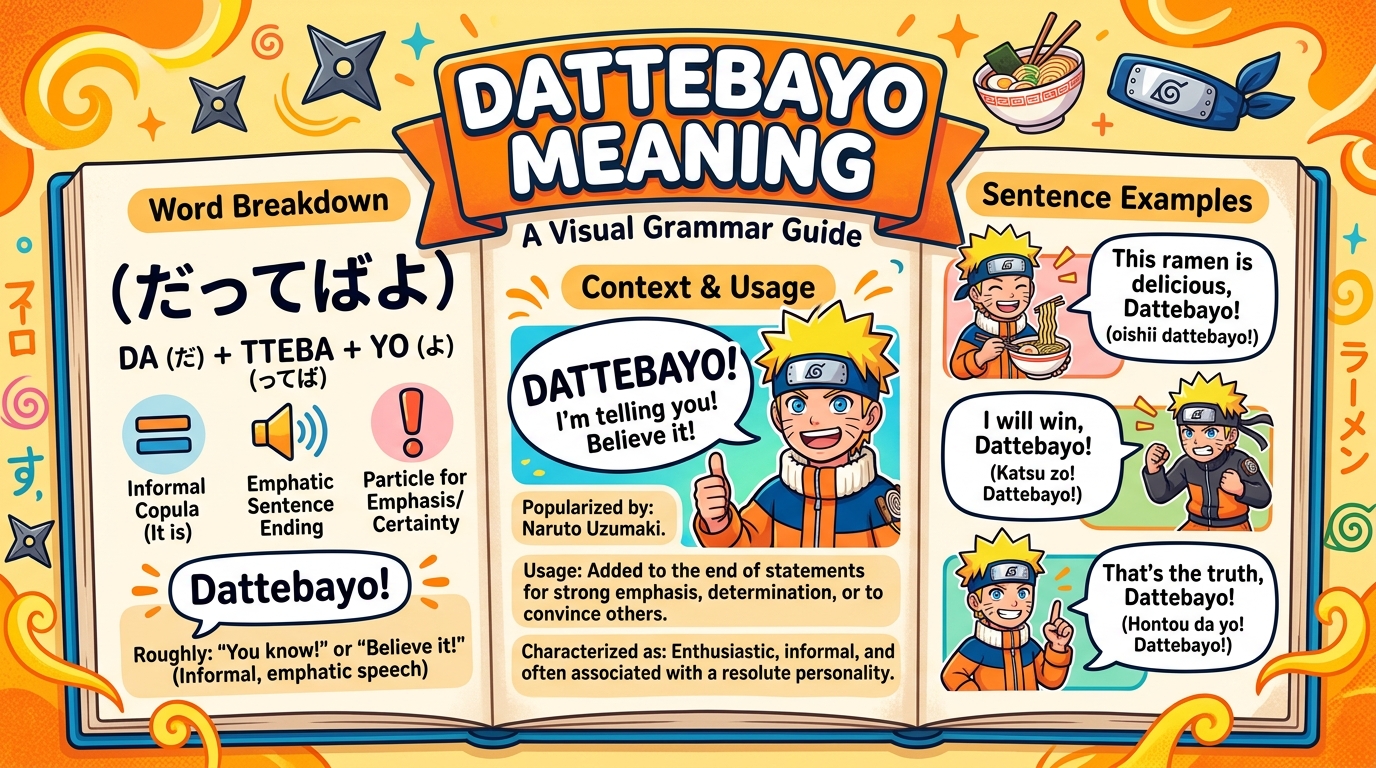
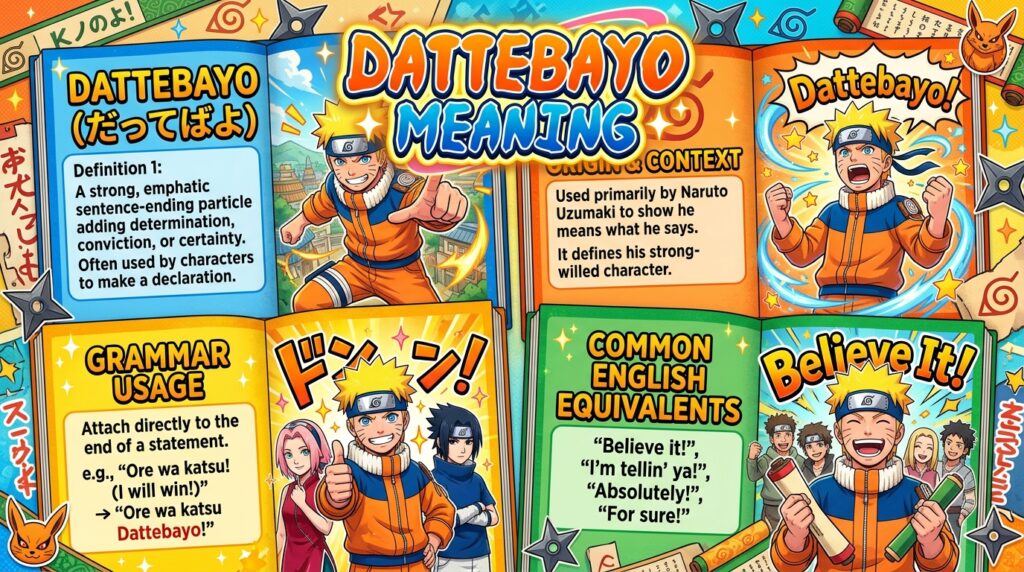
In simple terms, “dattebayo” (だってばよ) is a Japanese sentence-ending expression used for emphasis.
It does NOT have a perfect English translation.
Basic meaning:
- “Believe me!”
- “I’m telling you!”
- “Seriously!”
- “You know!”
What it does in speech:
- Adds emotional emphasis
- Shows strong personality
- Makes statements sound more forceful or confident
Example usage (anime style):
- “I will become Hokage, dattebayo!”
- “Believe what I’m saying, dattebayo!”
In real Japanese conversation, the phrase structure is flexible, and the emotion matters more than the literal meaning.
Origin & Background
“Dattebayo” is not standard textbook Japanese. It comes from a stylized speech pattern used to make characters sound unique.
In Naruto, the main character Naruto Uzumaki uses “dattebayo” at the end of many sentences. It reflects his:
- Energetic personality
- Emotional intensity
- Determination and impulsiveness
The phrase itself is a variation of:
- “da” (is/am)
- “tte ba yo” (emphatic speech ending)
Japanese creators often design such speech quirks to make characters instantly recognizable without needing visual explanation.
With time, anime fans around the world started repeating it, turning it into a cultural symbol.
Social media platforms like TikTok, Instagram, and meme pages amplified it further. Now, even people who don’t speak Japanese recognize it instantly.
Dattebayo Meaning in Japanese
In Japanese context, dattebayo (だってばよ) is:
- A casual emphatic sentence-ending particle
- Used mainly for emotional or forceful speech
- Often associated with childish or energetic tone
It does not have a fixed dictionary definition but functions as a spoken emphasis marker.
Simple understanding:
It’s like adding “I’m serious!” at the end of a sentence.
Example:
- 行くってばよ!
(I’m going, dattebayo!)
Dattebayo Meaning in English
In English, there is no exact equivalent, but closest interpretations include:
- “Believe me!”
- “I swear!”
- “I’m telling you!”
- “Seriously!”
It depends on tone and situation.
Example translations:
- “I will win, dattebayo!” → “I will win, believe me!”
- “Don’t underestimate me, dattebayo!” → “Don’t underestimate me!”
The emotional weight matters more than literal translation.
Dattebayo Meaning in Hindi
In Hindi, “dattebayo” is often understood in a more expressive way:
- “Maan lo!”
- “Sach mein!”
- “Main keh raha hoon!”
Example:
- “Main Hokage banunga, dattebayo!”
→ “Main Hokage banunga, maan lo!”
Hindi speakers usually interpret it as strong emotional emphasis rather than translation.
Dattebayo Meaning in Urdu
In Urdu, it carries a similar expressive tone:
- “Yaqeen karo!”
- “Main keh raha hoon!”
- “Sach samjho!”
Example:
- “Main jeetunga, dattebayo!”
→ “Yaqeen karo, main jeetunga!”
Urdu interpretation focuses on confidence and emotional assertion.
Baka Dattebayo Meaning
“Baka dattebayo” mixes two anime-style expressions:
- Baka (ばか) = “idiot” or “st*pid”
- Dattebayo = emphatic speech ending
Meaning:
- “You idiot, believe me!”
- “Seriously, you fool!”
It can sound:
- Funny among friends
- Slightly rude if used aggressively
Anime often uses “baka” for playful insults, not always offensive.
Arigato Dattebayo Meaning
- Arigato (ありがとう) = Thank you
Combined meaning:
- “Thank you, believe me!”
- “Thanks a lot!”
In reality, Japanese speakers wouldn’t normally combine them this way. It’s more of an anime-style playful expression used by fans.
It shows gratitude with strong emotional emphasis.
Dattebayo Meaning in Korean
Korean does not have a direct equivalent, but similar expressions include:
- “진짜야!” (It’s real!)
- “믿어!” (Believe me!)
- “정말!” (Seriously!)
Interpretation:
Korean speakers understand “dattebayo” as an expressive anime-style emphasis phrase rather than literal language.
Anime fans in Korea often keep it unchanged when speaking casually about Naruto.
Dattebayo Meaning in Bengali Language
In Bengali, it is interpreted as:
- “বিশ্বাস করো!”
- “আমি বলছি!”
- “সত্যি বলছি!”
Example:
- “Ami Hokage hobo, dattebayo!”
→ “Ami Hokage hobo, bishwas koro!”
Bengali speakers treat it as emotional emphasis rather than translation.
Real-Life Conversations (MANDATORY)
WhatsApp Chat
Person A: Are you really going to finish this project tonight?
Person B: Yes, dattebayo! I’m not sleeping until it’s done.
Instagram DM
Person A: You think you can beat him in the game?
Person B: Of course, dattebayo 😤 just watch me.
TikTok Comment Section
Person A: This anime scene is overrated.
Person B: No way, dattebayo! This is literally the best moment.
Text Message
Person A: You sure you’ll come tomorrow?
Person B: I promise, dattebayo. I’ll be there on time.
Emotional & Psychological Meaning
“Dattebayo” reflects more than speech—it shows personality.
It represents:
- Confidence without hesitation
- Emotional intensity
- A need to be heard and believed
People use similar expressions in real life when they want to:
- Emphasize truth
- Strengthen emotional impact
- Sound more energetic or expressive
Real-life scenario:
Imagine someone defending their idea in a group discussion. Instead of calmly stating facts, they might emotionally stress their point to ensure others feel the conviction behind it.
That’s the energy “dattebayo” carries in anime communication.
Usage in Different Contexts
Social Media
Used in memes, captions, and anime edits to show hype or confidence.
Friends & Relationships
Used jokingly to express excitement or stubbornness.
Work / Professional Settings
Not appropriate—sounds informal and childish.
Casual vs Serious Tone
- Casual: Funny, expressive
- Serious: Strong emotional emphasis in anime context only
When NOT to Use It
- Formal conversations
- Academic writing
- Workplace communication
- With people unfamiliar with anime culture
Using it in serious settings may confuse listeners or reduce credibility.
Common Misunderstandings
Many people think:
- It has a fixed English meaning (it doesn’t)
- It is just a random anime sound (it actually has structure)
- It is used widely in Japan daily (it is not)
The biggest confusion is between literal translation and emotional function.
Comparison Table
| Term | Meaning Intent | Usage Intent | Example Intent | Comparison |
|---|---|---|---|---|
| Dattebayo | Emphatic speech ending | Express emotion/confidence | “I’ll win, dattebayo!” | Anime-style emphasis vs normal speech |
| Believe me | Request trust | Direct statement | “Believe me, I’m right” | Literal vs expressive tone |
| Seriously | Strong emphasis | Reaction marker | “Seriously, stop it!” | Short emotional emphasis |
| I swear | Promise/truth assertion | Emotional guarantee | “I swear I didn’t do it” | Formal vs anime tone |
Key Insight:
“Dattebayo” is not about translation—it’s about emotional energy in speech.
Variations / Types (8–10)
1. Dattebayo meaning in text
Used in anime-style texting to show confidence or hype.
2. Dattebayo slang
Fan-created slang for strong emotional emphasis.
3. Dattebayo abbreviation
Not an abbreviation, but stylized speech ending.
4. Dattebayo in chat
Used to exaggerate confidence in conversations.
5. Dattebasa (similar form)
Female variation used in anime style.
6. Dattebane (another variation)
Softer tone version used by characters.
7. Anime dattebayo
Refers to Naruto-style speech pattern.
8. Funny dattebayo
Used humorously in memes.
9. Emotional dattebayo
Used to express strong feelings.
10. Meme dattebayo
Internet slang used in fandom communities.
How to Respond When Someone Uses It
Casual replies:
- “Haha, I believe you!”
- “Alright, I trust you!”
Funny replies:
- “Okay Naruto, calm down 😄”
- “Dattebayo energy detected!”
Mature replies:
- “Got it, I understand your point.”
- “I hear your confidence.”
Respectful replies:
- “I appreciate your certainty.”
- “Thanks for explaining.”
Regional & Cultural Usage
Western culture
Mostly used in anime fandom and memes.
Asian culture
Recognized as anime speech pattern, not daily language.
Middle Eastern culture
Known through anime exposure and social media.
Global internet usage
Popular as meme expression and fandom reference.
Generational differences
- Gen Z: Uses it humorously online
- Millennials: Recognize it from early anime exposure
Is It Safe for Kids?
Yes, it is safe.
It is:
- Non-offensive
- Non-vulgar
- Anime-related expression
However, children may misunderstand it as real Japanese grammar if not explained properly.
FAQs
What is the meaning of Dattebayo?
“Dattebayo” is an anime-style Japanese speech ending used for emphasis. It roughly means “believe me” or “I’m serious,” but the real meaning depends on tone and context rather than a direct translation.
Is dattebayo a made-up word?
It is not a standard dictionary word, but it is a stylized Japanese expression. It was popularized by anime characters, especially Naruto, to add personality and emotional intensity to speech.
What does “ara ara” mean?
“Ara ara” is a Japanese expression used to show surprise, amusement, or mild teasing. In anime, it often has a playful or flirtatious tone depending on context and character.
What is Naruto’s famous line Dattebayo?
Naruto’s signature line “dattebayo” is used at the end of his sentences to show strong emotion, confidence, and determination. It became one of the most recognizable anime catchphrases worldwide.
Where did dattebayo come from?
It originates from Japanese speech patterns designed for fictional characters. The Naruto series made it famous by using it as a unique verbal habit for the main character.
Is dattebayo used in real Japanese conversation?
Not commonly. Native speakers do not usually use “dattebayo” in daily life. It is mainly an anime-style expression rather than standard spoken Japanese.
Why does Naruto say dattebayo?
Naruto uses it to reflect his energetic, stubborn, and emotional personality. It helps emphasize his confidence and makes his character more memorable.
What does dattebasa and dattebane mean?
They are softer variations of “dattebayo” used by other anime characters. They serve the same purpose—adding emotional emphasis—but with different speech styles.
Is dattebayo rude or polite?
It is neither strictly rude nor polite. It depends on tone. In anime, it usually sounds energetic and emotional rather than offensive.
Can I use dattebayo in real life conversations?
Yes, but only in a fun or humorous way with friends who understand anime culture. In formal or serious settings, it may sound confusing.
Conclusion
“Dattebayo” is more than a catchy anime phrase—it is a reflection of emotion, identity, and expressive communication. While it doesn’t have a direct English translation, it conveys confidence, intensity, and personality in speech. Its popularity comes from anime culture, especially Naruto, and has grown into a global internet expression. Understanding it helps you see how language can carry feeling beyond words. Use it casually, enjoy its energy, and appreciate the emotional depth behind this iconic phrase.