Some words don’t just describe meaning — they carry emotional weight that can change how a person feels about themselves. “Emasculate” is one of those words.
People often search for emasculate meaning because they hear it in arguments, relationships, movies, or online conversations and feel confused or even disturbed by it. It sounds harsh, personal, and deeply emotional — and that’s exactly why it stands out.
At its core, emasculation is not just about language. It’s about power, identity, and how words can quietly shape someone’s self-worth without physical harm. Understanding it helps you recognize emotional patterns in relationships, communication, and even culture.
This article breaks down the meaning of emasculate in simple, real-life language so you never misinterpret it again.
Emasculate Meaning – Quick Meaning
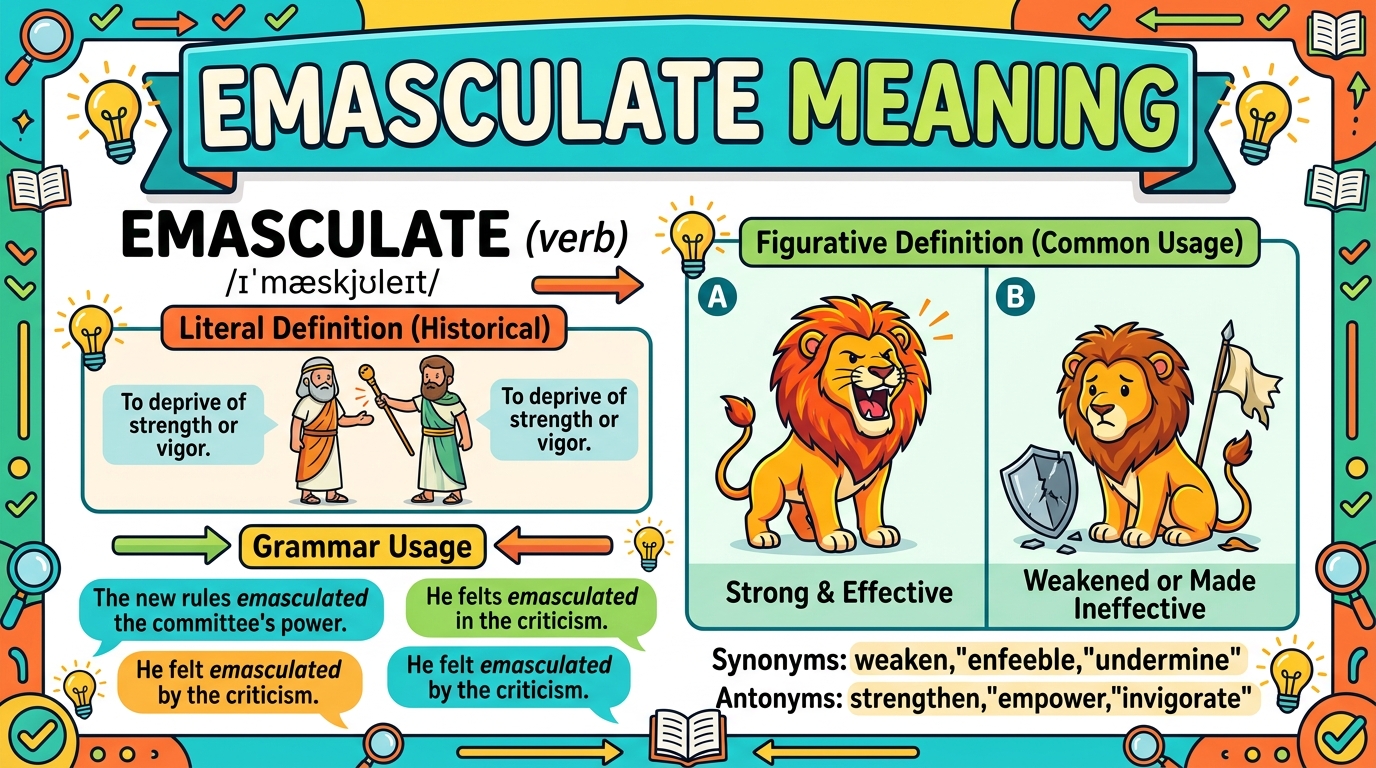
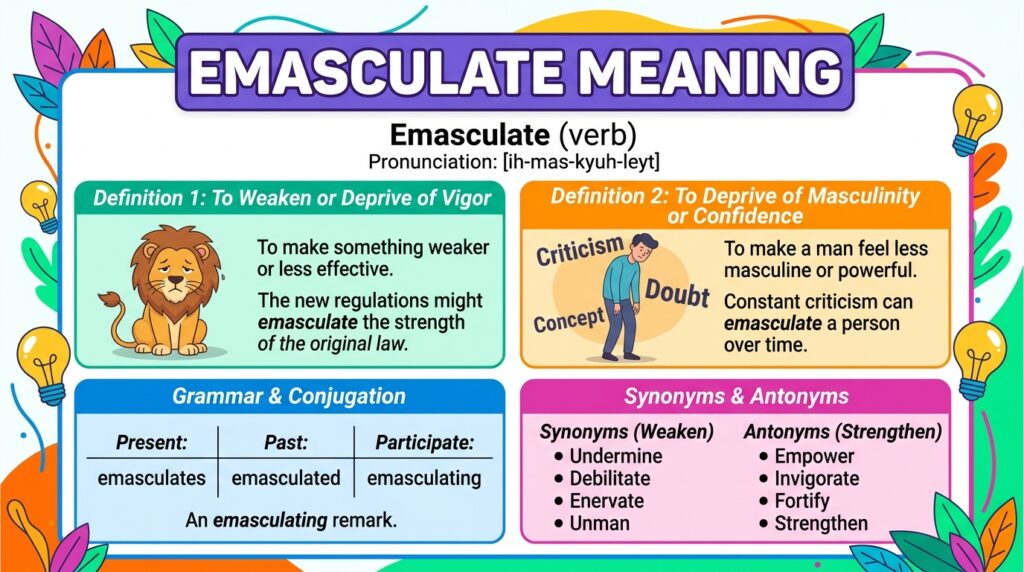
The word emasculate means to weaken someone emotionally, mentally, or symbolically — often by making them feel less powerful, less confident, or less “manly” in traditional terms.
In simple words:
- To take away someone’s confidence or strength
- To make someone feel less capable or less respected
- To reduce authority, especially in emotional or social situations
Examples in short form:
- “He felt emasculated after being mocked in front of everyone.”
- “Constant criticism can emasculate a partner emotionally.”
- “The decision made him feel completely emasculated at work.”
It’s usually used in emotional or psychological contexts, not literal physical meaning.
Origin & Background
The word emasculate comes from the Latin word emasculare, meaning “to remove the male qualities.”
Historically, it referred to literal removal of male power or strength, but over time, the meaning evolved into something psychological and symbolic.
In modern communication, especially online culture, the word is used more metaphorically:
- In relationships to describe emotional weakening
- In workplaces to describe loss of authority
- In social settings to describe humiliation or loss of respect
Social media has amplified the term, often using it in debates about masculinity, gender roles, and emotional expression. Today, it is less about biology and more about emotional identity.
Emasculate Meaning in Law
In legal contexts, emasculation is not commonly used as a formal legal term, but it can appear in descriptive or historical discussions.
It may relate to:
- Cases involving bodily harm or mutilation (historically)
- Discussions about violation of dignity or human rights
- Psychological abuse arguments in extreme emotional harm cases
However, modern law focuses more on terms like:
- Emotional abuse
- Psychological harm
- Degradation or humiliation
So while the word exists in language, it is rarely used directly in legal documentation today.
Emasculate Meaning in Relationship
In relationships, this word carries a strong emotional charge.
To emasculate a man in a relationship means:
- Constantly criticizing his decisions
- Undermining his confidence
- Making him feel “not enough” emotionally or socially
- Dismissing his opinions or efforts
It does NOT mean physical harm — it refers to emotional impact.
Real-life example:
When one partner repeatedly says, “You can’t do anything right,” it slowly weakens trust and confidence.
Healthy relationships rely on respect. When respect turns into ridicule, emotional emasculation can occur without either partner realizing it immediately.
Emasculate Meaning in English
In standard English usage, emasculate means:
- To deprive someone of strength or effectiveness
- To make someone feel less powerful or less confident
- To weaken authority or identity (symbolically)
It can be used in both formal and informal communication.
Example sentences:
- “The leader felt emasculated after losing control of the team.”
- “His voice was emasculated by constant interruption.”
It is a strong word and should be used carefully.
Emasculate Meaning Opposite
The opposite of emasculate includes words that restore strength, confidence, or authority:
- Empower
- Strengthen
- Encourage
- Uplift
- Validate
If emasculation reduces confidence, its opposite builds emotional resilience and self-worth.
Example:
- Emasculate: “He felt small after the comment.”
- Opposite: “She empowered him to speak confidently.”
Emasculate vs Demasculate Meaning
Many people confuse these two words, but only one is correct in standard English.
- Emasculate: to weaken or strip confidence/strength
- Demasculate: not a standard English word (often incorrectly used online)
“Demasculate” appears in informal internet slang but is not recognized in formal dictionaries.
Key difference:
- Emasculate = real, established word
- Demasculate = slang or incorrect variation used for emphasis
So if you want to sound accurate, always use emasculate.
Emasculate Meaning Synonyms
Here are words that carry similar emotional or psychological meaning:
- Weaken
- Humiliate
- Undermine
- Degrade
- Disempower
- Subdue
- Belittle
- Diminish
Each synonym depends on context, but all reflect some form of emotional reduction in strength or confidence.
Emasculate a Man Meaning
This phrase is commonly used but often misunderstood.
To emasculate a man means:
- Making him feel powerless in his identity or role
- Damaging his confidence through words or actions
- Challenging his sense of respect or authority
It is important to understand this is not about gender superiority. It is about emotional perception and respect.
Example scenario:
A man is constantly told his efforts are “useless,” even when he tries his best. Over time, he may withdraw emotionally due to feeling emasculated.
Emasculate Meaning in the Bible
In biblical and historical interpretations, emasculation sometimes appears in discussions of:
- Symbolic loss of strength or honor
- Ancient practices involving physical alteration (historically referenced)
- Metaphorical weakening of moral or spiritual strength
However, modern religious interpretation focuses more on:
- Inner strength
- Moral integrity
- Emotional discipline
So in most modern readings, emasculation is understood metaphorically rather than literally.
Real-Life Conversations (MANDATORY)
WhatsApp Chat
Person A: “Why are you so quiet lately?”
Person B: “Honestly, I feel like everything I do is wrong… it’s making me feel emasculated.”
Instagram DM
Person A: “He always interrupts you like that?”
Person B: “Yes… it feels like he’s trying to emasculate me in front of others.”
TikTok Comments
Person A: “That joke was too harsh 😂”
Person B: “It wasn’t funny, it was just emasculating honestly.”
Text Message
Person A: “Talk to her about how you feel.”
Person B: “I tried… but I felt completely emasculated in that conversation.”
Emotional & Psychological Meaning
Emasculation is not just a word — it’s an emotional experience.
It often reflects:
- Loss of confidence
- Feeling disrespected
- Identity confusion
- Emotional withdrawal
People use this word when they feel their voice or presence has been minimized.
Real-life scenario:
A man in a workplace keeps getting ignored in meetings. Over time, he stops sharing ideas because he feels emotionally “shrunk.” That internal feeling is what people describe as emasculation.
Usage in Different Contexts
Social Media:
Used in debates, memes, and relationship discussions.
Friends & Relationships:
Used to describe emotional hurt or disrespect.
Workplace:
Used when authority or ideas are dismissed repeatedly.
Casual vs Serious Tone:
- Casual: “That comment was kinda emasculating lol”
- Serious: “The experience left him feeling emotionally emasculated”
When NOT to Use It
Avoid using “emasculate” in:
- Light jokes (it can sound offensive)
- Professional emails
- Situations involving sensitive emotional trauma
- Conversations where tone is unclear
It is a strong word and can easily be misunderstood.
Common Misunderstandings
People often think:
- It only applies to men (incorrect — it’s psychological, not gender-exclusive)
- It means physical harm (wrong — it is emotional or symbolic)
- It is always intentional (not true — it can be accidental in communication)
Tone matters more than the word itself.
Comparison Table
| Concept | Meaning Intent | Usage Intent | Example Intent | Comparison |
|---|---|---|---|---|
| Emasculate | To weaken confidence or strength | Emotional or social context | “He felt emasculated.” | Opposite of empowerment |
| Empower | To give strength or confidence | Motivation or support | “She empowered him to speak.” | Direct opposite |
| Humiliate | To embarrass publicly | Social or emotional harm | “He was humiliated in class.” | More public than emasculate |
| Undermine | To weaken gradually | Subtle emotional damage | “She undermined his ideas.” | More indirect impact |
Key Insight:
Emasculation is often subtle — it doesn’t always look like obvious harm, but it slowly affects confidence and identity over time.
Variations / Types (8–10)
- Emasculate meaning – weakening confidence or strength
- Emasculate in text – used to describe emotional hurt in chats
- Emasculate abbreviation – rarely abbreviated, usually written fully
- Emasculate slang – used informally in emotional contexts
- Emasculate in chat – describing disrespectful communication
- Emasculation meaning – noun form describing the state of being weakened
- Emasculated meaning – past tense describing emotional impact
- Emasculating behavior – actions that reduce confidence
- Emasculate joke meaning – harsh humor that hurts confidence
- Emasculate tone – communication style that feels degrading
How to Respond When Someone Uses It
Casual replies:
- “That’s a strong word, what happened?”
Funny replies:
- “Okay Shakespeare, calm down 😄”
Mature replies:
- “I understand how that situation affected you.”
Respectful replies:
- “I didn’t realize it made you feel that way, let’s talk.”
Regional & Cultural Usage
- Western culture: Used in psychology, relationships, and workplace discussions
- Asian culture: Often tied to respect, family roles, and social expectations
- Middle Eastern culture: Connected to honor, dignity, and masculinity norms
- Global internet: Used in memes, debates, and relationship content
- Gen Z vs Millennials: Gen Z uses it more casually online; Millennials use it more seriously
Is It Safe for Kids?
The word itself is not inappropriate, but its emotional meaning can be complex. Children may not fully understand its psychological depth, so it is better explained in simple terms when used in conversation.
FAQs
What does “emasculated someone” mean?
It means making someone feel less confident, less powerful, or emotionally weakened, often through words or behavior. It is usually psychological, not physical.
What is an example of emasculation?
An example is when a person is constantly criticized in front of others, making them feel small or incapable. Over time, this can damage their confidence.
What is another word for emasculate?
Common synonyms include undermine, weaken, humiliate, belittle, and disempower, depending on the context.
Why does emasculate mean?
It comes from Latin roots meaning “to remove male strength,” but in modern English it refers to reducing someone’s confidence, power, or effectiveness emotionally or symbolically.
Is emasculate always about men?
No, although it is often used in relation to men, it actually refers to emotional weakening and can apply to anyone in a psychological sense.
Is emasculate a formal word?
Yes, it is a formal English word used in emotional, psychological, and descriptive contexts, especially in writing and discussion.
Can words really emasculate someone?
Yes, repeated criticism, insults, or disrespectful communication can emotionally weaken a person and affect their confidence over time.
What is the opposite of emasculate?
The opposite includes empower, uplift, strengthen, encourage, and validate someone’s confidence and identity.
Is emasculate used in relationships?
Yes, it is often used when one partner consistently undermines or disrespects the other, leading to emotional damage and loss of confidence.
Is emasculate offensive?
The word itself is not offensive, but it describes emotionally sensitive situations, so it should be used carefully and respectfully.
Conclusion
Emasculate is more than just a word—it reflects emotional experiences where confidence, respect, or identity feels diminished. In relationships, workplaces, and conversations, it often appears when someone feels unheard or undervalued. Understanding its meaning helps you communicate more carefully and avoid unintentionally hurting others. When used thoughtfully, it also becomes a powerful way to describe emotional struggles with clarity. Language shapes emotions, and knowing this word gives you better awareness of how deeply words can affect human confidence and relationships.