If you’ve ever heard someone say, “I’ll post it on my finsta,” you probably paused and wondered what that really means. It sounds casual, almost secretive—and that’s exactly the point.
The term finsta has quietly become part of everyday digital language, especially among younger users. People search for it because they sense there’s more behind it than just another social media trend. And they’re right.
At its core, finsta meaning isn’t just about a second account—it’s about identity, privacy, and emotional honesty in a world where everything feels curated. This guide breaks it down in a way that actually makes sense, so you can understand not just the word, but the feeling behind it.
Finsta Meaning – Quick Meaning
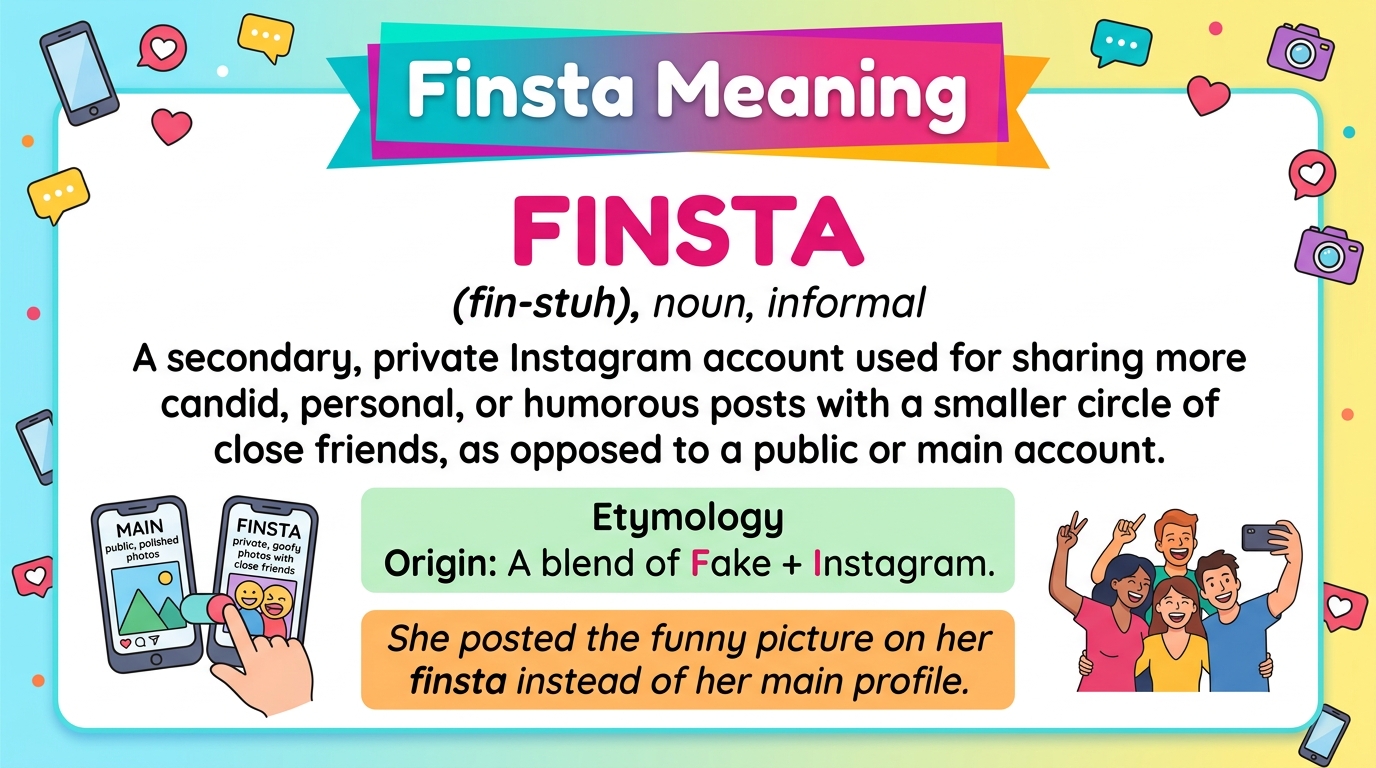
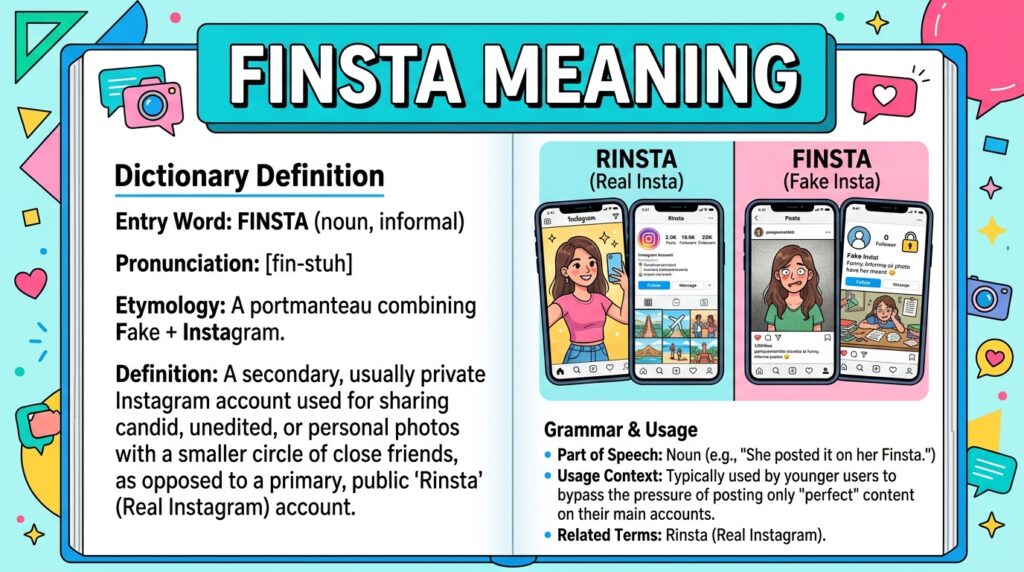
A finsta is a secondary, private social media account, usually on Instagram, where users share more personal, unfiltered, or real content with a smaller, trusted audience.
Key points:
- “Fake Instagram” (but not always fake in intention)
- Private and selective followers
- More authentic or raw content
- Often hidden from public view
Simple examples:
“Don’t post that on your main—put it on your finsta.”
“I only share my real thoughts on my finsta.”
“My finsta is where I can be myself.”
Origin & Background
The word finsta comes from a combination of “fake” + “Instagram.” It first appeared among teenagers in the early 2010s when social media started feeling… performative.
As Instagram evolved into a polished highlight reel, people began creating separate accounts to escape that pressure. Ironically, what started as “fake” became more real than their main profiles.
Cultural evolution:
- Early stage: Used for humor, memes, and inside jokes
- Growth phase: Became a space for emotional expression
- Today: A symbol of digital dual identity
Social media created a paradox: people wanted to be seen—but not fully seen. The finsta became the solution.
Real-Life Conversations
WhatsApp Chat
Person A: Why didn’t you post those pics?
Person B: I did… just on my finsta 😅
Instagram DM
Person A: Your main account is so aesthetic
Person B: That’s fake me. My finsta is chaos 😂
TikTok Comments
User 1: This is so real
User 2: Giving strong finsta vibes
Text Message
Person A: Why didn’t you tell me?
Person B: I posted it on my finsta… thought you saw
These conversations show something subtle: finsta isn’t just a platform—it’s a different version of communication.
Emotional & Psychological Meaning
A finsta represents something deeper than just privacy. It reflects a human need: the desire to be authentic without judgment.
People use finstas because:
- They feel pressure to maintain a “perfect image”
- They want a safe space to express emotions
- They trust a smaller audience more than a large one
What it reveals:
Modern communication isn’t just about sharing—it’s about controlling how you’re perceived.
A real-life style scenario:
Imagine someone posting polished travel photos on their main account. Everything looks perfect. But on their finsta, they share a late-night post saying, “I feel lost even in beautiful places.”
That contrast tells the real story.
Usage in Different Contexts
Social Media
Finstas are mostly used on Instagram, but the idea exists everywhere. It’s about having a “private digital room.”
Friends & Relationships
Among close friends, finstas create a deeper level of trust. Being added to someone’s finsta feels personal.
Work / Professional Settings
Using the term in professional environments can feel out of place. It’s informal and personal.
Casual vs Serious Tone
- Casual: “Post it on your finsta 😂”
- Serious: “I only talk about that on my finsta”
The tone shifts depending on emotional context.
When NOT to Use It
Even though finsta is common, it’s not always appropriate.
Avoid using it:
- In formal or professional conversations
- With people unfamiliar with internet slang
- In serious discussions where clarity matters
- When privacy or trust could be misunderstood
Sometimes, using the term casually can make you seem dismissive or unclear.
Common Misunderstandings
1. “Finsta means fake personality”
Not true. It often represents the real personality.
2. “It’s only for teenagers”
While popular with Gen Z, many adults use the concept.
3. “It’s always secretive or negative”
Not necessarily. It’s more about selective sharing.
4. Tone confusion
Some people assume it’s a joke—but it can carry emotional weight.
Comparison Table
| Topic | Meaning |
|---|---|
| What Does Finsta Mean | A private, secondary account for real or selective sharing |
| How to Use Finsta | Refer to personal or hidden social media activity |
| Examples of Finsta | Posting emotional thoughts, memes, or unfiltered content |
| Finsta vs Main Account | Finsta = private & real, Main = public & curated |
Key Insight:
A finsta isn’t about being fake—it’s about choosing where and how to be real.
Variations / Types
- Finsta meaning
A private account used for authentic expression - Finsta in text
“I’ll post it on my finsta” - Finsta abbreviation
Short for “fake Instagram” - Finsta slang
Informal term for a hidden or private account - Finsta in chat
Used casually among friends - Private finsta
Highly restricted audience - Spam finsta
Used for random or frequent posting - Close friends finsta
Limited to a trusted circle - Emotional finsta
Used for personal thoughts or feelings - Anonymous finsta
No real identity attached
How to Respond When Someone Uses It
Casual replies
- “Haha makes sense”
- “Yeah finstas are safer”
Funny replies
- “So that’s where your real personality lives 😂”
- “Drop the finsta handle 👀”
Mature replies
- “I get why you’d keep that private”
- “That sounds like a safe space for you”
Respectful replies
- “I respect your privacy”
- “Thanks for sharing that with me”
Regional & Cultural Usage
Western Culture
Finstas are widely accepted and part of everyday slang, especially among Gen Z.
Asian Culture
Used more carefully. Privacy and social image often carry stronger weight.
Middle Eastern Culture
More sensitivity around privacy and social boundaries. Finstas may be used discreetly.
Global Internet Usage
The concept exists everywhere, even if the term “finsta” isn’t always used.
Generational Differences
- Gen Z: Uses it naturally and frequently
- Millennials: Understand it but may use it less
- Older generations: May find it confusing
Is It Safe for Kids?
A finsta can be safe—but it depends on how it’s used.
Because it involves privacy and selective sharing, it can create a safe space. However, it can also lead to secrecy or risky behavior if not guided properly.
Parents and guardians should focus on open conversations, not strict control.
FAQs
What does finsta mean in simple terms?
A finsta is a private social media account used to share real or personal content with a small group.
Is finsta a bad thing?
Not necessarily. It depends on how and why it’s used.
Why do people have finstas?
To express themselves freely without public pressure.
Is finsta only for Instagram?
It started there, but the idea applies to other platforms too.
Can anyone see a finsta?
No, only approved followers can access it.
Is finsta the same as a fake account?
Not always. It’s often more real than a main account.
Conclusion
Understanding finsta meaning goes beyond decoding a trendy word—it reveals how people navigate identity in a digital world. Behind every finsta is a quiet desire to be seen without pressure, to share without judgment, and to exist without constant performance. It’s not about being fake; it’s about choosing authenticity on your own terms. As communication evolves, terms like this remind us that people still crave real connection, even online. Once you understand that, the word “finsta” stops feeling confusing—and starts feeling deeply human.