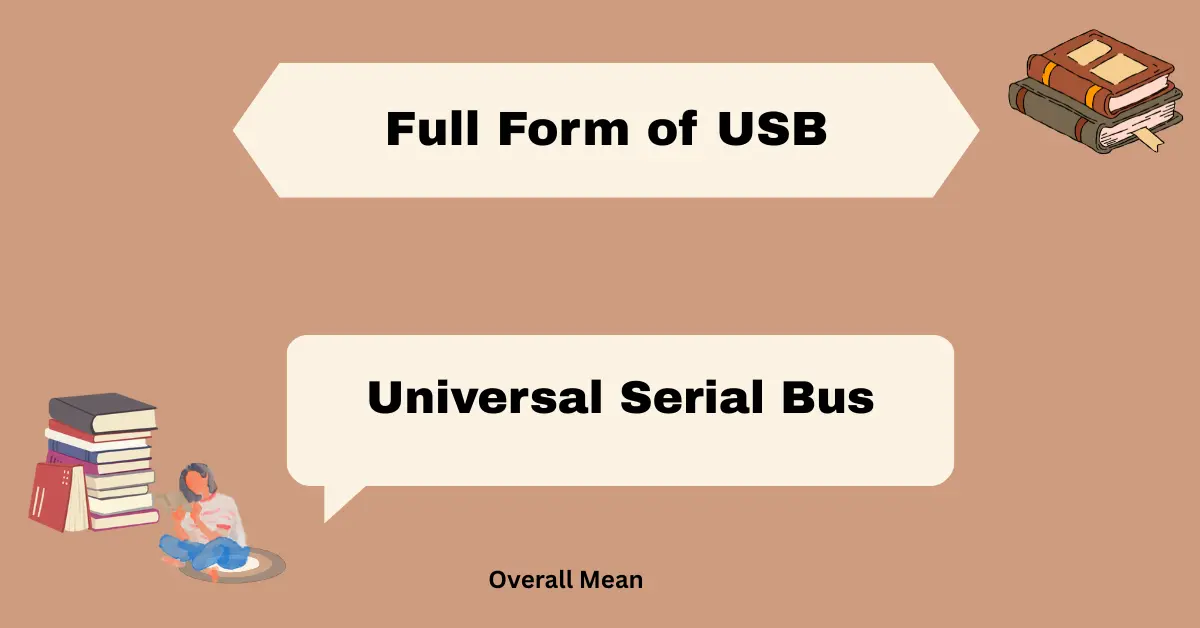
The full form of USB is Universal Serial Bus, one of the most widely used technical terms in modern digital technology. It plays a key role in connecting devices such as computers, smartphones, keyboards, flash drives, and printers, making data transfer and power supply simple and universal.
In today’s digital world, understanding abbreviations like USB is essential for students, professionals, and everyday users. These terms are commonly used in technology, communication, and education, yet many people only know the short form without understanding its real meaning.
This article explains the USB full form, its definition, how it works, its components, and its global usage across different languages. You will also learn why USB remains an important standard in 2026 and how it continues to shape modern connectivity.
What Is the Full Form of USB?
USB – Universal Serial Bus
The full form of USB is Universal Serial Bus.
Definition of USB (Universal Serial Bus)
Universal Serial Bus (USB) is a standardized technology that enables the transfer of data and power between computers and electronic devices through a single interface.
In simple terms, USB is the system that allows devices such as:
- Flash drives
- Keyboards
- Mice
- Smartphones
- Printers
- External hard drives
to connect, communicate, and receive power from a host device like a computer or charger.
Meaning of USB in Text, Chat, and Daily Communication
In text messages, online chats, forums, and professional conversations, USB is commonly used as a standalone technical term rather than an abbreviation that gets expanded every time.
Common chat meanings:
- “Send it via USB.”
- “My USB isn’t detected.”
- “Do you have a USB cable?”
- “Copy the files to a USB drive.”
In casual digital communication, people rarely say Universal Serial Bus, but understanding the full form helps users grasp:
- Why USB works across devices (Universal)
- Why it sends data sequentially (Serial)
- Why it follows a structured connection system (Bus)
Breaking Down the Full Form: Universal Serial Bus
Understanding each word in Universal Serial Bus adds depth to its meaning.
1. Universal
The term Universal means the interface is designed to work across different devices, brands, and operating systems.
2. Serial
Serial refers to how data is transmitted—bit by bit in sequence, rather than all at once.
3. Bus
A Bus is a communication system that transfers data between components inside or outside a computer.
Together, these words describe a system that universally connects devices through a structured data pathway.
Why USB Matters More in 2026 Than Ever Before
In 2026, USB is no longer just a “computer accessory.” It is a foundational digital infrastructure.
Key relevance in 2026:
- Rise of remote work and hybrid offices
- Increased use of external storage for privacy
- Universal charging standards adoption
- Reduced e-waste through standardized ports
- Faster data transfer needs for high-resolution media
USB is now a language of connectivity, not just a cable.
Full Form of USB in 10 Different Languages
Although the abbreviation USB remains the same globally, its interpretation, explanation, and contextual usage vary across languages and cultures.
Below are 10 languages, each with:
- Language name
- Local explanation or translation
- Usage context
- Chat-style example
- Origin or linguistic background
- Comparative insight where useful
1. English – Universal Serial Bus
Language:
English
Meaning and Usage:
In English, USB is universally recognized as Universal Serial Bus, the official technical term used in documentation, education, and professional communication.
Chat Example:
A: “Can you transfer the files?”
B: “Yes, I’ll put them on a USB.”
Origin/Background:
The term originated in the technology sector to standardize hardware communication. English serves as the base language for most technical documentation worldwide.
Comparison Insight:
English terminology is often retained even in non-English-speaking countries due to its role as the global tech language.
2. Hindi – यूनिवर्सल सीरियल बस (Universal Serial Bus)
Language:
Hindi
Meaning and Usage:
In Hindi, USB is commonly pronounced as “यूएसबी” and occasionally explained as
यूनिवर्सल सीरियल बस, though the English term dominates daily usage.
Chat Example:
A: “डेटा कैसे भेजूं?”
B: “यूएसबी में डाल दो।”
Origin/Background:
Hindi borrows technical vocabulary from English due to globalization and education systems.
Comparison Insight:
Unlike English, Hindi speakers rarely expand USB unless teaching or explaining to beginners.
3. Italian – Universal Serial Bus
Language:
Italian
Meaning and Usage:
Italian uses Universal Serial Bus directly, without translation, especially in technical and academic contexts.
Chat Example:
A: “Hai il file?”
B: “Sì, è sulla USB.”
Origin/Background:
Italy retains English technical terms to maintain international compatibility.
Comparison Insight:
Similar to English, but pronunciation adapts to Italian phonetics.
4. Spanish – Bus Serie Universal
Language:
Spanish
Meaning and Usage:
While USB remains the abbreviation, it may be explained as
Bus Serie Universal in educational contexts.
Chat Example:
A: “¿Dónde está el documento?”
B: “Está en la USB.”
Origin/Background:
Spanish-speaking regions blend translated meanings with English abbreviations.
Comparison Insight:
Spanish adapts the phrase linguistically while preserving the acronym.
5. French – Bus Série Universel
Language:
French
Meaning and Usage:
French explains USB as Bus Série Universel, especially in formal or instructional material.
Chat Example:
A: “Tu peux copier ça?”
B: “Oui, sur la clé USB.”
Origin/Background:
French emphasizes linguistic adaptation while maintaining technical accuracy.
Comparison Insight:
French localizes the phrase more than English or Italian.
6. Arabic – الناقل التسلسلي العام
Language:
Arabic
Meaning and Usage:
USB is explained as
الناقل التسلسلي العام, though the abbreviation USB is still commonly used.
Chat Example:
A: “أين الملفات؟”
B: “على USB.”
Origin/Background:
Arabic technical language often translates concepts while retaining English acronyms.
Comparison Insight:
Arabic balances translation with global technical recognition.
7. Chinese (Mandarin) – 通用串行总线
Language:
Chinese (Mandarin)
Meaning and Usage:
USB translates to
通用串行总线, which directly mirrors the English meaning.
Chat Example:
A: “文件怎么给我?”
B: “用USB吧。”
Origin/Background:
Chinese technical language focuses on precise semantic translation.
Comparison Insight:
Chinese provides one of the most accurate conceptual translations.
8. German – Universeller Serieller Bus
Language:
German
Meaning and Usage:
German explains USB as
Universeller Serieller Bus, maintaining technical structure.
Chat Example:
A: “Hast du den Bericht?”
B: “Ja, auf dem USB-Stick.”
Origin/Background:
German technical language prioritizes clarity and structure.
Comparison Insight:
German translations closely follow original meanings.
9. Japanese – ユニバーサル・シリアル・バス
Language:
Japanese
Meaning and Usage:
USB is written as
ユニバーサル・シリアル・バス, a phonetic adaptation.
Chat Example:
A: “データある?”
B: “USBに入ってる。”
Origin/Background:
Japanese uses katakana for foreign technical terms.
Comparison Insight:
Japanese focuses on pronunciation rather than translation.
10. Russian – Универсальная последовательная шина
Language:
Russian
Meaning and Usage:
USB is explained as
Универсальная последовательная шина in formal contexts.
Chat Example:
A: “Файлы готовы?”
B: “Да, на USB.”
Origin/Background:
Russian technical language translates meaning while retaining global acronyms.
Comparison Insight:
Russian balances linguistic depth with international usage.
Why USB Remains the Same Across Languages
Despite translations, USB as an abbreviation remains unchanged worldwide. This consistency:
- Reduces confusion
- Enables cross-border compatibility
- Supports global manufacturing standards
- Strengthens universal digital literacy
USB is not just a term—it is a shared technological language.
Importance of Full Forms Like USB in Communication and Culture
Understanding full forms such as USB is essential because:
- It improves clarity in professional settings
- It prevents miscommunication in technical tasks
- It supports digital education
- It bridges linguistic and cultural gaps
- It empowers users in a technology-driven world
In 2026 and beyond, full forms are not about memorization—they are about comprehension, confidence, and competence.
Final Conclusion
The full form of USB—Universal Serial Bus— represents far more than a technical abbreviation. It reflects how language, technology, and global communication intersect.
From English to Arabic, Chinese to Russian, USB serves as a universal connector—not just of devices, but of people and ideas.
By understanding full forms deeply, users move from passive usage to active mastery of technology.
And in a world where digital understanding defines opportunity, that mastery matters.