If you’ve ever heard the word “gringo” in a movie, song, or online comment, you probably paused for a second. It sounds casual, maybe even playful—but also a little uncertain depending on the tone.
That confusion is exactly why so many people search for gringo meaning.
The truth is, “gringo” is not just a word. It carries culture, history, identity, and sometimes even emotion. In some conversations, it sounds harmless. In others, it feels sharp or sarcastic.
Understanding it properly helps you avoid misunderstandings—especially in travel, social media, or cross-cultural communication where tone matters more than words alone.
Gringo Meaning – Quick Definition
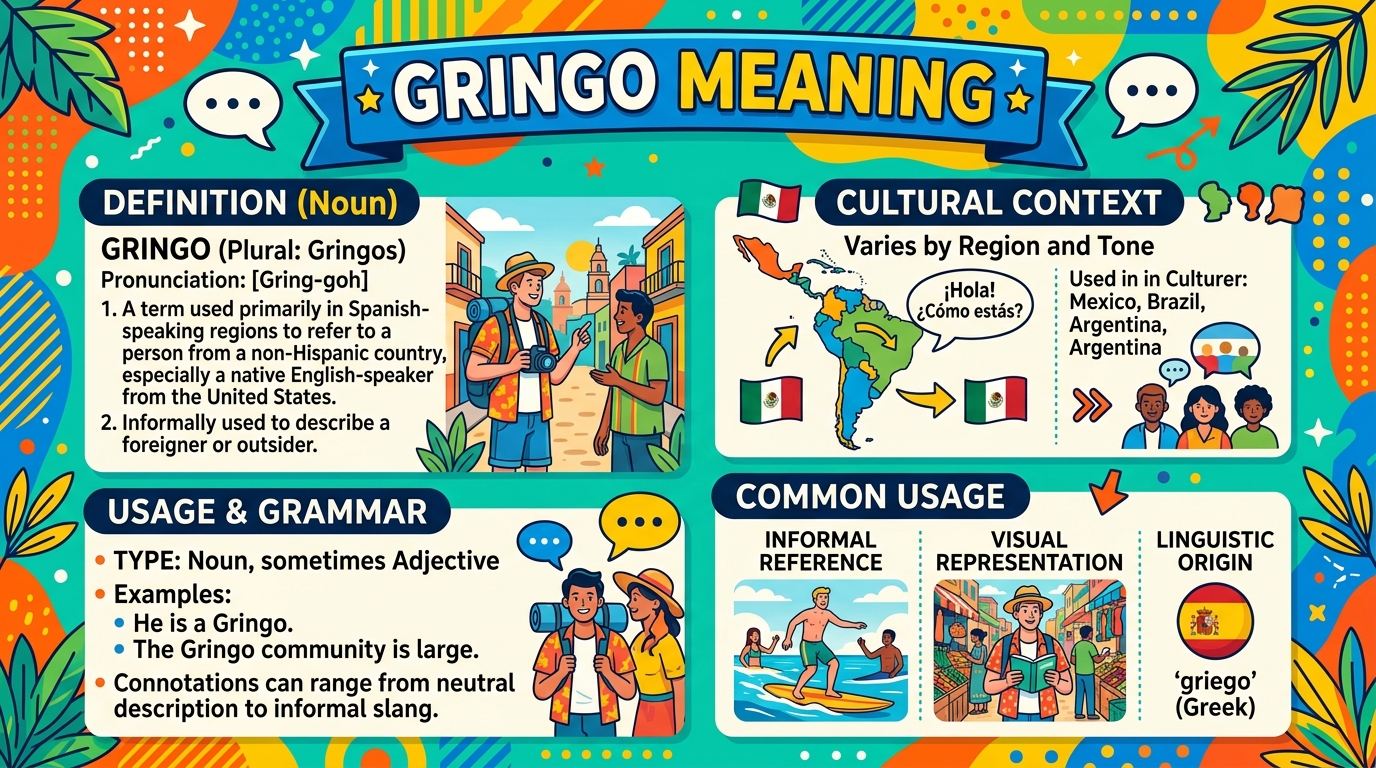
At its simplest, gringo is a slang term commonly used in Spanish-speaking countries to refer to foreigners, especially English-speaking people.
Most often, it refers to:
- A person from the United States
- Someone who doesn’t speak Spanish fluently
- A foreigner standing out in a local culture
Simple meaning breakdown:
- Neutral: “foreign visitor”
- Informal: “English-speaking outsider”
- Contextual: Can be friendly or slightly teasing
Example sentences:
- “That gringo doesn’t speak Spanish yet.”
- “We met some gringos traveling in Mexico.”
- “The gringo ordered food without knowing the menu.”
The tone changes everything.
Origin & Background of the Word “Gringo”
The exact origin of gringo is debated, but most linguistic historians trace it back to Spanish-speaking regions of the 18th and 19th centuries.
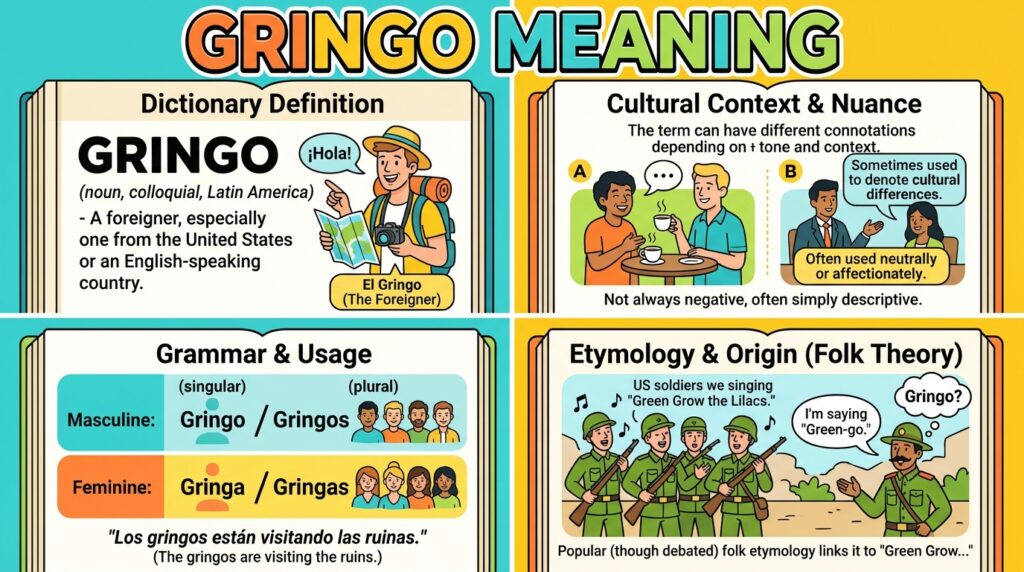
One popular theory links it to Spanish soldiers hearing English speakers say “green grow” in songs like “Green Grow the Lilacs.” Over time, this phrase allegedly evolved into gringo.
Another explanation connects it simply to the Spanish word “griego” (Greek), used historically to describe something incomprehensible—similar to saying “it’s all Greek to me.”
Cultural evolution:
In countries like Mexico, gringo became widely used during interactions with travelers and migrants from United States.
Over time, its meaning softened in some regions and became part of everyday speech, especially in tourism and border cities.
Social media then expanded its global reach, turning it into a widely recognized slang term.
Real-Life Conversations (How “Gringo” Actually Sounds in Daily Life)
1. WhatsApp Chat
Person A: “Where are you right now?”
Person B: “At the beach with some gringos.”
Person A: “Haha, hope they’re not too loud!”
2. Instagram DM
Person A: “Is that your new friend?”
Person B: “Yes, he’s a gringo from Texas.”
Person A: “Nice, does he understand Spanish yet?”
3. TikTok Comment Section
User 1: “Only gringos think tacos are hard to make 😂”
User 2: “I mean… I tried and failed, so fair enough.”
4. Text Message
Friend A: “Who joined your trip group?”
Friend B: “Two locals and one gringo who’s trying his best.”
These examples show something important: tone decides everything. Sometimes it’s friendly. Sometimes it’s teasing. Rarely is it truly offensive in casual use.
Emotional & Psychological Meaning Behind “Gringo”
Words like gringo are not just labels—they reflect perception.
Psychologically, people use it to:
- Mark cultural difference quickly
- Create informal social grouping
- Add humor or light teasing in conversation
In modern communication, especially online, gringo often carries a playful tone. It can signal curiosity, friendliness, or cultural identity awareness.
Mini real-life scenario:
Imagine traveling in Mexico. A local smiles and says, “You’re such a gringo, but you’re trying your best Spanish.”
It may feel slightly awkward at first—but the tone is usually warm, not hostile. It reflects recognition of difference without necessarily creating distance.
Usage in Different Contexts
Social Media
Used casually in memes, jokes, and cultural commentary. Often humorous.
Friends & Relationships
Can be playful among bilingual speakers or locals talking about foreigners.
Work / Professional Settings
Generally avoided. It may sound informal or insensitive depending on context.
Casual vs Serious Tone
- Casual: friendly or joking
- Serious: can feel labeling or excluding
When NOT to Use “Gringo”
Even though it’s widely used, there are moments where it can cause discomfort.
Avoid using it when:
- You are speaking in formal environments
- You are unsure how the listener perceives it
- You are in multicultural professional settings
- You are trying to avoid cultural labeling
In some cases, tone mismatch can make the word feel disrespectful even if it wasn’t intended that way.
Common Misunderstandings About “Gringo”
Many people assume:
- It is always offensive (not true)
- It only means American (not always)
- It is used with hate (rare in casual speech)
- It has one fixed meaning (it changes by context)
The biggest misunderstanding is ignoring tone. In language, tone often matters more than vocabulary.
Comparison Table: Understanding “Gringo” Clearly
| Concept | Meaning |
|---|---|
| What does gringo mean | A slang term for a foreigner, often English-speaking |
| How to use gringo | Informally in casual or cultural contexts |
| Examples of gringo | “The gringo is traveling in town.” |
| Gringo vs foreigner | “Gringo” is informal; “foreigner” is neutral |
Key Insight
The meaning of gringo is not fixed—it depends heavily on tone, relationship, and cultural context. Understanding that difference is what prevents miscommunication.
Variations / Related Uses of “Gringo”
- Gringo meaning (basic)
A foreigner, often from English-speaking countries. - Gringo in text
Used informally in chats to describe outsiders. - Gringo slang
Casual cultural slang, not formal language. - Gringo abbreviation
Not an abbreviation; it’s a standalone slang word. - Gringo in chat
Used jokingly in social conversations. - “That gringo” usage
Refers to a specific foreign person. - Friendly gringo meaning
Light, non-offensive reference. - Tourist gringo meaning
Foreign traveler in local context. - Internet gringo usage
Meme culture and online humor. - Cultural gringo meaning
Identity-based informal label.
How to Respond When Someone Calls You “Gringo”
Casual replies
- “Yeah, I guess I am!”
- “Still learning the culture!”
Funny replies
- “Certified gringo, but improving!”
- “Gringo level: beginner mode 😄”
Mature replies
- “Yes, I’m visiting from abroad.”
- “I appreciate you helping me learn.”
Respectful replies
- “I’m glad to be here and learning your language.”
- “Thanks for making me feel welcome.”
Regional & Cultural Usage Differences
Western culture
Often neutral or descriptive, especially in travel contexts.
Asian culture
Less common; usually understood through media or internet slang.
Middle Eastern culture
Rare usage, mostly known via global content.
Global internet usage
Mostly humorous, meme-based, or informal commentary.
Gen Z vs Millennials
- Gen Z: playful, meme-driven use
- Millennials: more context-aware, sometimes cautious
Is “Gringo” Safe for Kids?
Generally, yes—but with context awareness.
It is not a violent or explicit word. However, children should understand:
- It describes cultural difference
- Tone matters a lot
- It should not be used to insult others
Teaching context is more important than avoiding the word entirely.
FAQs About “Gringo Meaning”
Is it okay to call someone gringo?
It depends on context and tone. In casual or friendly situations, it can be harmless or even playful. However, in formal or sensitive settings, it may sound labeling or disrespectful, so it’s better to avoid using it unless you’re sure how the other person perceives it.
What does “loco gringo” mean?
“Loco gringo” combines loco (meaning “cr*zy” in Spanish) with gringo. It usually means “cr*zy foreigner” and is often used jokingly among friends or in informal speech. Still, tone matters because it can sound offensive if said harshly.
What is another word for gringos?
Common alternatives include “foreigners,” “tourists,” “expats,” or “visitors.” Unlike gringo, these terms are more neutral and widely accepted in formal communication.
Does gringo mean green?
No, gringo does not mean “green.” The similarity is purely phonetic. The word is unrelated to color and instead refers to foreign or non-Spanish-speaking people in cultural contexts.
Why do people use the word gringo?
People use it to quickly identify cultural or linguistic differences, especially in informal conversations. It can be humorous, descriptive, or social depending on the situation.
Is gringo offensive?
It can be, but not always. In many places like Mexico, it is used casually. However, in sensitive conversations or formal settings, it may sound inappropriate or exclusionary.
Can gringo be used in friendly conversations?
Yes, many bilingual speakers and locals use it in a light, friendly tone when talking about foreigners. The emotional intent behind it is more important than the word itself.
What does gringo mean in travel culture?
In travel contexts, it often refers to tourists or foreign visitors, especially from the United States or other English-speaking countries. It is commonly heard in popular tourist destinations.
Is gringo used in English slang?
Yes, especially in online memes, travel stories, and cross-cultural jokes. However, it remains a borrowed slang term rather than a native English word.
What should you say instead of gringo?
If you want to avoid confusion, you can use neutral terms like “foreigner,” “traveler,” “visitor,” or “expat,” depending on the situation. These are safer in professional or respectful communication.
Conclusion
The word “gringo” is simple on the surface but layered in meaning when you look closer. It reflects culture, identity, and how people naturally label differences in everyday communication. In some moments it feels friendly, in others slightly teasing, but rarely truly harmful. Understanding its tone is what makes the difference. When used thoughtfully, it becomes just another example of how language evolves through culture, travel, and human interaction across borders and experiences worldwide.