If you’ve ever received a message saying “HRU?” and paused for a second, you’re not alone. In today’s fast-moving digital conversations, abbreviations like this often appear suddenly, leaving people curious, confused, or even slightly unsure how to respond.
At first glance, it looks like random letters. But in reality, it carries a very simple human intention: connection.
“HRU meaning” is one of the most searched chat-related queries because people want clarity in modern texting language. We live in a world where emotions are often compressed into 2–3 letters, and understanding them helps avoid miscommunication.
Whether it comes from a friend, a stranger on social media, or someone you’re reconnecting with, HRU is more than just shorthand—it’s a digital doorway to conversation.
2️⃣ HRU Meaning – Quick Definition
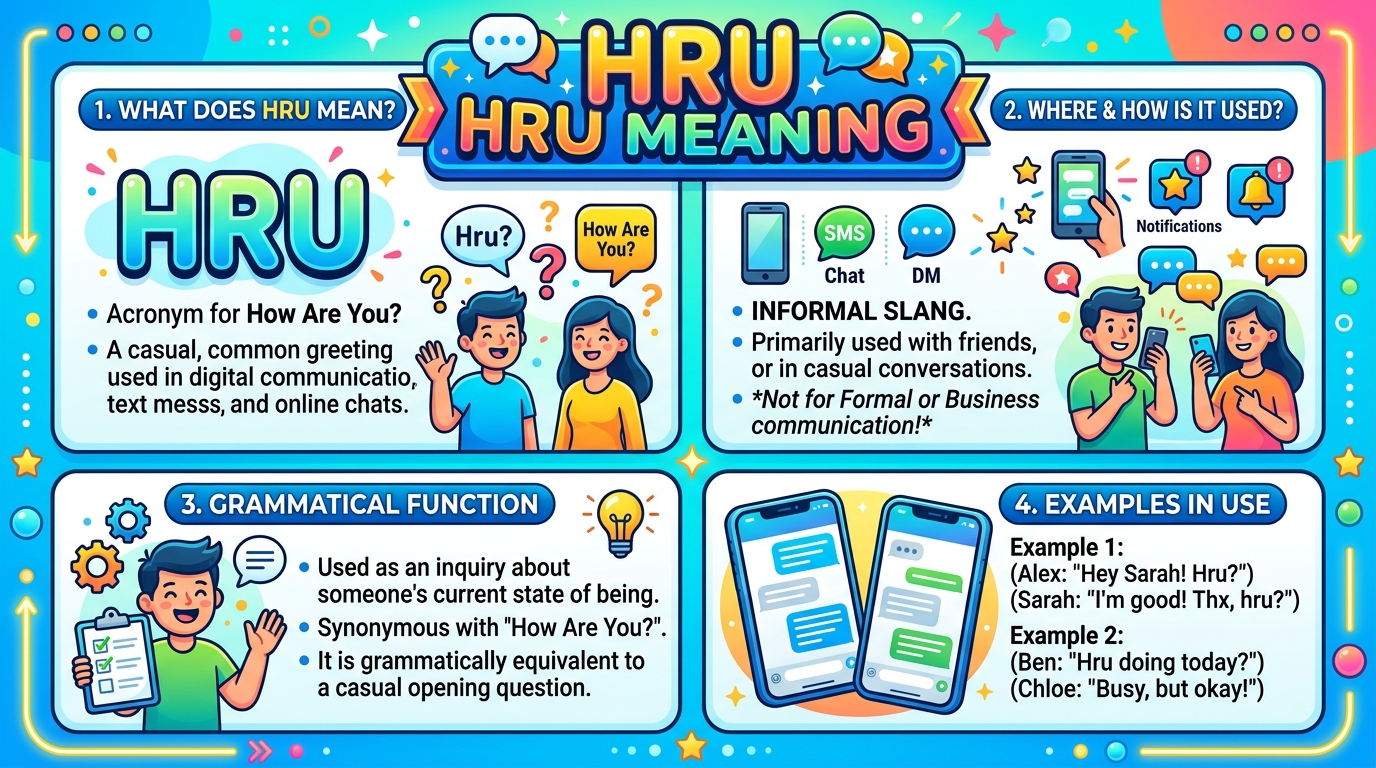
HRU = “How Are You?”
It is a casual abbreviation used in texting and online chats to ask about someone’s well-being.
Simple breakdown:
- HRU → How are you?
- Used in informal conversations
- Common in texting, social media, and gaming chats
Example usage:
- “Hey, HRU today?”
- “HRU? Haven’t heard from you in days.”
- “HRU doing after the exam?”
In most cases, it is a friendly check-in message, not a deep emotional inquiry—unless the context suggests otherwise.
3️⃣ Origin & Background of HRU
The abbreviation HRU emerged during the early internet and SMS era when character limits were strict and typing speed mattered.
Back then:
- Mobile keyboards were slow
- SMS had character limits
- Internet chatrooms encouraged shortcuts
People naturally started shortening common phrases like:
- How are you → HRU
- Be right back → BRB
- See you → CU
Over time, HRU became part of digital communication culture. Even though modern keyboards no longer require shortening words, the habit stuck because it feels quick, casual, and familiar.
On social media platforms like Instagram, Snapchat, and TikTok, HRU evolved further—not just as a question, but as a soft conversation starter, especially among younger users.
4️⃣ Real-Life Conversations Using HRU
💬 WhatsApp Chat
Person A: Hey, HRU?
Person B: I’m good, just tired from work. You?
Person A: Same here, long day!
💬 Instagram DM
Person A: HRU?? Long time no talk
Person B: I’m okay, just been offline a lot lately
Person A: Understandable, hope everything’s good
💬 TikTok Comment Section
User A: HRU everyone after that ending?
User B: Emotionally destroyed 😂
User C: Same, need recovery time
💬 Text Message (Friends)
Person A: HRU these days?
Person B: Better now, finally getting things sorted
Person A: That’s good to hear
These examples show how HRU fits naturally into everyday digital communication without feeling formal or heavy.
5️⃣ Emotional & Psychological Meaning of HRU
On the surface, HRU is simple. But emotionally, it reflects something deeper.
It usually expresses:
- Care in a minimal form
- A desire to reconnect
- Social awareness without pressure
- Light emotional checking-in
People use HRU because modern communication is fast. Instead of writing long emotional messages, they rely on short signals that still carry warmth.
Real-life scenario:
Imagine someone you haven’t spoken to in weeks sends you “HRU?”
That message may feel small, but psychologically, it often signals:
- “I thought about you”
- “I want to reconnect”
- “I’m opening a conversation door”
In a world of busy schedules and short attention spans, HRU becomes a soft emotional bridge.
6️⃣ Usage in Different Contexts
📱 Social Media
Used as:
- Engagement comment
- Casual check-in
- Reaction message
Example: “HRU guys after the episode??”
💬 Friends & Relationships
Used for:
- Checking emotional state
- Starting conversations
- Reconnecting after silence
Example: “HRU? Miss our talks.”
💼 Work / Professional Settings
Rarely used. If used, it feels too casual.
Better alternative:
- “How are you?”
- “Hope you’re doing well.”
🎭 Casual vs Serious Tone
- Casual: Friendly, relaxed, no pressure
- Serious: Can feel out of place or emotionally light for heavy topics
HRU works best when the mood is informal and comfortable.
7️⃣ When NOT to Use HRU
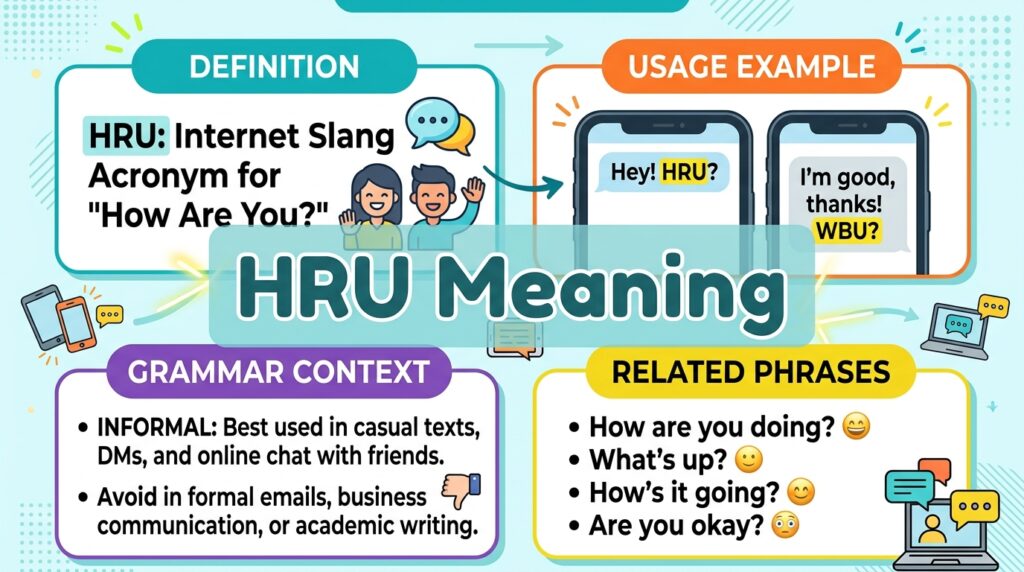
Even though HRU is widely used, it’s not suitable everywhere.
Avoid using it:
- In formal emails
- In job interviews or workplace communication
- During serious emotional conversations
- When someone expects emotional depth
For example, if someone is going through grief or stress, “HRU?” may feel too shallow or disconnected.
In such cases, full sentences show more care:
👉 “How are you feeling today?”
👉 “I hope you’re doing okay.”
8️⃣ Common Misunderstandings About HRU
Many people misinterpret HRU in different ways:
❌ Mistake 1: Thinking it is rude or lazy
It’s not rude—it’s just informal shorthand.
❌ Mistake 2: Assuming it needs a deep answer
Usually, a short reply is expected.
❌ Mistake 3: Overthinking tone
Tone depends on context, not the abbreviation itself.
❌ Mistake 4: Confusing it with sarcasm
HRU is neutral unless paired with emotional context.
9️⃣ Comparison Table
| Term | Meaning Intent | Usage Intent | Example Intent | Comparison Insight |
|---|---|---|---|---|
| HRU meaning | How are you | Casual check-in | HRU today? | Short informal greeting |
| How to use HRU | Application guide | Chat usage | When to text HRU | Focuses on usage rules |
| Examples of HRU | Practical cases | Real conversations | HRU? I miss you | Shows real context |
| HRU vs How are you | Formal vs informal | Tone difference | HRU vs full sentence | HRU is casual, shorter |
Key Insight:
HRU is not just a shortcut—it’s a tone choice. It signals familiarity, speed, and casual connection rather than formal communication.
🔟 Variations / Types of HRU
1. HRU meaning
“How are you?” – basic form
2. HRU in text
Used in chatting for quick check-ins
3. HRU abbreviation
Short form of greeting phrase
4. HRU slang
Informal digital speech
5. HRU in chat
Common messaging shorthand
6. Hruu
Extended playful version
7. Hru bro
Friendly masculine tone
8. Hru tho
Adds curiosity or emotion
9. Hru doing
Slightly more conversational
10. Hru today
Time-specific emotional check-in
1️⃣1️⃣ How to Respond When Someone Says HRU
😊 Casual replies:
- “I’m good, you?”
- “Doing fine!”
- “All good here.”
😂 Funny replies:
- “Still surviving 😄”
- “Running on coffee and hope”
- “Emotionally buffering…”
💬 Mature replies:
- “I’m doing well, thanks for asking.”
- “Things are improving धीरे-धीरे.”
- “Managing things, appreciate you asking.”
❤️ Respectful replies:
- “I’m okay, thank you for checking in.”
- “That’s kind of you, I’m doing fine.”
1️⃣2️⃣ Regional & Cultural Usage
🌍 Western culture
Very common in texting; casual friendliness.
🌏 Asian culture
Used mostly among younger people and online chat users.
🕌 Middle Eastern culture
Less formal use; prefers full greetings in many contexts.
🌐 Global internet usage
Universal shorthand across platforms like Instagram, WhatsApp, TikTok.
👶 Gen Z vs Millennials
- Gen Z: Uses HRU frequently, casually
- Millennials: Understand it but may prefer full phrases
1️⃣3️⃣ Is HRU Safe for Kids?
Yes, HRU is safe for children and teenagers. It is simply a greeting abbreviation with no harmful meaning. However, kids should also learn the full phrase “How are you?” for formal communication skills.
1️⃣4️⃣ FAQs
1. What does HRU mean in chat?
It means “How are you?” used in casual texting.
2. Is HRU rude?
No, it is informal but not rude.
3. Can I use HRU in professional messages?
It is better to avoid it in formal communication.
4. What should I reply to HRU?
You can reply with “I’m good” or ask back “you?”
5. Is HRU still used in 2026?
Yes, especially in social media and texting.
6. Is HRU emotional or casual?
Mostly casual, sometimes emotional depending on context.
7. What is the full form of HRU?
How Are You.
Conclusion
HRU may look like a small digital shortcut, but it represents something very human—connection in a fast-moving world. It’s a simple way of checking in, starting conversations, or quietly showing care without saying too much. Understanding HRU meaning helps you navigate modern texting with confidence and clarity. Whether you reply casually or thoughtfully, what matters most is the intention behind it. In the end, HRU is less about letters and more about staying connected in everyday life.