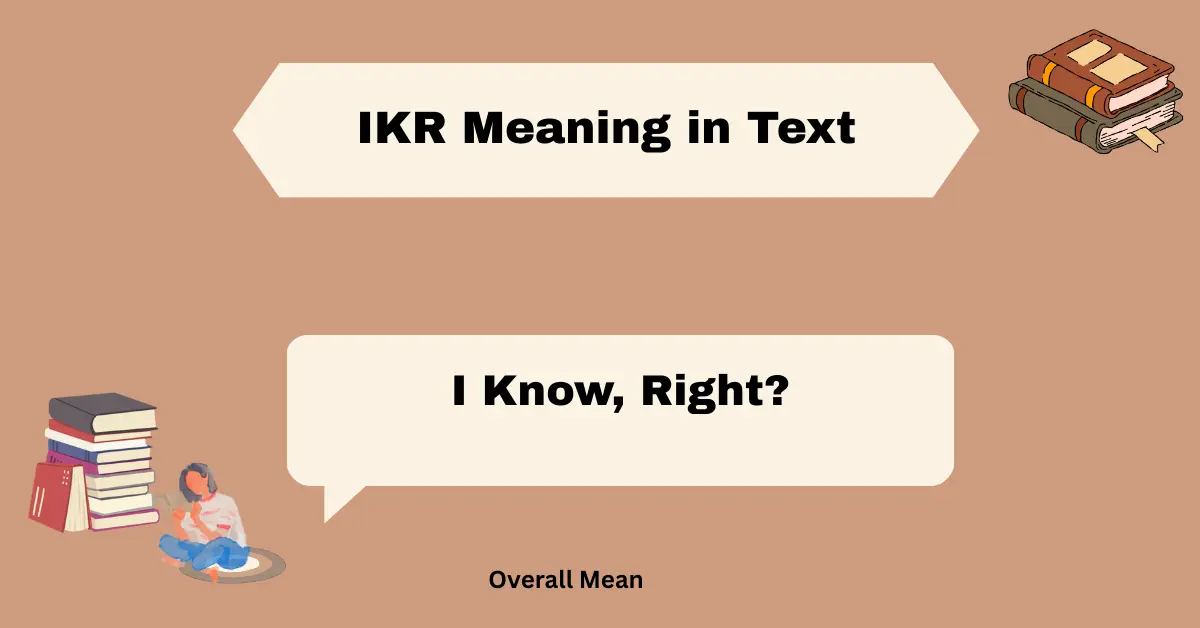
People often search “IKR meaning in text” after seeing the abbreviation in a message, comment, or social media reply and wanting to understand the exact tone behind it. While the phrase looks simple, its meaning can change depending on context, emojis, punctuation, and the relationship between the people chatting.
In texting culture, IKR stands for “I know, right?” and is commonly used to show strong agreement, shared emotions, or mutual understanding. This guide explains what IKR really means, where it came from, how younger generations use it in 2026, and when it sounds friendly, awkward, sarcastic, or unprofessional.
2. What Does “IKR” Mean in Text?
IKR stands for “I Know, Right?”
Literal Meaning
At its core, IKR expresses strong agreement with what the other person just said.
It translates to:
“I completely agree with you”
“Exactly what I was thinking”
“Yes—this is obvious to both of us”
Implied Meaning
Beyond agreement, IKR carries a layer of shared understanding. It signals:
- Mutual validation
- Emotional alignment
- “We’re on the same wavelength”
It often implies:
“I felt this too, and I’m glad you said it.”
When It Does Not Mean What People Assume
IKR does not usually mean:
- Boredom
- Dismissiveness
- Disinterest
Unless paired with dry context or negative punctuation, IKR is not passive-aggressive by default. Misreading happens when people ignore tone markers like emojis, punctuation, or relationship context.
3. Is “IKR” a Slang, Typo, or Intentional Usage?
Slang Usage
Yes—IKR is intentional slang. It is not shorthand caused by laziness or error. It’s a deliberate linguistic choice meant to:
- Save time
- Match conversational rhythm
- Signal informality and closeness
Typing Behavior & Keyboard Influence
IKR became popular because:
- It’s fast to type
- No autocorrect interference
- Easy on mobile keyboards
- Fits one-line replies perfectly
Unlike accidental abbreviations, IKR is consciously selected.
Intentional Stylistic Usage
In digital linguistics, IKR functions as a stance marker—it shows the speaker’s alignment without repeating content.
How to Tell the Difference Using Context
IKR is intentional when:
- It follows an opinion or emotional statement
- It appears as a standalone reply
- It’s paired with emojis or punctuation
If someone meant something else, they wouldn’t use IKR at all.
4. Origin and Evolution of “IKR” in Digital Communication
Early Chat & SMS Influence
IKR emerged in early 2000s:
- SMS character limits
- AIM, MSN Messenger
- Early forum culture
People shortened common conversational phrases to keep chats flowing.
Social Media and Instant Messaging Evolution
IKR gained popularity on:
- Twitter (reaction culture)
- Tumblr (shared emotional validation)
- Instagram and Snapchat replies
It became a reaction phrase, not just a sentence.
How Younger Generations Shaped Usage
Gen Z normalized:
- Minimal replies
- Reaction-based affirmation
- Emotional shorthand
IKR thrived because it fit those habits perfectly.
Why It Still Exists in 2026
Despite voice notes and AI replies, IKR survives because:
- It’s emotionally efficient
- It feels human, not robotic
- It signals connection without effort
Abbreviations persist when they feel natural, not outdated.
5. Real-World Usage Scenarios (Detailed Examples)
a) Casual Friend Conversations
Tone: Friendly, validating, warm
Example:
“This weather is exhausting.”
“IKR 😩”
Meaning: Shared frustration and emotional alignment.
b) Workplace & Professional Chat (Formal vs Informal Teams)
Informal Team Chat:
“These back-to-back meetings are brutal.”
“IKR, no breathing room today.”
Acceptable in relaxed company cultures.
Formal Corporate Setting:
Using IKR alone may feel too casual. Expanded versions work better:
“I know, right—it’s been intense.”
c) Social Media, Gaming, and Online Communities
Social Media Reply:
“This season finale destroyed me.”
“IKR 😭”
Gaming Chat:
“That boss fight was unfair.”
“IKR, insane difficulty spike.”
Here, IKR acts as group bonding language.
6. Emotional Tone and Intent Behind “IKR”
Friendly Tone
- Paired with emojis
- Casual punctuation
- Quick replies
Example:
“IKR 😂”
Neutral Tone
- Plain text
- No emojis
- Informational chats
Example:
“IKR.”
Awkward or Cold Tone
- Delayed response
- No follow-up
- Formal context misuse
How Punctuation and Emojis Change Meaning
- IKR! → enthusiastic
- IKR… → tired or resigned
- IKR 😅 → shared awkwardness
Small signals matter.
7. Cultural and Regional Differences in Usage
Native vs Non-Native English Speakers
Non-native speakers often:
- Understand meaning
- Hesitate to use it
- Fear sounding casual or incorrect
Regional Texting Habits
- US, UK, Canada: very common
- Europe & South Asia: recognized but less used
- Professional Asia-Pacific chats: avoided
Cross-Platform Language Adoption
IKR travels well across:
- Discord
But less in email or formal tools.
8. “IKR” Compared With Similar Texting Terms
| Term | Meaning | Tone | Formality | Best Use |
|---|---|---|---|---|
| IKR | Strong agreement | Friendly | Casual | Texting |
| Exactly | Agreement | Neutral | Semi-formal | Work chat |
| True | Light agreement | Neutral | Flexible | Online |
| Facts | Emphatic | Casual | Informal | Social |
| Same | Shared feeling | Casual | Informal | Friends |
IKR stands out for emotional validation, not just agreement.
9. Common Misunderstandings and Mistakes
Misinterpretation Cases
- Assuming sarcasm when none exists
- Reading coldness without context
Autocorrect and Keyboard Issues
Rare, but “IKR” can confuse older users unfamiliar with slang.
Overuse Problems
Overusing IKR can:
- Sound lazy
- End conversations prematurely
How to Avoid Confusion
- Add a follow-up line
- Use emojis when tone matters
- Match the other person’s style
10. Is “IKR” Polite, Rude, or Unprofessional?
Relationship-Based Analysis
- Friends: polite and affirming
- Colleagues: depends on culture
- Clients: usually avoid
Context-Based Analysis
- Chat apps: fine
- Email: risky
- Presentations: no
Professional Etiquette Guidance
If unsure, expand it:
“I know, right—completely agree.”
11. Expert Linguistic Insight (Text Language in 2026)
Digital language evolves toward:
- Speed
- Emotional efficiency
- Shared shorthand
Abbreviations like IKR persist because:
- They replace entire emotional sentences
- They feel conversational, not lazy
- They mirror spoken reactions
Grammar rules bend when connection is the goal.
12. How and When You Should Use “IKR”
Do’s
- Use with peers
- Use in casual chats
- Match tone and context
Don’ts
- Don’t use with clients
- Don’t use in serious discussions
- Don’t rely on it alone in professional settings
Safer Alternatives
- “I completely agree”
- “Exactly”
- “That’s true”
13. FAQs About “IKR Meaning in Text”
Q1: What does IKR mean in texting?
It means “I know, right?” and shows strong agreement.
Q2: Is IKR rude?
No, it’s usually friendly unless context suggests otherwise.
Q3: Can I use IKR at work?
Only in informal team chats, not formal communication.
Q4: Is IKR sarcasm?
Not by default. Tone depends on context and punctuation.
Q5: Do younger people still use IKR in 2026?
Yes, especially in casual and social messaging.
Q6: Is IKR outdated slang?
No. It remains relevant due to emotional efficiency.
Q7: Can I reply only “IKR”?
Yes, but adding context keeps conversations flowing.
14. Final Summary and Key Takeaways
IKR meaning in text is simple on the surface but rich in nuance. It means “I know, right?”—a phrase that signals agreement, shared emotion, and conversational alignment.
Key takeaways:
- IKR is intentional slang, not a typo
- Tone depends heavily on context, emojis, and relationship
- It’s friendly, not rude, in most casual settings
- Use caution in professional communication
- It remains relevant because it’s emotionally efficient
Used correctly, IKR strengthens digital connection instead of weakening it.