If you recently heard the term “PACU” in a hospital, medical drama, nursing conversation, or surgery update, you are not alone. Many people search for PACU meaning after seeing it written on hospital paperwork or hearing doctors mention it during a stressful moment.
The confusion usually happens because PACU sounds technical and unfamiliar. Some people think it is a machine, while others assume it is a medical condition. In reality, PACU plays a major role in patient recovery and post-surgery care.
Understanding this term can help patients, families, nursing students, and even healthcare workers communicate more confidently. It also removes fear during medical situations because knowing where a loved one is — and what happens there — brings reassurance.
In modern healthcare communication, PACU has become one of the most commonly used hospital abbreviations, especially in surgical settings.
PACU Meaning – Quick Definition
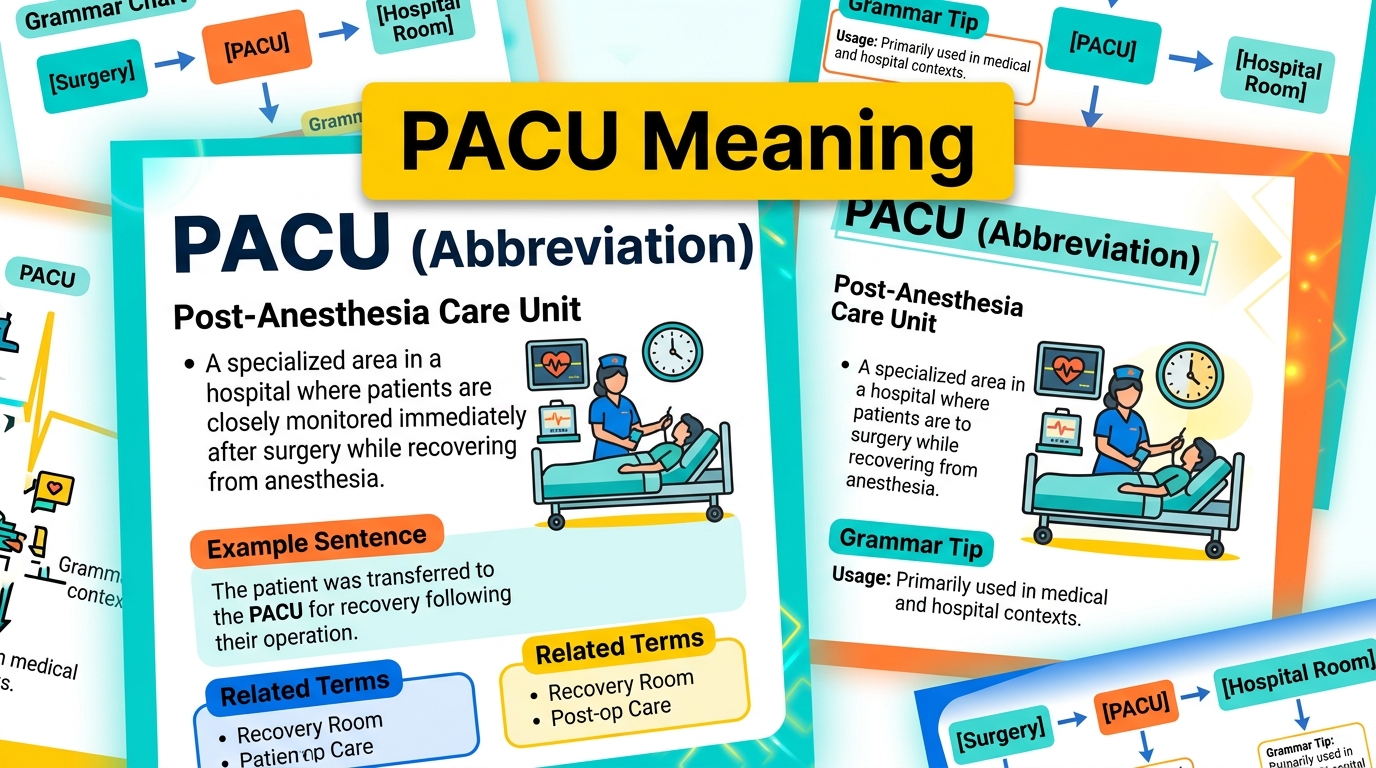
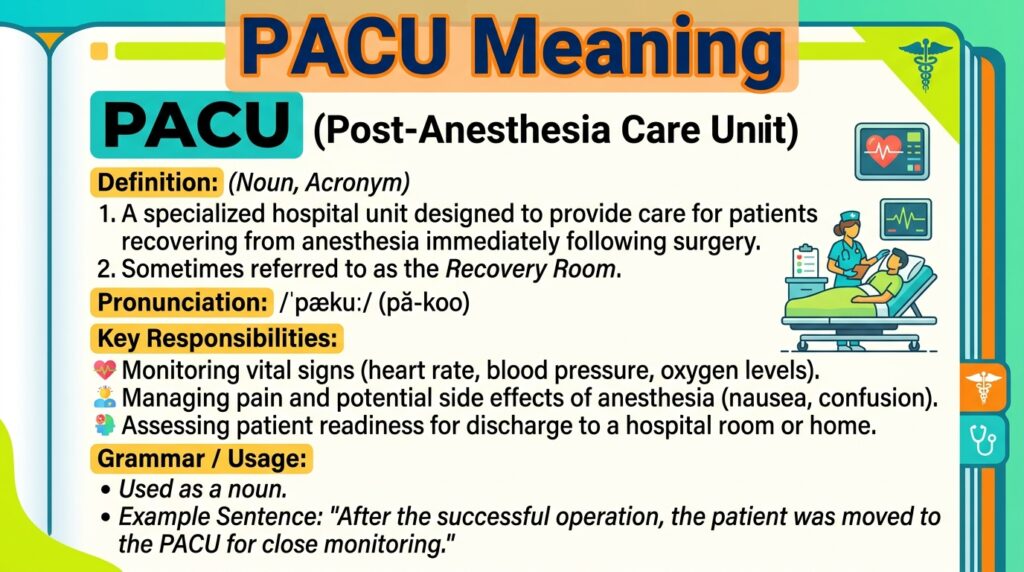
PACU stands for Post-Anesthesia Care Unit.
It is the specialized hospital area where patients recover immediately after surgery or anesthesia.
In simple words:
- Patients are moved to PACU after surgery
- Nurses closely monitor breathing, heart rate, and pain
- It is often called the “recovery room”
- Patients stay there until they are stable and awake
Common examples people hear:
“Your mother is currently in PACU recovering from surgery.”
“The patient stayed in PACU for two hours.”
“PACU nurses are monitoring him closely.”
The term is heavily used in hospitals, nursing education, surgical care, and medical communication.
Origin & Background
The concept behind PACU developed as surgeries became safer and more advanced during the twentieth century. Earlier hospitals often moved patients directly back to regular rooms after operations. Unfortunately, many complications happened during the first hours after anesthesia.
Doctors realized patients needed specialized observation immediately after surgery. This led to the creation of dedicated recovery spaces — eventually known as the Post-Anesthesia Care Unit.
Why PACU became important
Modern anesthesia affects:
- Breathing
- Blood pressure
- Awareness
- Reflexes
- Pain response
Even successful surgeries require careful monitoring afterward.
Over time, PACU evolved into a highly skilled hospital department staffed by specially trained nurses and recovery professionals.
Social media and public awareness
Interestingly, social media has increased awareness of PACU. People now share surgery experiences online using phrases like:
- “Just got out of PACU”
- “PACU nurses are angels”
- “Woke up crying in PACU”
- “First day working in PACU”
TikTok and nursing communities especially helped normalize medical conversations that once stayed inside hospitals.
Real-Life Conversations
WhatsApp Conversation
Person A:
Did the surgery go okay?
Person B:
Yes, thankfully. He’s in PACU right now waking up.
Person A:
That’s a relief. Let me know when they move him to a room.
Instagram DM
Friend 1:
Where are you working now?
Friend 2:
I moved to PACU nursing last month.
Friend 1:
Wow, that sounds intense but rewarding.
TikTok Comments
User 1:
PACU nurses seriously deserve more appreciation.
User 2:
True. Mine comforted me when I woke up scared after surgery.
Text Message
Mom:
Doctor said she’s stable in PACU.
Daughter:
Thank God. I was so worried.
Emotional & Psychological Meaning
Even though PACU is a clinical term, it carries strong emotional weight for many people.
For families, hearing “They’re in PACU” usually means the surgery is finally over. It often brings relief after hours of anxiety.
For patients, PACU can feel confusing, emotional, and vulnerable. People wake up groggy, emotional, or disoriented. Some remember comforting voices. Others remember fear or pain management.
Why people emotionally connect with PACU
PACU represents:
- Safety after uncertainty
- Recovery after surgery
- Human reassurance during vulnerability
- Medical protection during a fragile moment
Many nurses describe PACU as one of the most emotionally sensitive hospital units because patients are physically and mentally exposed.
Personal-style scenario
A patient waking up after emergency surgery may not remember the operation itself, but they often remember the PACU nurse holding their hand and calmly explaining where they are. Small moments like that shape how people emotionally experience healthcare.
PACU Meaning in HVAC
The term PACU can occasionally appear outside healthcare.
In HVAC environments, PACU may refer to specialized Precision Air Conditioning Units used in controlled technical spaces like:
- Server rooms
- Data centers
- Laboratories
- Industrial environments
These units maintain stable temperature and humidity levels.
However, this meaning is much less common than the hospital definition. Most searches for PACU relate to healthcare and surgery recovery.
What Is PACU 1 in Hospital
Many hospitals divide recovery care into phases.
PACU 1 meaning
PACU Phase 1 is the immediate recovery stage after surgery.
During this stage:
- Patients are closely monitored
- Vital signs are checked constantly
- Breathing support may still be needed
- Nurses manage pain and anesthesia effects
Patients remain in PACU 1 until they become medically stable.
This phase is highly intensive because anesthesia-related complications are most likely during early recovery.
PACU vs Recovery Room
People often wonder whether PACU and recovery room mean the same thing.
The answer is mostly yes.
| Term | Meaning |
|---|---|
| PACU | Formal medical term |
| Recovery Room | Common everyday term |
Main difference
“Recovery room” is casual language used by families and patients.
“PACU” is the professional hospital term used by healthcare workers.
Both refer to the area where patients recover after anesthesia and surgery.
PACU Meaning Nursing
In nursing, PACU refers to a specialized recovery-care department requiring advanced observation skills.
PACU nurses typically handle:
- Post-surgery monitoring
- Airway management
- Pain control
- Emergency response
- Emotional reassurance
PACU nursing is considered both technically demanding and emotionally sensitive.
Nurses in this field must react quickly because patient conditions can change rapidly after anesthesia.
Many nursing students view PACU as a respected specialty because it combines critical care skills with direct patient interaction.
PACU Unit
A PACU Unit is the physical hospital department where post-anesthesia care happens.
Inside a PACU Unit, you may find:
- Monitoring machines
- Oxygen equipment
- Recovery beds
- Emergency medications
- Specialized nursing stations
The environment is designed for constant observation and fast medical response.
Unlike regular hospital rooms, PACU units are highly controlled spaces focused on short-term recovery stabilization.
Pacu Meaning in Construction
In construction or engineering discussions, PACU can occasionally refer to project-specific abbreviations depending on the company or region.
However, there is no universally recognized construction meaning as dominant as the medical definition.
Sometimes organizations create internal abbreviations using PACU for:
- Project coordination units
- Portable air conditioning units
- Planning divisions
Because usage varies, context matters heavily in construction-related conversations.
Pacu 2 Meaning
PACU 2, or Phase 2 Recovery, happens after initial stabilization.
During PACU 2:
- Patients become more alert
- Drinking fluids may begin
- Family communication increases
- Discharge instructions are explained
- Patients prepare to go home or move rooms
This stage is calmer than PACU 1.
Many outpatient surgeries move patients through PACU 1 and PACU 2 on the same day.
Pacu Meaning Children’s Hospital
In children’s hospitals, PACU has additional emotional importance because pediatric recovery requires extra reassurance.
Pediatric PACU teams often focus on:
- Comforting frightened children
- Helping parents stay calm
- Monitoring child-specific anesthesia responses
- Reducing emotional distress
Children waking up after surgery may cry, panic, or feel confused. Pediatric PACU nurses are trained to respond gently and patiently.
Parents frequently describe these nurses as emotionally lifesaving during stressful moments.
Usage in Different Contexts
Social Media
People share surgery recovery experiences using PACU in captions, hospital updates, and recovery stories.
Example:
“Finally out of PACU and feeling better.”
Friends & Relationships
Family members often use the term during emotional updates.
Example:
“Dad’s surgery went well. He’s still in PACU.”
Work & Professional Settings
Healthcare workers use PACU formally during patient communication.
Example:
“Transfer the patient from OR to PACU.”
Casual vs Serious Tone
| Tone | Example |
|---|---|
| Casual | “She’s in recovery now.” |
| Professional | “Patient transferred to PACU.” |
When NOT to Use It
Even common medical terms should be used carefully.
Avoid using PACU:
- As a joke during serious medical situations
- Without understanding the context
- In non-medical conversations where people may misunderstand
- To sound medically knowledgeable unnecessarily
Cultural sensitivity matters
Some families become anxious hearing unfamiliar hospital language. In emotional situations, simpler wording like “recovery room” may feel kinder and clearer.
Common Misunderstandings
Mistake 1: Thinking PACU is a disease
It is not a medical condition.
Mistake 2: Assuming PACU means ICU
PACU and ICU are different.
PACU focuses on short-term post-anesthesia recovery, while ICU handles critical intensive care patients.
Mistake 3: Believing PACU always means danger
Being in PACU is normal after surgery.
Most patients pass through it safely every day.
Mistake 4: Confusing PACU with operating rooms
PACU happens after surgery, not during surgery.
Comparison Table
| Topic | Meaning |
|---|---|
| What Does PACU Mean | Post-Anesthesia Care Unit used after surgery |
| How to Use PACU | Used in medical, hospital, and recovery conversations |
| Examples of PACU | “The patient is recovering in PACU.” |
| PACU vs ICU | PACU is temporary recovery; ICU handles critical care |
Key Insight
The word PACU may sound highly technical, but emotionally it represents recovery, protection, and medical transition after surgery. Understanding the term reduces fear and improves communication between healthcare teams and families.
Variations / Types
PACU meaning
Post-Anesthesia Care Unit where patients recover after surgery.
PACU in text
Used in hospital updates and recovery conversations.
PACU abbreviation
Short form of Post-Anesthesia Care Unit.
PACU slang
Healthcare workers sometimes casually call it “recovery.”
PACU in chat
Frequently used in medical group chats and nursing discussions.
PACU nurse meaning
A nurse specializing in post-surgical recovery care.
PACU patient meaning
Someone recovering from anesthesia after surgery.
PACU Phase 1 meaning
Immediate intensive recovery stage after surgery.
PACU Phase 2 meaning
Later recovery stage focused on discharge readiness.
PACU recovery meaning
The monitoring period after anesthesia wears off.
How to Respond When Someone Uses It
Casual replies
- “Glad the surgery went well.”
- “Hope recovery stays smooth.”
Funny replies
- “Looks like the nap finally ended.”
- “Hospital sleep hits differently.”
Mature replies
- “Wishing you a calm and healthy recovery.”
- “Take your time healing.”
Respectful replies
- “I’m happy they’re being monitored carefully.”
- “Sending support for a smooth recovery.”
Regional & Cultural Usage
Western Culture
PACU is widely recognized in hospitals and healthcare systems. Many families understand it through surgery experiences.
Asian Culture
Families often rely heavily on doctors for explanation, so simpler terms like “recovery ward” may be more common.
Middle Eastern Culture
Family-centered medical communication is strong. Relatives usually ask detailed questions about recovery stages, including PACU care.
Global Internet Usage
Social media has made PACU more familiar worldwide through recovery stories and healthcare education content.
Generational Differences
| Generation | Usage Style |
|---|---|
| Gen Z | Learns terms through TikTok and health content |
| Millennials | Familiar through parenting and surgery experiences |
| Older Adults | More likely to say “recovery room” |
Is It Safe for Kids?
Yes. PACU itself is completely safe as a medical recovery environment.
Children may feel scared waking up after surgery, but pediatric PACU teams are trained to support both physical and emotional recovery.
Parents should explain PACU using calm, simple language to reduce fear.
FAQs
Is PACU the same as recovery?
PACU is often called the recovery room, but medically it is more specific. It is the Post-Anesthesia Care Unit where patients are closely monitored after surgery until they stabilize.
What does PACU mean in medical terms?
PACU stands for Post-Anesthesia Care Unit. It is the hospital area where patients recover immediately after surgery and anesthesia under professional monitoring.
What is a PACU in NHS?
In the NHS, PACU is the recovery unit where patients are observed after surgery. Nurses monitor vital signs, manage pain, and ensure safe recovery from anesthesia.
What’s the difference between ICU and PACU?
PACU is for short-term recovery after surgery, while ICU is for critically ill patients needing long-term intensive care. PACU focuses on waking up safely after anesthesia.
How long do patients stay in PACU?
Most patients stay in PACU for 1–3 hours, depending on the type of surgery and how quickly they recover from anesthesia and sedation.
Who works in a PACU unit?
PACU units are staffed mainly by specially trained nurses, anesthesiologists, and recovery staff. They monitor breathing, heart rate, pain levels, and overall stability.
Can family visit patients in PACU?
In most hospitals, family visits in PACU are limited or not allowed. This is because patients need close medical observation during early recovery.
Is PACU only for major surgeries?
No, PACU is used for both minor and major surgeries. Any procedure involving anesthesia may require recovery time in the PACU unit.
Why do patients feel confused in PACU?
Confusion is common because anesthesia takes time to wear off. Patients may feel sleepy, emotional, or disoriented during early recovery.
Is PACU a safe place for patients?
Yes, PACU is designed for safety and close monitoring. Patients are continuously observed to ensure stable breathing, heart rate, and recovery progress.
Conclusion
Understanding PACU meaning helps people feel less overwhelmed during medical experiences. While the term sounds highly clinical, it actually represents one of the most protective stages of healthcare — the moment patients safely transition from surgery toward recovery. Whether you hear it in hospitals, nursing conversations, or family updates, PACU symbolizes monitoring, reassurance, and healing. Knowing what it means allows patients and loved ones to communicate with more confidence, less fear, and greater emotional clarity during stressful medical moments.