If you’ve spent time on BookTok, Instagram book communities, or online reading forums, you’ve probably seen people talking about “smut books.” The phrase appears everywhere—from book reviews and recommendation lists to casual conversations between readers.
Many people search for smut book meaning because they’re unsure whether it refers to romance, adult fiction, erotica, or something entirely different. The term is often used casually online, which can make its meaning confusing for new readers.
Understanding what a smut book is helps readers choose books that match their interests and comfort levels. It also provides insight into modern reading culture, where genres and labels continue to evolve through social media discussions.
In this guide, you’ll learn what smut means, how smut books differ from other genres, where the term originated, and how people use it in everyday conversations.
Smut Book Meaning – Quick Meaning
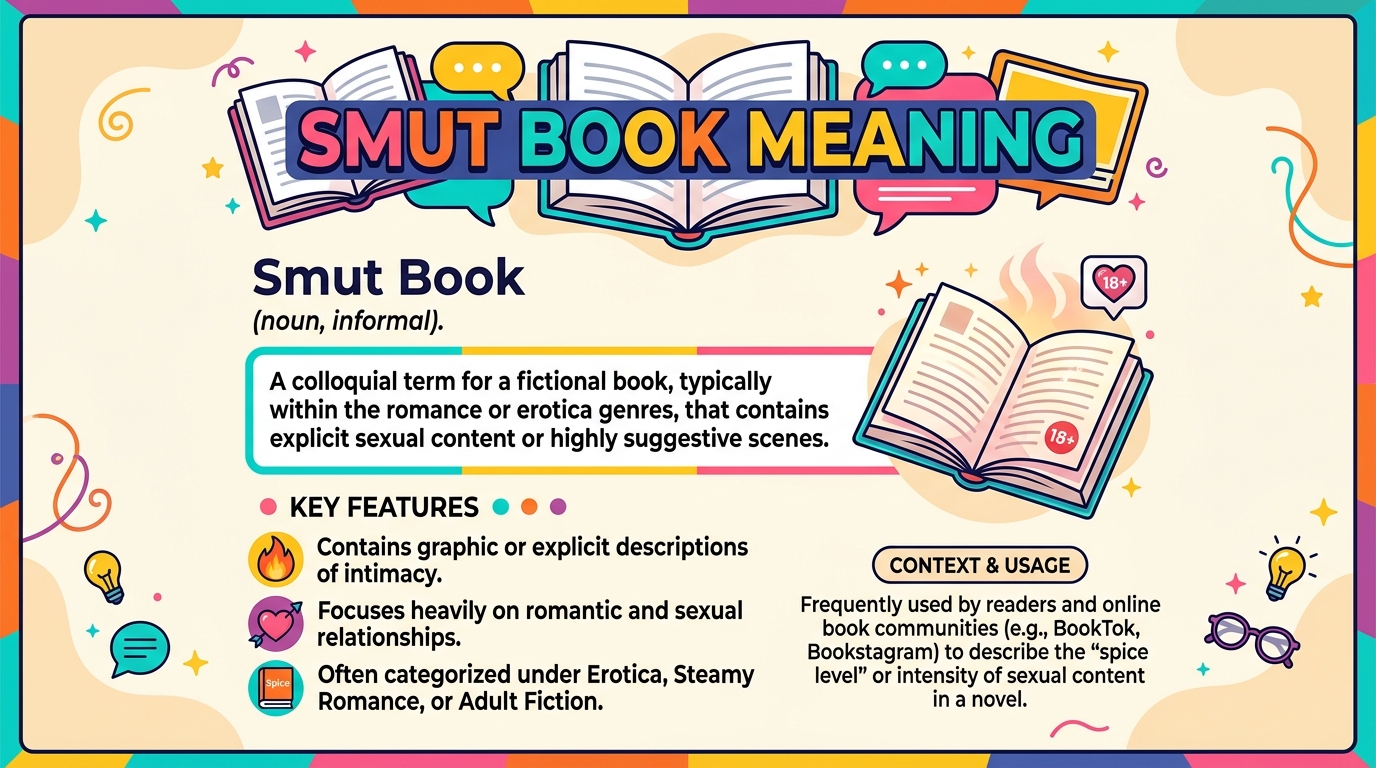
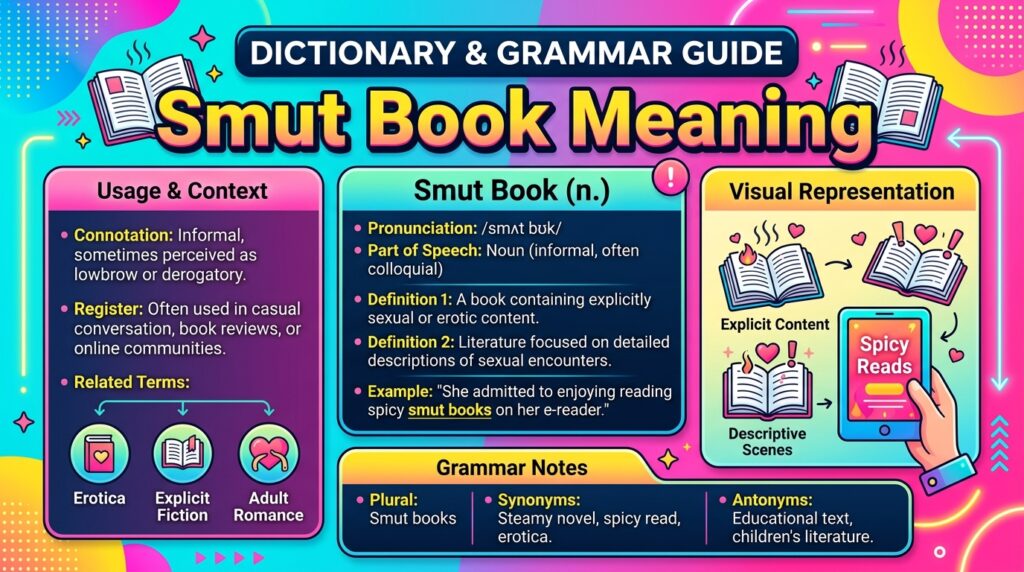
A smut book is generally a novel or story that contains explicit romantic or sexual content. The term is commonly used by readers to describe books where intimate scenes play a significant role in the story.
Simple Definition
A smut book typically includes:
- Detailed romantic scenes
- Explicit sexual content
- Emotional or physical relationship development
- Adult themes intended for mature readers
Quick Examples
“That fantasy novel has amazing world-building and plenty of smut.”
“I wanted a light romance, but the book turned out to be very smutty.”
“BookTok recommended this spicy smut book last week.”
The word is often used informally and can be playful rather than negative.
What Does Smut Mean in Text?
In texting and online conversations, smut usually refers to content that contains sexual or highly romantic themes.
People commonly use it when discussing:
- Books
- Fan fiction
- Online stories
- Movies
- Romance content
Examples in Text Messages
Friend 1: Have you finished that novel yet?
Friend 2: Yes, and wow, the smut was way more intense than I expected.
Person A: Is it romance or fantasy?
Person B: Both. But there’s definitely some smut in it.
In most online conversations, the word carries a casual and humorous tone rather than a judgmental one.
Origin & Background
The word smut has existed in English for centuries.
Originally, it referred to dirt, soot, or stains. Over time, the meaning expanded to describe material considered indecent or obscene.
Historical Evolution
- Early English: dirt or soot
- Later usage: offensive or indecent writing
- Modern usage: sexually explicit content
Cultural Influence
As romance publishing grew, readers began using the term more casually.
Today, social media platforms such as TikTok, Instagram, and reader communities have transformed the word into a popular genre label.
Rather than being used as criticism, many readers now use it affectionately when recommending books.
Smut Book Example
A smut book can appear in many genres.
Examples Include
- Contemporary romance
- Fantasy romance
- Paranormal romance
- Historical romance
- Dark romance
- New adult fiction
For example, a fantasy novel may feature magical kingdoms, political conflicts, and adventurous quests while also including detailed romantic scenes between major characters.
The key difference is that intimacy becomes an important part of the reading experience rather than remaining completely off-page.
Real-Life Conversations
WhatsApp Conversation
Person A: Why is everyone recommending that book?
Person B: Because it’s romantic, emotional, and honestly… pretty smutty.
Person A: Now I’m curious.
Instagram DM
Reader 1: Would you recommend this novel?
Reader 2: Absolutely. Great story and excellent smut scenes.
Reader 1: Adding it to my list.
TikTok Comments
Commenter: Is this book spicy?
Creator: Very spicy. Definitely smut-reader approved.
Commenter: Ordering it tonight.
Text Message
Friend: What are you reading?
Friend: A fantasy romance.
Friend: Any smut?
Friend: Plenty.
Emotional & Psychological Meaning
The popularity of smut books isn’t only about romance or attraction.
Many readers enjoy them because they combine emotional intimacy with character development.
These stories often explore:
- Vulnerability
- Trust
- Desire
- Connection
- Personal growth
A reader might spend hundreds of pages watching two characters overcome challenges before finally becoming romantically involved. That emotional buildup often creates a stronger reading experience.
From a communication perspective, the popularity of smut books reflects a growing openness toward discussing relationships and emotional needs.
Smut Reader Meaning
A smut reader is someone who enjoys reading books that contain explicit romantic or sexual content.
This label is usually self-described and often used humorously.
Characteristics of Smut Readers
- Enjoy romance-focused stories
- Appreciate relationship development
- Read across multiple genres
- Frequently participate in online book communities
Being a smut reader doesn’t necessarily mean someone only reads explicit books. Many readers enjoy a variety of genres while occasionally choosing books with mature romantic themes.
Smut Story Meaning
A smut story is a written narrative that includes explicit romantic or sexual content.
The term may refer to:
- Novels
- Short stories
- Fan fiction
- Online fiction
Some smut stories focus primarily on intimacy, while others combine romance with adventure, fantasy, mystery, or drama.
Smut Book Quotes
Readers often use playful quotes when discussing smut books.
Examples include:
“I came for the plot and stayed for the chemistry.”
“The romance hooked me before the spice did.”
“Every great smut book still needs a great story.”
“Chemistry makes readers stay invested.”
These quotes highlight how readers often value both emotional storytelling and romantic content.
Smut in a Sentence
Here are several examples:
- The novel became popular because of its romance and smut.
- She enjoys fantasy books that include a little smut.
- Many online reviewers openly discuss the smut level of a book.
- The author balanced adventure, suspense, and smut effectively.
- Readers debated whether the story contained too much smut.
Usage in Different Contexts
Social Media
The term appears frequently in:
- TikTok book reviews
- Instagram reading communities
- YouTube recommendations
- Reader forums
Friends & Relationships
Friends often use the term casually when discussing reading preferences.
Example:
“Do you want a sweet romance or something with more smut?”
Work and Professional Settings
The word is generally inappropriate in formal workplace conversations unless discussing literature in a professional context.
Casual vs Serious Tone
Casually, the term is playful.
Formally, people may prefer terms like:
- Erotic fiction
- Adult romance
- Explicit romance
When NOT to Use It
Avoid using the term:
- In professional business communication
- Around young children
- In formal academic settings without context
- With people who may find the topic uncomfortable
Cultural expectations vary, so understanding your audience is important.
Common Misunderstandings
Smut Does Not Always Mean Pornography
Many smut books include strong stories, emotional depth, and complex characters.
All Romance Books Are Not Smut
Many romance novels contain little or no explicit content.
Smut Is Not a Formal Genre
Publishers may classify books as romance, erotica, or adult fiction instead.
“Smut” is primarily reader-created terminology.
Comparison Table
| Search Term | Definition Intent |
|---|---|
| What Does Smut Mean | Understand the basic definition |
| How to Use Smut | Learn proper usage in conversation |
| Examples of Smut | See real-world usage examples |
| Smut vs Romance | Compare explicit content levels |
| Smut vs Erotica | Understand genre differences |
| Smut Book Meaning | Learn the reading-community definition |
Key Insight
The word smut has evolved from a negative description into a widely accepted community term used by readers to discuss explicit romantic content openly and comfortably.
Variations / Types
Smut Meaning
General term for explicit romantic or sexual content.
Smut in Text
Used online to describe mature content.
Smut Abbreviation
No standard abbreviation exists, though readers often use “spicy” as a substitute.
Smut Slang
Modern internet slang for explicit romance content.
Smut in Chat
Used casually in messaging conversations.
Smut Book Meaning
A book containing explicit romantic scenes.
Smut Reader Meaning
Someone who enjoys reading such books.
Smut Story Meaning
A written story featuring mature romantic content.
Smut Fiction Meaning
Fiction that includes explicit intimacy.
Smut Romance Meaning
A romance novel where intimate scenes play a significant role.
How to Respond When Someone Uses It
Casual Replies
- “Sounds interesting.”
- “What book is it?”
- “I’ll add it to my reading list.”
Funny Replies
- “For research purposes, obviously.”
- “My bookshelf is judging me.”
Mature Replies
- “Different readers enjoy different genres.”
- “A good story matters too.”
Respectful Replies
- “Thanks for the recommendation.”
- “I’ll check whether it’s my style.”
Regional & Cultural Usage
Western Culture
The term is widely recognized within online reading communities and book clubs.
Asian Culture
Usage varies by country. Some communities embrace the term openly, while others discuss such content more privately.
Middle Eastern Culture
Conversations about explicit content may be more culturally sensitive and less public.
Global Internet Usage
Social media has created a shared understanding of the term across many countries.
Gen Z vs Millennials
Gen Z: Frequently uses “smut” and “spicy” in online discussions.
Millennials: Often use romance, adult romance, or erotica depending on context.
Smuts Meaning in Biology
Interestingly, smuts have another completely unrelated meaning in biology.
In biological science, smuts are fungal plant diseases caused by certain fungi that infect crops such as corn, wheat, and barley.
This biological definition has nothing to do with books, reading, romance, or internet slang.
Context usually makes the intended meaning obvious.
Is It Safe for Kids?
Generally, smut books are intended for mature audiences because they contain adult themes and explicit romantic content.
Parents and guardians should review age recommendations and content warnings before allowing younger readers access to such material.
Context and maturity level are important factors.
FAQs
What Does Smut Mean in Books?
In books, smut refers to stories that contain explicit romantic or sexual content. These scenes are usually described in detail rather than being implied or skipped. While smut is often associated with romance novels, it can also appear in fantasy, paranormal, historical, and contemporary fiction. Many readers use the term casually to describe books with a high level of “spice” or intimacy.
Why Is Smut Called Smut?
The word smut originally came from an old English term meaning soot, dirt, or a stain. Over time, its meaning evolved and was used to describe material considered indecent or obscene. In modern reading culture, especially online book communities, the term has been reclaimed and is often used playfully to describe books with explicit romantic content rather than as an insult.
What Is the Smuttiest Book to Read?
There is no single book that everyone agrees is the “smuttiest.” The answer depends on personal preferences and comfort levels. However, books in the erotica and dark romance categories are often considered among the most explicit. Readers frequently recommend titles based on how much romance, intimacy, and character chemistry they want in a story.
What Genre Is Smut?
Smut is not technically a standalone publishing genre. Instead, it is a reader-created term used to describe books that contain explicit sexual content. Smut can appear within several genres, including romance, fantasy romance, paranormal romance, contemporary fiction, and erotica. The level of explicit content varies from one book to another.
Is Smut the Same as Erotica?
Not always. Smut is a broad informal term for explicit content, while erotica is a specific literary genre where sexual relationships and intimacy are central to the story. A romance novel can contain smut without being classified as erotica.
Are All Romance Books Smutty?
No. Many romance books focus on emotional connections, relationships, and character growth without including explicit scenes. Some romances are completely “closed-door” or “clean,” while others contain varying levels of intimacy.
What Does “Spicy” Mean in Book Reviews?
“Spicy” is a popular term used by readers to indicate romantic or sexual content in a book. The higher the spice level, the more explicit the scenes are likely to be. Social media platforms often use spice ratings to help readers choose books that match their preferences.
Can Fantasy Books Contain Smut?
Yes. Fantasy romance has become one of the most popular categories featuring smut. These books combine magical worlds, adventure, and character-driven romance with explicit intimate scenes, creating a blend of fantasy and romance storytelling.
Is Smut Appropriate for Teen Readers?
Most smut books are written for adult audiences because they contain mature themes and explicit content. Parents, educators, and readers should check age recommendations and content warnings before selecting a book for younger readers.
Why Do People Enjoy Reading Smut Books?
Readers enjoy smut books for different reasons. Some appreciate the romance and emotional connection between characters, while others enjoy the escapism, character chemistry, and relationship development. For many readers, the appeal comes from the combination of storytelling, emotion, and intimacy rather than the explicit scenes alone.
Conclusion
Understanding the smut book meaning helps readers navigate modern book culture with confidence. While the term once carried a negative association, it has evolved into a widely recognized way of describing books that contain explicit romantic content. From BookTok recommendations to casual conversations among friends, the word is now part of everyday reading vocabulary. Whether you’re curious about the genre, exploring new books, or simply trying to understand online discussions, knowing the context behind the term makes communication easier and helps you choose reading material that matches your interests and comfort level.