If you’ve been scrolling through chats, comments, or even workplace messages, you’ve probably seen “tbf” pop up everywhere. At first glance, it looks confusing—almost like a typo. But in reality, it carries a surprisingly human tone.
Most people search tbf meaning because they feel left out of modern digital language. It shows up in arguments, opinions, and even casual jokes, yet its meaning shifts slightly depending on context. That’s where the confusion starts.
At its core, “tbf” helps people soften opinions, balance arguments, or admit a fair point without sounding harsh. It’s short, but emotionally powerful in conversation.
TBF Meaning – Quick Meaning
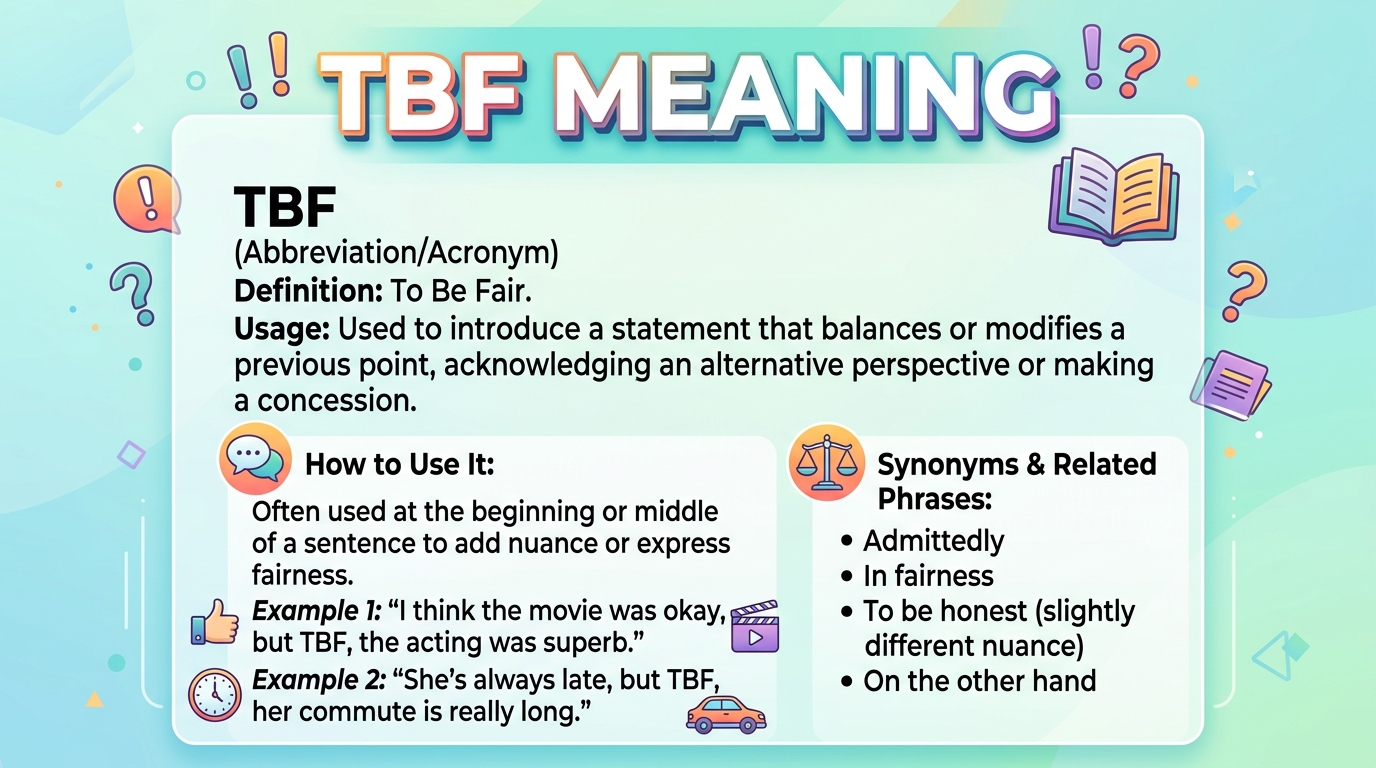
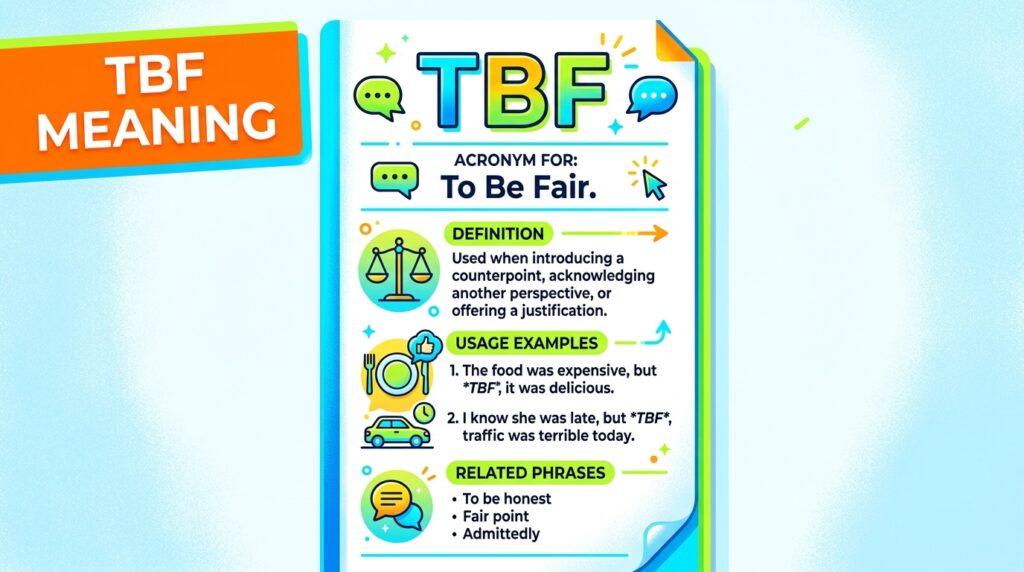
TBF stands for “To Be Fair.”
It is used when someone wants to:
- Present a balanced opinion
- Acknowledge another person’s point
- Soften disagreement
- Add honesty to a statement
Examples:
- “TBF, he did warn us about the delay.”
- “TBF, that movie wasn’t as bad as people say.”
- “TBF, you also forgot to reply.”
It’s a phrase that quietly says: “Let’s be honest here.”
Origin & Background
The phrase “to be fair” has existed in spoken English for decades, but its abbreviation TBF gained momentum with texting culture.
As messaging became faster, people started shortening common phrases. “To be fair” naturally became “tbf” in online conversations, especially in:
- Forums
- Gaming chats
- Social media comment sections
- Text messaging culture
Its popularity exploded with Gen Z communication, where short expressions carry emotional weight and speed matters more than formal grammar.
Interestingly, “tbf” isn’t just about saving time—it reflects how digital communication has become more direct, honest, and emotionally raw.
TBF Meaning in Chat
In chat conversations, tbf meaning in chat is usually used to soften an opinion or add balance.
It often appears when someone is:
- Defending themselves
- Agreeing partially
- Correcting without sounding rude
Example:
Friend A: “You never help in group work.”
Friend B: “TBF, I did most of the research last time.”
In chats, it works like a “softener”—it reduces conflict while still making a point.
It’s not aggressive. It’s diplomatic.
TBF Meaning in English
In standard English, TBF meaning in English is simply:
👉 “To be fair” = used to introduce a balanced or honest statement.
It’s commonly used in speech and writing when someone wants to:
- Show fairness in judgment
- Consider both sides of an argument
- Avoid sounding biased
Example:
“To be fair, she handled the situation better than expected.”
Unlike slang-heavy usage, in formal English it is usually written fully instead of abbreviated.
TBF Meaning in Instagram
On Instagram, tbf meaning in Instagram is heavily tied to opinions, comments, and reactions.
You’ll often see it in:
- Comment debates
- Meme pages
- Story replies
- Caption sarcasm
Example:
“TBF, this outfit is actually fire 🔥”
On Instagram, it often carries emotional honesty mixed with casual humor. People use it to:
- Agree with unpopular opinions
- Defend celebrities or influencers
- Lighten criticism
It feels less formal and more expressive.
TBF Meaning in Business
In professional settings, TBF meaning in business is less common as an abbreviation, but the phrase “to be fair” is widely used in discussions and meetings.
It appears when professionals:
- Balance performance reviews
- Discuss project delays
- Evaluate decisions objectively
Example:
“To be fair, the delay was due to external vendors, not the internal team.”
In business communication, it helps maintain neutrality and professionalism while avoiding blame.
However, in formal documents, people usually avoid abbreviations like “tbf” and use the full phrase instead.
TBF Meaning in Slang
In slang culture, tbf meaning slang is deeply conversational and expressive.
It often signals:
- Honest admission
- Slight disagreement
- Emotional honesty
- Real talk energy
Example:
“TBF, I didn’t even like that restaurant.”
It’s commonly used in:
- Friend groups
- Gaming chats
- TikTok comments
- Meme replies
Slang usage makes conversations feel more real and less filtered.
TBF Meaning in Books
In literature or academic discussions, tbf meaning books is rarely used as an abbreviation.
Instead, writers use the full phrase “to be fair” to:
- Present balanced arguments
- Show analytical thinking
- Add nuance to storytelling
Example in writing:
“To be fair, the character had no other choice.”
In books, it plays a role in:
- Character development
- Narrative fairness
- Ethical reflection
It adds depth rather than casual tone.
TBF Meaning in Football
In sports discussions, especially football, tbf meaning in football is extremely common in fan debates.
Fans use it when analyzing:
- Player performance
- Referee decisions
- Match outcomes
Example:
“TBF, the referee missed that obvious foul.”
It helps fans:
- Defend players
- Accept mixed opinions
- Reduce emotional bias during heated debates
Football conversations are emotional, and “tbf” helps calm extreme reactions.
Real-Life Conversations (MANDATORY)
WhatsApp Chat
Friend A: Bro he didn’t pass the ball on purpose 😤
Friend B: TBF, he had 3 defenders on him
Instagram DM
User A: This influencer is so overrated
User B: TBF, her editing skills are actually in*ane
TikTok Comments
Comment A: This trend is cringe
Comment B: TBF, it’s kinda fun if you don’t take it seriously
Text Message
Person A: You always cancel plans last minute
Person B: TBF, work has been cr*zy this week
Emotional & Psychological Meaning
“TBF” is more than slang—it reflects how people manage conflict in modern communication.
It expresses:
- Fairness
- Emotional balance
- Social awareness
- Reduced aggression in arguments
People use it because it allows them to disagree without creating tension.
Personal-style scenario:
Imagine two friends arguing about a movie. One dislikes it strongly, but instead of attacking the other’s opinion, they say “tbf it had some good scenes.” That small phrase prevents the argument from becoming personal.
It acts like emotional cushioning in digital conversations.
Usage in Different Contexts
Social Media
Used for opinions, jokes, and reactions.
Friends & Relationships
Used to soften disagreements and avoid fights.
Work / Professional Settings
Used in verbal discussions but rarely written as “tbf.”
Casual vs Serious Tone
- Casual: slang-heavy, humorous
- Serious: more reflective, balanced
When NOT to Use It
“TBF” should be avoided when:
- Writing formal reports
- Sending official emails
- Addressing authority figures
- Making sensitive or emotional statements
It may reduce seriousness or professionalism in such cases.
Common Misunderstandings
Many people confuse “tbf” with:
- A sarcastic remark
- A defensive excuse
- A dismissive tone
But its real purpose is balance, not argument.
Another misunderstanding is thinking it always disagrees—it can also agree gently.
Comparison Table
| Concept | Meaning | Usage Intent |
|---|---|---|
| What Does TBF Mean | “To be fair” | Introduces balanced opinion |
| How to Use TBF | In replies or arguments | To soften or justify a point |
| Examples of TBF | Chat, comments, speech | Shows fairness in tone |
| TBF vs TBH | Fairness vs honesty | TBF balances, TBH confesses |
Key Insight:
TBF is not about winning arguments—it’s about making conversations more human and less extreme.
Variations / Types (8–10)
- tbf meaning → To be fair
- tbf in text → Used in messaging for balance
- tbf abbreviation → Short form of “to be fair”
- tbf slang → Casual conversational fairness
- tbf in chat → Soft disagreement tool
- tbf meaning Instagram → Opinion balancing in comments
- tbf meaning football → Fan debate moderation
- tbf meaning business → Neutral professional judgment
- tbf meaning books → Narrative fairness expression
- tbf usage → Introduces honest perspective
How to Respond When Someone Uses It
Casual replies:
- “Yeah, you’re right tbf.”
- “TBF that makes sense.”
Funny replies:
- “TBF, I was just pretending to agree 😭”
- “Okay tbf, you got me there.”
Mature replies:
- “TBF, I understand your point.”
- “Yes, that’s a fair assessment.”
Respectful replies:
- “TBF, I appreciate your honesty.”
- “That’s a fair observation.”
Regional & Cultural Usage
- Western culture: Common in everyday texting and debates
- Asian culture: Used mostly in online English chats
- Middle Eastern culture: Popular in social media English slang
- Global internet: Universally recognized in digital communication
- Gen Z: Very frequent in memes and casual talk
- Millennials: Used but slightly more formal
Is It Safe for Kids?
Yes, “tbf” is safe for kids.
It is simply a neutral expression meaning “to be fair.” It does not contain offensive or inappropriate language, making it suitable for everyday communication.
FAQs
What does TBF mean in slang text?
TBF means “To Be Fair.” It is used in slang to give a balanced opinion or soften a statement in conversations.
Is it TBH or TBF?
They are different. TBH means “To Be Honest,” while TBF means “To Be Fair.” TBH shows honesty, but TBF shows balance.
What does TBF mean in Gen Z?
For Gen Z, TBF is a quick way to agree, disagree, or justify something while keeping the tone casual and less aggressive.
Is TBF “to be frank”?
No, TBF does not mean “to be frank.” That would be TBFK or TBFR in rare informal use, but standard meaning is only “to be fair.”
Where is TBF mostly used?
It is commonly used in texts, Instagram comments, Snapchat chats, TikTok replies, and online gaming conversations.
Is TBF formal or informal?
TBF is informal slang, so it is best used in casual chats rather than professional emails or official documents.
Can TBF be used in arguments?
Yes, it is often used in arguments to calm down emotions and present a fair or balanced point of view.
Does TBF always show disagreement?
No, TBF can also show agreement while adding a fair point, not just disagreement.
Why do people use TBF instead of full sentence?
People use TBF because it is faster, shorter, and fits modern texting style without changing the meaning.
Is TBF still popular in 2026?
Yes, TBF is still widely used in Gen Z and online communication because it stays relevant in quick digital conversations.
Conclusion
“TBF” may look like a small abbreviation, but it plays a big role in how people communicate today. It brings balance, fairness, and emotional softness into conversations that could otherwise become harsh or one-sided. Whether in chats, social media, or even casual debates, it helps people express honesty without conflict. Understanding its meaning makes digital communication smoother and more human. Once you start noticing it, you’ll see how often it quietly shapes everyday conversations.