If you’ve ever received a quick “tysm” in a message and paused for a second, you’re not alone. In today’s fast-moving digital world, short forms dominate how we communicate. But behind these tiny abbreviations are real emotions, intentions, and sometimes even confusion.
“TYSM” is one of those expressions people use daily—yet many aren’t completely sure how strong, sincere, or appropriate it actually is. Is it casual? Is it heartfelt? Or is it just another lazy shortcut?
This guide clears that confusion. You’ll understand not just what “tysm” means, but how it feels, when it works, and when it doesn’t.
TYSM Meaning – Quick Explanation
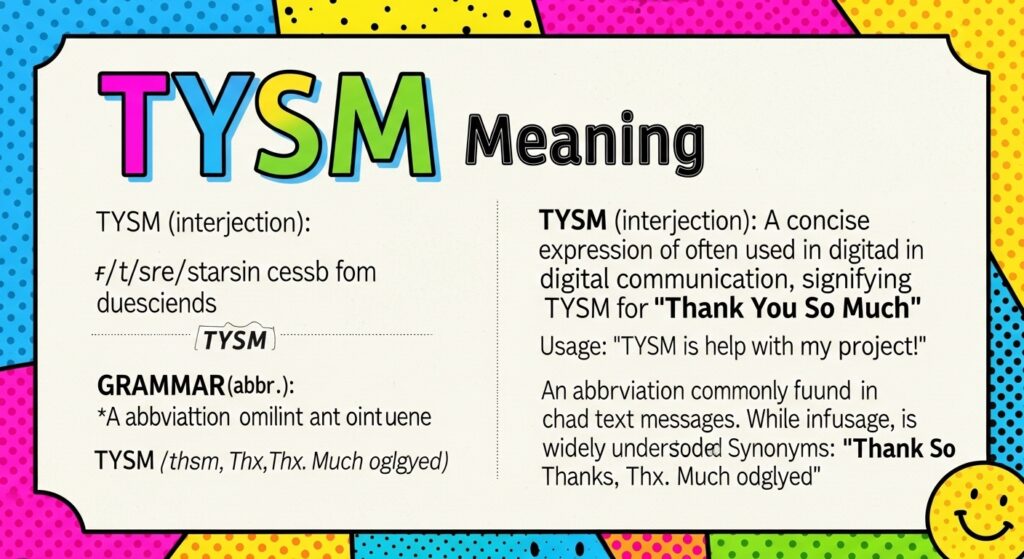
TYSM stands for:
👉 “Thank You So Much”
It’s a quick, informal way to express gratitude in digital conversations.
What it usually conveys:
- Appreciation
- Warmth
- Relief
- Gratitude (often slightly emotional)
Simple examples:
“tysm for helping me today!”
“I got the notes tysm!”
“tysm, you saved me honestly”
Even though it’s short, it often carries genuine feeling—especially in casual chats.
Origin & Background
“TYSM” didn’t come from formal language—it grew naturally from texting culture.
In the early days of SMS messaging, character limits pushed people to shorten phrases. “Thank you so much” became “TYSM” simply because it was faster.
But its real rise came with platforms like:
- Snapchat
- TikTok
As communication became more instant, people preferred quick emotional expressions. Over time, “tysm” evolved from just a shortcut into a tone marker—something that signals friendliness and appreciation without sounding overly formal.
Interestingly, its meaning hasn’t changed much—but its emotional weight depends heavily on context.
Real-Life Conversations
Here’s how “tysm” actually shows up in everyday chats:
WhatsApp Chat
Person A: Can you send me yesterday’s lecture notes?
Person B: Just sent
Person A: tysm 😭 I was stressed
Instagram DMs
Person A: Your recommendation was amazing
Person B: I’m glad you liked it
Person A: tysm!! 💛
TikTok Comments
User 1: What song is this?
User 2: It’s “Golden Hour”
User 1: tysm!!!
Text Message
Person A: I covered your shift today
Person B: Wait really? tysm, I owe you one
These examples show something important:
“tysm” isn’t just about saying thanks—it often carries relief, excitement, or emotional support.
Emotional & Psychological Meaning
At its core, “tysm” is about connection.
People use it because:
- It feels quick but still warm
- It softens conversations
- It adds a human touch to digital messages
In a world where messages can feel cold or transactional, “tysm” acts like a small emotional signal: “I appreciate you.”
A real-life style scenario
You’re overwhelmed, maybe juggling studies or work. Someone helps you unexpectedly—shares notes, gives advice, or simply shows up.
You don’t type a long paragraph. You just send:
“tysm, that really helped.”
It’s short—but the feeling behind it is real.
That’s the power of modern communication. It’s not always about length—it’s about intent.
Usage in Different Contexts
1. Social Media
Common and widely accepted. Often paired with emojis:
- “tysm 🫶”
- “tysm!!!”
2. Friends & Relationships
Very natural. Shows warmth without being overly serious.
3. Work / Professional Settings
Use cautiously. It may feel too casual.
Instead of:
- “tysm for the report”
Better:
- “Thank you for the report, I appreciate it.”
4. Casual vs Serious Tone
- Casual: “tysm” works perfectly
- Serious: Full phrase is more appropriate
When NOT to Use It
There are moments where “tysm” can feel out of place:
- Formal emails
- Job applications
- Academic communication
- Sensitive situations (e.g., condolences)
Also, in some cultures, shortening gratitude may seem less respectful, especially with elders or authority figures.
Common Misunderstandings
1. It’s always sincere
Not always. Sometimes it’s used quickly without deep emotion.
2. It’s universally appropriate
Context matters. What works in a chat may not work in an email.
3. It replaces proper gratitude
It doesn’t always. Sometimes a full “thank you” feels more meaningful.
4. Tone confusion
“tysm.” vs “tysm!!!” can feel very different:
- “tysm.” → neutral
- “tysm!!!” → excited, emotional
Comparison Table
| Expression | Meaning | Tone | Usage |
|---|---|---|---|
| TYSM | Thank you so much | Warm, casual | Chats, social media |
| Thanks | Basic gratitude | Neutral | Universal |
| Thx | Short thanks | Casual, sometimes lazy | Informal chats |
| Much appreciated | Polite gratitude | Semi-formal | Work contexts |
| No thanks | Opposite meaning | Polite refusal | General use |
Key Insight
“TYSM” sits in a unique space—it’s more emotional than “thx” but less formal than “thank you so much.” That balance is why it’s so popular.
Variations / Types
Here are common variations people use:
- TY – Simple “thank you”
- THX – Casual thanks
- TYVM – Thank you very much
- TYSMMM – Extra emotional emphasis
- TYSM!!! – Excited gratitude
- TYSM 🥺 – Emotional, soft tone
- TYSM ❤️ – Warm, affectionate
- TYSM bro – Friendly appreciation
- TYSM 🙏 – Respectful tone
- TYSM lol – Light, playful thanks
Each version subtly changes the feeling behind the message.
How to Respond When Someone Uses It
Casual Replies
- “No problem!”
- “Anytime!”
Funny Replies
- “You owe me snacks now 😄”
- “I accept payment in pizza”
Mature Replies
- “Glad I could help.”
- “Happy to support you.”
Respectful Replies
- “You’re welcome, take care.”
- “Always here if you need help.”
Regional & Cultural Usage
Western Culture
Very common. Seen as friendly and normal.
Asian Culture
Used among peers, but less in formal or hierarchical settings.
Middle Eastern Culture
Gratitude is often expressed more fully, so abbreviations may feel too casual in serious contexts.
Global Internet Usage
“TYSM” is widely understood across platforms regardless of language barriers.
Generational Differences
- Gen Z: Uses it frequently, often with emojis
- Millennials: Use it, but slightly more selectively
Is It Safe for Kids?
Yes, “tysm” is completely safe.
It’s a positive expression that encourages gratitude. However, it’s helpful to teach kids when to use full phrases—especially in formal or respectful situations.
FAQs
1. Does TYSM mean thank you so much?
Yes, it’s a direct abbreviation of that phrase.
2. Is TYSM rude?
No, but it can feel too casual in formal situations.
3. Can I use TYSM in emails?
Better to avoid it in professional emails.
4. Is TYSM sincere?
It can be very sincere—context and tone matter.
5. What’s the difference between TY and TYSM?
“TY” is basic thanks, while “TYSM” adds stronger appreciation.
6. Why do people use TYSM instead of full words?
It’s faster and fits modern digital communication habits.
7. Can TYSM be sarcastic?
Rarely, but tone and context can make any phrase sarcastic.
Conclusion
“TYSM” may look small, but it carries a surprisingly human touch. It reflects how communication has evolved—faster, lighter, but still emotional at its core.
Used in the right context, it feels warm, genuine, and effortless. Used in the wrong place, it can seem rushed or informal.
The key is awareness.
Know your audience, understand the moment, and choose your words accordingly.
Because even in a world of shortcuts, meaning still matters.
Discover more posts:
- RCBO Full Form Explained: Meaning, Uses & 10 Language Guide
- CC Full Form in Bike: Meaning, Engine Capacity & Complete Guide (2026)
- DAP Full Form: All Meanings in Chat, Trade, and 10 Languages (2026 Guide)
- AVP Full Form: Meaning, Uses, and Global Translations in 10 Languages
- What is the Full Form of UPSC? Meaning, Exam & 2026 Details