If you spend time on TikTok, Instagram, WhatsApp chats, or even real-life conversations in Muslim communities, you’ve probably heard someone say “wallahi” with serious emotion.
At first, it sounds simple. But it often carries deep weight.
People search “wallahi meaning” because they hear it in moments of honesty, anger, jokes, or even exaggeration—and they get confused about what it truly signals.
Is it just slang?
Is it religious?
Or is it something deeper tied to truth and trust?
The answer sits somewhere in between language, culture, and belief. This article breaks it all down in a simple, real-world way so you can understand exactly how and when it is used.
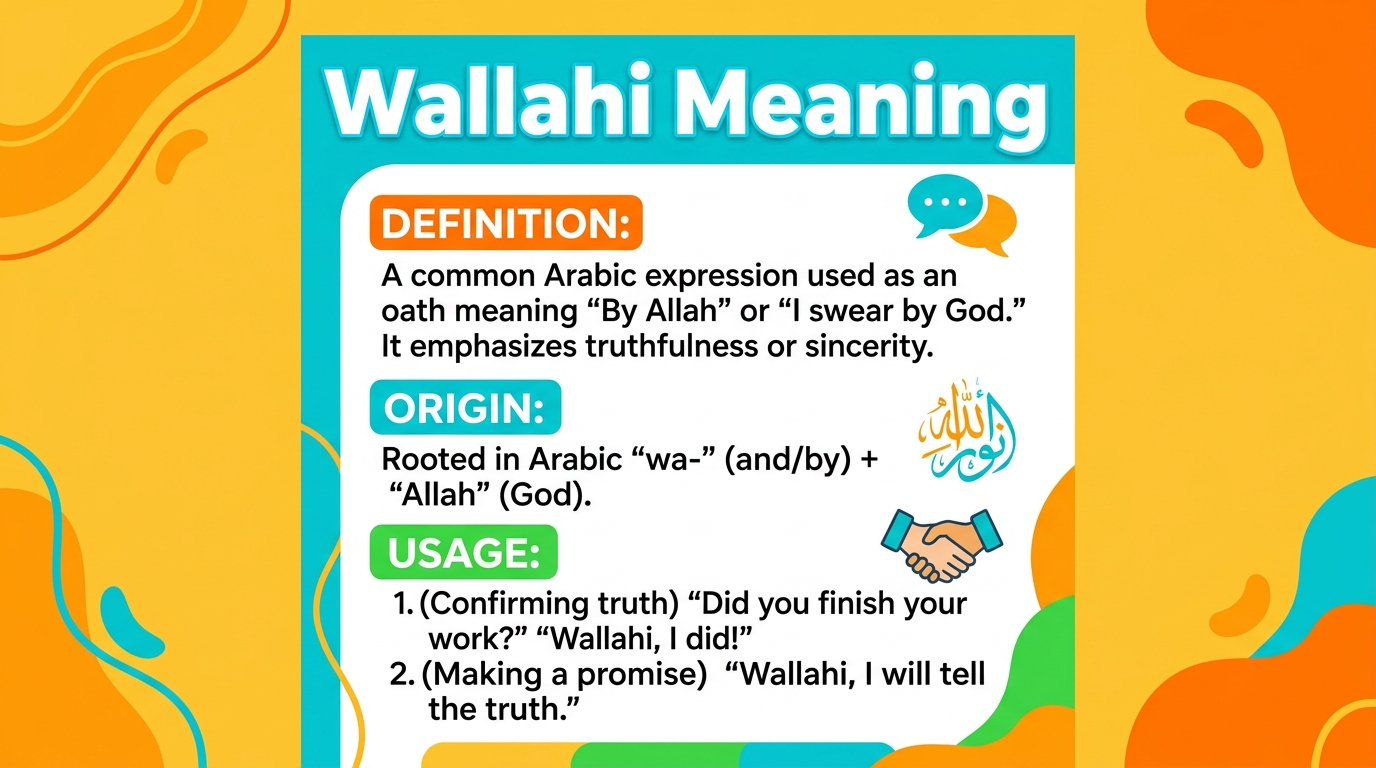
Wallahi Meaning – Quick Meaning
The word “wallahi” comes from Arabic and is commonly used by Muslims worldwide.
Simple meaning:
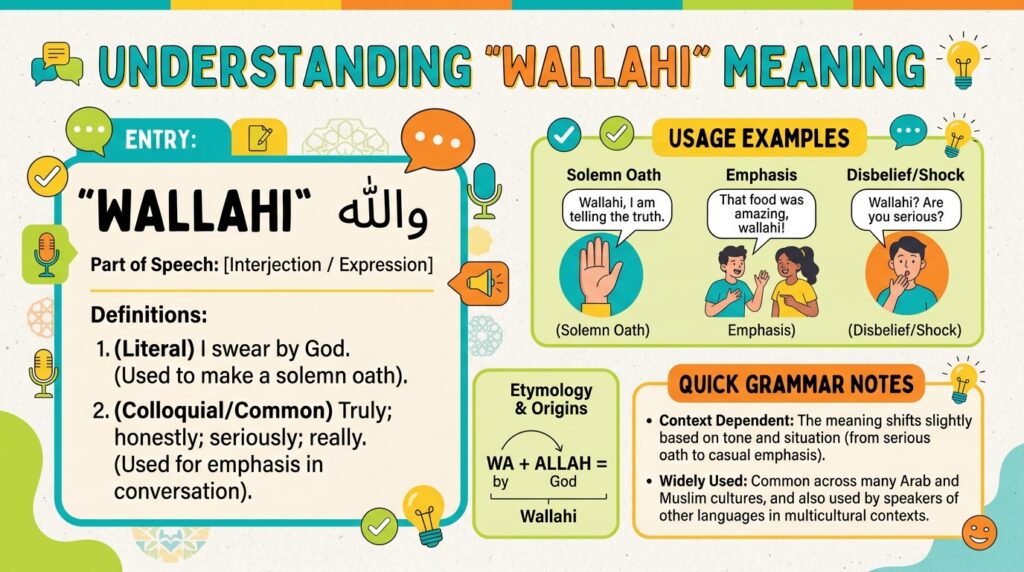
“Wallahi” means “I swear by Allah” or “I swear to God.”
It is used to strongly emphasize truthfulness.
Core idea:
- A serious promise of honesty
- A way to prove sincerity
- A strong emotional expression
Examples:
- “Wallahi, I didn’t take your phone.”
- “Wallahi, I’m telling the truth.”
- “Wallahi, this is the best day of my life.”
It is not just a word—it is a verbal oath tied to faith and truth.
Origin & Background
The term “wallahi” comes from classical Arabic:
- “Wallah” = By Allah (God)
- “-i” = emphasis in pronunciation
So “wallahi” literally strengthens the oath.
In Islamic tradition, swearing by Allah is considered a serious statement. It is meant to confirm honesty and sincerity, not to be used casually or falsely.
Over time, the word spread beyond Arabic-speaking regions due to:
- Islamic culture and education
- Migration and global Muslim communities
- Social media and online slang evolution
Today, even non-Arab Muslims use it naturally in daily speech.
On platforms like TikTok and Instagram, it has also evolved into a casual emotional expression—sometimes serious, sometimes playful depending on tone.
Wallahi Meaning in Islam
In Islam, “wallahi” carries spiritual weight.
It is not just slang—it is an oath.
Islamic perspective:
- Swearing by Allah is serious
- It should only be used when speaking truth
- Lying after saying “wallahi” is considered sinful
- It reflects accountability before God
Muslim teachings emphasize honesty, so using “wallahi” casually without truth can weaken trust.
Key understanding:
It is not forbidden to say it, but it should not be misused or repeated carelessly.
In short, it reflects a deep commitment to truthfulness in Islamic culture.
Say wallahi meaning Speed
When people say “say wallahi” in conversations, especially online, it means:
👉 “Are you telling the truth? Swear it.”
Meaning of “speed” context (fast reaction usage):
In fast texting or heated chats, “say wallahi” is used quickly when someone is shocked or doubts a statement.
Examples:
- “I got 100% in the exam.”
“Say wallahi!” - “He left the job today.”
“Say wallahi bro?”
It adds urgency and emotional pressure to confirm truth instantly.
Say wallahi meaning meme
On social media, “say wallahi” has become a meme phrase.
It is often used humorously when someone says something unbelievable.
Meme usage:
- Exaggerated reactions
- Funny disbelief
- Fake shock comments
Example:
Post: “I studied 10 minutes and passed.”
Comment: “Say wallahi 💀”
Here, it’s not religious—it’s playful disbelief.
This shift shows how language evolves from serious meaning to internet humor.
Wallahi meaning vs wallah
Many people confuse “wallahi” and “wallah.”
Difference:
| Term | Meaning | Usage |
|---|---|---|
| Wallahi | I swear by Allah | Strong, complete oath |
| Wallah | By God / I swear | Shortened informal version |
Key difference:
- “Wallahi” = more formal and intense
- “Wallah” = casual or slang version
In short:
“Wallahi” carries more emotional and religious weight.
Say wallahi bro Say wallahi Meaning
When someone says “say wallahi bro”, it usually reflects:
- Shock
- Doubt
- Emotional disbelief
Example conversation:
Friend A: “I met a celebrity today.”
Friend B: “Say wallahi bro!”
It means:
👉 “I can’t believe you. Prove it’s true.”
It strengthens emotional reaction in friendship communication.
Wallahi meaning in Hindi
In Hindi-Urdu speaking regions, “wallahi” is understood as:
👉 “Main Allah ki kasam khata hoon” (I swear by God)
Simple explanation:
- Used in informal Urdu/Hindi conversations
- Common among South Asian Muslim youth
- Expresses honesty or emotional emphasis
Example:
“Wallahi, maine kuch nahi kiya.”
(“I swear I didn’t do anything.”)
It blends Arabic origin with local language expression.
Allah wallahi meaning
The phrase “Allah wallahi” is often used for extra emphasis.
Meaning:
It strengthens the oath:
👉 “I swear by Allah” (with deep seriousness)
Emotional tone:
- Strong belief
- Deep frustration or honesty
- Urgent emotional expression
Example:
“Allah wallahi, I told you the truth!”
It is rarely used casually because of its intensity.
Does wallahi mean on God?
Yes, in English interpretation:
👉 “Wallahi” is equivalent to “I swear to God.”
However, there is a cultural difference:
- In English, “on God” is often slang
- In Arabic/Islamic context, it is a sacred oath
So while the translation matches, the emotional and religious weight is stronger in “wallahi.”
Real-Life Conversations (MANDATORY)
WhatsApp Chat
Friend A: I saw your brother at the mall yesterday.
Friend B: Wallahi? Are you sure?
Friend A: Yes bro, he was with someone else.
Instagram DM
User 1: I just got verified on my page.
User 2: Say wallahi 😭
User 1: Wallahi I’m serious.
TikTok Comment Section
Creator: I quit my job to start content creation.
Comment: Say wallahi bro 💀
Creator: Wallahi, I did.
Text Message
Friend A: I think she likes you.
Friend B: Wallahi? Don’t joke like that man.
Emotional & Psychological Meaning
“Wallahi” is not just a word. It is an emotional anchor.
People use it because:
- It builds trust instantly
- It adds emotional seriousness
- It reduces doubt in conversations
- It strengthens storytelling
Psychological insight:
When someone says “wallahi,” they are not only communicating facts—they are trying to control belief and trust.
Real-life scenario:
Imagine someone defending themselves in an argument. Instead of long explanations, they say “wallahi I didn’t do it.” It instantly shifts emotional pressure in their favor.
Usage in Different Contexts
Social media
Used for humor, memes, exaggeration, and reactions.
Friends & relationships
Used to prove honesty or emotional truth.
Work / professional settings
Rarely used; may feel too informal or emotional.
Casual vs serious tone
- Casual: jokes, memes
- Serious: promises, truth confirmation
When NOT to Use It
- In formal business meetings
- In legal or official documents
- When unsure about truth (avoid false oaths)
- In cultures where religious expressions may be misunderstood
Respect matters when using such a meaningful phrase.
Common Misunderstandings
Many people think:
- It is just slang → but it has religious roots
- It is casual → but it can be a serious oath
- It can be used freely → but misuse reduces its meaning
Another confusion is tone:
Sometimes “wallahi” is joking online, but serious in real life.
Comparison Table
| Term | Meaning Intent | Usage Intent | Example Intent | Comparison Intent |
|---|---|---|---|---|
| Wallahi | Swear by God | Serious truth | Wallahi I’m honest | Strongest oath form |
| Wallah | I swear | Casual truth | Wallah it’s true | Lighter version |
| Say wallahi | Confirm truth | Challenge statement | Say wallahi bro | Doubt expression |
| Allah wallahi | Strong oath | Emotional truth | Allah wallahi I did | Intense emphasis |
Key Insight
All variations center around truth, but emotional intensity changes based on context and culture.
Variations / Types
- Wallahi meaning – Core oath meaning
- Wallahi in text – Used in chats for emphasis
- Wallahi abbreviation – Shortened from “Wallah Allah”
- Wallahi slang – Casual online usage
- Wallahi in chat – Emotional confirmation
- Say wallahi meaning – Request for truth confirmation
- Wallahi bro meaning – Friendship-based disbelief
- Allah wallahi meaning – Strong emotional oath
- Wallah vs wallahi – Intensity comparison
- Wallahi meme meaning – Humorous internet usage
How to Respond When Someone Uses It
Casual replies
- “I believe you.”
- “Okay, I trust you.”
Funny replies
- “Don’t wallahi me like that 😂”
- “Bro swearing too much today 💀”
Mature replies
- “I understand, no need to swear.”
- “I trust your word.”
Respectful replies
- “May Allah keep your words truthful.”
- “I appreciate your honesty.”
Regional & Cultural Usage
Western culture
Often misunderstood as slang or meme.
Asian culture
Used widely in Muslim communities, especially South Asia.
Middle Eastern culture
Used as a serious oath with religious weight.
Global internet usage
Mixed usage—serious + humorous.
Gen Z vs Millennials
- Gen Z: meme-heavy, casual use
- Millennials: more traditional and respectful usage
Is It Safe for Kids?
Yes, but with guidance.
Kids may hear it online, but they should understand:
- It is a promise of truth
- It should not be used as a joke
- It carries cultural and religious meaning
FAQs
What does “wallahi” slang mean?
“Wallahi” slang means “I swear to God” and is used to strongly emphasize that someone is telling the truth. Online, it is often used for both serious promises and funny reactions.
Is it haram to sleep without a bra?
No, it is not haram to sleep without a bra. In Islam, modesty rules mainly apply in public or in front of non-mahram people. Comfort during sleep is completely allowed.
Can Muslims eat bananas?
Yes, Muslims can eat bananas. They are halal and completely permissible, as long as the food itself is not mixed with haram ingredients.
Why do Muslims always say “wallahi”?
Muslims often say “wallahi” to emphasize honesty and truthfulness, as it means “I swear by Allah.” It reflects sincerity in speech and cultural communication habits.
Is “wallahi” a serious word?
Yes, it can be serious. In Islamic context, it is an oath, so it should not be used for lying or casual false claims.
Can “wallahi” be used in jokes?
Yes, but only in informal online or friendly contexts. In serious or religious settings, it should be used with respect and honesty.
What is the difference between “wallah” and “wallahi”?
“Wallahi” is a stronger and more formal oath, while “wallah” is a shorter, more casual version often used in everyday speech.
Is saying “wallahi” necessary in Islam?
No, it is not necessary. Muslims can speak truth without swearing. It is only used for emphasis, not as a requirement.
What does “say wallahi” mean in chat?
It means “prove it’s true” or “swear you are telling the truth.” It is commonly used in conversations when someone is surprised or doubtful.
Is it okay to say “wallahi” too much?
It is better not to overuse it. In Islam, oaths should be taken seriously, so frequent casual use may reduce its meaningful impact.
Conclusion
Wallahi is more than just a word you see online. It carries truth, emotion, and cultural depth rooted in Arabic and Islamic tradition. From serious promises to playful memes, its meaning shifts with tone and context. Yet its core remains unchanged: a strong declaration of honesty. Understanding wallahi helps you read conversations better and respond with respect. Whether used seriously or casually, it reflects trust, belief, and human emotion in modern digital communication today across cultures worldwide.