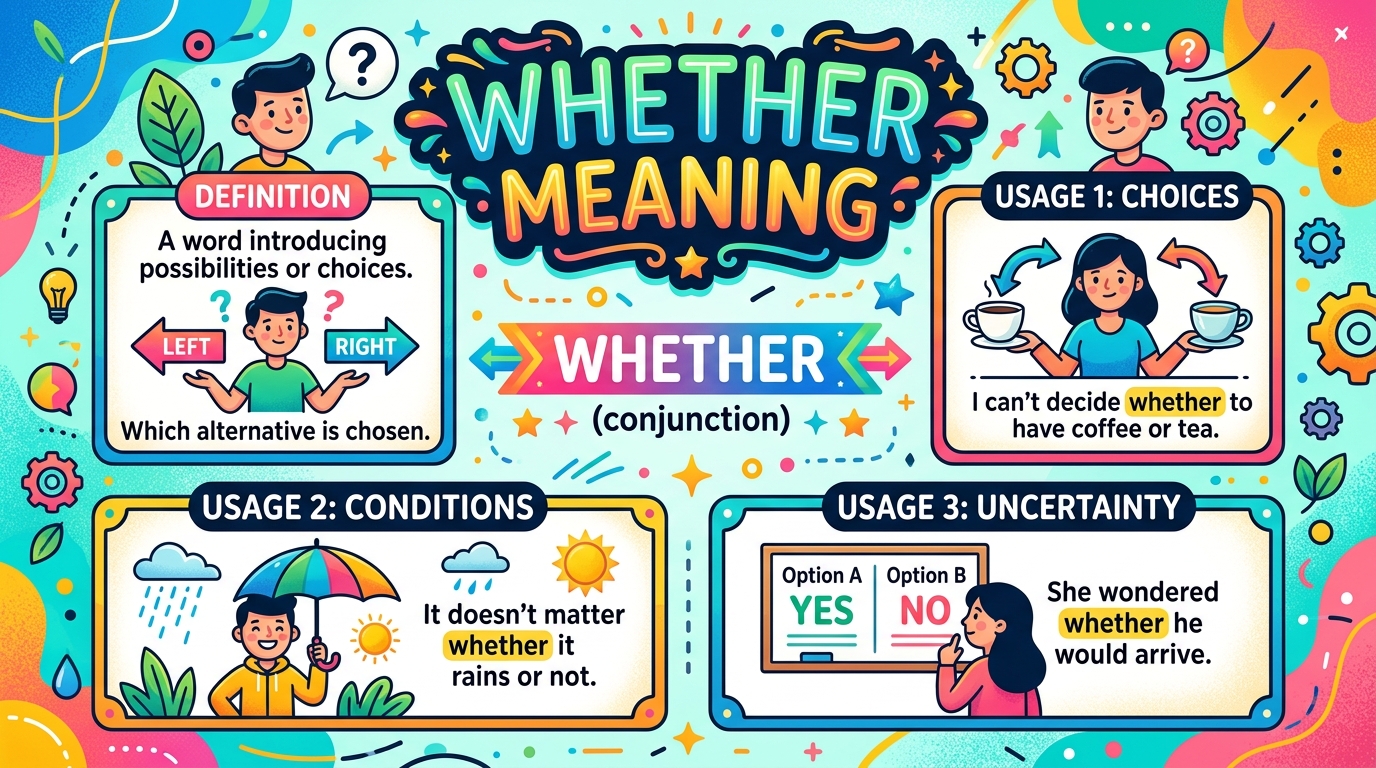
The phrase “whether meaning” is searched by thousands of people every month because the word whether often creates confusion. Many learners wonder when to use it, how it differs from weather, and why native English speakers use it so frequently in conversations, writing, and professional communication.
At first glance, whether looks like a simple word. However, it plays an important role in expressing uncertainty, choices, possibilities, and decisions. Understanding its meaning can instantly improve your English speaking and writing skills.
In this guide, you’ll learn the meaning of whether, its origin, real-life examples, cultural usage, common mistakes, and how people use it in modern communication.
Whether Meaning – Quick Meaning
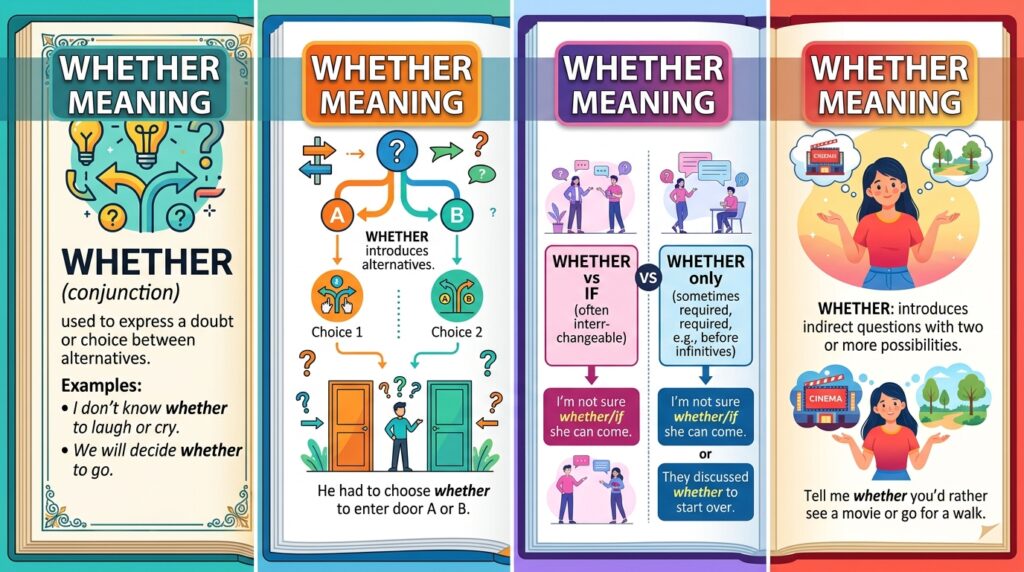
Whether is a conjunction used to introduce alternatives, choices, possibilities, or uncertainty.
Simple Definition
Whether means “if” or “which of two possibilities.”
It is commonly used when someone is uncertain about something or when two options are being considered.
Examples
“I don’t know whether he will come.”
“She asked whether I liked the movie.”
“We’re deciding whether to move abroad.”
Key Points
- Shows uncertainty
- Presents alternatives
- Used in formal and informal English
- Common in speech and writing
Origin & Background
The word whether comes from Old English hwæther, which meant “which of two.”
Historically, it was used to express a choice between alternatives. Over time, English speakers adopted it as a standard conjunction to indicate uncertainty or options.
In modern communication, whether remains extremely important because people constantly discuss possibilities:
- Whether to change jobs
- Whether to travel
- Whether to buy something
- Whether a relationship will work
Social media has also increased its usage. People frequently ask questions online seeking opinions before making decisions.
Today, whether appears in emails, text messages, business communication, academic writing, and everyday conversations.
Whether Meaning in Urdu
In Urdu, whether is commonly translated as:
آیا
کہ
یا نہیں
Examples
- I don’t know whether he is coming.
- مجھے نہیں معلوم آیا وہ آرہا ہے یا نہیں۔
- She asked whether I was busy.
- اس نے پوچھا کہ کیا میں مصروف تھا۔
The exact translation often depends on the sentence structure.
Whether Meaning in Farsi
In Persian (Farsi), whether is often translated as:
آیا
(Aya)
Example
- I don’t know whether she agrees.
- نمیدانم آیا او موافق است یا نه.
In Farsi, the word helps express uncertainty or a question indirectly.
Weather or Whether Meaning
One of the most common English mistakes involves confusing weather and whether.
| Word | Meaning |
|---|---|
| Whether | Expresses choice or uncertainty |
| Weather | Refers to climate conditions |
Examples
Correct:
- I don’t know whether he will call.
Correct:
- The weather is sunny today.
Incorrect:
- I don’t know weather he will call.
A simple trick:
Whether = Choice
Weather = Climate
Whether Meaning in English
In English grammar, whether is classified as a conjunction.
It connects ideas involving uncertainty, alternatives, or possibilities.
Examples
- Tell me whether you agree.
- We haven’t decided whether to stay.
- I’m unsure whether it’s true.
Native speakers use it naturally when discussing decisions and unknown outcomes.
Whether Meaning in French
In French, whether is often translated as:
si
or
que
Example
- I don’t know whether he understands.
- Je ne sais pas s’il comprend.
French speakers often use si in indirect questions where English uses whether.
Whether Meaning Today
Today, the meaning of whether remains largely unchanged, but its usage has become even more common due to digital communication.
People constantly seek opinions online about:
- Whether a product is worth buying
- Whether a relationship should continue
- Whether a career move is a good idea
- Whether information is true
The word has become a central part of modern decision-making conversations.
Whether Meaning in Law
In legal language, whether is used to introduce questions that require determination.
Example
“The court must decide whether the agreement is valid.”
Legal professionals use whether because it allows objective examination of alternatives without assuming an outcome.
You’ll often see phrases such as:
- Whether the defendant acted knowingly
- Whether evidence is admissible
- Whether the contract is enforceable
Whether Meaning in Russian
In Russian, whether is commonly translated as:
ли
(li)
Example
- I don’t know whether he is home.
- Я не знаю, дома ли он.
Russian uses the particle ли to express uncertainty or alternatives similar to English whether.
Real-Life Conversations
WhatsApp Conversation
Person A: Are you joining us tonight?
Person B: I’m still deciding whether I can leave work early.
Instagram DM
Person A: Should I post this photo?
Person B: I’m not sure whether it’s your best one. Maybe try another angle.
TikTok Comments
Person A: Thinking about moving to another city.
Person B: The biggest question is whether you’ll be happier there.
Text Message
Person A: Did you tell her?
Person B: Not yet. I’m still wondering whether it’s the right time.
Emotional & Psychological Meaning
Although whether is a grammar word, it often reflects deeper emotions.
People use it when they feel:
- Uncertain
- Curious
- Hopeful
- Nervous
- Reflective
Whenever someone says:
“I don’t know whether I should do it,”
they’re usually expressing an internal conflict.
Personal-Style Scenario
Imagine receiving a job offer in another country.
The question isn’t simply about employment.
It’s about family, comfort, risk, dreams, and future possibilities.
The sentence becomes:
“I’m trying to decide whether to accept the offer.”
That single word carries emotional weight because it represents a life-changing decision.
Usage in Different Contexts
Social Media
Used when seeking opinions or advice.
Example:
“Can’t decide whether to buy this.”
Friends & Relationships
Used to discuss feelings and choices.
Example:
“I’m not sure whether they like me.”
Work & Professional Settings
Common in emails and meetings.
Example:
“We need to determine whether the proposal is feasible.”
Casual vs Serious Tone
Casual:
- Whether should I go?
Serious:
- We must evaluate whether the strategy aligns with our objectives.
When NOT to Use It
Avoid using whether when certainty already exists.
Incorrect:
- I know whether he is here.
Better:
- I know he is here.
Avoid using it where a direct statement is clearer.
Also consider cultural differences in communication styles. Excessive uncertainty can sometimes appear indecisive in professional environments.
Common Misunderstandings
Confusing Whether with Weather
The most common mistake.
Using It Instead of If
While similar, they are not always interchangeable.
Assuming It Means “Maybe”
Whether introduces possibilities but doesn’t itself mean maybe.
Grammar Placement Errors
Incorrect:
- Whether I think he will come.
Correct:
- I wonder whether he will come.
Comparison Table
| Search Intent | Meaning |
|---|---|
| What Does Whether Mean | Definition and purpose |
| How to Use Whether | Grammar and sentence structure |
| Examples of Whether | Real-life sentence examples |
| Whether vs Weather | Choice versus climate comparison |
| Whether vs If | Uncertainty versus conditional usage |
Key Insight
The word whether does not provide an answer. Instead, it opens the door to possibilities, alternatives, and thoughtful decision-making.
Variations / Types
Whether Meaning
Shows uncertainty or alternatives.
Whether in Text
Used when discussing choices through messages.
Whether Abbreviation
No standard abbreviation exists.
Whether Slang
Not generally used as slang.
Whether in Chat
Common in online conversations and forums.
Whether in Emails
Used for professional decision-making.
Whether in Questions
Introduces indirect questions.
Whether in Academic Writing
Adds precision and objectivity.
Whether in Business Communication
Useful when evaluating options.
Whether in Everyday Speech
Frequently used in normal conversations.
How to Respond When Someone Uses It
Casual Replies
- Go with what feels right.
- I’d probably do it.
- Sounds like a good idea.
Funny Replies
- Flip a coin.
- Ask your dog.
- Let fate decide.
Mature Replies
- Consider the long-term impact.
- Think about your priorities.
- Weigh both options carefully.
Respectful Replies
- That’s your decision to make.
- I support whichever choice you make.
- Take your time before deciding.
Regional & Cultural Usage
Western Culture
Often associated with personal choice and independence.
Asian Culture
Frequently used when balancing family expectations and individual decisions.
Middle Eastern Culture
May appear in discussions involving community, tradition, and responsibility.
Global Internet Usage
Used universally when asking opinions or seeking advice online.
Gen Z vs Millennials
Gen Z
- Uses it frequently in social media discussions.
Millennials
- Often use it in career, lifestyle, and relationship decisions.
Is It Safe for Kids?
Yes.
Whether is a standard English grammar word and is completely safe for children.
Teaching it helps kids express choices, possibilities, and decision-making skills more clearly.
FAQs
What is the exact meaning of whether?
Whether is an English conjunction used to express uncertainty, alternatives, or choices between two or more possibilities.
How do you use whether in a sentence?
You can use whether when discussing options or uncertainty. For example: “I haven’t decided whether to accept the job offer.”
What is the difference between whether and weather?
Whether refers to choices or uncertainty, while weather refers to atmospheric conditions such as rain, sunshine, or temperature.
Can whether and if be used interchangeably?
Sometimes they can, but not always. Whether is generally preferred when presenting alternatives or discussing multiple possibilities.
What is the Urdu meaning of whether?
In Urdu, whether is commonly translated as “آیا”، “کہ”، or “یا نہیں” depending on the context of the sentence.
Is whether a formal English word?
Whether is suitable for both formal and informal communication. It appears in academic writing, business documents, and everyday conversations.
Why is whether important in English grammar?
Whether helps speakers and writers express uncertainty, indirect questions, and choices clearly, making communication more precise.
Can a sentence start with whether?
Yes. For example: “Whether we succeed or fail depends on our preparation and effort.”
What part of speech is whether?
Whether is a conjunction because it connects ideas involving alternatives, possibilities, or uncertainty.
Why do people often search for the meaning of whether?
Many learners confuse whether with weather or if. Understanding whether helps improve grammar, writing accuracy, and spoken English confidence.
Conclusion
The word whether may seem small, but it carries significant meaning in everyday communication. It helps us discuss choices, explore possibilities, and express uncertainty with clarity. From casual text messages to legal documents, whether plays an important role in how people communicate decisions and doubts. Understanding its meaning, proper usage, and common misunderstandings can make your English sound more natural and confident. Once you master whether, you’ll find it easier to express complex thoughts and navigate conversations with greater accuracy and ease.