When people first see the word “bugler”, they often pause. It looks simple, but the meaning can shift depending on context—military, music, slang, or even brand references.
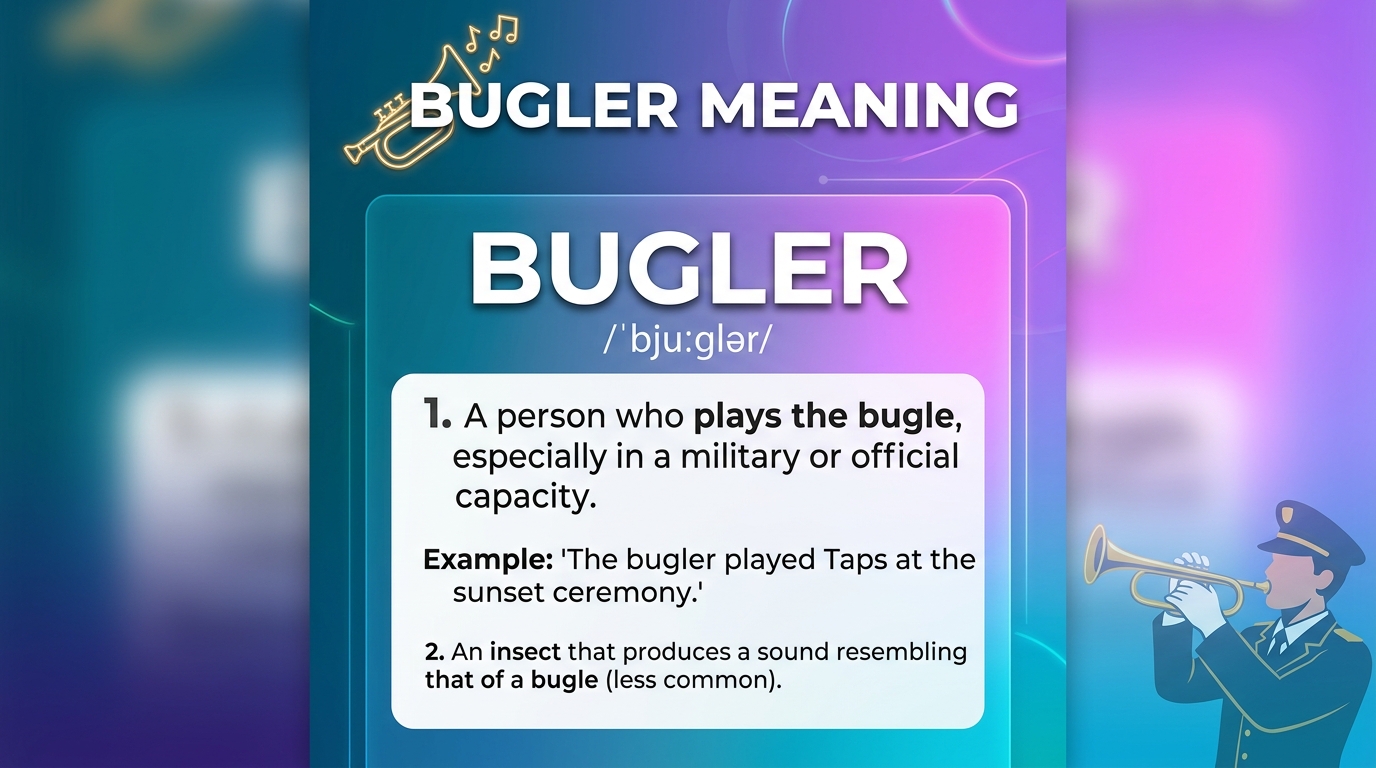
In English, a bugler is primarily:
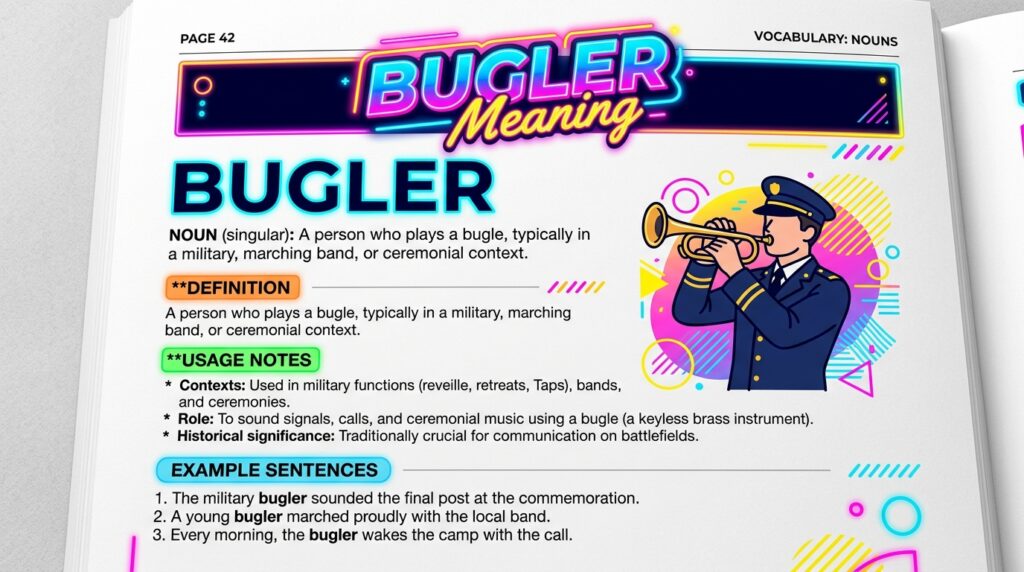
- A person who plays the bugle, a brass musical instrument
- Especially used in military settings for signals
But over time, the word has expanded in casual use and even appears in unexpected places like product names and internet conversations.
In simple terms:
A bugler is someone who plays the bugle to communicate signals or ceremonies.
Examples:
- “The bugler sounded the morning call at dawn.”
- “He trained as a military bugler during service.”
- “The bugler played at the memorial ceremony.”
People search this term because it sounds unfamiliar, slightly old-fashioned, and often appears in historical movies or army-related content.
Bugler pronunciation
The pronunciation of bugler is often confused because of its spelling.
It is pronounced as:
👉 /ˈbjuːɡlər/ → “BYOO-glur”
Breakdown:
- “Bu” sounds like byoo
- “gler” sounds like glur
Common mistakes:
- “bug-ler” (wrong separation)
- “buggler” (double g sound)
In real conversations, especially among learners, people often ask:
“Is it bug-ler or byoo-glur?”
The correct natural flow is smooth—almost like one soft word, not two separate parts.
Bugler definition military
In the military world, a bugler holds a very respected role.
A bugler is responsible for playing the bugle to signal commands such as:
- Wake-up calls
- Meal times
- Lights out
- Ceremonial honors
- Funerals or memorials
Before modern communication systems, armies relied on sound signals. The bugler’s role was essential for discipline and coordination.
A simple way to understand it:
A bugler was the “voice of the battlefield” through sound.
Historical insight:
- Used widely in British, American, and colonial armies
- Important during wars before radios existed
- Still used in ceremonies today for tradition
Bugle meaning
To understand bugler, you must understand bugle.
A bugle is:
- A brass wind instrument
- Has no valves or keys
- Produces sound using lip vibration
Its sound is:
- Loud
- Sharp
- Clear over long distances
Because of this, it was perfect for military communication.
Example:
- “The bugle echoed across the camp at sunrise.”
The bugle is not just an instrument—it’s a symbol of discipline, tradition, and military history.
Bugler person
A bugler person refers to someone who:
- Plays the bugle professionally or ceremonially
- Often trained in music or military communication
In modern times, buglers are seen in:
- Army parades
- National day ceremonies
- Memorial services
- Scout groups
A personal-style scenario:
I once attended a remembrance ceremony where a bugler played “Last Post.” The entire atmosphere shifted instantly—people became silent, emotional, and reflective. That sound carried more emotion than words ever could.
That is the power of a bugler.
Bugler synonym
Depending on context, synonyms vary.
For military/music context:
- Bugle player
- Trumpeter (similar role, different instrument)
- Horn player
- Musician (general term)
- Signal musician
For broader communication meaning:
- Signal player
- Ceremonial musician
However, “bugler” is quite specific and doesn’t have a perfect one-word replacement.
Bugler food
Here’s where confusion increases.
Bugler food is not actually food in the traditional sense.
In many cases, “Bugler” refers to:
- A brand of rolling tobacco
So when people see “Bugler,” they sometimes mistakenly think it’s food-related, but it is actually:
- Smoking tobacco used for rolling cigarettes
Important clarity:
- It is NOT edible food
- It is a consumer tobacco product
People often search it because they see it on packaging or hear it in conversations without context.
Bugler Price
The price of Bugler tobacco products varies depending on:
- Country
- Taxes
- Pack size
- Retail store
General idea:
- Small packs are usually affordable in local markets
- Larger rolls or pouches cost more
In regions where tobacco is heavily taxed, prices can rise significantly.
Example understanding:
- Budget-friendly in some markets
- Premium-priced in others due to import duties
Origin & Background
The word bugler comes from the instrument bugle, which itself has European military roots.
Historically:
- Bugles were used in European armies in the 18th–19th centuries
- Sound carried across battlefields better than speech
- Each signal had meaning (advance, retreat, rest)
Cultural influence:
- Featured in war movies and documentaries
- Used in ceremonial traditions globally
Social media impact:
Today, younger audiences encounter the word in:
- Historical edits
- Military TikTok videos
- Documentary clips
Its meaning has stayed stable but its visibility has increased online.
Real-Life Conversations (MANDATORY)
Person A:
What does bugler mean in that army video?
Person B:
It’s the guy who plays the bugle for signals in the military.
Instagram DM
Person A:
I saw “bugler ceremony” in a reel. What is that?
Person B:
That’s when a bugler plays music during military or memorial events.
TikTok comments
Person A:
Why does the soldier have a trumpet?
Person B:
That’s a bugle, and the person playing it is called a bugler.
Text message
Person A:
Is bugler a job or instrument?
Person B:
It’s both—bugler is the person, bugle is the instrument.
Emotional & Psychological Meaning
The role of a bugler is not just functional—it is deeply emotional.
The sound of a bugle often represents:
- Respect
- Farewell
- Discipline
- Unity
People react emotionally because:
- It signals important life moments
- It connects to history and sacrifice
- It creates silence in crowds instantly
Psychologically, the sound triggers reflection. That’s why even today, bugler performances are used in memorials.
Usage in Different Contexts
Social media
- Used in historical clips or captions
- Often misunderstood by younger audiences
Friends & relationships
- Rarely used, but may appear in educational talk
Work / professional settings
- Military, music, ceremonial professions
Casual vs serious tone
- Serious: military ceremonies
- Casual: explaining history or slang confusion
When NOT to Use It
Avoid using “bugler” in:
- Casual slang conversations
- Humorous contexts where respect is required
- Sensitive ceremonies (unless appropriate tone is maintained)
It carries historical and emotional weight, so misuse can seem insensitive.
Common Misunderstandings
People often confuse:
- Bugler vs bugle (person vs instrument)
- Bugler as food or brand name
- Bugler as modern slang
Another misunderstanding:
Some think it’s a musical band member, but it is specifically tied to the bugle instrument.
Comparison Table
| Term | Meaning | Usage Intent |
|---|---|---|
| Bugler | Person who plays bugle | Military/music role |
| Bugle | Musical instrument | Sound communication |
| Trumpeter | Trumpet player | Similar musical role |
| Musician | General performer | Broad category |
| Signal player | Communication role | Military signals |
Key Insight:
A bugler is highly specific, historically rooted, and emotionally tied to military tradition, unlike general music terms.
Variations / Types (8–10)
- Bugler meaning – Definition of the role
- Bugler in text – Rare but used in explanations
- Bugler abbreviation – No standard abbreviation
- Bugler slang – Not commonly used as slang
- Bugler in chat – Used for clarifying military meaning
- Bugler job meaning – Ceremonial musician role
- Bugler military meaning – Army signal player
- Bugler instrument meaning – Connected to bugle
- Bugler usage – Mostly formal contexts
- Bugler explanation – Educational use
How to Respond When Someone Uses It
Casual replies
- “It’s the guy who plays the bugle in the army.”
- “It’s a military musician basically.”
Funny replies
- “He’s the official sound system of old-school armies 😄”
Mature replies
- “A bugler is responsible for ceremonial military signals.”
Respectful replies
- “It’s a traditional role used in military ceremonies and memorials.”
Regional & Cultural Usage
Western culture
- Strong military and ceremonial association
Asian culture
- Mostly learned through media or education
Middle Eastern culture
- Seen in formal or historical contexts
Global internet usage
- Often searched due to confusion in movies or reels
Generational differences
- Gen Z: mostly unfamiliar
- Millennials: somewhat aware through media exposure
Is It Safe for Kids?
Yes, the term is completely safe.
It is educational and related to music and military history, making it suitable for learning environments.
FAQs
What is the meaning of bugler?
A bugler is a person who plays the bugle, usually in military or ceremonial events to send signals or play formal tunes.
What is the meaning of Buglar?
Buglar is a common misspelling of “bugler,” which refers to someone who plays the bugle instrument in official or military settings.
What does bulger mean?
Bulger is often a typing mistake or confusion with “bugler” or “bulgur,” and its meaning depends on context, but it is not related to the military term.
What is the meaning of bugles?
Bugles are brass musical instruments that produce sound without valves and are used for signals and ceremonial music.
Is bugler and bugle same?
No, bugle is the instrument, while bugler is the person who plays that instrument.
How do you pronounce bugler?
Bugler is pronounced as “BYOO-glur,” with a soft and smooth flow.
What is bugler in military?
In the military, a bugler is responsible for playing signals like wake-up calls, lights out, and ceremonial music.
What is bugler used for?
A bugler is used to communicate commands or perform ceremonial music in armies, parades, and memorial events.
What is bugler synonym?
Synonyms include bugle player, signal musician, or ceremonial musician, depending on the context.
Is bugler a job or instrument?
Bugler is a job or role for a person, while the bugle is the musical instrument they play.
Conclusion
The meaning of bugler goes far beyond a simple dictionary definition. It represents a deep connection between music, military tradition, and human emotion. From battlefield signals to solemn ceremonies, the bugler’s role has always carried respect and purpose. Even today, its sound brings silence and reflection wherever it is heard. Understanding this word helps us appreciate history and communication in a more meaningful way, reminding us how sound once guided entire armies and still moves hearts today.