If you’ve ever scrolled through social media, watched a TikTok, or listened to Latin-inspired music, you’ve probably heard the word “mamacita.” It sounds playful, confident, and a little flirty—but its meaning is often misunderstood.
People search “mamacita meaning” because they’re unsure whether it’s a compliment, slang, or something deeper tied to culture and attraction. And honestly, the confusion makes sense. The word carries layers of emotion, tone, and cultural identity that don’t translate into one simple English phrase.
At its core, mamacita is used to express admiration—often for someone attractive, charming, or confidently feminine. But the way it’s said changes everything: it can feel sweet, bold, romantic, or even inappropriate depending on context.
Let’s break it down in a natural, real-world way so you can actually understand how people use it in daily conversation.
Mamacita Meaning in English
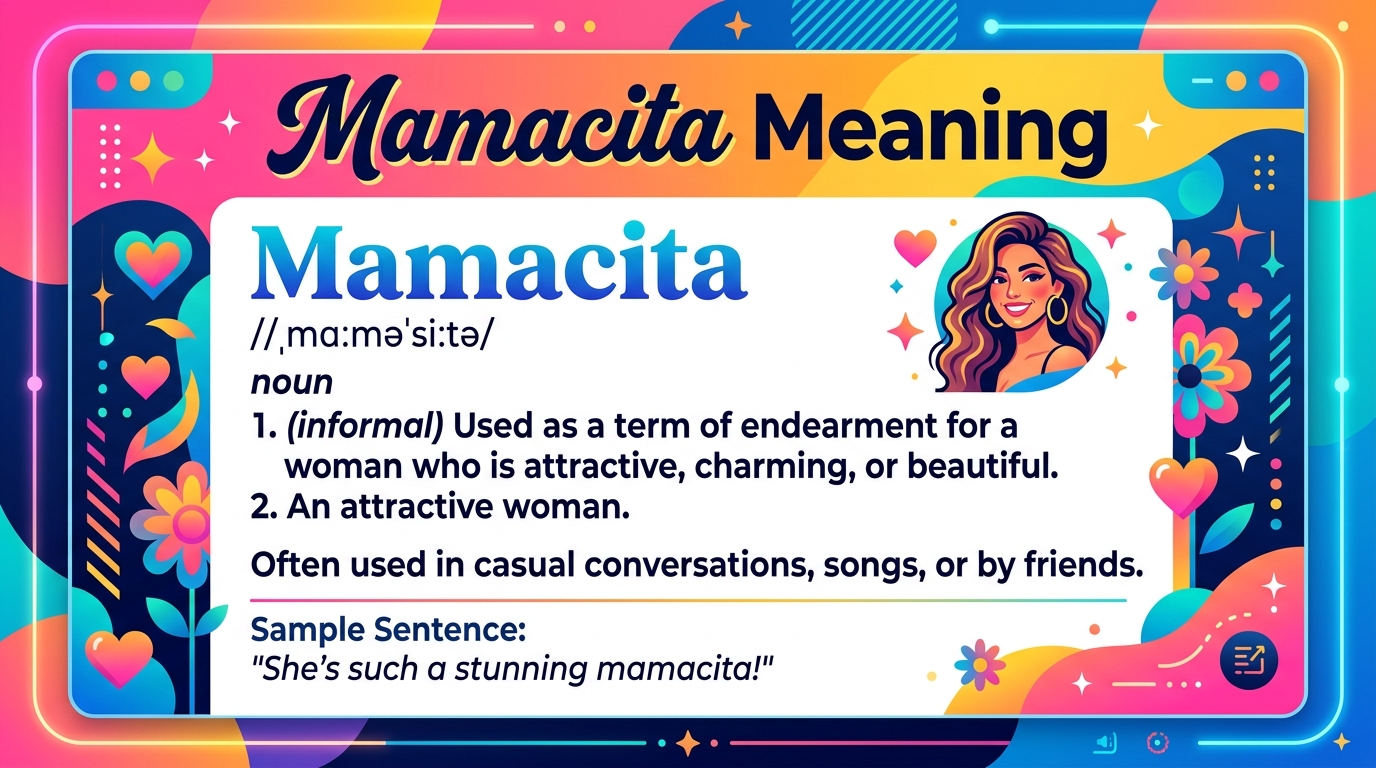
In English, mamacita is a Spanish slang word that loosely translates to:
- “Hot girl”
- “Attractive woman”
- “Sexy lady” (flirty tone)
- “Sweetheart” (in softer contexts)
But it’s not just about appearance. Tone matters deeply.
Examples:
- “Mamacita, you look amazing today!”
- “Hey mamacita, what’s up?”
- “She walked in like a total mamacita.”
It can be playful admiration or strong flirtation depending on who says it and how.
Mamacita Meaning in Urdu
In Urdu, the closest natural meanings depend on tone:
- “Khoobsurat larki” (خوبصورت لڑکی)
- “Haseen aur purkashish aurat”
- “Pyaari / dilkash larki” (playful tone)
- Sometimes: “Attractive ladki” (slang use)
Examples:
- “Woh to bilkul mamacita lag rahi hai.”
- “Kya khoobsurat mamacita hai!”
In Urdu culture, however, using such slang publicly can feel informal or overly bold, especially in traditional settings.
Mamacita Meaning in Portuguese
In Portuguese-speaking cultures, especially Brazil, “mamacita” is not originally native slang but is understood due to Spanish influence and media.
It is often interpreted as:
- “Mulher bonita e atraente”
- “Garota charmosa”
- “Jeito carinhoso/flertante de chamar uma mulher”
Examples:
- “Ela é uma mamacita!”
- “Olha essa mamacita chegando.”
It carries a similar flirty and admiring tone, often influenced by music and pop culture.
Mamacita Meaning in Japanese
In Japanese communication, “mamacita” is not a native word. When used in anime fandoms, music culture, or social media, it is interpreted as:
- “魅力的な女性” (attractive woman)
- “セクシーな女性” (sexy woman, informal tone)
- A foreign slang term meaning admiration
Examples in chat:
- “That girl is such a mamacita vibe.”
- “Mamacitaってかっこいい意味だね。”
Japanese users usually treat it as imported slang rather than a cultural expression.
Mamacita Meaning in Arabic
In Arabic-speaking contexts, the closest meanings are:
- “امرأة جميلة” (beautiful woman)
- “فتاة جذابة” (attractive girl)
- “تعبير غزلي غير رسمي” (informal flirtation)
Examples:
- “هي تبدو مثل ماما سيـتا.”
- “يا لها من mamacita!”
However, it is rarely used in formal Arabic speech and mostly appears in online or pop-culture conversations.
Mamacita Meaning in Slang
As slang, mamacita is a blend of admiration and flirtation.
It usually means:
- A confident, attractive woman
- A playful compliment
- A flirtatious nickname
- Sometimes exaggerated admiration
In modern internet culture:
- It’s common in memes
- Used in TikTok comments
- Seen in Instagram captions
- Popular in music lyrics
It’s less about dictionary meaning and more about vibe and energy.
Mamacita Meaning in Flirting
This is where the word becomes emotionally charged.
In flirting, “mamacita” expresses:
- Attraction
- Confidence
- Playful desire
- Romantic teasing
Examples:
- “Hey mamacita, you’ve been on my mind.”
- “Looking like that? You’re trouble, mamacita.”
But here’s the important part: tone decides respect vs discomfort. In close relationships, it can feel sweet. From strangers, it may feel too forward.
Mamacita Meaning in Relationship
In relationships, “mamacita” often becomes a nickname.
It can express:
- Affection
- Emotional closeness
- Romantic admiration
- Playful bonding
Example conversations:
Partner A: “Good morning, mamacita ❤️”
Partner B: “Only you can call me that and get away with it 😄”
However, in serious or traditional relationships, not everyone prefers slang like this. Comfort matters more than words.
Origin & Background
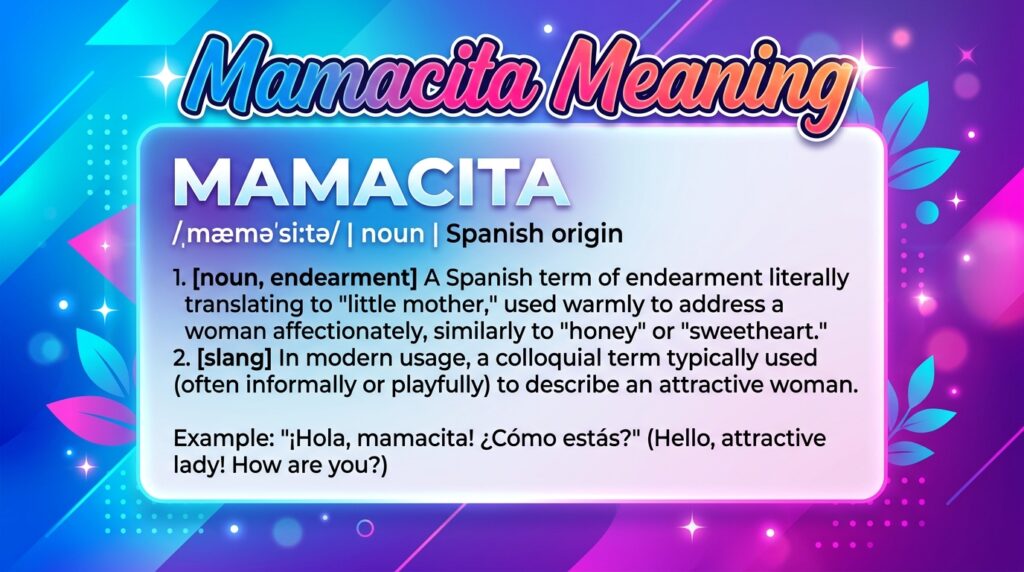
The word “mamacita” comes from Spanish:
- “Mamá” = mother
- “-cita” = diminutive (small/affectionate suffix)
Originally, it could mean “little mother” or affectionate reference to a woman.
Over time, especially in Latin American pop culture, music, and urban slang, it evolved into a term for an attractive woman.
Its global spread came from:
- Latin music
- Hip-hop culture
- TikTok trends
- International memes
Today, it is more about attitude and attraction than literal meaning.
Real-Life Conversations (MANDATORY)
WhatsApp Chat:
Person A: “You posted that pic?? 🔥”
Person B: “Why?”
Person A: “You look like a total mamacita 😭❤️”
Instagram DM:
Person A: “Mamacita vibes in your latest reel 😏”
Person B: “Haha stop it, you’re embarrassing me 😂”
TikTok Comment Section:
User1: “She didn’t walk… she owned the whole place”
User2: “Facts, that’s a mamacita energy right there 🔥”
Text Message:
Boy: “Be careful, mamacita, you’re distracting me today.”
Girl: “You always say that when I wear red 😌”
Emotional & Psychological Meaning
“Mamacita” is more than slang—it reflects modern communication patterns.
It shows:
- Desire for playful expression
- Need for emotional connection
- Comfort with informal language
- Influence of global pop culture
Emotionally, it carries admiration mixed with attraction.
Personal-style scenario:
Imagine someone walking into a room after a long day, tired but confident. A partner looks at them and says “mamacita.” Suddenly, the mood shifts—it feels like recognition, warmth, and attraction wrapped into one word.
That’s the emotional weight behind it.
Usage in Different Contexts
- Social Media: Used in captions, comments, viral posts
- Friends & Relationships: Nicknames, playful teasing
- Work/Professional: Not appropriate in formal settings
- Casual Tone: Common among youth and online culture
It thrives in informal communication but struggles in professional environments.
When NOT to Use It
Avoid using “mamacita” when:
- Speaking formally or professionally
- Talking to someone who prefers respectful boundaries
- Cultural settings where slang is inappropriate
- You don’t know the person well
It can feel disrespectful if misused.
Common Misunderstandings
Many people think:
- It only means “beautiful woman” (not always true)
- It is universally positive (context changes everything)
- It can be used anywhere (it cannot)
Tone confusion is the biggest issue. What sounds cute to one person may sound flirty or uncomfortable to another.
Comparison Table
| Aspect | Meaning | Usage Intent |
|---|---|---|
| What does mamacita mean | Attractive or charming woman | Expression of admiration |
| How to use mamacita | Casual/flirty nickname | Informal communication |
| Examples of mamacita | “Hey mamacita 👀” | Social or romantic context |
| Mamacita vs other slang | More expressive than “pretty” | Stronger emotional tone |
Key Insight:
“Mamacita” is not just a word—it’s a tone-driven expression. Its meaning changes based on emotion, relationship, and cultural setting rather than strict translation.
Variations / Types
- Mamacita meaning slang → Flirty compliment used online
- Mamacita meaning in text → Informal admiration in messages
- Mamacita abbreviation → No official short form, used as-is
- Mamacita in chat → Playful nickname in conversations
- Mamacita vibe → Confident, attractive energy
- Mamacita tone → Flirtatious or admiring expression
- Mamacita usage → Depends on relationship context
- Mamacita emoji style → Often paired with 🔥❤️😏
- Mamacita culture → Latin + internet slang fusion
- Mamacita meaning online → Viral social media compliment
How to Respond When Someone Uses It
Casual replies:
- “Haha stop it 😄”
- “You’re funny!”
Funny replies:
- “Only on weekends 😎”
- “Careful, I might believe it 😂”
Mature replies:
- “Thank you, I appreciate it.”
- “That’s kind of you to say.”
Respectful replies:
- “I prefer my name, but thank you.”
- “Let’s keep it simple, please.”
Regional & Cultural Usage
- Western culture: Common slang in music and social media
- Asian culture: Seen as foreign, trendy slang
- Middle Eastern culture: Used cautiously, often informal online
- Global internet: Widely recognized through memes
- Gen Z vs Millennials: Gen Z uses it more casually and frequently
Is It Safe for Kids?
“Mamacita” is generally mild slang, but it carries flirtatious undertones. Because of that, it is not always suitable for children to use in formal or school environments. Context matters more than the word itself.
FAQs
What does mamacita mean in slang?
It is a Spanish slang word used to describe an attractive, charming, or confident woman. In texting or social media, it often carries a playful or flirty vibe.
Is Mamacita flirty?
Yes, it is usually flirty. The tone can feel romantic or teasing depending on how and where it is used.
Is it okay to call a girl mamacita?
It depends on the relationship. It’s okay among close friends or partners, but it may feel inappropriate or too forward with strangers.
Is mamacita a compliment?
Yes, it is generally a compliment, but it can also feel flirtatious, so context and tone matter a lot.
What does mamacita mean in English?
It loosely means “attractive woman” or “beautiful girl,” often used in a playful or admiring way.
Where is mamacita commonly used?
It is commonly used in Latin culture, music, social media captions, TikTok comments, and casual conversations online.
Can mamacita be used in relationships?
Yes, couples sometimes use it as a cute or flirty nickname to show affection and attraction.
Is mamacita offensive?
Not usually, but if used in the wrong setting or with the wrong tone, it can feel disrespectful or uncomfortable.
Why do people say mamacita online?
People use it online to express admiration, attraction, or playful energy, especially in comments or memes.
What is the emotional meaning of mamacita?
It often expresses admiration mixed with attraction, confidence, and playful emotional connection in modern slang.
Conclusion
Mamacita is more than just slang—it is a cultural expression shaped by tone, emotion, and context. It can feel playful, romantic, or simply admiring depending on how it is used. In modern communication, it reflects confidence and attraction wrapped in a single word. However, understanding boundaries is important before using it. When used naturally and respectfully, mamacita adds color to conversation and helps express admiration in a lively, human way that text alone often cannot capture.