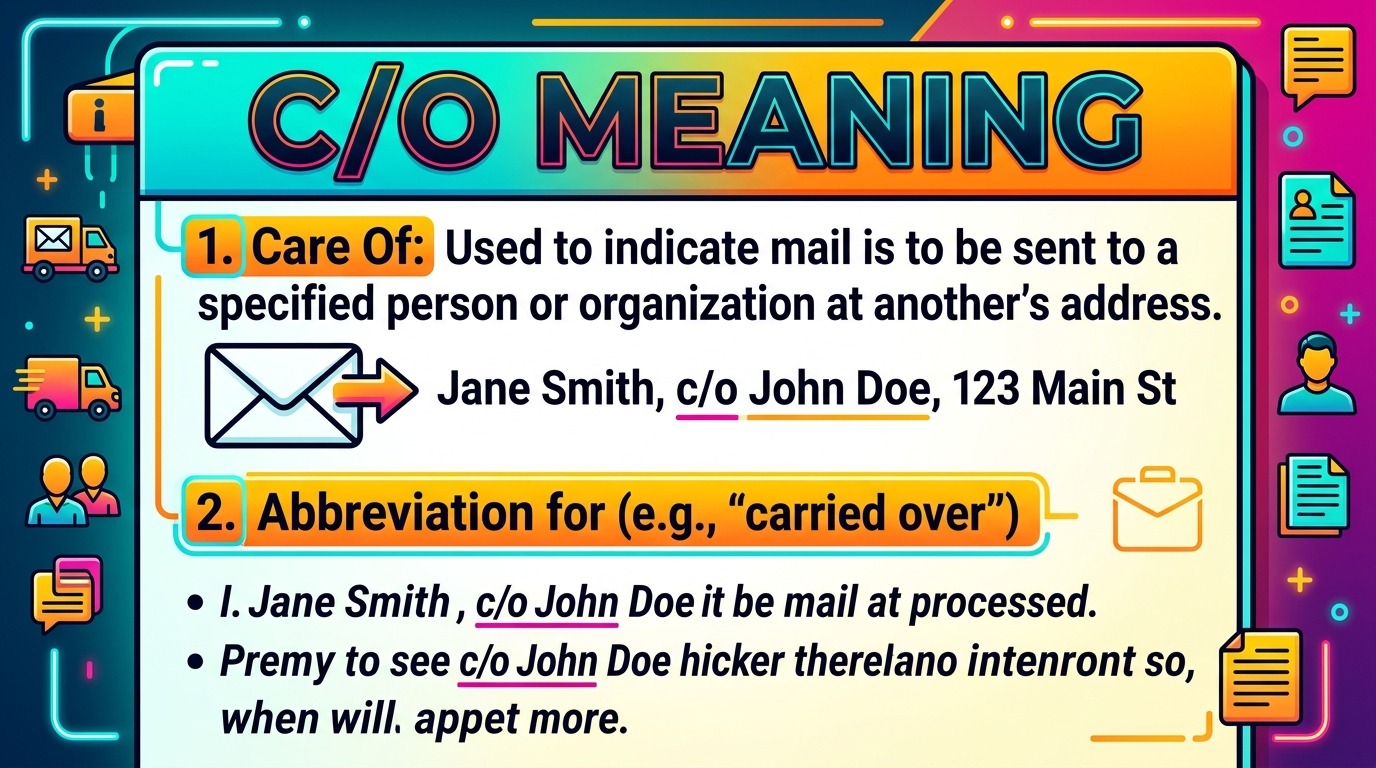
Have you ever seen C/O written on a letter, invoice, package, school document, or workplace form and wondered what it actually means?
You’re not alone.
Many people encounter this abbreviation regularly but never fully understand its purpose. Some assume it is a company code, while others think it relates to accounting, medical records, or even texting slang. The reality is that C/O can have different meanings depending on where it appears.
In mailing addresses, it usually means “Care Of.” In medical notes, it often means “Complains Of.” In business and professional settings, it can carry specific administrative meanings.
Understanding the context behind C/O can help you avoid mistakes in communication, shipping, documentation, and professional correspondence.
This guide explains every major meaning of C/O, where it came from, and how people use it in real life today.
C/O Meaning – Quick Meaning
The abbreviation C/O most commonly stands for “Care Of.”
It is used when mail, packages, or documents are sent to someone through another person or organization.
Simple Definition
C/O = Care Of
It tells the postal service or delivery company that the item should be delivered through another individual or location.
Examples
“John Smith, C/O Sarah Johnson”
“Maria Lopez, C/O ABC Corporation”
“David Brown, C/O University Housing Office”
In these examples, the recipient receives the item through another person or organization.
Origin & Background
The term “Care Of” has existed for centuries in postal communication.
Before modern digital communication, people frequently traveled, lived temporarily with relatives, or worked in different cities. Mail needed a reliable way to reach them.
The abbreviation C/O became a practical solution.
Postal services adopted it to indicate that correspondence should be delivered to an intermediary who could pass it on to the intended recipient.
Over time, the abbreviation expanded beyond mailing.
Businesses started using it in administrative records, healthcare professionals adopted a different interpretation in medical documentation, and shipping companies incorporated it into logistics systems.
Today, C/O appears in everything from legal paperwork and invoices to workplace records and online forms.
Real-Life Conversations
WhatsApp Conversation
Person A: Where should I send the documents?
Person B: Send them to my uncle’s address. Put my name C/O Ahmed Khan.
Person A: Got it. That should make delivery easier.
Instagram DM
Person A: Your package says delivered, but I didn’t get it.
Person B: Check with the office reception. It was sent C/O the building manager.
Person A: Ah, that explains it.
TikTok Comments
User 1: What does C/O mean on shipping labels?
User 2: It usually means Care Of. The package is going through another person or place first.
User 1: Thanks, I was confused.
Text Message
Person A: The company asked for my mailing address.
Person B: If you’re staying with your cousin, use your name C/O your cousin’s address.
Person A: That makes sense.
Emotional & Psychological Meaning

Although C/O seems like a simple abbreviation, it represents something deeper in communication: trust and connection.
When someone uses C/O, they are relying on another person or organization to help deliver information, documents, or belongings.
It reflects cooperation and shared responsibility.
I once helped a friend receive important legal paperwork while he was working abroad. The documents were addressed C/O my home address. That tiny abbreviation ensured the paperwork reached him safely and on time.
In many ways, C/O symbolizes how people support each other through communication networks.
Usage in Different Contexts
Social Media
People occasionally ask about C/O when discussing shipping addresses, online purchases, or business correspondence.
It is not commonly used as social media slang but often appears in discussions about mail and deliveries.
Friends & Relationships
Friends may use C/O when receiving mail at another person’s home.
Example:
“Send it to me C/O my roommate because I’m moving next week.”
Work / Professional Settings
Businesses frequently use C/O when sending documents to employees, clients, or departments through another contact point.
It helps ensure important information reaches the right person.
Casual vs Serious Tone
C/O itself is neutral.
Its tone depends entirely on the situation. It can appear in casual personal mail or highly formal legal documentation.
C/O Meaning Medical
In medical terminology, C/O commonly means “Complains Of.”
Doctors, nurses, and healthcare professionals use it in patient records.
Example:
“C/O headache for three days.”
This means the patient reports experiencing headaches for three days.
Medical professionals use this abbreviation to quickly record symptoms and concerns.
C/O Meaning in Business
In business settings, C/O usually retains its “Care Of” meaning.
Companies use it when correspondence is directed through another employee, department, branch, or office.
Example:
“Jane Williams, C/O Human Resources Department.”
This helps ensure internal communication reaches the correct person.
C/O Meaning in Invoice
On invoices, C/O often identifies the party through whom billing documents are being routed.
Example:
“Invoice addressed to Client Name, C/O Accounting Department.”
It helps organizations manage payment records efficiently.
C/O Meaning in Work
At work, C/O may indicate that communication, packages, or official documents should pass through a designated office or supervisor.
This is common in large corporations where employees work across multiple locations.
C/O Meaning in Relationship
In relationships, C/O is rarely used formally but may appear when partners share addresses or receive mail through each other.
Example:
“Emily Carter, C/O Michael Carter.”
It simply indicates that one person receives mail through another household member.
C O Meaning Slang
Unlike many internet abbreviations, C/O is not a major slang term.
However, online users occasionally shorten it when discussing shipping, deliveries, or mailing instructions.
The meaning usually remains “Care Of.”
C O Meaning in School
Schools often use C/O for communication sent through parents, guardians, or administrative offices.
Example:
“Student Name, C/O Parent Name.”
This ensures important notices reach the correct family member.
C/O Meaning in Shipping
Shipping companies frequently use C/O on labels.
It indicates that the package should be delivered through a specific person, office, warehouse, or organization.
Example:
“Alex Johnson, C/O Downtown Distribution Center.”
This helps avoid delivery errors and improves package tracking.
When NOT to Use It
When You Know the Direct Address
If the recipient has a permanent address, C/O may be unnecessary.
In Informal Digital Chats
Using C/O in everyday texting can confuse people unfamiliar with postal terminology.
When It Creates Ambiguity
Avoid using it if multiple people share the same address and the recipient is not clearly identified.
In Sensitive Legal Situations
Incorrect C/O usage on legal documents may create delays or confusion.
Common Misunderstandings
Thinking It Always Means Care Of
In medicine, C/O usually means “Complains Of.”
Assuming It’s a Company Name
Some people mistake C/O for part of a business title.
Believing It’s Internet Slang
While occasionally discussed online, it is primarily an administrative abbreviation.
Ignoring Context
The biggest mistake is assuming the same meaning applies everywhere.
Context determines the correct interpretation.
Comparison Table
| Term | Definition Intent |
|---|---|
| What Does C/O Mean | Understand the abbreviation’s meaning |
| How to Use C/O | Learn proper placement and formatting |
| Examples of C/O | See real-world usage scenarios |
| C/O vs Attn | Care Of routes mail through someone; Attn directs attention to a specific person |
Key Insight
The meaning of C/O depends heavily on context. In mailing, it means “Care Of.” In healthcare, it often means “Complains Of.” Understanding where it appears is the key to interpreting it correctly.
Variations / Types
C/O Meaning
The standard abbreviation for Care Of or Complains Of depending on context.
C/O in Text
Usually discussed when explaining addresses or deliveries.
C/O Abbreviation
A shortened form commonly used in documentation.
C/O Slang
Not true slang but occasionally referenced online.
C/O in Chat
Typically appears when discussing shipping or mailing.
C/O Address Meaning
Mail sent through another individual or organization.
C/O Medical Meaning
Patient complains of a symptom or condition.
C/O Business Meaning
Communication routed through another department or contact.
C/O Shipping Meaning
Package delivered via an intermediary recipient.
C/O Invoice Meaning
Billing documentation sent through a designated office or department.
How to Respond When Someone Uses It
Casual Replies
- “Thanks, I’ll send it there.”
- “Got it, that makes sense.”
Funny Replies
- “Looks like your mail has a middleman.”
- “Your package is taking the VIP route.”
Mature Replies
- “Thank you for clarifying the delivery details.”
- “I’ll make sure the documents are addressed correctly.”
Respectful Replies
- “I appreciate the information.”
- “I’ll follow those instructions exactly.”
Regional & Cultural Usage
Western Culture
C/O is widely recognized in postal systems, business communication, and legal documentation.
Asian Culture
Many businesses and institutions use C/O in formal correspondence, especially in international shipping.
Middle Eastern Culture
C/O commonly appears in government paperwork, commercial shipping, and workplace records.
Global Internet Usage
Online shoppers frequently encounter C/O while entering delivery information.
Generational Differences
Gen Z: More likely to encounter it through e-commerce and online orders.
Millennials: Often recognize it from forms, invoices, and workplace communication.
Older generations generally understand it from traditional mailing systems.
Is It Safe for Kids?
Yes.
C/O is a harmless administrative abbreviation. Children may encounter it on school forms, mailing addresses, or educational documents. The only challenge is understanding the context in which it is used.
FAQs
What does “C/O” mean in address?
In an address, C/O (Care Of) means mail or packages are being sent to someone through another person or organization. It helps ensure the recipient receives the item at a location where they can be reached.
What does C/O mean in contact?
In contact information, C/O indicates that communication should go through a specific person, office, or department before reaching the intended recipient. It is commonly used in professional and mailing contexts.
Is C/O the same as on behalf of?
No, C/O and on behalf of are different. C/O refers to receiving mail or communication through someone else, while “on behalf of” means acting or speaking for another person.
What does C/O mean in medical terms?
In medical records, C/O usually stands for “Complains Of.” Healthcare professionals use it to note symptoms reported by a patient, such as “C/O chest pain” or “C/O dizziness.”
What does C/O stand for in business documents?
In business documents, C/O generally means Care Of and is used when correspondence is routed through a department, office, or intermediary contact to reach the intended recipient.
Can I use C/O when shipping a package?
Yes, you can use C/O when sending a package to someone staying at another person’s home, office, hotel, or temporary location. It helps carriers identify who should receive the package.
Where should C/O be placed in an address?
C/O should be written on the line below the recipient’s name and before the intermediary person’s or organization’s name. This format helps delivery services process the address correctly.
Is C/O still used today?
Yes, C/O remains widely used in shipping, legal paperwork, business correspondence, school records, and situations where someone receives mail through another location.
What is the difference between C/O and Attn?
C/O directs mail through another person or organization, while Attn (Attention) identifies a specific person or department within an organization that should receive the correspondence.
Can C/O be used for online shopping deliveries?
Yes, many people use C/O when ordering online and having purchases delivered to a friend, family member, workplace, or temporary address where they can safely receive the package.
Conclusion
Understanding the meaning of C/O can save you from confusion in everything from shipping labels to medical records. While most people recognize it as “Care Of,” its meaning changes depending on the situation, making context incredibly important. Whether you see it on an invoice, workplace document, school form, or healthcare note, knowing how to interpret C/O helps you communicate more confidently and accurately. It may be a small abbreviation, but it plays a surprisingly important role in everyday communication around the world.