The phrase carte blanche meaning often sparks curiosity because it sounds elegant, foreign, and powerful all at once. People encounter it in movies, business meetings, legal discussions, books, and even everyday conversations. Yet many are unsure what it actually means or how to use it correctly.
At its core, carte blanche refers to complete freedom or unlimited authority to make decisions without restrictions. It is a phrase that carries a sense of trust, responsibility, and sometimes even risk.
Whether you have seen it in a workplace email, heard it in a courtroom drama, or noticed it in social media discussions, understanding this expression can help you communicate more confidently and accurately.
Carte Blanche Meaning – Quick Meaning
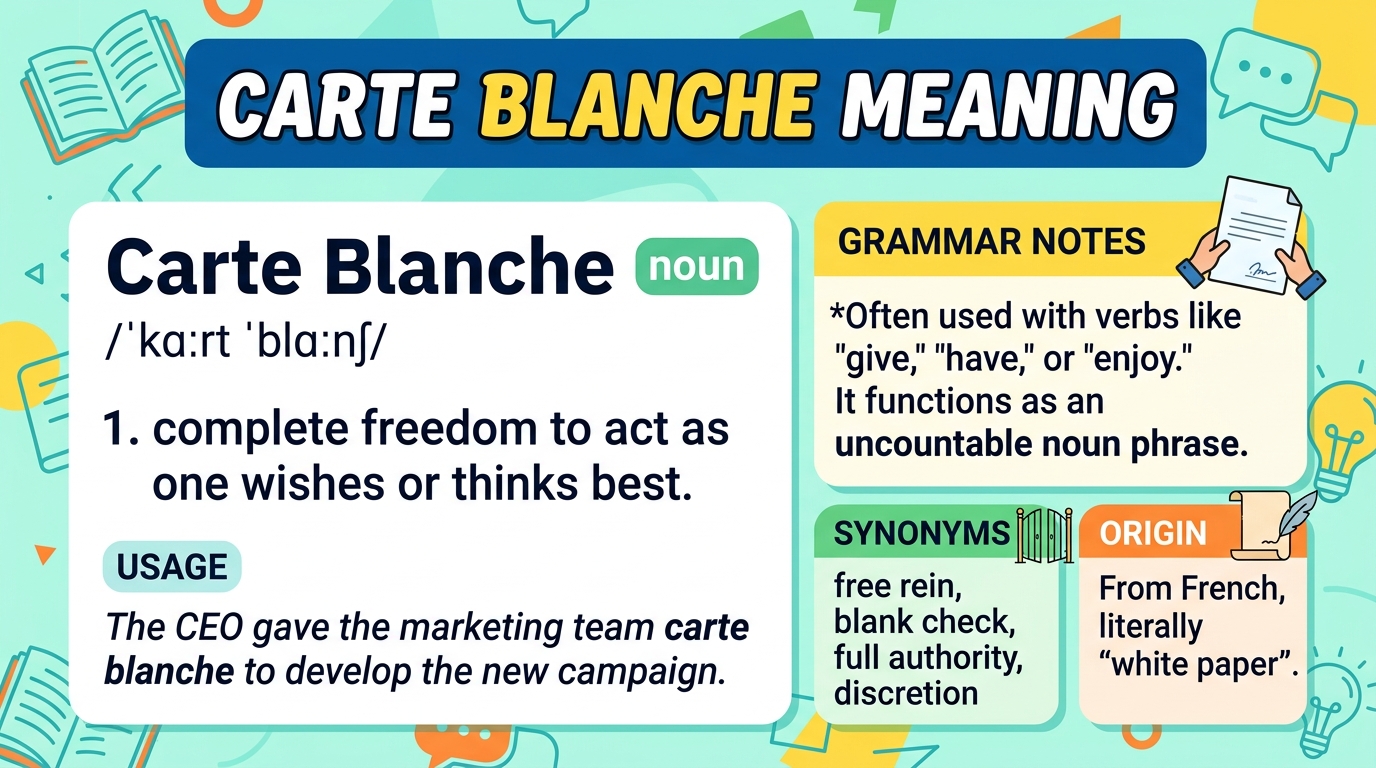
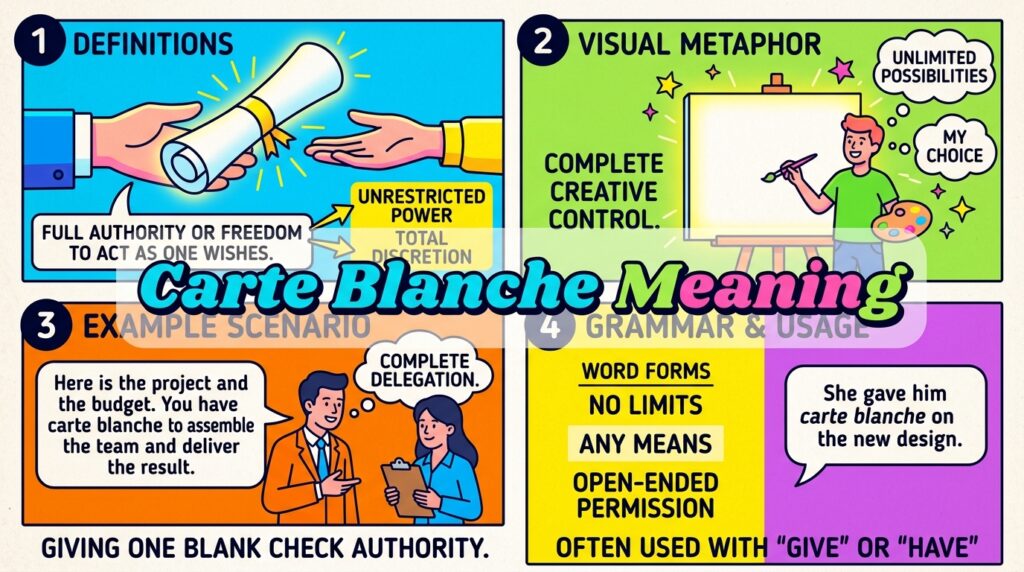
Carte blanche means giving someone full authority, permission, or freedom to act as they see fit.
Simple Definition
- Complete freedom to decide
- Unlimited authority within a situation
- Permission to take action without needing approval
Quick Examples
“My manager gave me carte blanche to redesign the website.”
“The director had carte blanche over the entire project.”
“Her parents gave her carte blanche when planning the wedding.”
In each example, the person receives broad decision-making power without constant supervision.
Carte Blanche Meaning in English
In English, carte blanche is used to describe a situation where someone has unrestricted power or freedom to make decisions.
The phrase is often associated with trust. When a person receives carte blanche, it usually means another person believes in their judgment enough to let them proceed independently.
For example:
“The company gave the marketing team carte blanche to launch a new campaign.”
This means the marketing team can make decisions without seeking approval for every step.
Although the phrase originates from French, it has become a well-established part of modern English vocabulary.
Carte Blanche Meaning in Law
Carte Blanche Meaning in Law
In legal contexts, carte blanche refers to broad authority granted to an individual or organization.
However, legal systems rarely allow truly unlimited power. Even when someone appears to have carte blanche, legal boundaries, regulations, contracts, and ethical responsibilities still apply.
For example:
- A company executive may have authority to negotiate deals.
- A trustee may have broad discretion over assets.
- An attorney may have significant decision-making authority in specific situations.
Courts generally interpret authority within reasonable limits rather than viewing it as absolute.
Therefore, while the phrase suggests unlimited freedom, legal reality usually includes checks and responsibilities.
Carte Blanche Pronunciation
Many people hesitate to use the phrase because they are unsure how to pronounce it.
Pronunciation
Carte Blanche
Phonetic: kart blahnsh
Easy Breakdown
- Carte = “kart”
- Blanche = “blahnsh”
Say it smoothly:
“kart blahnsh”
Because it comes from French, the pronunciation sounds softer than many English words.
Carte Blanche Meaning in Urdu
Carte Blanche Meaning in Urdu
The closest Urdu meanings include:
- مکمل اختیار
- مکمل آزادی
- کھلی چھوٹ
- بے حد فیصلہ سازی کا اختیار
Example in Urdu Context
اگر کسی کو کسی منصوبے پر کارٹے بلانش دیا جائے تو اس کا مطلب ہے کہ اسے اپنی مرضی سے فیصلے کرنے کی مکمل اجازت حاصل ہے۔
The phrase is often translated conceptually rather than literally because its true meaning centers on unrestricted authority and trust.
Carte Blanche Origin
Where Did the Phrase Come From?
The phrase comes from French.
- Carte means “card” or “document.”
- Blanche means “white” or “blank.”
Literally, carte blanche means “blank paper” or “blank document.”
Historically, a signed blank document allowed the recipient to fill in whatever terms they wanted. Over time, the phrase evolved into a metaphor for unlimited authority.
Historical Development
In European diplomacy and military affairs, rulers sometimes granted trusted officials broad powers to negotiate on their behalf.
As the expression spread into English, it became a symbol of complete confidence and freedom.
Modern Cultural Influence
Today, the phrase appears in:
- Movies
- Business communication
- Leadership discussions
- Political commentary
- Social media content
Its meaning has remained remarkably consistent through the centuries.
Carte Blanche Language
What Language Is Carte Blanche?
Carte blanche comes from the French language.
It is an example of a foreign expression that English speakers borrowed directly without translating it.
English contains many French expressions, including:
- Bon voyage
- Déjà vu
- Faux pas
- Carte blanche
Because of its long history in English usage, many people now consider it a natural part of English vocabulary even though its roots remain French.
Real-Life Conversations
WhatsApp Conversation
Person A: My boss told me to handle the event.
Person B: Just the logistics?
Person A: Nope, complete carte blanche.
Person B: That’s a lot of trust.
Instagram DM
Person A: Who picked the wedding theme?
Person B: My sister gave me carte blanche.
Person A: Lucky you. I’d spend months choosing colors.
TikTok Comments
User 1: Who decided on this redesign?
User 2: The creative director had carte blanche.
User 1: That explains the bold choices.
Text Message
Person A: Can I organize the trip?
Person B: Absolutely. You have carte blanche.
Person A: Don’t blame me if we end up somewhere expensive.
Emotional & Psychological Meaning
Language often reveals deeper emotions than we realize.
When someone grants carte blanche, they communicate more than permission. They communicate trust.
The phrase often reflects:
- Confidence
- Respect
- Belief in someone’s abilities
- Delegation of responsibility
Interestingly, receiving carte blanche can feel both exciting and stressful.
Many people enjoy freedom until they realize complete freedom also means complete accountability.
I once worked with a team leader who gave employees broad authority over projects. Everyone initially loved the freedom. Later, many realized that making every decision independently required confidence, judgment, and responsibility. The freedom felt empowering, but it also demanded maturity.
That emotional balance is why the phrase remains powerful today.
Usage in Different Contexts
Social Media
Influencers and creators often use the phrase when discussing creative freedom.
Example:
“The brand gave me carte blanche for this campaign.”
Friends and Relationships
People use it when discussing unrestricted choices.
Example:
“You have carte blanche to choose the restaurant.”
Work and Professional Settings
This is one of the most common environments for the phrase.
Example:
“The CEO gave the project manager carte blanche.”
Casual vs Serious Tone
Casual:
“You have carte blanche for movie night.”
Serious:
“The board granted the director carte blanche over negotiations.”
The phrase works effectively in both settings because it sounds professional yet easy to understand.
When NOT to Use It
Although useful, the phrase isn’t appropriate everywhere.
Avoid When Clarity Is Critical
Some audiences may not understand the expression.
Instead of saying:
“You have carte blanche.”
You may need to say:
“You have full authority to decide.”
Avoid Overstating Authority
Few situations involve truly unlimited power.
Using the phrase carelessly can create confusion.
Cultural Considerations
Not everyone is familiar with French expressions. In global communication, simpler language may sometimes be more effective.
Common Misunderstandings
Thinking It Means Unlimited Power Forever
Carte blanche usually applies to a specific situation, not every aspect of life.
Assuming It Removes Responsibility
Greater freedom often means greater accountability.
Confusing It With Permission for Anything
Even with carte blanche, legal, ethical, and organizational boundaries still exist.
Taking It Literally
The phrase no longer refers to an actual blank document in most situations.
Its modern meaning is symbolic.
Comparison Table
| Phrase | Definition Intent |
|---|---|
| What Does Carte Blanche Mean | Understanding complete freedom or authority |
| How to Use Carte Blanche | Learning proper usage in speech and writing |
| Examples of Carte Blanche | Seeing practical real-world situations |
| Carte Blanche vs Permission | Carte blanche suggests broader authority |
| Carte Blanche vs Freedom | Freedom is general; carte blanche is delegated authority |
| Carte Blanche vs Autonomy | Autonomy may be earned; carte blanche is granted |
| Carte Blanche vs Authority | Authority may have limits; carte blanche implies very broad discretion |
Key Insight
The defining feature of carte blanche is not freedom itself—it is freedom that another person intentionally grants because they trust your judgment.
Variations / Types
Carte Blanche Meaning
Complete authority or unrestricted freedom.
Carte Blanche in Text
Used to indicate someone can decide without approval.
Carte Blanche Abbreviation
There is no widely accepted abbreviation.
Carte Blanche Slang
Not technically slang, but often used casually.
Carte Blanche in Chat
Common in professional and personal messaging.
Carte Blanche in Business
Authority to make major decisions independently.
Carte Blanche in Leadership
Trust-based delegation of power.
Carte Blanche in Relationships
Allowing a partner complete decision-making freedom.
Carte Blanche Online
Used in discussions about creative or personal freedom.
Carte Blanche in Communication
Signals trust, confidence, and responsibility.
How to Respond When Someone Uses It
Casual Replies
- “Sounds good to me.”
- “I’ll make the most of it.”
- “Thanks for trusting me.”
Funny Replies
- “That’s dangerous knowledge.”
- “You’ve unleashed my creativity.”
- “No pressure, right?”
Mature Replies
- “I appreciate the confidence.”
- “I’ll handle it responsibly.”
- “Thank you for the opportunity.”
Respectful Replies
- “I value the trust you’ve placed in me.”
- “I’ll do my best.”
- “I won’t let you down.”
Regional & Cultural Usage
Western Culture
Often associated with leadership, business, and personal independence.
Asian Culture
May be used less frequently because many professional environments emphasize collective decision-making.
Middle Eastern Culture
Usually appears in formal business or academic discussions.
Global Internet Usage
The phrase is widely recognized online and frequently used in professional content.
Gen Z vs Millennials
Gen Z: More likely to use simpler alternatives such as “full control.”
Millennials: Often recognize and use the phrase in professional settings.
Is It Safe for Kids?
Yes.
Carte blanche is not offensive, inappropriate, or harmful. It simply refers to giving someone complete freedom or authority.
Parents and educators may use it to teach responsibility, trust, and decision-making skills.
FAQs
What does carte blanche mean literally?
Carte blanche literally means “blank card” or “blank document” in French. Historically, it referred to a signed blank paper that allowed someone to fill in whatever terms they wished.
What is another word for carte blanche?
Common synonyms for carte blanche include full authority, free rein, complete discretion, unrestricted freedom, and full control. Each conveys the idea of having broad decision-making power.
What does it mean to get carte blanche?
Getting carte blanche means receiving complete freedom or authority to make decisions without needing approval at every step. It usually reflects a high level of trust from the person granting it.
Do the French say carte blanche?
Yes, French speakers still use the phrase carte blanche. While it originated in French, it has also become a widely recognized expression in English and many other languages.
Is carte blanche a positive expression?
Most of the time, yes. It often suggests trust, confidence, and respect for someone’s judgment, although it can also imply significant responsibility.
Can carte blanche be used in business?
Yes, the phrase is commonly used in business settings when an employee, manager, or team receives broad authority to make decisions independently.
Is carte blanche the same as freedom?
Not exactly. Freedom is a general concept, while carte blanche specifically refers to freedom or authority that has been granted by another person or organization.
Can carte blanche have limits?
In practice, yes. Even when someone is given carte blanche, legal, ethical, financial, or organizational boundaries usually still apply.
How do you use carte blanche in a sentence?
You can say, “The company gave the creative director carte blanche to develop the new brand strategy,” meaning the director had broad decision-making authority.
Why is carte blanche still popular today?
The phrase remains popular because it expresses the powerful combination of trust, authority, and independence in just two words, making it useful in both professional and everyday conversations.
Conclusion
Understanding the carte blanche meaning goes beyond memorizing a definition. The phrase represents trust, responsibility, and the freedom to act without constant oversight. Whether it appears in legal discussions, workplace conversations, social media posts, or everyday communication, it signals that someone has been given significant authority to make decisions. Knowing how and when to use it helps you communicate more clearly and confidently. More importantly, it reminds us that true freedom often comes with responsibility, making carte blanche one of the most powerful expressions in modern language.