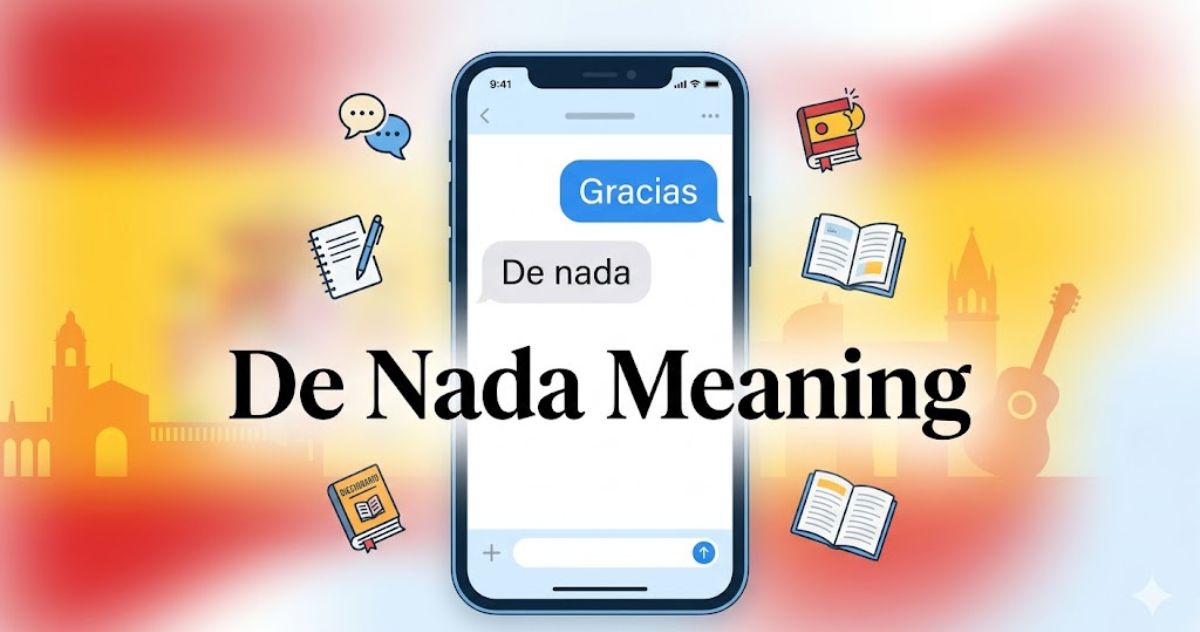
If you’ve ever heard someone say “de nada” after being thanked, you may have wondered what it really means. While many people know it as the Spanish way of saying “you’re welcome,” its meaning goes beyond a simple translation. It reflects kindness, humility, and a natural way of making everyday conversations feel more comfortable.
People often search for de nada meaning because they encounter the phrase while traveling, watching Spanish movies, listening to music, learning Spanish, or chatting with native speakers online. Although the expression looks simple, many learners are unsure when to use it, how to pronounce it, or whether it has the same meaning in every situation.
In this guide, you’ll discover not only its literal meaning but also its cultural importance, practical usage, pronunciation, and the emotions behind one of the most common phrases in the Spanish language.
De Nada Meaning – Quick Meaning
The phrase de nada is a polite Spanish expression that means “you’re welcome.” It is used after someone says “gracias” (thank you) to show that helping was no trouble at all.
Quick facts
- Language: Spanish
- English meaning: You’re welcome
- Literal meaning: “Of nothing”
- Purpose: A polite response to gratitude
- Tone: Friendly, respectful, and warm
Everyday examples
“Gracias por tu ayuda.”
“De nada.”
“Thank you for explaining.”
“De nada. Happy to help.”
“Gracias por venir.”
“De nada. It was my pleasure.”
Although the literal translation is “of nothing,” native speakers understand it as a natural way of saying that the favor or help was not a burden.
Origin & Background
The expression de nada has deep roots in the Spanish language. It developed from the idea that the favor being appreciated was “nothing worth mentioning.” Instead of drawing attention to the effort, the speaker minimizes it to make the other person feel comfortable.
This idea reflects an important cultural value found across many Spanish-speaking communities: showing generosity without expecting recognition.
Over time, the phrase became the standard response to gracias throughout Spain and Latin America.
Today, its popularity extends far beyond native Spanish speakers.
Millions of people recognize de nada from:
- Spanish language classes
- Netflix and television dramas
- Latin music
- TikTok videos
- Travel experiences
- Social media conversations
Because Spanish is one of the world’s most widely spoken languages, de nada has become one of the first expressions many language learners remember.
De Nada Meaning in English
In English, de nada most commonly means:
- You’re welcome
- Don’t mention it
- It was nothing
- No problem
- My pleasure (depending on context)
Although all of these translations are acceptable, “you’re welcome” is the closest everyday equivalent.
Imagine this conversation:
Emily:
“Thank you for helping me move.”
Carlos:
“De nada.”
An English speaker would naturally understand this as:
“You’re welcome.”
However, Spanish speakers often say it with a sense of warmth that can make the exchange feel even friendlier.
De Nada Meaning Spanish
In Spanish, de nada is much more than a dictionary phrase.
Native speakers use it naturally after receiving thanks, whether the favor was large or small.
Examples include:
- Holding a door
- Giving directions
- Sharing notes
- Helping someone at work
- Offering advice
- Giving a compliment
The phrase tells the other person:
“It wasn’t any trouble.”
Because of this, it helps create friendly, respectful conversations without making anyone feel indebted.
De Nada Meaning in Portuguese
Many people assume de nada is Portuguese because Portuguese and Spanish share many similar words.
Interestingly, Portuguese speakers also understand de nada, and the phrase is used in Portuguese as well, especially as a response to thanks.
However, depending on the region, Portuguese speakers may also say expressions such as:
- Não há de quê
- Por nada
While the exact wording varies, the message remains the same: you’re welcome.
This similarity often surprises people learning either language because both languages share historical Latin roots.
De Nada Is Which Language?
One of the most common questions learners ask is:
De nada is which language?
The answer is simple:
De nada is a Spanish phrase.
Spanish is spoken by hundreds of millions of people across Europe, Latin America, and many communities around the world.
Because Spanish has become increasingly popular through music, entertainment, travel, and education, even people who do not speak the language often recognize de nada.
Although Portuguese also uses the phrase in some situations, it is most strongly associated with Spanish.
De Nada Pronunciation
Many beginners hesitate because they are unsure how to pronounce it.
The standard pronunciation is:
day NAH-dah
A simple pronunciation guide:
- De sounds similar to “day,” but slightly shorter.
- Nada sounds like “NAH-dah.”
Say it smoothly rather than emphasizing every syllable.
Practice:
“Gracias.”
“De nada.”
After repeating it several times, it quickly becomes one of the easiest Spanish expressions to remember.
You’re Welcome in Spanish
Although de nada is the most common response, Spanish offers several ways to say you’re welcome depending on the situation.
Some popular alternatives include:
- De nada – everyday and universal
- Con gusto – with pleasure
- Por supuesto – of course
- No hay problema – no problem
- Es un placer – it’s a pleasure
Choosing among these depends on the level of formality and the relationship between the speakers.
For casual conversations, de nada remains the safest and most natural option.
Gracias Meaning
To fully understand de nada, it’s important to know the phrase that usually comes before it.
Gracias means:
Thank you.
It is one of the first Spanish words most learners study.
The conversation naturally follows this pattern:
Person A:
“Gracias.”
Person B:
“De nada.”
Together, they create one of the most common exchanges in everyday Spanish.
Whether someone thanks you for opening a door, giving directions, or offering support, de nada completes the interaction politely.
No Problem in Spanish
Many English speakers respond to thanks by saying “No problem.”
Spanish has similar expressions.
Some examples include:
- No hay problema
- No pasa nada
- De nada
Although all three can respond to gratitude, they are not identical.
De nada is generally the most polite and universally accepted.
No hay problema sounds more like “No problem.”
No pasa nada often means “It’s okay” or “Don’t worry about it.”
Choosing the right expression depends on the situation, but if you’re unsure, de nada is always a safe and respectful choice.
Real-Life Conversations
WhatsApp Chat
Person A:
Thanks for sending me your class notes. You saved me today!
Person B:
De nada! I’m glad they helped. Good luck with the exam.
Instagram DM
Person A:
Your restaurant recommendation was amazing!
Person B:
De nada! I knew you’d love that place.
TikTok Comments
Person A:
Thanks for explaining this Spanish phrase.
Person B:
De nada! Happy to help. Language learning is more fun together.
Faqs
What does “de nada” literally mean?
“De nada” literally means “of nothing” in Spanish. It is used to show that helping someone was not a big effort.
Do you say “de nada” after “gracias”?
Yes, “de nada” is the most common response after someone says “gracias” in Spanish conversations.
Do people actually say “de nada”?
Yes, native Spanish speakers use it every day in casual, friendly, and even professional situations.
What can I say instead of “de nada”?
You can say “no hay de qué,” “con gusto,” “fue un placer,” or “no pasa nada” depending on the situation.
Is “de nada” formal or informal?
It is mostly neutral, meaning it works in both formal and informal conversations.
Is “de nada” used in every Spanish-speaking country?
Yes, it is widely understood across all Spanish-speaking countries, though some regions prefer other polite alternatives.
Can I use “de nada” with friends?
Yes, it is very common among friends, family, and casual conversations.
What is the tone of “de nada”?
The tone is usually polite, humble, and friendly, showing that the help was no trouble.
Is “de nada” similar to “no problem”?
Yes, but “de nada” is closer to “you’re welcome”, while “no problem” is a more casual modern English expression.
Can “de nada” sound rude?
No, it is not rude. However, tone of voice can change how it feels, but normally it is always polite.
Conclusion
In simple terms, “de nada” is more than just a reply to “gracias”—it’s a small expression that reflects kindness, humility, and everyday respect in Spanish communication. It literally means “of nothing,” but culturally it feels warm and natural, like saying “you’re welcome” without making a big deal out of helping someone. Once you understand its meaning and usage, it becomes an easy phrase to use confidently in real conversations, helping you sound more natural and culturally aware when speaking Spanish.