The phrase devil’s advocate meaning often confuses people because it sounds darker than it actually is. In reality, it has nothing to do with evil—it’s about thinking differently, questioning ideas, and testing arguments before accepting them as truth.
People search this term when they hear someone “arguing for the sake of argument” or challenging a popular opinion in a conversation. It can feel frustrating, especially in debates or group discussions where someone keeps pushing back just to see the weak points.
But here’s the truth: playing devil’s advocate is not about opposition—it’s about clarity. It forces people to think deeper, not just agree quickly.
Devil’s Advocate Meaning – Quick Meaning
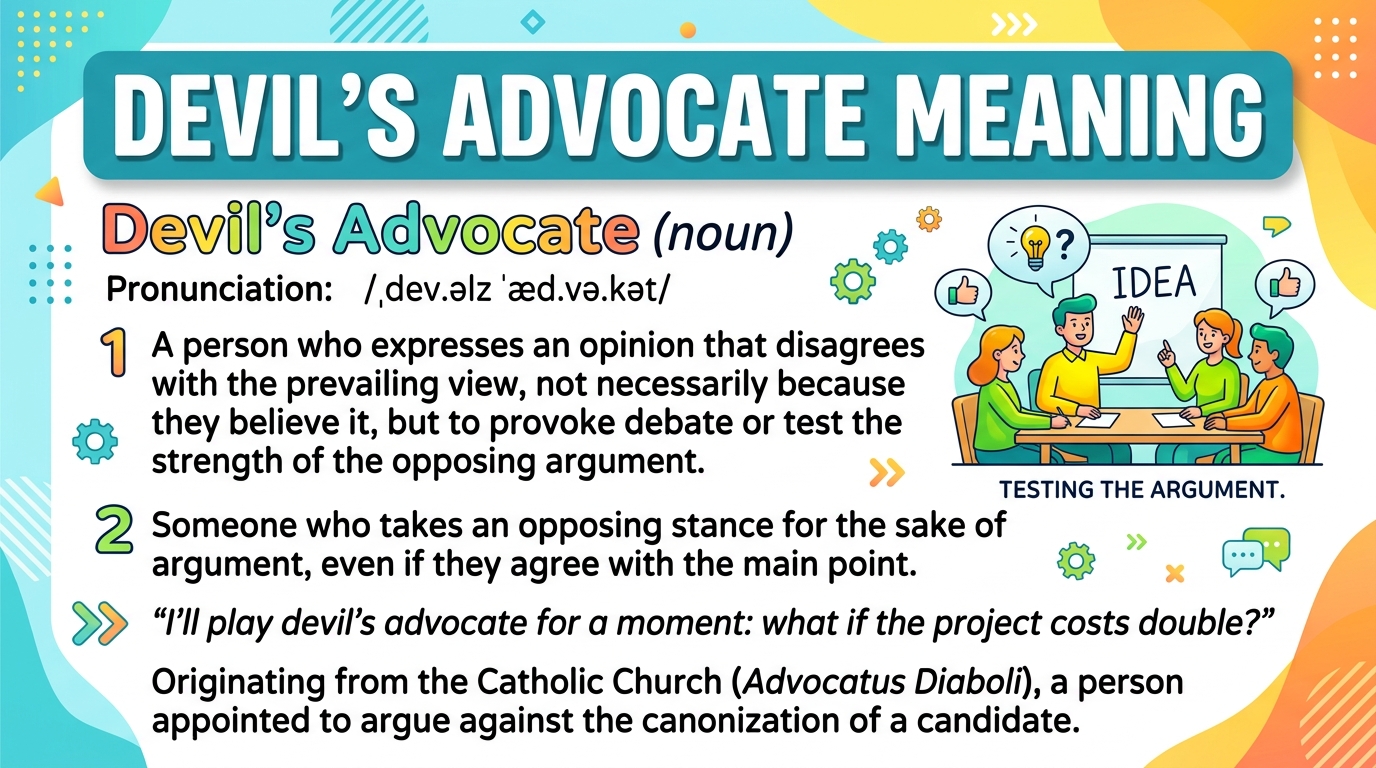
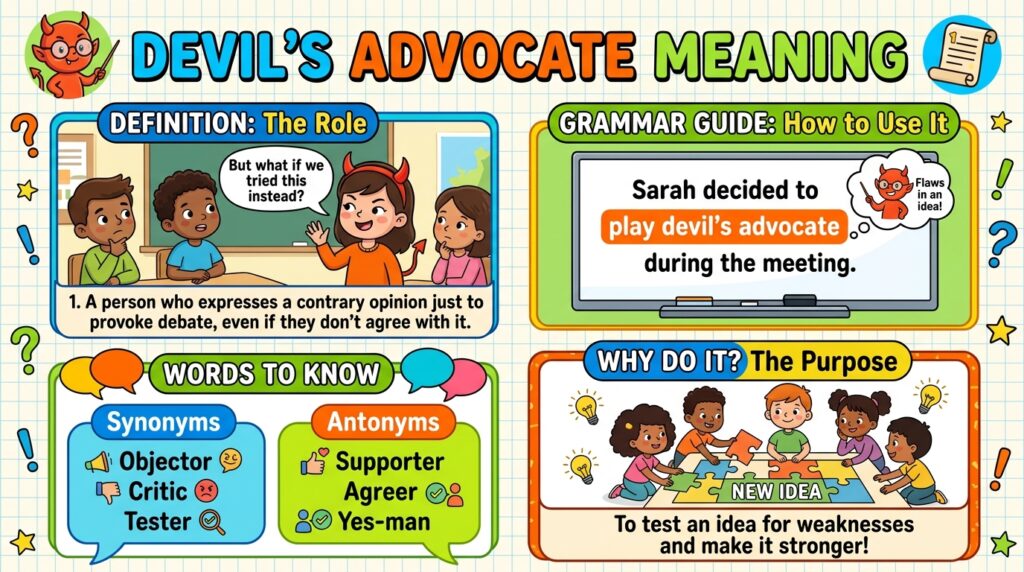
The devil’s advocate meaning refers to a person who intentionally argues against an idea, even if they agree with it, just to explore its weaknesses or test its strength.
In simple words:
- It means questioning ideas on purpose.
- It helps in critical thinking and decision-making.
- It is not personal disagreement, but intellectual testing.
Example quotes:
- “Let me play devil’s advocate here—what if this plan fails?”
- “I agree, but I’ll still be devil’s advocate for clarity.”
- “Someone has to question this idea, even if it’s unpopular.”
Origin & Background
The term comes from Latin “advocatus diaboli”, used in the Roman Catholic Church. A person was assigned to argue against someone’s sainthood to test whether they truly deserved it.
Over time, the meaning moved from religious settings to everyday conversation and professional discussions.
Today, it’s widely used in:
- Business meetings
- Legal debates
- Social media arguments
- Academic discussions
On platforms like Reddit and Twitter, people often use it to challenge viral opinions or trending beliefs.
Real-Life Conversations (MANDATORY)
WhatsApp Chat:
Person A: “We should invest all savings in this crypto project.”
Person B: “I’ll play devil’s advocate… what if the market crashes tomorrow?”
Instagram DM:
Person A: “This influencer is always right.”
Person B: “Devil’s advocate here—what about their past controversies?”
TikTok Comment Thread:
Person A: “This movie is a masterpiece.”
Person B: “I’ll be devil’s advocate, the pacing was actually slow in the middle.”
Text Message:
Person A: “We should trust this new startup completely.”
Person B: “Let me be devil’s advocate—do we even know their track record?”
Emotional & Psychological Meaning
The devil’s advocate meaning goes deeper than language—it reflects how people think under uncertainty.
It shows:
- A need for truth verification
- Fear of blind agreement
- Desire for balanced thinking
Psychologically, people use it to avoid groupthink, where everyone agrees without questioning. It helps create emotional safety in decision-making because all sides are tested.
Personal-style scenario:
In a team meeting, everyone agrees on a marketing strategy. One person quietly says, “Let me play devil’s advocate…” Suddenly, the room slows down. Weak points appear. The idea becomes stronger—not weaker.
That’s the real power of this phrase.
Usage in Different Contexts
In social media, it’s often used to challenge viral opinions or controversial posts.
In friendships, it appears during debates like movies, relationships, or lifestyle choices.
In work environments, it is a professional tool used in brainstorming and risk analysis.
In casual tone, it can sound playful:
- “I’m just being devil’s advocate 😄”
In serious tone, it becomes analytical:
- “Let’s consider risks by playing devil’s advocate.”
When NOT to Use It
Even though it’s useful, there are times when it can backfire:
- During emotional arguments where someone needs support, not debate.
- In sensitive topics like personal trauma or grief.
- When people are looking for validation, not opposition.
- In situations where tone can be misunderstood as negativity.
Used at the wrong time, it can feel dismissive or argumentative.
Common Misunderstandings
Many people think:
- It means being negative → ❌ Wrong
- It means disagreeing personally → ❌ Wrong
- It means arguing for attention → ❌ Wrong
The real idea is:
- Testing logic, not people
- Strengthening ideas, not destroying them
- Encouraging deeper thinking
Comparison Table
| Concept | Meaning | Usage | Example | Comparison |
|---|---|---|---|---|
| Devil’s advocate meaning | Challenging an idea to test it | Critical thinking | “What if this fails?” | Different from blind agreement |
| How to use devil’s advocate | Apply in debates | Analytical discussions | Risk evaluation in meetings | More structured than casual disagreement |
| Examples of devil’s advocate | Real-life usage | Conversations | “Let’s question this plan” | Helps refine ideas |
| Devil’s advocate vs disagreement | Testing vs opposing | Intellectual debate | “I’m not against you, just exploring” | Not emotional conflict |
Key Insight:
Devil’s advocate is not about saying “no”—it’s about making sure “yes” is strong enough to survive questioning.
Variations / Types (8–10)
- Devil’s advocate meaning in text
Used in chat to challenge ideas casually. - Devil’s advocate slang
Informal way of saying “I disagree to test logic.” - Devil’s advocate abbreviation
Often shortened as “DA” in notes or discussions. - Devil’s advocate in chat
Used during group messaging debates. - Devil’s advocate tone
Neutral, questioning, analytical. - Being devil’s advocate
Act of intentionally opposing an idea. - Play devil’s advocate
Common phrase for argument testing. - Devil’s advocate mindset
Thinking style focused on critique and logic. - Devil’s advocate discussion
Structured debate technique. - Devil’s advocate argument
Counterpoint used to test validity.
How to Respond When Someone Uses It
Casual replies:
- “Fair point, let’s explore that.”
- “Okay, I see what you mean.”
Funny replies:
- “Here comes the professional troublemaker 😄”
- “You’re just here to make things complicated!”
Mature replies:
- “That’s a valid perspective, let’s consider it seriously.”
- “Good point, we should examine that risk.”
Respectful replies:
- “I appreciate you questioning this.”
- “That helps improve the idea.”
Regional & Cultural Usage
In Western cultures, it’s widely accepted in business and education as a critical thinking tool.
In Asian cultures, it may be used more carefully to avoid appearing confrontational, especially in hierarchical settings.
In Middle Eastern cultures, tone matters strongly—direct opposition can be seen as disrespectful unless framed politely.
On global internet platforms, especially Reddit, it is extremely common in debates and opinion threads.
Gen Z uses it casually in memes and comment sections, while Millennials often use it in structured discussions or workplaces.
Is It Safe for Kids?
Yes, it is safe because it is a thinking concept, not harmful language. However, children should be guided on tone so it doesn’t turn into unnecessary arguments or negativity in conversations.
FAQs
What does being a devil’s advocate mean?
Being a devil’s advocate means intentionally questioning or challenging an idea, even if you personally agree with it. It is done to test logic, uncover weak points, and make decisions stronger through critical thinking.
What is an example of a devil’s advocate?
An example is when someone says, “This business idea will succeed,” and another person responds, “Let me play devil’s advocate—what if customers don’t find it useful?” It helps explore risks before finalizing decisions.
Why is it called the Devil’s Advocate?
It comes from the Latin term advocatus diaboli, used in the Catholic Church. A person was assigned to argue against sainthood to test whether the candidate truly deserved it, ensuring fairness and truth.
What is a better term for devil’s advocate?
Better or alternative terms include “counter-arguer,” “critical thinker,” “skeptic,” or “playing the opposing viewpoint.” In professional settings, it is often called “constructive challenge.”
Is being a devil’s advocate negative?
No, it is not negative when used correctly. It is a thinking tool that improves ideas by testing them. However, if overused or used in emotional situations, it can feel argumentative.
Where is devil’s advocate commonly used?
It is commonly used in business meetings, debates, academic discussions, and online conversations where people want to test ideas before making final decisions.
Does devil’s advocate mean you disagree?
Not necessarily. It means you are exploring the opposite side of an idea for better understanding, not rejecting it completely or personally disagreeing.
Can devil’s advocate improve decision-making?
Yes, it helps identify risks, hidden flaws, and alternative perspectives. This leads to more balanced and well-thought-out decisions in both personal and professional life.
Is devil’s advocate used in everyday conversation?
Yes, people often use it casually when discussing movies, opinions, plans, or social media topics to question popular views and keep conversations balanced.
What is the main purpose of devil’s advocate thinking?
The main purpose is to challenge assumptions, avoid groupthink, and strengthen ideas by testing them from different angles before accepting them as final truth.
Conclusion
Understanding the devil’s advocate meaning helps you see how powerful questioning can be in everyday life. It is not about negativity or conflict, but about building stronger ideas through thoughtful challenge. When used correctly, it improves conversations, sharpens decisions, and prevents blind agreement. In modern communication, this mindset encourages balance between belief and doubt. Whether in friendships, work, or online debates, it reminds us that asking “what if?” is often the first step toward better understanding and smarter thinking.