Some words don’t just add meaning—they shift the entire tone of a sentence. “Nevertheless” is one of those words. It often appears in writing, speeches, conversations, and even social media captions, yet many people still feel unsure about its exact use.
People search “nevertheless meaning” because it sounds formal, slightly literary, and sometimes confusing in real-life conversation. You may understand the sentence, but the word itself feels like a bridge you’re not fully crossing.
Simply put, “nevertheless” is used when something is true despite a previous idea. It connects contrast in a smooth, confident way.
In this article, you’ll understand it deeply through real examples, emotions, cultural usage, and everyday situations so you can use it naturally—not mechanically.
Nevertheless Meaning in Urdu
“Nevertheless” in Urdu is commonly translated as:
- “اس کے باوجود”
- “پھر بھی”
- “تاہم”
It expresses contrast or unexpected continuation.
Examples:
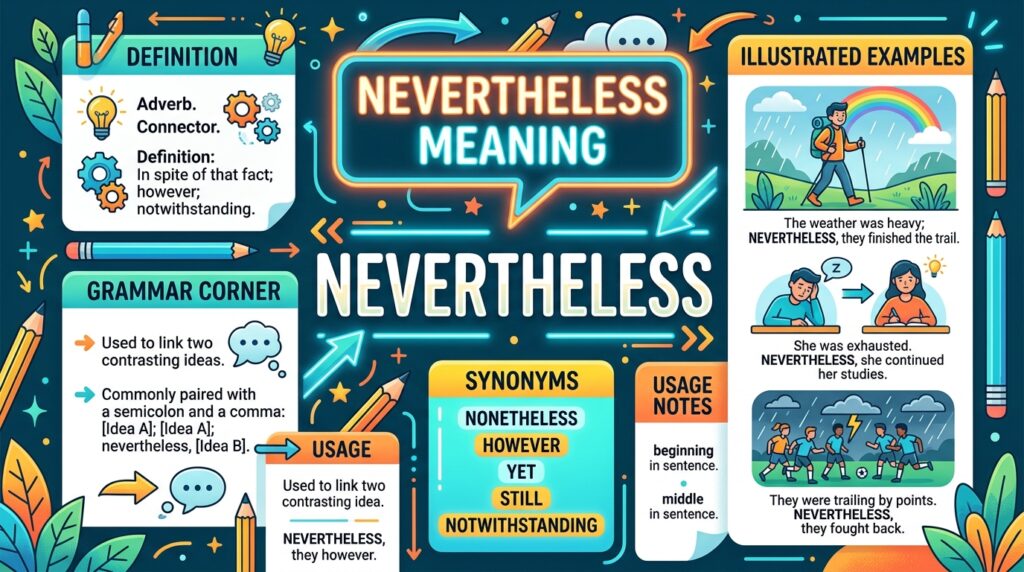
- He was tired; nevertheless, he kept working.
وہ تھکا ہوا تھا، پھر بھی وہ کام کرتا رہا۔ - The weather was bad; nevertheless, the match continued.
موسم خراب تھا، اس کے باوجود میچ جاری رہا۔
It carries a tone of determination and emotional strength in Urdu usage.
Nevertheless Meaning with Example
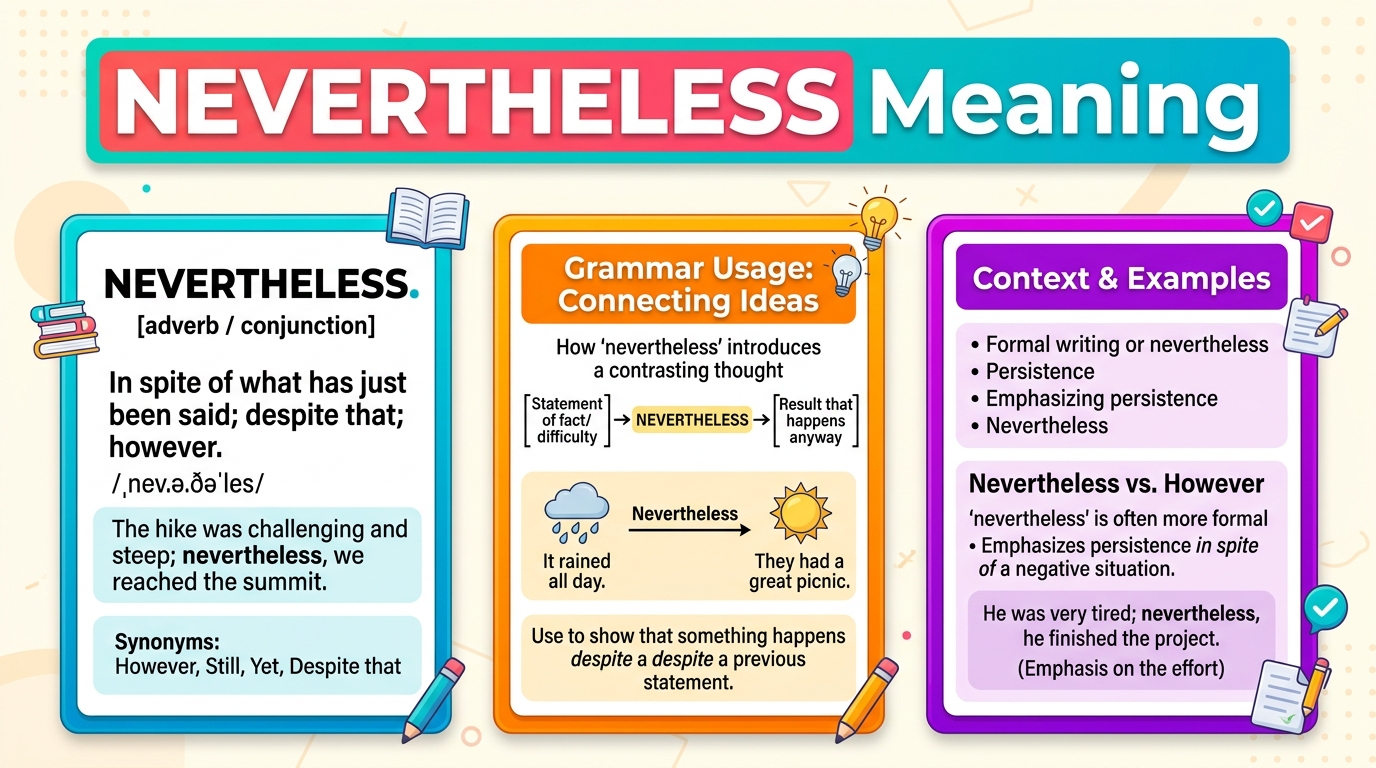
“Nevertheless” means: in spite of that; however; still.
It connects two opposite ideas smoothly.
Examples:
- She was nervous; nevertheless, she gave a great speech.
- The journey was long; nevertheless, it was worth it.
- He failed twice; nevertheless, he didn’t give up.
It is often used in writing to show resilience, contrast, or emotional strength.
Nevertheless Meaning in English
In English, “nevertheless” is a transitional adverb used to introduce a contrast.
Simple definition:
- It means “despite what has just been said”
Common uses:
- Formal writing
- Essays
- Storytelling
- Professional speech
Example sentences:
- The task was difficult; nevertheless, they completed it on time.
- She didn’t agree with the decision; nevertheless, she respected it.
It adds elegance and depth to communication.
Nevertheless Meaning in Law
In legal language, “nevertheless” is used to maintain clarity while introducing exceptions.
It often appears in clauses where rules and exceptions coexist.
Example:
- The contract was terminated; nevertheless, certain obligations remain valid.
In law:
- It signals exceptions
- It preserves legal balance
- It avoids ambiguity between conflicting statements
Legal writing relies on it to ensure precision without emotional tone.
Nevertheless Meaning Kdrama
In K-dramas, “nevertheless” is often used as a symbolic expression rather than a literal word.
It represents:
- Emotional conflict
- Uncertainty in relationships
- Attraction despite consequences
The famous drama Nevertheless uses the idea of:
- “I know it’s risky… nevertheless, I still want it.”
It reflects modern love dilemmas where logic and emotion collide.
Nevertheless Meaning in Russian
In Russian, “nevertheless” is translated as:
- “тем не менее”
Example:
- Он устал, тем не менее он продолжал работать.
(He was tired; nevertheless, he kept working.)
It is commonly used in formal and literary Russian, similar to English usage.
Nevertheless Meaning in Arabic
In Arabic, “nevertheless” can be expressed as:
- “مع ذلك”
- “ومع ذلك”
Example:
- كان الجو حارًا، ومع ذلك استمروا في اللعب.
(The weather was hot; nevertheless, they continued playing.)
It carries a tone of persistence and contrast, often used in storytelling and speeches.
Nevertheless Meaning for Kids
For kids, “nevertheless” can be understood as:
👉 “Even though that happened, something else still happened.”
Simple examples:
- I was scared; nevertheless, I tried.
- It was raining; nevertheless, we went outside.
Kid-friendly meaning:
- A fancy word for “but still”
It helps children understand contrast in storytelling.
Origin & Background
“Nevertheless” comes from Middle English, formed by combining:
- “never” + “the” + “less”
Historically, it was used in formal writing to emphasize contrast strongly.
Over time:
- It became common in literature
- Later entered legal and academic writing
- Now appears in social media captions and motivational speech
On platforms like TikTok and Instagram, it is often used to add emotional weight:
- “I was broken, nevertheless I healed.”
Real-Life Conversations (MANDATORY)
WhatsApp Conversation:
Person A: I think I failed the exam.
Person B: You studied hard; nevertheless, sometimes results are unpredictable.
Instagram DM:
Person A: She ignored my message again.
Person B: That hurts… nevertheless, don’t lose your self-respect.
TikTok Comment Thread:
Person A: Life is too unfair.
Person B: True, nevertheless, we keep going.
Text Message:
Person A: I don’t feel like going out today.
Person B: It’s okay, nevertheless, fresh air might help you feel better.
Emotional & Psychological Meaning
“Nevertheless” often reflects emotional resilience. It shows that someone acknowledges difficulty but chooses to continue anyway.
Psychologically, it signals:
- Acceptance of reality
- Inner strength
- Emotional balance between logic and feeling
Example scenario:
A person fails repeatedly in job interviews. They feel discouraged, nevertheless they apply again because they believe in their growth.
It becomes a quiet statement of courage.
Usage in Different Contexts
Social Media:
- Used in captions for emotional depth
“Life broke me, nevertheless I smile.”
Friends & Relationships:
- Used to show understanding or contrast
“You were wrong, nevertheless I forgive you.”
Work / Professional Settings:
- Used in reports and formal speech
“The project faced delays; nevertheless, it was completed.”
Casual Tone:
- Less common, replaced by “but still”
When NOT to Use It
Avoid using “nevertheless” in:
- Very casual texting with friends (sounds too formal)
- Emotional arguments where tone matters more than structure
- Child-friendly conversations without explanation
It may sound distant or overly serious in relaxed communication.
Common Misunderstandings
Many people confuse “nevertheless” with:
- “Therefore” (wrong—this shows result, not contrast)
- “Because” (wrong—this shows reason)
Another confusion:
- Thinking it means agreement (it does not)
It always shows contrast, not agreement.
Comparison Table
| Term | Meaning Intent | Usage Intent | Example Intent | Comparison Intent |
|---|---|---|---|---|
| Nevertheless | Contrast despite situation | Formal transition | He was tired; nevertheless, he worked | Stronger than “but” |
| However | Mild contrast | Neutral tone | She tried; however, she failed | Softer than nevertheless |
| But | Simple contrast | Casual speech | I like it but it’s expensive | Most informal |
| Although | Condition-based contrast | Subordinate clause | Although tired, he worked | More grammatical structure |
Key Insight:
“Nevertheless” is the most emotionally strong and formal way to show contrast, often used when determination or seriousness needs to be highlighted.
Variations / Types (Minimum 8–10)
- nevertheless meaning in text – used in formal messages
- nevertheless meaning slang – rare, but implies “still”
- nevertheless meaning in chat – shows contrast politely
- nevertheless abbreviation – not commonly abbreviated
- nevertheless meaning in writing – formal transition word
- nevertheless meaning in speech – used in structured speaking
- nevertheless synonym – however, still, yet
- nevertheless usage – linking contrasting ideas
- nevertheless tone – formal and serious
- nevertheless context – used in essays and narratives
How to Respond When Someone Uses It
Casual replies:
- “Yeah, I get what you mean.”
- “Still true though.”
Funny replies:
- “Nevertheless, I’m still tired 😂”
- “That word sounds like a lawyer talking!”
Mature replies:
- “I understand your point despite that.”
- “That’s a fair contrast.”
Respectful replies:
- “I see your perspective.”
- “Nevertheless, I appreciate your view.”
Regional & Cultural Usage
- Western culture: Common in writing, speeches, and education
- Asian culture: Used more in academic English learning
- Middle Eastern culture: Seen in formal English communication
- Global internet: Used in captions for emotional storytelling
- Gen Z: Uses it ironically or for dramatic effect
- Millennials: Use it in professional or structured writing
Is It Safe for Kids?
Yes, “nevertheless” is completely safe for kids. It is an educational word that helps improve vocabulary and understanding of sentence contrast. It may sound advanced, but with simple explanation, children can easily use it in storytelling and writing exercises.
FAQs
What is nevertheless used for?
“Nevertheless” is used to show contrast between two ideas, meaning something happens or is true despite a previous statement. It connects opposing thoughts smoothly in formal writing or speech.
What is the synonym of nonetheless?
Common synonyms of “nonetheless” include nevertheless, however, still, yet, and even so. All these words express contrast, but “nonetheless” sounds slightly formal and written.
What is the meaning of the word nevertheless?
“Nevertheless” means in spite of that or still. It is used when one idea is true even after considering another opposite or limiting idea.
What does “nonetheless” mean?
“Nonetheless” means even though something happened or is true, another thing still happens. It shows contrast while maintaining flow in a sentence.
Is “nevertheless” formal or informal?
“Nevertheless” is mostly formal and is commonly used in essays, speeches, academic writing, and professional communication rather than casual texting.
Can “nevertheless” and “however” be used the same way?
They are similar but not identical. “However” is softer and more neutral, while “nevertheless” feels stronger and more emphatic in showing contrast.
Where is “nevertheless” commonly used?
It is commonly used in academic writing, legal documents, formal speeches, storytelling, and structured essays to express contrast clearly.
What is the difference between “nevertheless” and “but”?
“But” is simple and informal, used in daily conversation. “Nevertheless” is more formal and adds stronger emphasis to contrast between ideas.
Can I use “nevertheless” in daily conversation?
Yes, but it may sound slightly formal or dramatic in casual talk. People often replace it with “still” or “but” in everyday speech.
Why do writers use “nevertheless”?
Writers use it to add depth, contrast, and emotional strength to sentences, especially when showing persistence or unexpected outcomes.
Conclusion
“Nevertheless” is more than just a linking word; it is a reflection of contrast, resilience, and emotional balance in communication. It helps express situations where challenges exist, yet action continues. Whether used in writing, speech, or storytelling, it adds depth and clarity to ideas. Understanding it allows you to sound more confident and expressive in English. Once you start noticing it in conversations, you’ll see how naturally it shapes meaning and strengthens emotional expression.