If you’ve come across the term “DILF” online and felt confused, you’re not alone. It’s one of those slang words that pops up in memes, TikTok comments, and Instagram captions—often without explanation.
People search it because the internet rarely pauses to define what it’s saying. One moment it’s a joke, the next it’s a compliment, and sometimes it feels completely out of context.
At its core, DILF meaning is tied to modern internet slang that describes an attractive older man, usually a father. But the real story is more layered than just a definition.
This term reflects how Gen Z and millennials play with language, humor, attraction, and pop culture. It also shows how online communities turn bold expressions into everyday slang.
Understanding it isn’t just about knowing the words—it’s about understanding the culture behind them.
DILF Meaning – Quick Definition Explained Simply
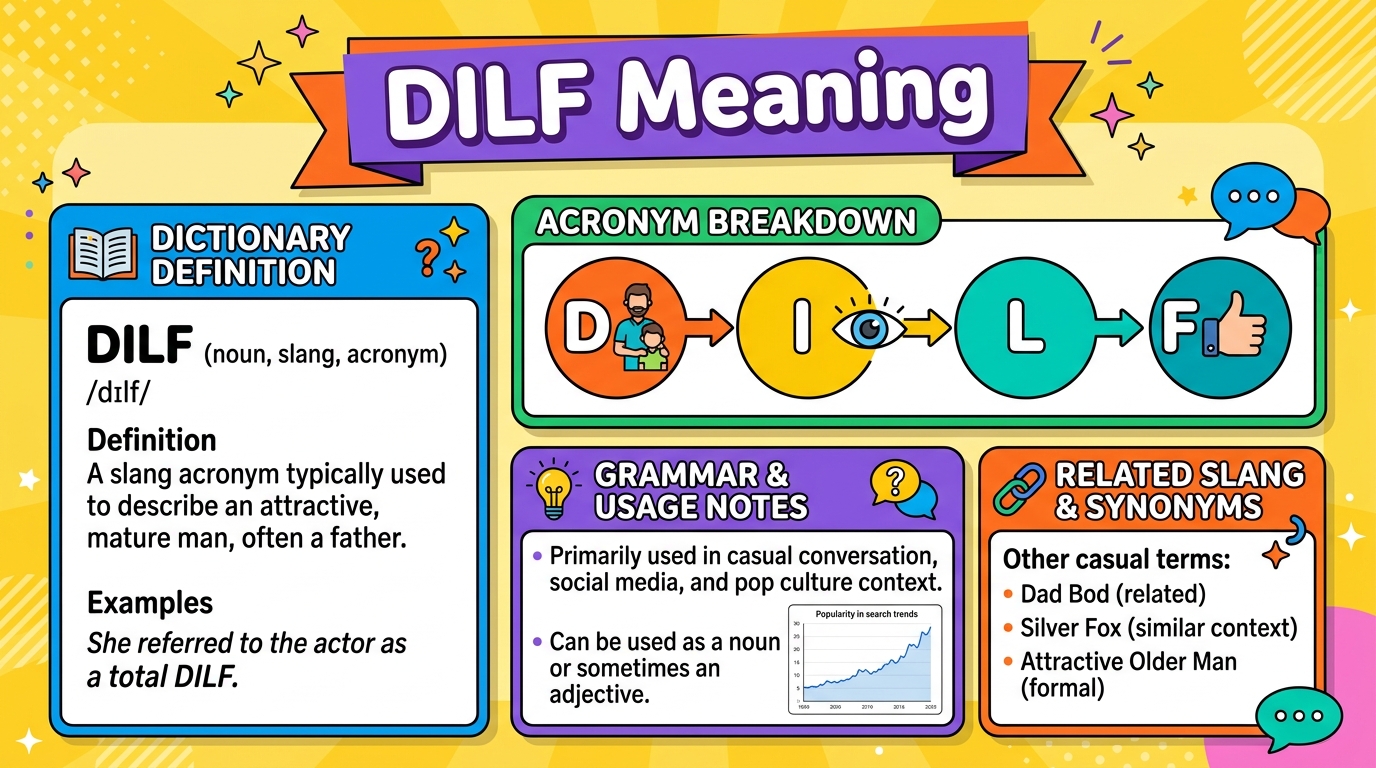
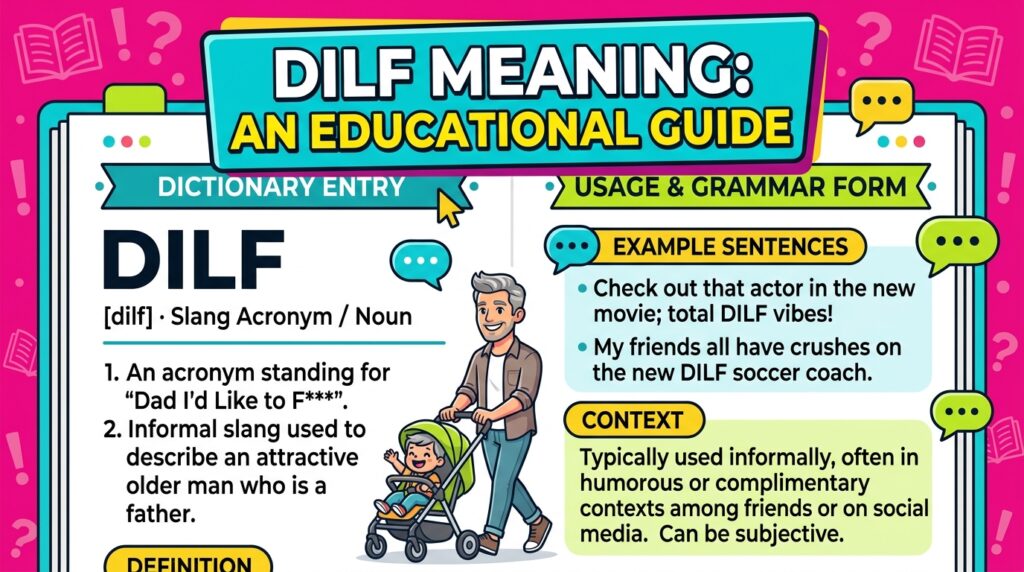
The term DILF is an acronym.
It generally stands for:
“Dad I’d Like to F*”**
However, in modern usage, it is often softened in meaning and used as:
- A compliment for an attractive older man
- A humorous internet label
- A pop culture reference for confident masculinity
- A meme-based expression online
Example usage in conversations:
- “That actor in his 40s is such a DILF.”
- “Bro, your gym coach? Total DILF energy.”
- “People on TikTok are calling him a DILF now.”
It is usually used informally and is not considered appropriate for professional settings.
Origin & Background of DILF Meaning
The term DILF evolved from earlier internet slang patterns like MILF, which became widely popular in early 2000s pop culture and comedy films.
Over time, internet users began creating variations, and DILF naturally followed the same structure.
How it spread:
- Early usage in American pop culture and comedy movies
- Expansion through meme culture and online forums
- Viral growth on platforms like Twitter, Reddit, and TikTok
- Adoption by Gen Z as playful humor rather than literal meaning
What makes DILF interesting is how its tone shifted. It started as crude slang but became more of a humorous admiration term in online communities.
Today, it is often used ironically, meaning people don’t always intend it seriously.
Real-Life Conversations Using “DILF”
1. WhatsApp Chat
Friend 1: Did you see Mr. Harris at the school event?
Friend 2: Yeah… why does he look like a movie star now?
Friend 1: Honestly… kind of a DILF 😂
Friend 2: STOP, I can’t unsee that now
2. Instagram DM
User A: That new gym trainer on your story looks intense
User B: Right?? Everyone in comments is calling him a DILF
User A: Internet never disappoints 💀
3. TikTok Comment Section
Comment 1: This dad is actually iconic
Comment 2: Full DILF energy, no debate
Comment 3: I didn’t expect this video to go this direction 😭
4. Text Message
Friend: Why is everyone talking about that celebrity?
You: Because apparently he aged like fine wine
Friend: So… DILF?
You: Exactly.
Emotional & Psychological Meaning Behind DILF
Beyond the humor, DILF meaning reveals something deeper about modern communication.
It reflects how people express attraction in a way that feels:
- Playful rather than serious
- Social-media friendly
- Slightly exaggerated for humor
- Emotionally detached but expressive
Psychologically, it shows how online culture removes traditional boundaries of compliments. Instead of formal praise, people use bold slang to create impact and humor.
In real life, someone might never say this directly. But online, it becomes a safe way to express admiration without seriousness.
Personal-style scenario:
You’re scrolling TikTok late at night. A video shows a dad helping his daughter with a school project. The comments are full of jokes like “DILF alert.” You laugh—not because it’s literal, but because the internet has turned ordinary moments into playful cultural expressions.
That’s the emotional layer: humor mixed with admiration.
Usage in Different Contexts
Social Media
This is where DILF is most common. It appears in:
- TikTok comments
- Instagram captions
- Meme pages
- Twitter jokes
Friends & Relationships
Among friends, it’s used jokingly:
- As a roast
- As playful humor
- As exaggerated admiration
Work / Professional Settings
It should never be used professionally. It is:
- Informal slang
- Potentially inappropriate
- Not suitable for workplace communication
Casual vs Serious Tone
- Casual: humorous, joking, meme-like
- Serious: rarely used seriously, almost always ironic
When NOT to Use DILF
Even though it is popular, there are moments when using it is not appropriate.
Avoid using it:
- In formal conversations
- With people you don’t know well
- In professional environments
- When referring to someone who may feel disrespected
Cultural sensitivity matters because not everyone interprets slang the same way.
What feels funny online may feel offensive in real life.
Common Misunderstandings About DILF Meaning
Many people misunderstand this slang because of its bold structure.
Common mistakes:
- Thinking it is always meant literally
- Assuming it is a formal compliment
- Believing it is appropriate in all contexts
- Confusing it with respectful admiration
In reality, it is mostly:
- Humorous
- Internet-driven
- Context-dependent
- Often ironic
Tone plays a huge role in how it is interpreted.
Comparison Table: Understanding DILF Meaning Clearly
| Term/Concept | What It Means | How It’s Used | Example | Comparison |
|---|---|---|---|---|
| DILF | Attractive older father figure slang | Internet humor/slang | “He’s such a DILF” | Similar to MILF but for men |
| MILF | Attractive older mother figure slang | Pop culture & memes | “She’s a MILF in that movie” | Older origin slang |
| Internet slang | Informal online language | Social media communication | “LOL, sus, DILF” | Broad category |
| Meme language | Humor-based online expression | Viral content jokes | “DILF energy 😂” | Context-driven humor |
Key Insight
DILF is not just a word—it is part of a larger internet language system where humor, attraction, and exaggeration merge into digital expression.
Variations & Related Slang (8–10 Types)
- DILF meaning slang – humorous label for attractive dad-type men
- DILF in text – used casually in messages or jokes
- DILF abbreviation – shortened internet acronym
- DILF slang meaning – playful attraction-based expression
- DILF in chat – used in memes or friendly banter
- Hot dad slang – softer version of the same idea
- Dad crush slang – informal admiration expression
- Older man attraction slang – general internet category
- Internet DILF joke – meme-based usage
- DILF energy – exaggerated compliment style
Each variation carries the same core idea but changes tone depending on context.
How to Respond When Someone Uses “DILF”
Casual replies
- “You’re wild for that 😂”
- “Internet has no chill”
Funny replies
- “I’m telling him you said that 💀”
- “That’s a dangerous opinion”
Mature replies
- “Let’s keep it respectful though”
- “That’s just internet slang, nothing serious”
Respectful replies
- “Different people interpret slang differently”
- “Let’s not label people like that”
Regional & Cultural Usage
Western culture
Most common usage. Seen in memes, TV references, and social media humor.
Asian culture
Used mainly among younger internet users familiar with Western slang.
Middle Eastern culture
Less common in public use due to cultural sensitivity.
Global internet usage
Primarily meme-driven and understood in online spaces.
Generational differences
- Gen Z: Uses it jokingly and frequently
- Millennials: Understands it but uses it less
- Older generations: Often confused by it
Is It Safe for Kids?
No, it is not considered appropriate for children or younger teens.
While it appears often online, it includes adult slang origins and should be understood in mature contexts only.
FAQs About DILF Meaning
What is the female version of DILF?
The female version of DILF is commonly “MILF,” which refers to an attractive older mother figure in slang. It is used in a similar humorous or pop culture context.
What is an example of a DILF?
An example would be a fit, confident father in his 30s or 40s who is admired for his looks. For instance, “That actor playing a dad in the movie is a total DILF.”
What is the term for hot dad?
The most common slang term for a “hot dad” is DILF. It is used casually online to describe an attractive father figure.
What is the plural form of DILF?
The plural form is “DILFs,” used when referring to more than one attractive older man or father figure in slang.
Is DILF always meant literally?
No, it is often used humorously or as internet slang. Many people use it jokingly without any literal intent.
Is DILF a respectful term?
It depends on context. Among friends or online memes, it is playful, but in real life it can be considered inappropriate.
Where is the term DILF mostly used?
It is mostly used on social media platforms like TikTok, Instagram, Twitter, and meme communities.
Can DILF be used for celebrities?
Yes, people often use it jokingly for older male celebrities who are seen as attractive or stylish.
Is DILF offensive?
It can be offensive if used in the wrong setting or directed at someone who may not appreciate it. Context matters a lot.
What does DILF energy mean?
“DILF energy” is a meme-style phrase used to describe a man who gives off attractive, confident, and mature vibes, often humorously.
Conclusion
Understanding DILF meaning is really about understanding modern internet language. It is not just a slang word but a reflection of how online communities mix humor, attraction, and exaggeration into everyday speech. While it can sound bold or confusing at first, its usage is usually lighthearted and meme-driven. Knowing when and how to interpret it helps avoid misunderstanding and keeps communication culturally aware. In the end, it shows how quickly language evolves in the digital world we live in today.