“Petty” is one of those words you hear everywhere—on social media, in conversations, even in casual jokes—but its meaning often feels deeper than just “small-minded behavior.” People use it when someone reacts over something minor, holds unnecessary grudges, or turns a simple situation into drama.
The reason people search petty meaning so often is because the word carries emotion, not just definition. It describes behavior we’ve all seen, and sometimes even caught ourselves doing. It’s not just about being “trivial”—it’s about how small actions can feel surprisingly personal.
In real life, “petty” can sound funny, insulting, or even self-aware depending on context. Understanding it helps you read tone better, respond wisely, and avoid misunderstandings in modern digital communication.
Petty Meaning in English – Quick Meaning
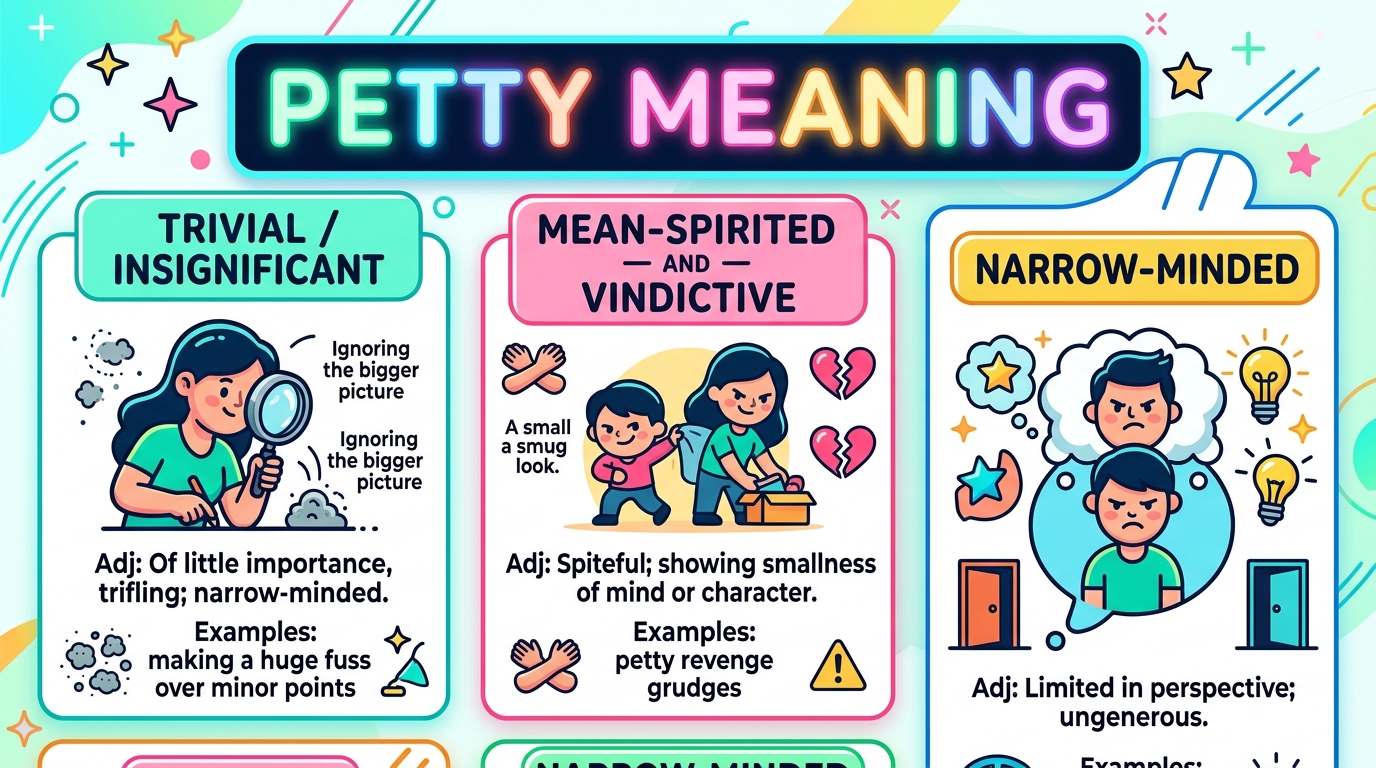
In simple English, petty means something small, unimportant, or trivial—but often used to describe behavior that is unnecessarily emotional or spiteful over minor issues.
Basic definition:
- Showing irritation over small things
- Acting immature or overly sensitive about minor issues
- Focusing on unimportant details in a negative way
Examples:
- “She blocked him over a petty argument.”
- “That was so petty of him to ignore the message.”
- “Stop being petty about small mistakes.”
In everyday language, “petty” is less about size and more about attitude.
Origin & Background of Petty Meaning
The word “petty” comes from the Old French word petit, meaning “small.” Over time, English adopted it to describe things that are minor or insignificant.
But language evolves with culture. Today, especially in internet slang, “petty” has taken on a more emotional meaning. It’s not just “small”—it’s deliberately small in a dramatic way.
Social media platforms like TikTok, Instagram, and Twitter have played a huge role in reshaping the word. People now proudly say things like “I’m being petty today” as a form of humor or revenge-driven sarcasm.
What used to be purely negative has become partly entertaining and self-aware in modern communication.
Petty Meaning in Urdu
In Urdu, petty is commonly translated as:
- چھوٹا / معمولی (chhota / mamooli)
- غیر اہم (ghair aham)
- چھوٹی باتوں پر ناراض ہونا
Simple explanation:
It refers to someone who gets upset over small or unimportant matters.
Examples:
- “وہ بہت petty ہے، چھوٹی باتوں پر لڑ پڑتا ہے۔”
- “اتنی petty بات پر ناراض ہونا ٹھیک نہیں ہے۔”
In Urdu conversation, it often carries a slightly critical tone, pointing out emotional immaturity.
Petty Person Meaning
A petty person is someone who tends to react strongly to small issues or behaves in a narrow-minded or spiteful way.
Traits of a petty person:
- Holds grudges over minor conflicts
- Gets offended easily
- Focuses on irrelevant details
- May act out of jealousy or ego
Example:
- “He didn’t invite me, so I won’t invite him either—what a petty person mindset.”
A petty person doesn’t always act badly intentionally; sometimes it comes from emotional sensitivity or insecurity.
Petty Meaning Slang
In slang, “petty” is often used in a humorous or sarcastic way.
It can mean:
- Playfully revengeful behavior
- Overreacting to something small for fun
- Light emotional drama
Slang examples:
- “I’m being petty and liking all his old posts.”
- “That was petty, but I respect it.”
On social media, being “petty” is sometimes celebrated as a funny personality trait rather than a flaw.
So Petty Meaning
When someone says “so petty,” they are emphasizing that a behavior is extremely small-minded or dramatic.
Examples:
- “You didn’t reply just because I was late? That’s so petty.”
- “Deleting my number over that? So petty.”
It usually expresses disbelief or playful criticism. The tone decides whether it’s joking or serious.
Don’t Be Petty Meaning
“Don’t be petty” is a gentle or direct way of telling someone to stop overreacting to something minor.
It usually means:
- Don’t act emotionally over small issues
- Don’t make unnecessary drama
- Be mature about the situation
Example:
- “He forgot your message once. Don’t be petty about it.”
It can sound caring or slightly firm depending on tone.
Petty Behavior Meaning
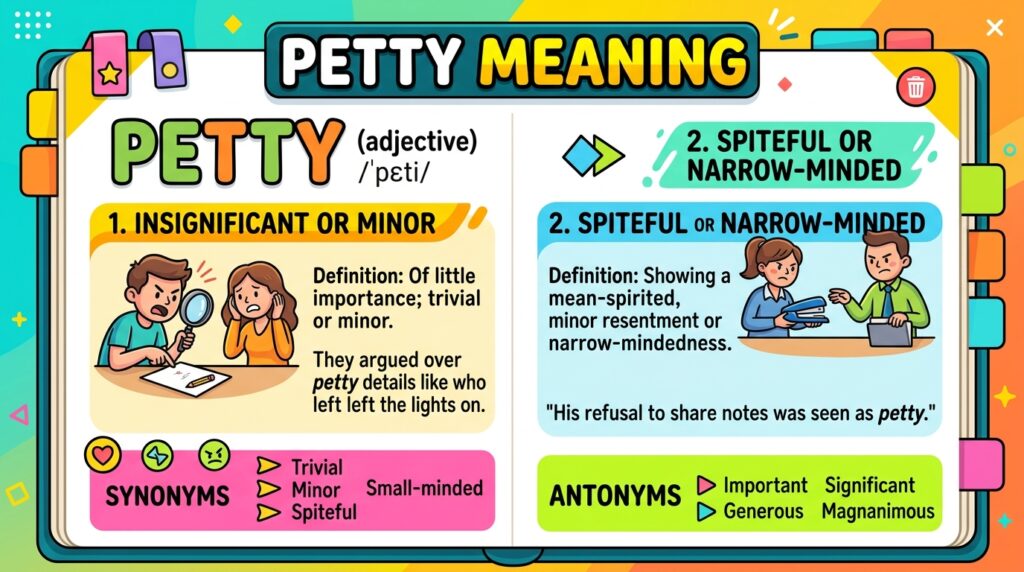
Petty behavior refers to actions that show unnecessary negativity over small things.
Common examples:
- Ignoring someone just to prove a point
- Deliberately not helping someone over a minor issue
- Making sarcastic comments out of annoyance
Petty behavior is often driven by emotions rather than logic. It can harm relationships if repeated often.
Petty Meaning Tagalog
In Tagalog (Filipino language), “petty” is commonly understood as:
- “mababaw ang dahilan” (shallow reason)
- “maliliit na bagay lang” (just small things)
- or directly borrowed as “petty”
Example:
- “Ang petty mo naman, maliit lang na bagay pinapalaki mo.”
In Filipino online culture, the word is also used humorously, especially in relationship jokes and meme content.
Real-Life Conversations
WhatsApp Chat
Person A: Why didn’t you reply?
Person B: You saw my story but ignored me.
Person A: That’s so petty, I was just busy!
Instagram DM
Person A: I unfollowed him.
Person B: Why?
Person A: He didn’t like my post.
Person B: Bro, that’s petty but iconic 😂
TikTok Comment Section
User A: I deleted his playlist after breakup.
User B: That’s petty energy right there.
User C: Sometimes petty is healing honestly.
Text Message
Friend A: She didn’t wish me happy birthday.
Friend B: Are you ignoring her now?
Friend A: Yep.
Friend B: Don’t be petty, just talk to her.
Emotional & Psychological Meaning
“Petty” is not just behavior—it reflects emotional reactions. People use it when they feel slightly hurt but don’t want to admit it directly.
Psychologically, petty behavior often comes from:
- Ego protection
- Feeling ignored or disrespected
- Desire for emotional balance or revenge
- Need for validation
Real-life scenario:
Someone doesn’t reply to your message for hours, and instead of expressing hurt directly, you ignore their next message. That silent reaction is “petty”—a soft emotional response disguised as control.
Usage in Different Contexts
Social Media:
Used humorously in memes, captions, and comment sections.
Friends & Relationships:
Can be playful or serious depending on emotional tension.
Work / Professional Settings:
Generally avoided because it sounds unprofessional.
Casual Conversations:
Very common, often used jokingly.
When NOT to Use It
Avoid using “petty” when:
- Talking in formal or workplace communication
- Discussing serious emotional conflicts
- Addressing sensitive cultural or personal issues
- The other person may feel insulted easily
Tone matters more than the word itself.
Common Misunderstandings
Many people think “petty” only means “bad behavior,” but that’s not always true.
Misunderstandings include:
- Thinking it always means insult
- Assuming it is always serious
- Confusing it with anger or toxicity
- Ignoring its humorous usage online
In reality, “petty” can be playful or emotional depending on context.
Comparison Table
| Term | Meaning Intent | Usage Intent | Example Intent | Comparison Intent |
|---|---|---|---|---|
| Petty Meaning | Small or emotionally minor behavior | Describes attitude | “That’s petty behavior.” | Compared to mature response |
| How to Use Petty | Express reactions or tone | Informal speech | “Don’t be petty.” | Compared to calm communication |
| Examples of Petty | Real-life reactions | Situational usage | Ignoring messages | Compared to rational behavior |
| Petty vs Mature | Emotional vs logical response | Behavior contrast | Silent treatment vs talk | Shows emotional growth difference |
Key Insight:
Petty behavior is less about the situation and more about emotional reaction. Small issues become big only when emotions take control.
Variations / Types of Petty (8–10)
- Petty in text – reacting emotionally in messages
- Petty slang – humorous revenge behavior
- Petty meaning chat – used in casual online talk
- Petty abbreviation – rarely abbreviated, used as-is
- Petty attitude – emotional or sensitive behavior
- Being petty – acting over small issues
- So petty – emphasizing exaggeration
- Don’t be petty – corrective phrase
- Petty humor – playful revenge jokes
- Petty mindset – thinking focused on small revenge
How to Respond When Someone Uses It
Casual replies:
- “Okay, maybe I was a little petty 😂”
- “Fair enough, I’ll chill.”
Funny replies:
- “Petty level unlocked!”
- “I accept my villain arc.”
Mature replies:
- “You’re right, I shouldn’t have reacted like that.”
Respectful replies:
- “I understand your point, let’s move forward.”
Regional & Cultural Usage
Western culture:
Often used humorously or sarcastically.
Asian culture:
More commonly seen as immature or negative behavior.
Middle Eastern culture:
Used in personal relationships, often with emotional weight.
Global internet culture:
A mix of humor, memes, and self-awareness.
Gen Z vs Millennials:
Gen Z uses it playfully; Millennials may use it more seriously.
Is It Safe for Kids?
Yes, the word itself is safe, but it depends on usage. It’s mild slang and commonly used in everyday speech. However, kids should understand context so they don’t misuse it in serious conversations or disrespect others unintentionally.
FAQs
What does “petty” mean in a person?
When someone is called petty, it means they often react strongly to small or unimportant issues. A petty person may focus on minor details, hold grudges, or get upset easily over things others consider insignificant.
What if someone is petty?
If someone is petty, it usually means they are acting emotionally over something minor. They might ignore others, take small revenge, or overthink simple situations instead of letting them go.
Is petty being rude?
Petty is not always directly rude, but it can come across as immature or passive-aggressive. The intention matters—sometimes it is playful, but in serious situations it may feel disrespectful.
Does petty mean selfish?
Not exactly. Petty and selfish are different. Petty is about overreacting to small issues, while selfish means prioritizing yourself over others in a broader sense.
Is being petty a bad thing?
It depends on context. Occasional petty behavior can be harmless or funny, but repeated pettiness in serious situations can damage relationships and trust.
Why do people act petty?
People often act petty due to hurt feelings, ego, jealousy, or emotional frustration. Instead of expressing emotions directly, they respond indirectly through small actions.
Can petty behavior ruin relationships?
Yes, if it becomes a habit. Constant petty actions like ignoring, silent treatment, or small revenge can slowly create distance and misunderstandings.
Is petty used in a joking way?
Yes, on social media and among friends, “petty” is often used humorously to describe playful revenge or small dramatic reactions.
What is the difference between petty and mature behavior?
Petty behavior reacts emotionally to small issues, while mature behavior focuses on understanding, communication, and letting go of minor problems.
How should you respond to a petty person?
It’s best to stay calm, avoid reacting emotionally, and communicate clearly. Not every petty action needs a response—sometimes ignoring it is the healthiest choice.
Conclusion
Petty meaning goes beyond just “small behavior”—it reflects how emotions shape our reactions to everyday situations. Sometimes it’s humorous, sometimes frustrating, but it always reveals something about human nature. In conversations, it can lighten moments or create misunderstandings depending on tone. Understanding its usage helps you communicate better, avoid unnecessary conflict, and read emotions more clearly. In the end, being aware of “petty” behavior allows you to choose maturity when it matters most in relationships and communication.