If you have ever seen “DND” in a text message, social media bio, gaming profile, phone setting, or workplace chat, you may have wondered what it actually means. The answer seems simple at first, but DND carries different meanings depending on where you see it.
Most people know DND as “Do Not Disturb,” but that is only one part of the story. In music, gaming, medicine, government systems, shipping, and online conversations, DND can represent completely different ideas.
People search for the meaning of DND because they encounter it in different situations and often receive mixed explanations. A friend might say “I’m on DND,” while a gamer talks about “playing DnD,” and a music fan mentions “DND by Rema.” Understanding the context is what solves the confusion.
This guide explains every major meaning of DND in a clear and practical way, helping you recognize exactly what someone means when they use it.
DND Meaning – Quick Meaning
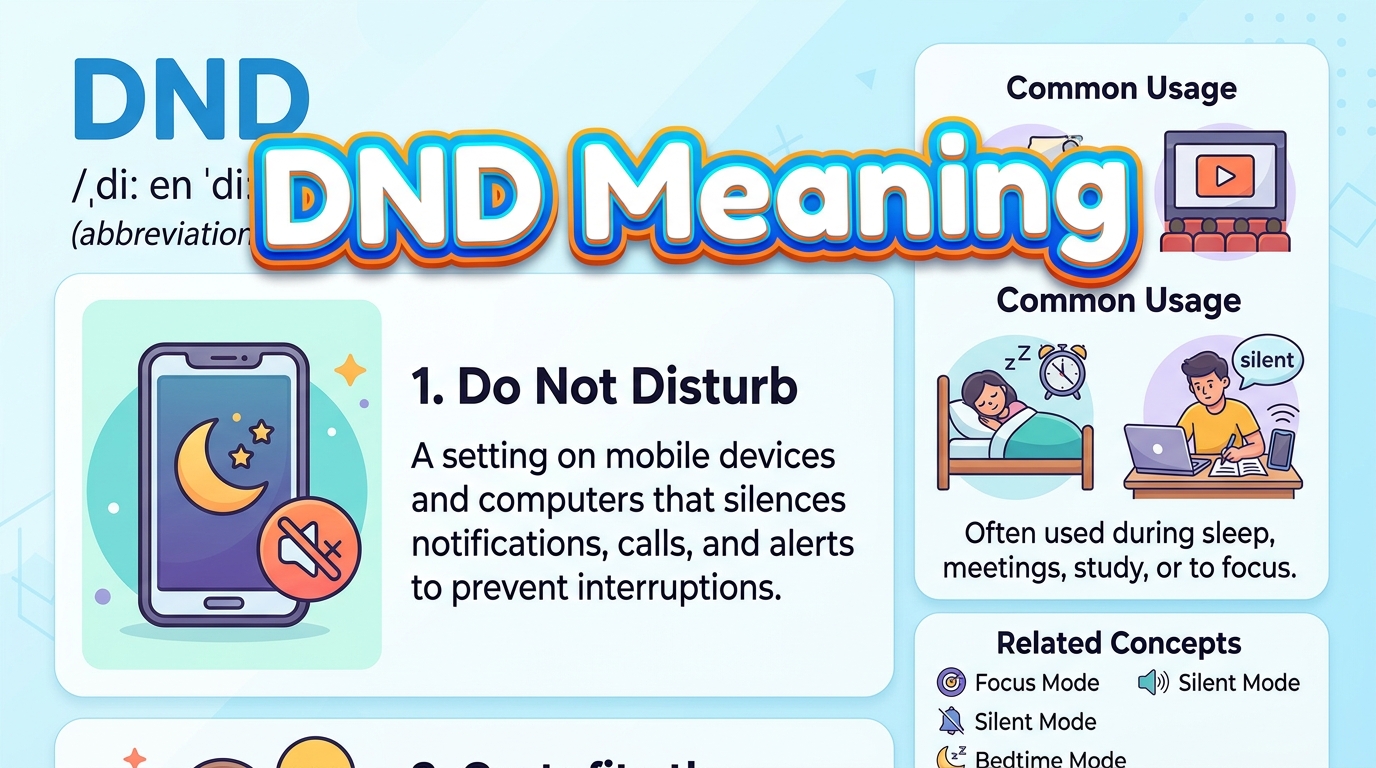
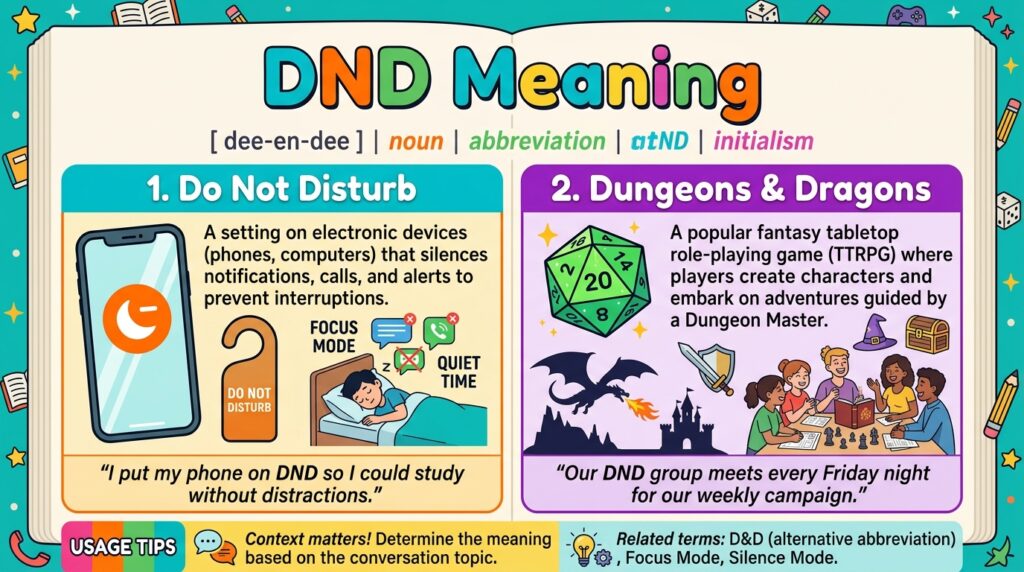
The most common meaning of DND is Do Not Disturb.
It usually signals that someone does not want interruptions, notifications, calls, or messages at that moment.
Quick Definition
- DND = Do Not Disturb
- Used on phones, apps, and messaging platforms
- Indicates a person is unavailable or busy
- Can also have specialized meanings in gaming, music, medicine, government, and shipping
Examples
“Sorry, my phone was on DND all afternoon.”
“She’s studying, so she switched on DND.”
“I’m putting my chat on DND while I finish this project.”
Origin & Background
The phrase “Do Not Disturb” existed long before smartphones appeared. Hotels commonly placed “Do Not Disturb” signs on room doors to give guests privacy.
As technology evolved, the phrase moved into telephones, computers, and eventually smartphones. Apple, Android, workplace messaging apps, and communication platforms adopted DND settings to help people manage distractions.
Social media transformed the phrase even further. Instead of merely describing a phone setting, people began using “DND” as a lifestyle statement.
Someone might post:
“On DND. Protecting my peace.”
In this context, DND reflects boundaries, focus, and emotional self-care rather than simply muting notifications.
Today, the abbreviation has become part of digital culture and everyday communication.
DND Meaning Rema
For music fans, DND often refers to “DND” by Rema, the Nigerian singer known for blending Afrobeats with modern global sounds.
In the song, DND symbolizes emotional distance, personal boundaries, and the desire to avoid unnecessary drama or distractions. The title uses the familiar idea of “Do Not Disturb” to communicate emotional independence.
Many listeners connect with the song because it reflects a modern mindset: protecting one’s peace and focusing on personal growth.
DND Meaning in Chat
In chat conversations, DND almost always means Do Not Disturb.
People use it to tell others they are unavailable without needing a lengthy explanation.
Examples:
- “I’m on DND during work hours.”
- “Put me on DND, I need to finish this assignment.”
- “Sorry for the late reply, my status was DND.”
In messaging apps, DND helps communicate boundaries while remaining polite.
DND Meaning in Mobile
On mobile phones, DND stands for Do Not Disturb Mode.
This feature silences calls, notifications, alerts, and other interruptions.
Most smartphones allow users to customize:
- Allowed contacts
- Emergency calls
- Alarm settings
- Scheduled quiet hours
Many people activate DND during sleep, meetings, study sessions, or important work tasks.
DND Meaning in Government
In some government and administrative contexts, DND can refer to specific departments or official programs depending on the country.
One common example is the Department of National Defence in countries such as Canada.
Because government acronyms vary by region, checking the surrounding context is important before assuming the meaning.
DnD Meaning Game
Among gamers, DnD usually means Dungeons & Dragons.
This famous tabletop role-playing game allows players to create characters, explore fantasy worlds, complete quests, and tell collaborative stories.
Millions of players worldwide use the abbreviation DnD when discussing:
- Campaigns
- Character builds
- Fantasy adventures
- Role-playing sessions
Example:
“We’re playing DnD this weekend.”
Here, DnD has nothing to do with Do Not Disturb.
DND Meaning in Medical
In healthcare environments, DND can have specialized meanings depending on the institution.
Some facilities use DND as an internal abbreviation for administrative notes, patient instructions, or departmental terminology.
Because medical abbreviations vary significantly between hospitals and countries, healthcare professionals rely on local standards to avoid confusion.
Dnd Meaning in Shipping
In shipping and logistics, DND may refer to industry-specific operational terms depending on the company or documentation system being used.
Shipping abbreviations often differ between carriers, ports, and freight providers. Therefore, professionals typically interpret DND based on the surrounding paperwork and context.
Dnd Meaning in English
In standard English usage, DND most commonly means Do Not Disturb.
It functions as an abbreviation rather than a dictionary word.
People use it to communicate:
- Privacy
- Focus
- Availability status
- Temporary unreachability
Its meaning is understood widely across digital communication platforms.
Real-Life Conversations
WhatsApp Conversation
Person A: Hey, are you coming to the group call tonight?
Person B: Maybe later. I’m on DND while I finish my project.
Person A: Got it. Good luck with the deadline.
Instagram DM
Person A: Why didn’t you answer my message?
Person B: Sorry, my phone was on DND all evening.
Person A: No worries. I thought you were upset.
TikTok Comments
Person A: How do you stay productive?
Person B: DND mode. Best decision I ever made.
Person A: Honestly, I need to start doing that.
Text Message
Person A: I’ve been calling you all morning.
Person B: My phone was on DND. Just saw everything now.
Person A: Glad you’re okay.
Emotional & Psychological Meaning
DND represents much more than silence.
For many people, it symbolizes control over attention. In a world full of constant notifications, messages, and social expectations, DND allows individuals to create breathing room.
When someone says they are on DND, they may be expressing:
- A need for focus
- Emotional exhaustion
- Personal boundaries
- Self-care
- Mental clarity
I have noticed that many professionals activate DND not because they dislike communication but because they value uninterrupted thinking. Sometimes protecting your attention is the healthiest choice you can make.
Usage in Different Contexts
Social Media
Users often place DND in bios, stories, or status updates to signal temporary unavailability.
Friends & Relationships
Friends use DND to politely communicate that they need personal time without hurting feelings.
Work & Professional Settings
Professionals use DND during meetings, deep work sessions, presentations, and important projects.
Casual vs Serious Tone
Casually, DND means “busy right now.”
More seriously, it can indicate a need for emotional space or mental rest.
When NOT to Use It
Avoid using DND when:
- Immediate communication is required.
- Emergency situations exist.
- Important deadlines require constant availability.
- The audience may not understand the abbreviation.
Using DND without explanation in professional environments can sometimes create confusion.
Common Misunderstandings
Assuming It Always Means Do Not Disturb
Gamers may actually mean Dungeons & Dragons.
Thinking It Means Someone Is Angry
Many people activate DND for productivity rather than emotional reasons.
Ignoring Context
The same abbreviation can mean entirely different things across industries.
Treating It as Rudeness
Setting boundaries is often healthy communication, not rejection.
Comparison Table
| Term | Definition Intent |
|---|---|
| What Does DND Mean | Explains the abbreviation itself |
| How to Use DND | Shows practical usage situations |
| Examples of DND | Demonstrates real conversations |
| DND vs Offline | DND mutes interruptions while offline means disconnected |
| DND vs Silent Mode | DND provides advanced control over notifications |
| DND vs Away Status | Away indicates absence; DND discourages interruptions |
| DND vs Busy | DND is often a digital setting while busy is a general condition |
Key Insight
The meaning of DND depends entirely on context. Most of the time it means Do Not Disturb, but in gaming, music, government, and professional environments, it can represent something completely different.
Variations / Types
DND meaning
The standard meaning is Do Not Disturb.
DND in text
Used to show someone is unavailable or limiting interruptions.
DND abbreviation
A short form of Do Not Disturb.
DND slang
Often used informally to indicate personal boundaries.
DND in chat
Signals that someone may respond later.
DND status meaning
A visible availability setting on many platforms.
DND mode meaning
A device feature that silences notifications.
DND on social media
A status update communicating limited engagement.
DND in gaming
Commonly refers to Dungeons & Dragons.
DND profile meaning
Indicates a preference for fewer interruptions.
How to Respond When Someone Uses It
Casual Replies
- No problem, message me later.
- Got it, talk when you’re free.
- Hope your day goes well.
Funny Replies
- DND activated, human temporarily unavailable.
- I’ll leave snacks outside your notification door.
- Mission accepted, disturbance canceled.
Mature Replies
- Take the time you need.
- I appreciate the heads-up.
- Reach out when you’re ready.
Respectful Replies
- Thanks for letting me know.
- I’ll wait for your response.
- Wishing you a productive day.
Regional & Cultural Usage
Western Culture
DND often emphasizes productivity, focus, and personal boundaries.
Asian Culture
It is commonly associated with study, work discipline, and respect for concentration.
Middle Eastern Culture
People often use DND while balancing social obligations and personal responsibilities.
Global Internet Usage
The abbreviation is widely recognized across platforms and languages.
Gen Z vs Millennials
Gen Z frequently uses DND as a symbol of mental wellness and self-protection.
Millennials often associate it with productivity and notification management.
Is It Safe for Kids?
Yes. DND itself is generally safe for children because it simply means Do Not Disturb in most situations.
Parents should still teach children to understand context since DND can have different meanings in gaming, online communities, and specialized environments.
FAQs
What is DnD meaning in chat?
In chat, DnD means “Do Not Disturb.” It shows that a person is busy and may not reply immediately.
What is a DnD in text?
In text messages, DnD is used to say someone is unavailable or has muted notifications.
It politely signals delayed responses.
What does DnD mean in phone?
On phones, DnD stands for Do Not Disturb mode, which silences calls and alerts.
It helps users focus, sleep, or work without interruptions.
What does D&D stand for?
In most chats, D&D can still mean Do Not Disturb, but in gaming it also means Dungeons & Dragons.
Context decides the correct meaning.
Is DnD rude in messages?
No, DnD is not rude—it simply shows someone is busy or needs focus time.
It’s a modern way to set communication boundaries.
What does DnD mean on social media?
On social media, DnD usually means a person is taking a break from notifications.
It signals limited availability or digital detox.
Why do people use DnD status?
People use DnD to avoid distractions and stay focused on important tasks.
It helps manage attention in a busy digital world.
Can DnD block calls?
DnD can silence or limit calls depending on phone settings.
Emergency or favorite contacts may still get through.
Is DnD the same as offline?
No, offline means disconnected, while DnD means still online but not disturbed.
You may still be active but choosing silence.
What does DnD mean in gaming?
In gaming, DnD often refers to Dungeons & Dragons, a fantasy role-playing game.
Players use it for storytelling, quests, and character-based adventures.
Conclusion
DND may look like a simple three-letter abbreviation, but its meaning changes dramatically depending on where you encounter it. Most commonly, it stands for Do Not Disturb, helping people create focus, privacy, and healthier boundaries in a constantly connected world. Yet it can also refer to music, gaming, government departments, medical terminology, and shipping contexts. Understanding the situation around the term is the key. Once you know the context, using and interpreting DND becomes easy, allowing you to communicate with greater confidence and clarity.