If you have ever seen the term OWI in a news article, police report, court document, or online discussion, you may have wondered exactly what it means. Many people assume it is simply another way of saying DUI, while others believe it has a completely different legal meaning.
The truth is that OWI is a term used in several contexts, and its meaning can vary depending on where you encounter it. Most commonly, it refers to a driving offense involving alcohol or drugs. However, it can also appear in military history, World War II records, and even in French-language contexts.
Understanding OWI matters because it is more than just an abbreviation. In legal situations, it can affect a person’s freedom, finances, career opportunities, and reputation. In other contexts, it reflects historical organizations and communication practices.
This guide explains the complete meaning of OWI, where it came from, how people use it today, and the important differences between OWI, DUI, and DWI.
OWI Meaning – Quick Meaning
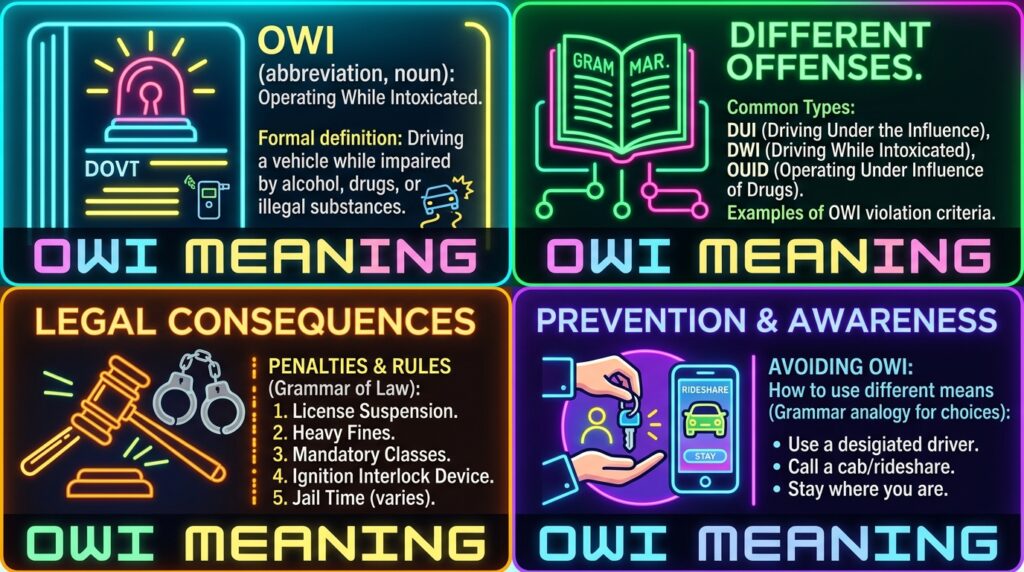
OWI stands for Operating While Intoxicated.
It generally refers to operating a motor vehicle while under the influence of alcohol, drugs, or other intoxicating substances.
Quick Definition
- OWI = Operating While Intoxicated
- Used as a legal term in certain U.S. states
- Similar to DUI and DWI
- Can result in fines, license suspension, and criminal penalties
Example Uses
“He was arrested for OWI after failing a roadside sobriety test.”
“An OWI conviction can stay on your record for years.”
“The officer suspected OWI due to impaired driving behavior.”
Origin & Background
The abbreviation OWI emerged from legal language used by several American states. Legislators wanted terminology that focused on the act of operating a vehicle while impaired, rather than simply driving.
Over time, different states adopted different terms:
- DUI (Driving Under the Influence)
- DWI (Driving While Intoxicated)
- OWI (Operating While Intoxicated)
The word operating is important because a person may be charged even if the vehicle is not actively moving. In some jurisdictions, merely being in control of a vehicle while intoxicated may qualify.
As online news coverage expanded, the term became more visible on social media, local news websites, and public court records. Today, many people encounter OWI through viral videos, police body-camera footage, or legal discussions online.
Real-Life Conversations
WhatsApp Conversation
Person A: Did you hear about Jake?
Person B: No, what happened?
Person A: He got an OWI last weekend.
Person B: Seriously? That could affect his job.
Instagram DM
Person A: Why is everyone talking about OWI in the comments?
Person B: It means Operating While Intoxicated. Someone got arrested after drinking and driving.
TikTok Comments
Commenter 1: Why was the police officer stopping him?
Commenter 2: According to the article, it was an OWI investigation.
Commenter 1: That’s much more serious than I thought.
Text Message
Friend 1: I won’t be driving tonight.
Friend 2: Good choice.
Friend 1: One mistake can turn into an OWI charge.
Friend 2: Better safe than sorry.
Emotional & Psychological Meaning
Although OWI is a legal term, it often carries a strong emotional impact.
When people hear “OWI,” they usually associate it with:
- Regret
- Poor judgment
- Public embarrassment
- Legal consequences
- Personal responsibility
Many individuals describe an OWI arrest as a life-changing event. The financial costs can be overwhelming, but the emotional burden is often even greater.
I have seen countless stories where one decision after a party or social gathering resulted in months or years of stress. The psychological lesson behind OWI is not only about law enforcement—it is about accountability and awareness.
In modern communication, mentioning an OWI often signals concern about safety rather than simply discussing a legal charge.
Usage in Different Contexts
Social Media
People frequently discuss OWI cases in local news comments, community groups, and public safety discussions.
Example:
“Another OWI arrest reported downtown this weekend.”
Friends & Relationships
Friends may use the term when discussing responsible behavior.
Example:
“Take a rideshare home. An OWI isn’t worth the risk.”
Work & Professional Settings
OWI can appear in employment background checks and legal disclosures.
Example:
“The applicant disclosed a previous OWI conviction.”
Casual vs Serious Tone
OWI is almost always serious.
Unlike internet slang, it rarely carries humor and usually relates to legal, safety, or personal responsibility topics.
OWI vs DUI
Many people believe OWI and DUI are different crimes. In reality, they are often different names for very similar offenses.
| Term | Meaning |
|---|---|
| OWI | Operating While Intoxicated |
| DUI | Driving Under the Influence |
The biggest difference usually depends on state law and legal wording.
OWI focuses on operating a vehicle while impaired, while DUI focuses on driving under the influence of alcohol or drugs.
In everyday conversation, people often use them interchangeably.
Is OWI Worse Than DUI?
In most cases, OWI is not automatically worse than DUI.
The seriousness depends on factors such as:
- Blood alcohol concentration
- Prior offenses
- Property damage
- Injuries caused
- State laws
Some states use OWI terminology, while others use DUI terminology. The penalties can be similar even when the names differ.
The actual circumstances matter far more than the abbreviation.
OWI Meaning WW2
During World War II, OWI had a completely different meaning.
It referred to the Office of War Information, a U.S. government agency responsible for distributing wartime information and public communications.
Its duties included:
- Public information campaigns
- Wartime news releases
- Propaganda efforts
- International communication
In historical documents, OWI often refers to this agency rather than intoxicated driving.
OWI Meaning Military
In military discussions, OWI may occasionally reference the Office of War Information when discussing historical operations.
However, modern military contexts can vary depending on the organization or country involved.
Because military abbreviations frequently overlap, understanding the surrounding context is essential.
OWI Meaning French
In French-speaking environments, OWI may appear as a name, acronym, brand, or organization rather than a legal driving term.
Unlike English legal usage, it does not commonly mean “Operating While Intoxicated.”
Whenever you encounter OWI in French content, checking the surrounding sentence is important because the meaning often changes completely.
Is OWI a Felony?
Not always.
Many OWI offenses begin as misdemeanors, especially for first-time offenders.
However, an OWI can become a felony when:
- Multiple prior convictions exist
- Serious injuries occur
- A death results
- A child was present
- State law imposes enhanced penalties
The exact classification depends on local laws and circumstances.
OWI Punishment
Punishments for OWI vary widely but may include:
- Fines
- Jail time
- License suspension
- Probation
- Community service
- Alcohol education programs
- Ignition interlock devices
Repeat offenses generally lead to harsher consequences.
Courts often consider both public safety and personal responsibility when determining penalties.
DWI Meaning
DWI usually stands for Driving While Intoxicated or Driving While Impaired.
Like OWI and DUI, the precise meaning depends on the state.
Quick Comparison
| Term | Full Form |
|---|---|
| OWI | Operating While Intoxicated |
| DUI | Driving Under the Influence |
| DWI | Driving While Intoxicated |
All three terms generally relate to impaired vehicle operation.
When NOT to Use It
Avoid using OWI:
When You Mean General Slang
OWI is not common internet slang.
When Discussing Non-Legal Topics
Many readers will assume a legal driving offense.
In International Conversations Without Context
People outside the United States may not recognize the term.
As a Joke
Because OWI often involves serious legal and safety consequences, humor can appear insensitive.
Common Misunderstandings
Assuming It Means DUI Everywhere
Different states use different terminology.
Thinking It Always Means a Felony
Many OWI cases are misdemeanors.
Ignoring Context
Historical references may point to the Office of War Information.
Believing It Requires Vehicle Movement
In some jurisdictions, simply operating or controlling a vehicle may qualify.
Comparison Table
| Search Intent | Meaning |
|---|---|
| What Does OWI Mean | Understanding the definition |
| How to Use OWI | Learning proper usage |
| Examples of OWI | Seeing real-world situations |
| OWI vs DUI | Comparing legal terminology |
| OWI vs DWI | Understanding state differences |
| OWI Punishment | Learning legal consequences |
| Is OWI a Felony | Understanding offense severity |
Key Insight
The most important thing to remember is that OWI is usually a legal term rather than internet slang. Its meaning depends heavily on context, location, and the laws of the jurisdiction involved.
Variations / Types
OWI Meaning
Operating While Intoxicated; a legal term for impaired vehicle operation.
OWI in Text
Usually refers to a legal charge or news event involving intoxicated driving.
OWI Abbreviation
A shortened form of Operating While Intoxicated.
OWI Slang
Not traditionally slang; primarily legal terminology.
OWI in Chat
Often appears during discussions about law, traffic incidents, or news reports.
OWI Legal Meaning
A criminal offense involving vehicle operation under the influence.
OWI Court Meaning
A charge that may result in legal proceedings and penalties.
OWI Police Meaning
An investigation or arrest related to suspected intoxicated vehicle operation.
OWI Record Meaning
A conviction or offense appearing on a person’s legal record.
OWI News Meaning
A term frequently used in local crime and public safety reports.
How to Respond When Someone Uses It
Casual Replies
- “That’s a serious situation.”
- “I hope everyone is okay.”
Funny Replies
- “Definitely a reminder to call a ride home.”
Mature Replies
- “It’s important to learn from mistakes.”
- “Safety should always come first.”
Respectful Replies
- “I hope the situation gets resolved responsibly.”
- “Hopefully everyone involved stays safe.”
Regional & Cultural Usage
Western Culture
OWI is widely recognized as a legal driving offense.
Asian Culture
The abbreviation itself may be unfamiliar, though impaired-driving laws are understood.
Middle Eastern Culture
The term is less common, but legal consequences for intoxicated driving are often taken seriously.
Global Internet Usage
People usually encounter OWI through news articles, legal discussions, and public safety content.
Gen Z vs Millennials
Gen Z often learns the term through social media and viral content.
Millennials are more likely to encounter it through news reports or real-world legal discussions.
Is It Safe for Kids?
Yes, the term itself is safe.
However, it relates to alcohol, drugs, driving laws, and legal consequences. Parents may want to explain the topic within the broader context of safety and responsible decision-making.
FAQs
What is OWI slang for?
OWI is not traditionally considered slang. It is a legal abbreviation that stands for Operating While Intoxicated, commonly used in certain U.S. states to describe operating a vehicle while impaired by alcohol or drugs.
What is guilty of OWI?
Being guilty of OWI means a court has determined that a person operated a vehicle while under the influence of alcohol, drugs, or another intoxicating substance in violation of the law.
Is OWI a word?
OWI itself is an acronym rather than a standard dictionary word. It is widely recognized in legal, law enforcement, and public safety contexts as shorthand for Operating While Intoxicated.
What are the signs of impairment?
Common signs of impairment include slowed reaction times, poor coordination, slurred speech, blurred judgment, difficulty concentrating, and unsafe driving behaviors such as swerving or inconsistent speeds.
Can you get an OWI without driving?
Yes. In some jurisdictions, a person may receive an OWI charge if they are found operating or in control of a vehicle while intoxicated, even if the vehicle is not actively moving.
How long does an OWI stay on your record?
The length of time an OWI remains on a record depends on local laws. In many places, it can remain visible for years and may affect employment, insurance rates, and driving privileges.
Does an OWI affect car insurance?
Yes. An OWI conviction often leads to significantly higher insurance premiums because insurers consider impaired driving offenses a high-risk factor.
Can an OWI impact employment opportunities?
It can. Some employers review criminal or driving records during hiring, and an OWI conviction may influence decisions, especially for jobs involving driving responsibilities.
Is OWI considered a criminal offense?
In most cases, yes. OWI is generally treated as a criminal offense, although the severity may vary depending on factors such as prior convictions and the circumstances of the incident.
What should you do after an OWI arrest?
After an OWI arrest, it is important to understand your legal obligations, attend required court appearances, follow license requirements, and seek qualified legal guidance when necessary.
Conclusion
Understanding the OWI meaning is important because the term carries significant legal, social, and historical weight. Most commonly, it stands for Operating While Intoxicated, a serious offense that can impact nearly every part of a person’s life. Yet the abbreviation also appears in historical and military contexts, which often creates confusion. By understanding the different meanings and situations where OWI is used, you can interpret it correctly, communicate more confidently, and avoid misunderstandings when reading news, legal documents, or online discussions.