The phrase “haram meaning” is searched millions of times because it sits at the intersection of language, faith, and confusion. Many people hear it in conversations, social media, or religious discussions—but don’t fully understand what it truly carries.
For some, it simply means “forbidden.”
For others, it feels like a moral warning.
And for many young users online, it becomes slang detached from its original depth.
This article clears that confusion in a simple, human way. We’ll explore the real meaning of haram, where it comes from, how people use it today, and why it still holds emotional weight across cultures and generations.
By the end, you’ll understand not just the definition—but the feeling behind the word.
Haram Meaning – Quick Meaning
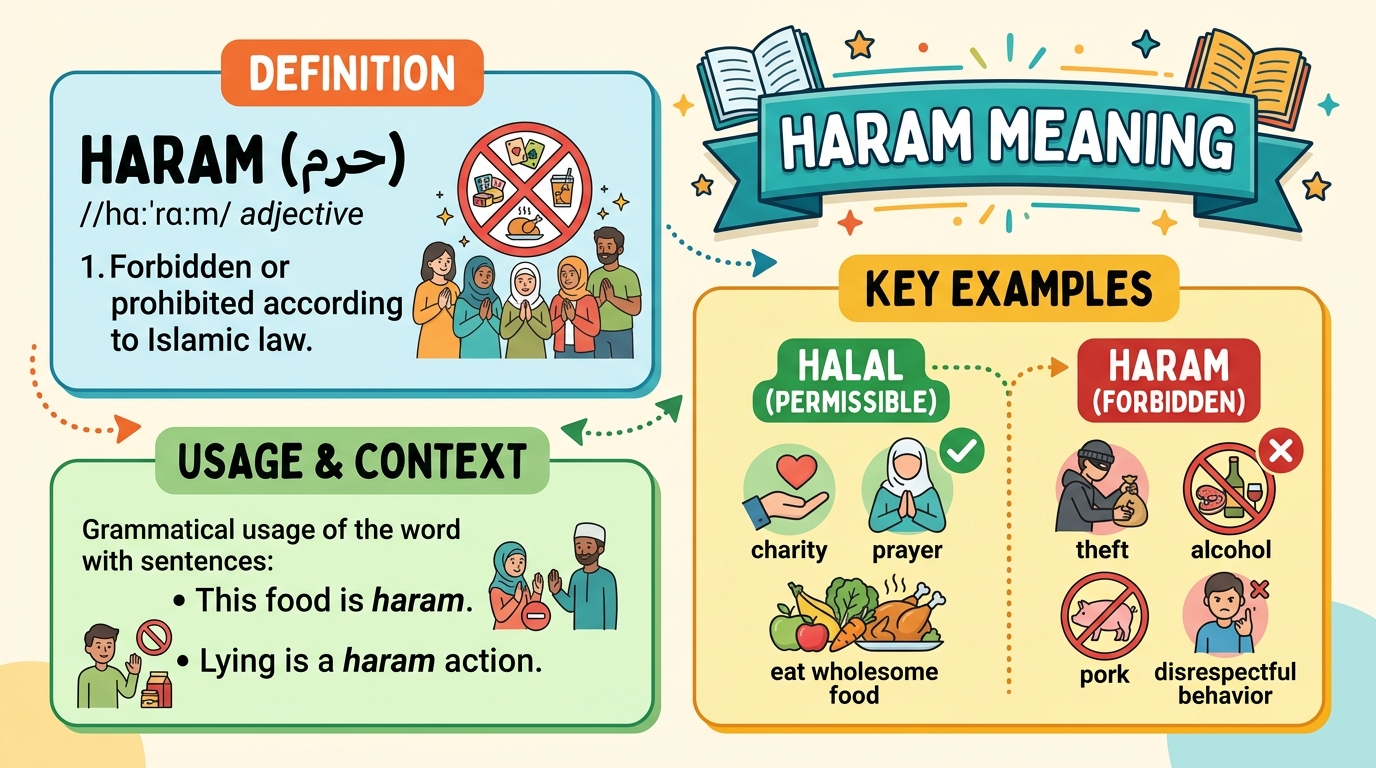
At its core, haram refers to something that is forbidden, prohibited, or not allowed according to Islamic teachings.
In simple terms:
- It means “religiously forbidden”
- It can refer to actions, food, behavior, or intentions
- It carries moral and spiritual weight, not just legal restriction
Examples:
- “This action is haram in Islam.”
- “Eating pork is considered haram.”
- “That behavior feels haram in our culture.”
But the meaning is not just technical—it is deeply emotional in many communities.
Origin & Background
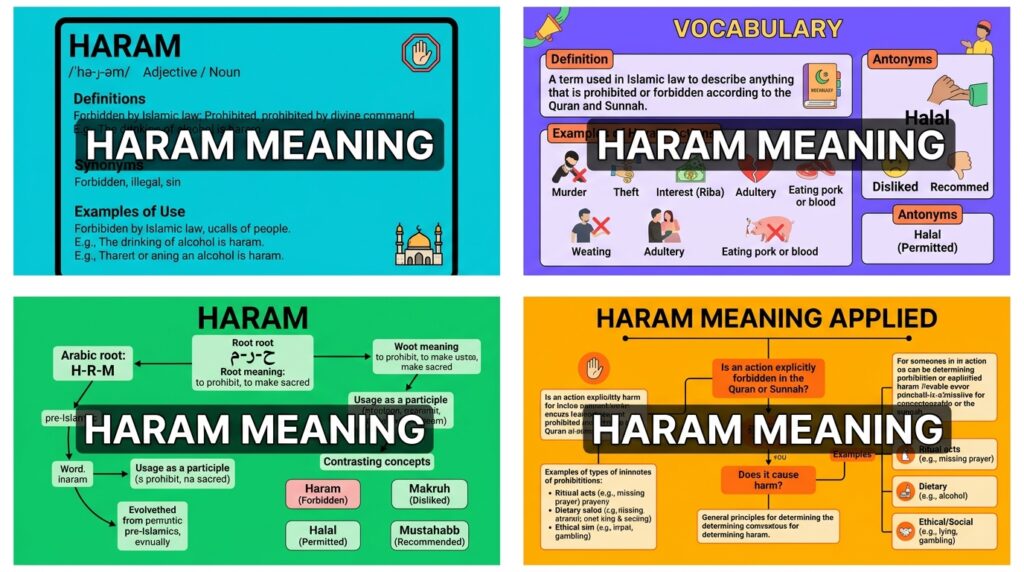
The word haram comes from Arabic roots meaning “forbidden” or “sacred boundary.” Interestingly, it carries a dual sense: something protected and something prohibited.
Over time, Islamic teachings gave it a strong moral framework. It became part of daily language across Middle Eastern, South Asian, and global Muslim communities.
In modern times, especially on social media, haram has evolved. It is now used:
- Seriously in religious discussions
- Lightly in memes and jokes
- Emotionally in moral judgments
This shift shows how language adapts while still holding its original depth.
Haram Meaning in Urdu
In Urdu, haram (حرام) directly translates to “na-jaiz” or “mana kiya gaya” (not allowed or prohibited).
In everyday Urdu conversation:
- It is used for religious rules
- It is also used for strong disapproval
- Sometimes it is used jokingly among friends
Example:
- “Yeh kaam haram hai” (This action is forbidden)
In South Asian culture, the word often carries emotional seriousness, especially when tied to ethics or faith.
Haram of Woman
This phrase is often misunderstood. In traditional Islamic context, “haram of woman” is not a standard term. However, people may use it informally when referring to:
- Boundaries in relationships
- Actions that are not permissible between genders
- Respecting modesty and personal limits
It is important to understand that Islam emphasizes dignity and respect for women, and the concept of haram is about boundaries—not restriction of identity or worth.
Misusing the phrase can create confusion, so context matters deeply.
Haram Meaning in English
In English, haram is commonly translated as:
- Forbidden
- Prohibited
- Not allowed (religiously)
- Unlawful (in Islamic law context)
However, English does not fully capture its emotional and spiritual depth. Unlike simple “illegal,” haram includes:
- Moral responsibility
- Spiritual consequences
- Cultural sensitivity
So while translation helps, it doesn’t fully carry the feeling behind the word.
Masjid al Haram Meaning in Urdu
Masjid al-Haram is one of the most sacred places in Islam, located in Makkah.
In Urdu, Masjid al Haram means:
“Wo masjid jahan haram (sacred boundary) hai” or simply “Sacred Mosque of Makkah.”
It is called “Al-Haram” because:
- It is a sacred protected area
- Certain actions are restricted within its boundaries
- It holds deep spiritual significance for Muslims worldwide
This place is central to Islamic worship and the pilgrimage of Hajj.
Haram Meaning in Arabic
In Arabic, haram (حرام) means:
- Forbidden
- Sacred boundary
- Something inviolable
Arabic gives the word a layered meaning. It is not only about restriction but also about protection and respect for divine limits.
For example:
- Certain actions are haram because they harm individuals or society
- Sacred places are called “haram” because they must be protected
This dual meaning makes it linguistically powerful.
Not Haram Meaning
When someone says “not haram,” it means:
- Allowed
- Permissible
- Acceptable within religious guidelines
In Islamic terms, something “not haram” is usually:
- Halal (permitted)
- Neutral (neither encouraged nor forbidden)
- Context-dependent
Example:
- “Is this food haram?”
- “No, it’s not haram.”
It’s a simple phrase, but often used to clarify doubts in daily life.
Haram Meaning in Turkish
In Turkish, haram is also used as:
- Forbidden
- Religious prohibition
- Something morally or spiritually wrong
Example in Turkish:
- “Bu haram” (This is forbidden)
The meaning remains close to Arabic, showing how Islamic vocabulary has influenced Turkish language deeply over centuries.
Masjid Haram Meaning
Masjid al-Haram literally means:
“The Sacred Mosque”
It is the holiest mosque in Islam, and its meaning includes:
- A place of ultimate spiritual purity
- A protected sacred zone
- The direction of prayer (Qibla for Muslims worldwide)
The word “Haram” here does not mean “forbidden” in a negative sense, but rather “sacred and inviolable.”
Real-Life Conversations
WhatsApp Chat:
Person A: “Bro is this music haram?”
Person B: “Depends on content, not everything is black and white.”
Instagram DM:
Person A: “Posting this pic okay?”
Person B: “Yeah it’s not haram chill 😄”
TikTok Comment Section:
User1: “Eating this looks haram 😂”
User2: “It’s just spicy noodles relax lol”
Text Message:
Person A: “I feel bad doing this.”
Person B: “If it feels wrong, maybe avoid it—not everything is haram but listen to your conscience.”
Emotional & Psychological Meaning
The word haram is not just a rule—it often carries emotion.
People use it because:
- It expresses moral boundaries instantly
- It reflects cultural upbringing
- It adds seriousness or humor depending on tone
Psychologically, it acts as a “moral trigger word.” It can make people pause and reflect.
Example scenario:
A young person hesitates before sharing something online, thinking, “Is this haram or just socially inappropriate?” This shows how the word influences decision-making beyond religion.
Usage in Different Contexts
Social Media:
Used in jokes, memes, reactions, and moral commentary.
Friends & Relationships:
Used to tease or warn about behavior.
Work Settings:
Rare, but may appear in culturally aware discussions.
Casual Tone:
Often humorous or exaggerated.
Serious Tone:
Used in religious or ethical conversations.
When NOT to Use It
Avoid using haram:
- To insult or mock someone’s beliefs
- In disrespectful jokes about religion
- Without understanding cultural sensitivity
- In situations where it may offend others
It is a meaningful word, so careless use can create misunderstanding.
Common Misunderstandings
Many people assume:
- Everything they dislike is “haram” (incorrect)
- It only means “bad” (oversimplified)
- It is always strict and negative (not true)
In reality, haram is context-based and deeply rooted in ethics, not just emotion or opinion.
Comparison Table
| Concept | Meaning | Usage | Example | Comparison |
|---|---|---|---|---|
| Haram meaning | Forbidden in Islam | Moral/religious context | “This is haram” | Opposite of halal |
| How to use haram | Context-based expression | Ethics or behavior | “Is this haram?” | Depends on situation |
| Examples of haram | Actions or food | Daily life guidance | Pork, theft | Cultural boundaries |
| Haram vs halal | Forbidden vs allowed | Religious balance | Halal food vs haram food | Ethical contrast |
Key Insight:
Haram is not just about restriction—it defines moral boundaries that help shape ethical behavior and cultural identity.
Variations / Types (8–10)
- Haram meaning in text – used in chats to show something is wrong or forbidden
- Haram slang – casual or humorous usage online
- Haram abbreviation – rarely shortened, usually written fully
- Haram in chat – used for moral reaction
- Haram meaning in conversation – ethical discussion context
- Haram reaction – expressing shock or disapproval
- Haram joke – playful exaggeration in memes
- Haram culture usage – traditional religious meaning
- Haram social media usage – modern internet slang
- Haram emotional tone – serious moral reflection
How to Respond When Someone Uses It
Casual replies:
- “Yeah, I get what you mean.”
- “True, that feels off.”
Funny replies:
- “Bro turned into a scholar real quick 😄”
- “Everything is haram now huh?”
Mature replies:
- “Let’s understand the context before judging.”
- “It depends on interpretation.”
Respectful replies:
- “I see your point, thanks for explaining.”
- “I’ll keep that in mind.”
Regional & Cultural Usage
Western culture:
Mostly seen as internet slang or curiosity-based search term.
Asian culture:
Used in religious and moral discussions with seriousness.
Middle Eastern culture:
Strong religious and cultural significance.
Global internet:
Blends humor, memes, and education.
Gen Z vs Millennials:
Gen Z uses it more casually; Millennials often use it in traditional context.
Is It Safe for Kids?
Yes, but only when used in educational or respectful contexts.
Children should be guided to understand its religious and cultural meaning properly to avoid misuse or misunderstanding.
Faqs
What is the true meaning of haram?
Haram means something that is strictly forbidden in Islam according to the Qur’an and teachings of Prophet Muhammad ﷺ. It refers to actions, foods, or behaviors that a Muslim must avoid because they go against religious guidance.
What five things are haram in Islam?
Some commonly known haram actions include:
- Eating pork or consuming alcohol
- Committing theft or dishonesty
- Engaging in adultery or immoral relationships
- Backbiting or spreading false rumors
- Taking interest (usury) in financial dealings
These are considered harmful for both spiritual and social well-being.
Is it haram to have a dog?
Keeping a dog is not completely haram in Islam, but there are guidelines. Dogs can be kept for protection, hunting, or farming. However, Islamic teachings emphasize cleanliness, so keeping dogs inside the house without need is discouraged by many scholars.
Can Muslims eat bananas?
Yes, Muslims can eat bananas. There is nothing in Islam that forbids bananas or any natural plant-based foods. They are completely halal and part of a healthy diet.
Is it haram to lie?
Yes, lying is considered haram in Islam. Honesty is strongly encouraged, and lying is only allowed in very limited situations such as resolving conflict or protecting someone from harm.
Is listening to music haram?
This is a debated topic among scholars. Some consider certain types of music haram if they promote immoral behavior, while others allow it if the content is clean and does not distract from religious duties.
Is dating haram in Islam?
Traditional Islamic teachings discourage romantic relationships before marriage. Instead, Islam promotes family-involved relationships and marriage as the proper way to build a bond between partners.
Is eating chocolate haram?
Chocolate itself is halal unless it contains haram ingredients like alcohol or non-halal gelatin. Most chocolate available in stores is allowed for Muslims.
Is it haram to miss الصلاة (prayer)?
Yes, intentionally missing daily prayers (Salah) without a valid reason is considered a serious sin in Islam, as prayer is one of the five pillars of Islam.
Is using swear words haram?
Yes, using abusive or offensive language is discouraged in Islam. Muslims are encouraged to speak kindly and avoid hurting others through words.
Conclusion
The meaning of haram goes far beyond a simple translation. It is a word shaped by faith, culture, and emotional understanding. While it defines what is forbidden in Islamic teachings, it also reflects respect, boundaries, and moral awareness. In modern conversations, it has evolved into both serious and casual usage. Understanding its depth helps us communicate more responsibly and respectfully. When used correctly, haram becomes not just a word, but a reminder of values that guide human behavior.