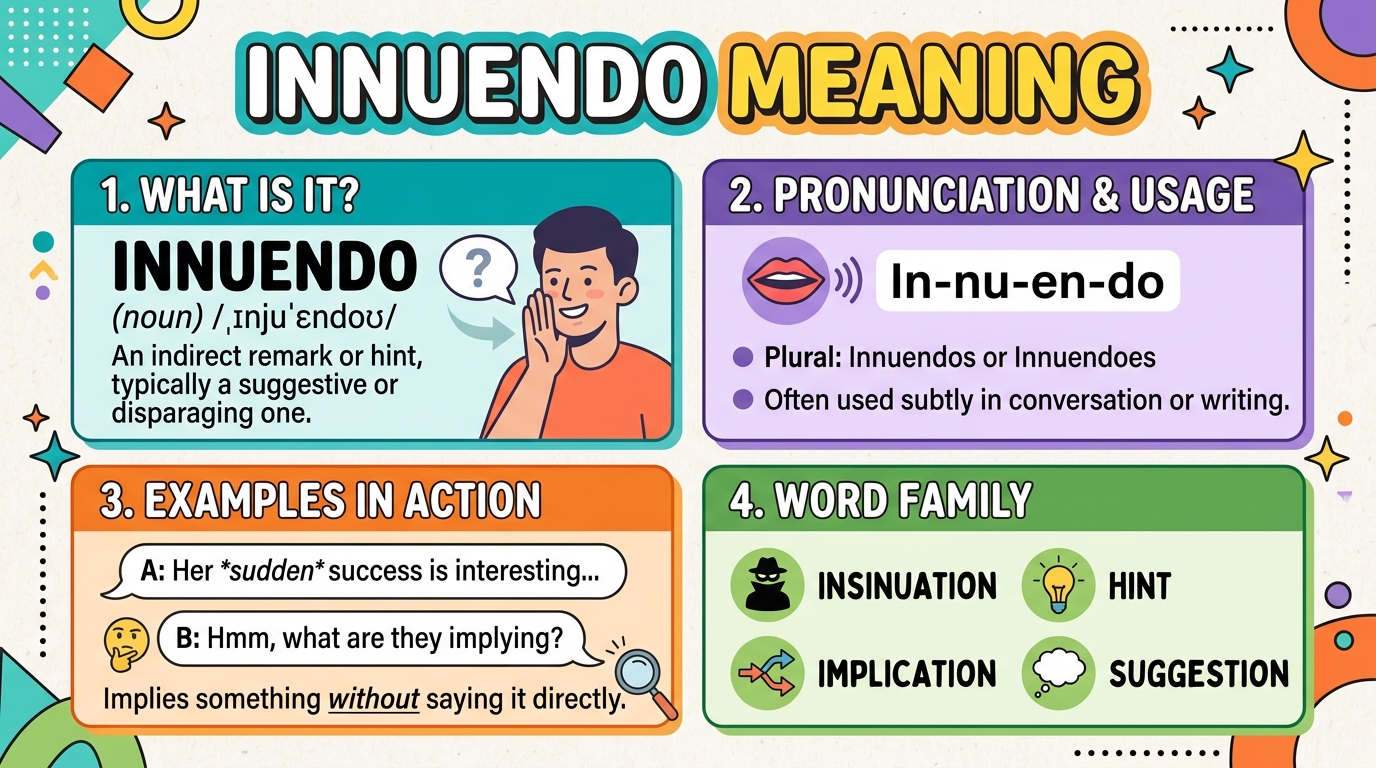
Have you ever heard someone say something that sounded innocent on the surface but seemed to carry a hidden message underneath? That subtle layer of meaning is often called an innuendo.
The term appears everywhere—from everyday conversations and social media comments to legal cases, comedy shows, movies, and relationships. Many people search for “innuendo meaning” because they encounter the word in texts, jokes, online discussions, or news stories and want to understand what it really implies.
The confusion usually comes from the fact that an innuendo is rarely direct. Instead, it hints, suggests, or implies something without openly stating it. Understanding innuendo can help you communicate more effectively, avoid misunderstandings, and recognize hidden meanings in conversations.
Innuendo Meaning – Quick Meaning
An innuendo is an indirect or subtle remark that suggests something, often something critical, negative, romantic, or sexual, without saying it openly.
Simple Definition
- A hidden or implied meaning
- A suggestion rather than a direct statement
- Often used humorously, sarcastically, or flirtatiously
- Can be positive, negative, or neutral depending on context
Quick Examples
“He seems very friendly with the boss.”
“That’s an interesting way to spend every evening with your neighbor.”
“She certainly got promoted quickly.”
In each example, the speaker implies something without directly saying it.
Origin & Background
The word innuendo comes from Latin and originally meant “by nodding to” or “hinting at.”
Over time, English speakers adopted the term to describe indirect suggestions and hidden meanings. Historically, writers and politicians used innuendo when they wanted to criticize someone without making direct accusations.
As media evolved, innuendo became a common tool in entertainment. Television writers used it to sneak jokes past censorship rules, while comedians relied on it to create humor that audiences could interpret in multiple ways.
Today, social media has made innuendo even more popular. Platforms like TikTok, Instagram, and X encourage short-form communication where hints, implications, and subtle jokes often spread faster than direct statements.
Innuendo Meaning in English
In English, innuendo refers to an indirect remark that implies something rather than stating it openly.
Unlike straightforward language, innuendo leaves room for interpretation. The listener must often read between the lines to understand the intended meaning.
For example:
“Wow, he always seems to have special access.”
The speaker does not explain what “special access” means, but the implication may suggest favoritism or privilege.
Because English communication often relies on tone and context, innuendo can carry very different meanings depending on who says it and how it is delivered.
Innuendo Meaning Sexually
One of the most common uses of innuendo involves sexual implications.
A sexual innuendo is a statement that appears innocent but subtly suggests something romantic or sexual.
Examples include:
- “Do you want to come upstairs and see my collection?”
- “That’s not the only thing I’m good at.”
- “I can show you a few tricks.”
The literal meaning may sound harmless, but the implied message suggests something more intimate.
Comedy, movies, music, and dating conversations frequently use sexual innuendo because it allows people to flirt or joke without being completely direct.
Innuendo Meaning in Farsi
In Farsi (Persian), innuendo is commonly translated as:
کنایه (Kenayeh)
or
اشاره غیرمستقیم (Eshareh Gheyr Mostaghim)
These expressions describe indirect speech, hidden implications, or suggestive remarks.
In Persian culture, indirect communication often plays an important role in social interactions. As a result, many forms of innuendo are understood through context, tone, and cultural awareness rather than explicit wording.
Innuendo Synonyms
Several words carry meanings similar to innuendo.
Common Synonyms
- Hint
- Suggestion
- Implication
- Insinuation
- Allusion
- Indirect remark
- Double meaning
- Undertone
- Subtext
- Suggestive comment
While these words are related, “innuendo” often emphasizes hidden or implied meaning more strongly than the others.
Innuendo Examples
Understanding examples makes the concept much easier.
Example 1
“She spends a lot of time with the manager.”
This may imply favoritism without directly accusing anyone.
Example 2
“Interesting car for someone with that salary.”
The speaker hints at possible financial dishonesty.
Example 3
“Looks like somebody had a very good night.”
This could imply romantic activity.
Example 4
“He always knows exactly where she is.”
The implication may suggest unusual interest or obsession.
Real-Life Conversations
WhatsApp Chat
Person A: Did you see Emma leave with Jake again?
Person B: Yeah, they seem pretty close lately.
Person A: Very close, apparently.
The final message contains innuendo suggesting a romantic relationship.
Instagram DM
Person A: Wow, you’re posting gym selfies every day now.
Person B: Just staying motivated.
Person A: Sure, motivation is definitely the reason.
The response implies another motive without directly stating it.
TikTok Comments
Person A: He suddenly became successful after meeting that influencer.
Person B: Funny how networking works.
The comment suggests hidden advantages while avoiding a direct accusation.
Text Message
Person A: You seem excited for tonight.
Person B: Maybe I have a reason.
Person A: I think I know what that reason is.
The conversation uses romantic innuendo to imply something without saying it outright.
Emotional & Psychological Meaning
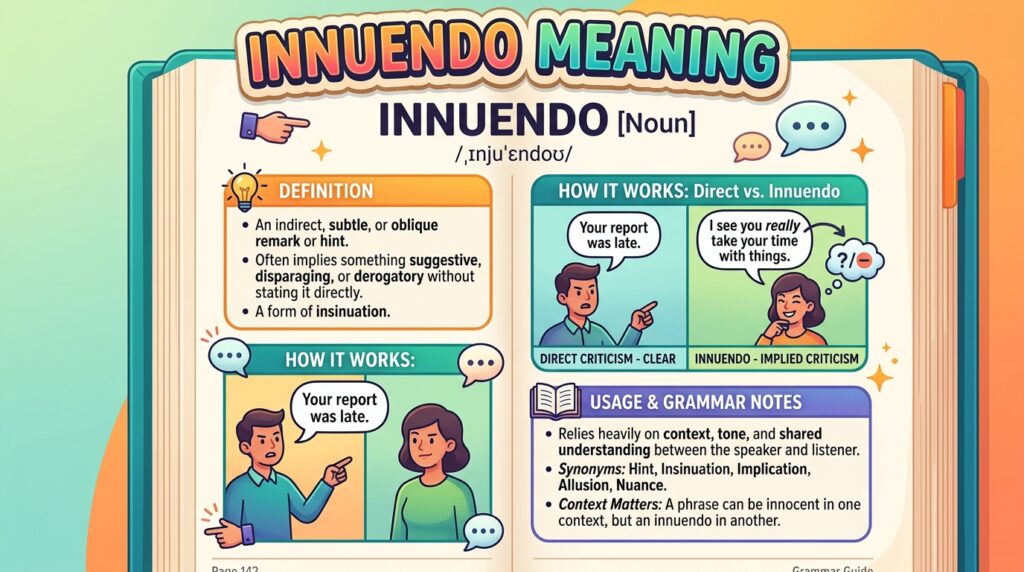
Innuendo serves an important emotional purpose.
People often use it when they want to express a thought without taking full responsibility for saying it directly. This creates a layer of emotional protection.
It can also make conversations more playful, mysterious, or humorous. In relationships, innuendo often adds flirtation and excitement because it encourages imagination.
Psychologically, humans enjoy solving hidden meanings. When someone uses innuendo, listeners become active participants in interpreting the message.
I once watched two coworkers communicate almost entirely through subtle hints during a meeting. Everyone understood what they meant, yet nobody could point to a direct statement. That experience showed how powerful implied communication can be.
Usage in Different Contexts
Social Media
People use innuendo to make jokes, share opinions, or criticize others indirectly.
Subtle comments often generate engagement because audiences enjoy decoding hidden meanings.
Friends & Relationships
Friends frequently use innuendo for humor and teasing.
In romantic settings, it can create flirtation without making interactions uncomfortable.
Work & Professional Settings
Professional environments require caution.
Indirect remarks can easily be misunderstood and may create tension if they imply criticism or favoritism.
Casual vs Serious Tone
In casual conversations, innuendo is often playful.
In serious situations, it can become harmful if it spreads rumors or damages someone’s reputation.
Innuendo Meaning in Law
In legal contexts, innuendo has a more technical meaning.
It refers to an implied meaning that may not appear obvious from the actual words used.
Courts sometimes examine whether a statement contains an implied accusation even when no direct allegation exists.
The legal interpretation focuses on how a reasonable person would understand the statement within its context.
This makes innuendo an important concept in defamation and reputation-related disputes.
Innuendo Meaning in Defamation
In defamation law, innuendo can become a serious issue.
A statement may appear harmless on the surface but imply something damaging about a person’s character, conduct, or reputation.
For example:
“Interesting how he always wins government contracts.”
The statement does not directly accuse anyone of corruption. However, listeners may infer wrongdoing.
Courts may consider whether the implied meaning could harm someone’s reputation.
Because of this, indirect accusations can sometimes carry legal consequences just like direct ones.
Innuendo Meaning Slang
In modern slang, innuendo usually refers to a hidden joke or suggestive remark.
Many people casually say:
“That sounded like an innuendo.”
This often means the statement carried a sexual, flirtatious, or humorous double meaning.
Online culture has expanded this usage, especially among younger generations who frequently communicate through memes, jokes, and coded language.
When NOT to Use It
There are situations where innuendo is best avoided.
Professional Meetings
Indirect suggestions can create confusion and misunderstandings.
Legal Discussions
Ambiguous language may cause unnecessary complications.
Sensitive Topics
Health, tragedy, discrimination, or personal struggles require direct and respectful communication.
Cross-Cultural Conversations
Not everyone interprets implied meanings the same way.
Common Misunderstandings
Assuming Every Joke Is Innuendo
Not all humor contains hidden meanings.
Confusing Innuendo with Sarcasm
Sarcasm mocks or criticizes directly, while innuendo implies.
Missing Cultural Context
What sounds obvious in one culture may sound completely innocent in another.
Taking It Literally
Many people misunderstand innuendo because they focus only on the literal meaning.
Comparison Table
| Term | Definition Intent |
|---|---|
| What Does Innuendo Mean | Explains the hidden or implied meaning |
| How to Use Innuendo | Shows practical communication usage |
| Examples of Innuendo | Demonstrates real-life applications |
| Innuendo vs Implication | Innuendo is usually deliberate; implication may be broader |
| Innuendo vs Insinuation | Insinuation often suggests criticism more strongly |
| Innuendo vs Double Meaning | Double meaning can be accidental; innuendo is intentional |
Key Insight
The core purpose of innuendo is not secrecy but suggestion. It allows people to communicate ideas indirectly while inviting listeners to interpret deeper meaning.
Variations / Types
Sexual Innuendo Meaning
Indirectly suggests romantic or sexual content.
Innuendo in Text
Hidden meaning within a text message.
Innuendo Abbreviation
No universal abbreviation exists, but online users may reference it simply as “innuendo.”
Innuendo Slang
Suggestive language used informally.
Innuendo in Chat
Implied meaning in online conversations.
Romantic Innuendo Meaning
Hints at attraction or affection.
Humorous Innuendo Meaning
Creates comedy through double meanings.
Negative Innuendo Meaning
Suggests criticism without direct accusation.
Social Media Innuendo
Hidden meanings within posts and comments.
Cultural Innuendo Meaning
Implications understood within specific cultural groups.
How to Respond When Someone Uses It
Casual Replies
- “I see what you did there.”
- “Nice hint.”
- “Interesting choice of words.”
Funny Replies
- “We’re all thinking it.”
- “Subtle as a brick.”
- “That wasn’t even hiding.”
Mature Replies
- “Could you explain what you mean?”
- “I want to be sure I’m understanding correctly.”
Respectful Replies
- “I understand the implication.”
- “Let’s keep the conversation clear.”
Regional & Cultural Usage
Western Culture
Innuendo is common in comedy, entertainment, and dating conversations.
Asian Culture
Indirect communication is often valued, making subtle implications easier to recognize.
Middle Eastern Culture
Context and social relationships strongly influence how innuendo is interpreted.
Global Internet Usage
Memes, jokes, and viral trends frequently rely on implied meanings.
Gen Z vs Millennials
Gen Z often uses innuendo through memes and internet humor.
Millennials tend to use it more in conversation, sarcasm, and pop culture references.
Is It Safe for Kids?
Innuendo itself is not automatically inappropriate.
However, because many examples contain adult themes or hidden sexual meanings, context matters. Parents and educators should help children understand implied communication while encouraging age-appropriate discussions.
FAQs
What is meant by innuendo?
An innuendo is an indirect remark or suggestion that hints at something without stating it openly. People often use it to imply a deeper meaning, whether humorous, critical, romantic, or suggestive.
What is the meaning of innuendo?
The meaning of innuendo is a subtle or hidden message conveyed through words that seem innocent on the surface. It relies on the listener to understand the implied meaning behind the statement.
What is an example of innuendoes?
A common example of innuendo is saying, “She got promoted very quickly,” in a tone that suggests there may be an unstated reason for the promotion. The speaker implies something without making a direct accusation.
What is the synonym of innuendo?
Common synonyms of innuendo include implication, insinuation, hint, suggestion, allusion, undertone, and indirect remark. Each refers to communication that conveys meaning indirectly.
Is innuendo always negative?
No, innuendo is not always negative. It can be playful, humorous, flirtatious, or simply used to suggest an idea without expressing it directly.
Why do people use innuendo?
People use innuendo to communicate sensitive thoughts, create humor, flirt, or avoid making direct statements. It allows them to imply something while leaving room for interpretation.
Is innuendo the same as sarcasm?
No, innuendo and sarcasm are different. Sarcasm uses irony to mock or criticize, while innuendo hints at a hidden meaning without stating it outright.
Can innuendo be used in professional settings?
Innuendo can appear in workplaces, but it should be used carefully. Indirect comments may be misunderstood and can sometimes create confusion or tension among colleagues.
How can you identify an innuendo?
You can identify an innuendo by paying attention to context, tone, and implied meanings. If a statement seems to suggest more than its literal words, it may contain innuendo.
Can innuendo have legal consequences?
Yes, in some situations, innuendo can be relevant in legal cases, especially defamation matters. An indirect statement that damages someone’s reputation may still be examined for its implied meaning.
Conclusion
Understanding the innuendo meaning helps you recognize one of the most powerful forms of human communication. People often reveal thoughts, emotions, jokes, and opinions indirectly rather than openly. Whether it appears in a text message, social media comment, workplace discussion, or romantic conversation, innuendo adds layers of meaning that go beyond the words themselves. The key is learning to notice context, tone, and intent. Once you do, you’ll communicate more confidently and better understand what people are really trying to say.