Few abbreviations appear in as many places as N/A, yet many people still pause when they see it. It shows up on school forms, job applications, medical documents, iPhones, websites, and even social media conversations. Because it appears in so many different situations, people often wonder what it actually means and when they should use it.
At its core, N/A is a simple way of saying that a question, field, or piece of information does not apply to a particular situation. However, depending on the context, it can also mean something slightly different, which is why confusion happens.
In this guide, you’ll learn the complete meaning of N/A, where it came from, how people use it in everyday communication, and why this tiny abbreviation has become such an important part of modern life.
N/A Meaning – Quick Meaning
N/A usually stands for:
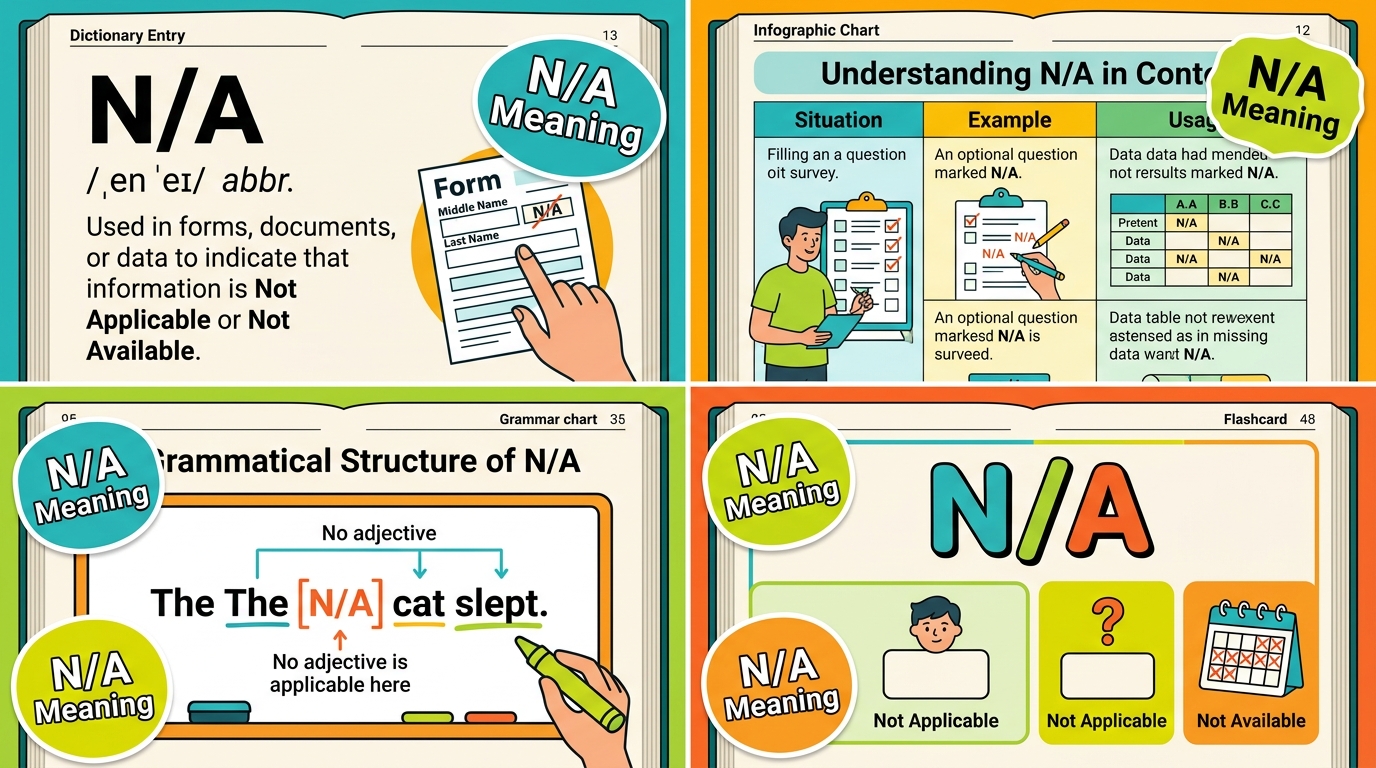
- Not Applicable
- Sometimes Not Available
The intended meaning depends on the situation.
Simple Definition
When something is not relevant to a question or situation, people write N/A instead of leaving a blank space.
Examples
“Middle Name: N/A”
“Spouse Information: N/A”
“Previous Work Experience: N/A”
In each example, the information either doesn’t exist or doesn’t apply to the person completing the form.
Origin & Background
The abbreviation N/A became common long before smartphones and social media existed.
Government agencies, schools, businesses, and healthcare organizations needed a quick way to indicate that certain information was irrelevant. Instead of leaving fields empty—which could create confusion—they began using N/A.
Over time, the abbreviation spread into:
- Paper forms
- Computer databases
- Online applications
- Mobile devices
- Workplace communication
Today, N/A is understood almost everywhere in the world. Its simplicity makes it useful across cultures and industries.
Social media also helped popularize the abbreviation among younger users. Many people now use N/A casually in texts and online conversations when a question does not apply to them.
N a Meaning in Text
In texting, N/A usually means “not applicable” or “I don’t have an answer for that.”
People use it when a question doesn’t relate to them.
Example
Person A:
What’s your favorite football team?
Person B:
N/A, I don’t really watch sports.
Here, the person is saying the question doesn’t apply to their interests.
N a Meaning in Urdu
In Urdu, N/A is commonly translated as:
“لاگو نہیں ہوتا”
or
“متعلق نہیں”
It indicates that the requested information is not relevant.
Example
Marital Status:
جو شخص غیر شادی شدہ ہو وہ بعض مخصوص خانے میں N/A لکھ سکتا ہے۔
The meaning remains the same whether the form is in English or Urdu.
N/A Meaning in iPhone
On an iPhone, N/A often appears when information is unavailable or cannot be displayed.
Examples include:
- Missing contact details
- Device information not detected
- Network data unavailable
- Certain settings lacking information
In this context, N/A usually means Not Available rather than Not Applicable.
For many users, seeing N/A on an iPhone simply indicates that the device currently cannot provide the requested data.
N A Meaning in Application
Job applications frequently use N/A.
If a question does not relate to your situation, entering N/A tells the employer that you intentionally skipped the field rather than forgetting it.
Examples include:
- Previous employer information for first-time job seekers
- Professional licenses not required for the role
- Optional sections that don’t apply
Using N/A can make applications appear more complete and professional.
N/A Meaning in School
Schools use N/A on forms, records, and assessments.
Students may write N/A when:
- They have no middle name
- A question does not apply
- Certain activities were not participated in
Teachers and administrators also use N/A when recording information that is irrelevant to a specific student.
N/A Meaning Cars
In the automotive world, N/A often has a completely different meaning.
It can mean:
Naturally Aspirated
This refers to an engine that operates without a turbocharger or supercharger.
Example
A car enthusiast might say:
“This vehicle has a 2.0-liter N/A engine.”
In this context, N/A has nothing to do with forms or applications.
The meaning depends entirely on the conversation.
N A Meaning in Form
Forms are where N/A appears most often.
When a question does not apply to you, writing N/A shows that you intentionally left the field unanswered.
Common examples:
- Maiden Name
- Driver’s License Number
- Previous Address
- Emergency Contact Relationship
Many organizations actually prefer N/A over blank spaces because it reduces confusion.
N a Meaning Medical
In medical settings, N/A generally means Not Applicable.
Healthcare providers use it when:
- A condition doesn’t apply
- A treatment wasn’t required
- A test was unnecessary
Medical records rely on precision, so N/A helps prevent misunderstandings.
For example:
“Pregnancy Status: N/A”
This tells medical staff that the category does not apply to the patient.
Real-Life Conversations
Person A:
Did you list your previous employer?
Person B:
N/A. This is my first job application.
Instagram DM
Person A:
What’s your favorite anime?
Person B:
Honestly, N/A. I’ve never watched anime.
TikTok Comments
Person A:
Which gym routine worked best for you?
Person B:
N/A, I do outdoor workouts only.
Text Message
Person A:
What’s your wedding anniversary?
Person B:
N/A. I’m not married.
These examples show how naturally N/A fits into everyday communication.
Emotional & Psychological Meaning
At first glance, N/A looks purely technical.
Yet it reflects something deeper about human communication.
People use N/A because they want clarity. Instead of leaving uncertainty, they communicate that a question doesn’t fit their situation.
I once helped someone complete a scholarship application. Several sections didn’t apply to them, and they worried about leaving blanks. Using N/A instantly removed confusion and made the form easier for reviewers to understand.
That small abbreviation communicated certainty, honesty, and completeness.
Usage in Different Contexts
Social Media
People use N/A when a trend or question doesn’t apply to them.
Friends and Relationships
It can politely indicate that someone has no answer or no experience with a topic.
Work and Professional Settings
N/A helps maintain accurate records and clear documentation.
Casual vs Serious Tone
Casually, it may mean “doesn’t apply to me.”
Professionally, it serves as an official notation.
When NOT to Use It
Avoid N/A when:
- An answer is required
- The information exists
- Clarification is needed
- Someone may misunderstand the abbreviation
Instead of using N/A, provide the actual information whenever possible.
Common Misunderstandings
Many people assume N/A always means one thing.
In reality:
- Not Applicable = doesn’t apply
- Not Available = information unavailable
- Naturally Aspirated = automotive meaning
The surrounding context determines the correct interpretation.
Another common mistake is leaving blanks when N/A should be used.
Blank spaces can suggest incomplete information.
Comparison Table
| Topic | Meaning |
|---|---|
| What Does N/A Mean | Explains definition and purpose |
| How to Use N/A | Shows correct usage situations |
| Examples of N/A | Demonstrates real-life applications |
| N/A vs Blank Field | N/A signals intentional omission |
| N/A vs Unknown | Unknown means information exists but isn’t known |
| N/A vs Not Available | One means irrelevant, the other unavailable |
Key Insight
The biggest misunderstanding is assuming N/A always means missing information. In many cases, it simply means the question is irrelevant to the person answering it.
Variations / Types
N/A Meaning
Not applicable or not available depending on context.
N/A in Text
Used when a question doesn’t relate to the sender.
N/A Abbreviation
A shorthand form used in documents and conversations.
N/A Slang
Sometimes used jokingly to mean “no opinion.”
N/A in Chat
Indicates no relevant answer.
N/A in Forms
Shows a field does not apply.
N/A in Applications
Marks non-relevant sections.
N/A in Business
Used in reports and records.
N/A in School Documents
Indicates information isn’t needed.
N/A in Online Surveys
Prevents empty fields and confusion.
How to Respond When Someone Uses It
Casual Replies
- Got it.
- Makes sense.
- No worries.
Funny Replies
- Fair enough, mystery solved.
- N/A accepted.
- That’s one way to answer.
Mature Replies
- Thanks for clarifying.
- Understood completely.
- I appreciate the explanation.
Respectful Replies
- That’s perfectly fine.
- Thank you for letting me know.
- I understand your situation.
Regional & Cultural Usage
Western Culture
Common in forms, business documents, and online communication.
Asian Culture
Frequently used in education, government paperwork, and employment forms.
Middle Eastern Culture
Widely recognized in English-language documents and applications.
Global Internet Usage
Used universally across websites, surveys, and digital forms.
Gen Z vs Millennials
Gen Z may use N/A casually in chats and comments.
Millennials typically encounter it more often in professional and administrative settings.
Is It Safe for Kids?
Yes.
N/A is a neutral abbreviation with no harmful meaning.
Children may encounter it on school forms, online surveys, or educational documents. Understanding its meaning can help them complete paperwork correctly and avoid confusion.
FAQs
What does NA stand for?
NA commonly stands for Not Applicable or Not Available, depending on the context. In documents and forms, it usually means the requested information does not apply to the person completing it.
What does N/A mean in application?
In an application, N/A means a question or field is not relevant to your situation. It helps show that you intentionally left the section unanswered rather than forgetting it.
When should I use N/A?
You should use N/A when a question does not apply to you or when the requested information is irrelevant. It provides clarity and prevents confusion for the person reviewing the form.
What does NA mean in a text?
In text messages, NA often means “not applicable” when someone has no relevant answer. Depending on the conversation, it can also mean “not available.”
Is N/A the same as leaving a blank space?
No, N/A is different from leaving a blank space because it clearly shows that the field was intentionally not answered. Blank spaces can sometimes appear incomplete or accidental.
What does N/A mean in school forms?
In school forms, N/A indicates that a particular question does not apply to a student or parent. It helps administrators understand that the information is not relevant.
Can I write N/A on official documents?
Yes, many organizations accept N/A on official documents when a field does not apply. It is often preferred because it makes your response clear and complete.
What does N/A mean in medical records?
In medical records, N/A means a condition, treatment, or category is not applicable to the patient. Healthcare professionals use it to maintain accurate documentation.
What does N/A mean on an iPhone?
On an iPhone, N/A usually means information is unavailable or cannot currently be displayed. It often appears in device settings, network details, or system information.
What is the difference between N/A and Not Available?
N/A often means Not Applicable, indicating something is irrelevant to the situation. Not Available means the information exists but cannot currently be accessed or provided.
Conclusion
N/A may look like a tiny abbreviation, but it plays an important role in everyday communication. Whether you’re filling out a job application, reviewing a medical record, completing a school form, or chatting online, N/A helps eliminate confusion and create clarity. Its meaning changes slightly depending on context, yet its purpose remains the same: communicating that certain information is either unavailable or simply doesn’t apply. Once you understand when and why to use it, you’ll navigate forms, conversations, and digital communication with far greater confidence.