In today’s fast-moving chat culture, even four simple letters can carry a whole emotional story. One of those phrases is “TFTI meaning”, a slang term that often confuses people when they see it in messages or social media comments.
At first glance, it looks harmless. But depending on the tone, it can feel funny, sarcastic, or even a little hurtful. That’s why people search for it so often—they want to understand what someone really meant, not just what they typed.
“TFTI” usually appears when someone feels left out or jokingly ignored. But the real meaning shifts based on context, relationship, and tone. And that’s exactly where confusion begins.
This guide breaks it all down in a natural, real-life way so you can confidently understand and use it without misreading emotions in conversations.
TFTI Meaning in Chat
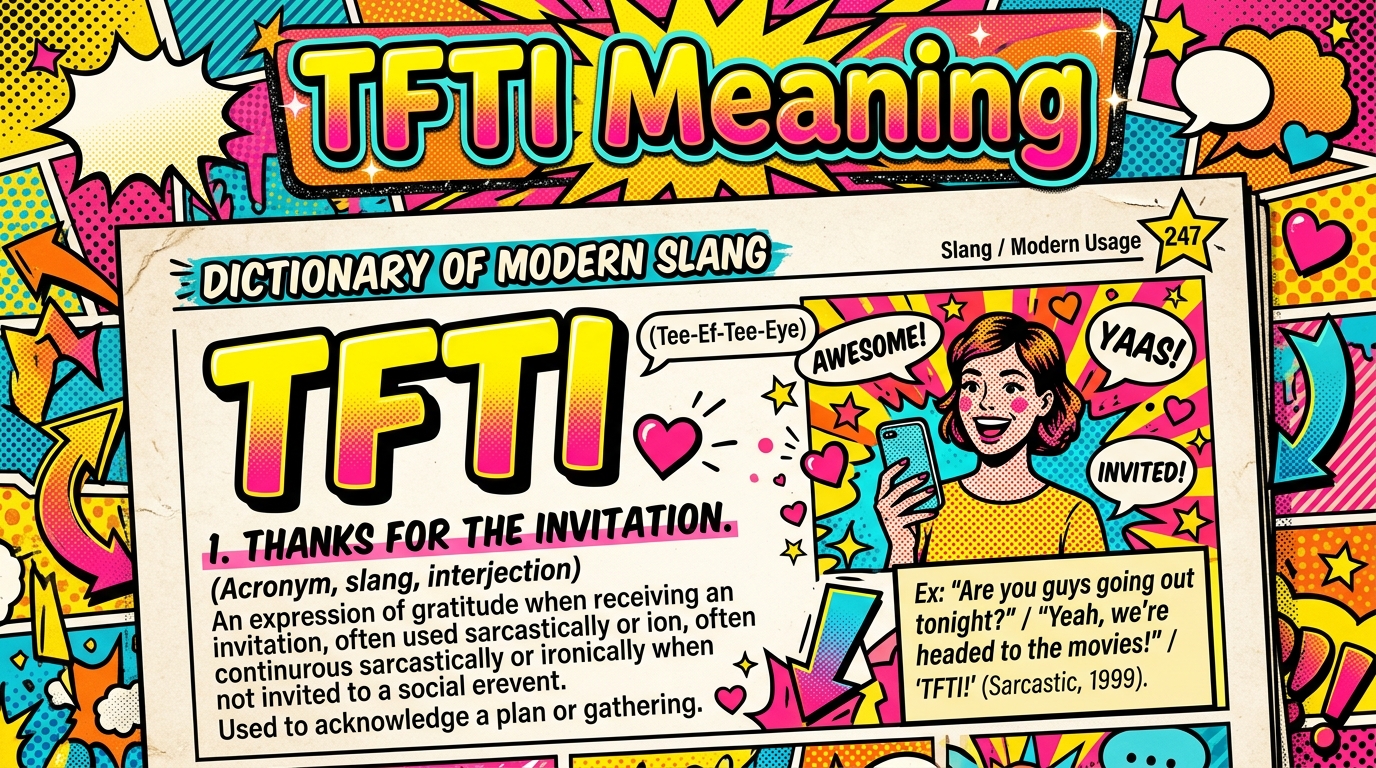
In chat conversations, TFTI stands for “Thanks For The Invite.”
But here’s the twist—it’s rarely used in a purely thankful way.
Most of the time, it carries a tone like:
- Mild sarcasm
- Playful disappointment
- Feeling excluded
- Friendly teasing
Simple meaning breakdown:
- Literal: “Thanks for inviting me”
- Emotional tone: “You didn’t invite me, and I noticed”
Examples in chat:
- “Oh wow, party at your place? TFTI 😒”
- “TFTI… I see how it is 😂”
- “TFTI bro, next time don’t forget me”
So while it looks polite, it often hides emotion underneath.
Origin & Background
“TFTI” grew naturally from texting culture in the early 2010s when abbreviations became popular on platforms like Facebook, Snapchat, and Twitter (now X).
Instead of typing full emotional reactions, people started shortening phrases. “Thanks for the invite” became “TFTI,” and over time, its tone shifted.
Social media influenced its evolution heavily:
- Meme culture made it sarcastic
- Group chats made it playful
- FOMO (fear of missing out) gave it emotional weight
Today, it is widely recognized as both a joke and a subtle emotional signal.
Real-Life Conversations (MANDATORY)
WhatsApp Group Chat:
Ali: We all went for dinner last night
Sara: TFTI 😭
Hamza: It was a last-minute plan, sorry!
Instagram DM:
Friend 1: Just posted pics from beach trip 🌊
Friend 2: TFTI… I’m unfollowing you 😂
Friend 1: Next time you’re coming for sure!
TikTok Comments:
User A: We had a creator meetup today!
User B: TFTI… I’m literally right here 😭
User A: Didn’t know you were in town!
Text Message:
Person A: Movie night was fun yesterday
Person B: TFTI, I was waiting for your call
Person A: I thought you were busy!
These examples show how TFTI can sound funny, emotional, or slightly passive-aggressive depending on context.
Emotional & Psychological Meaning
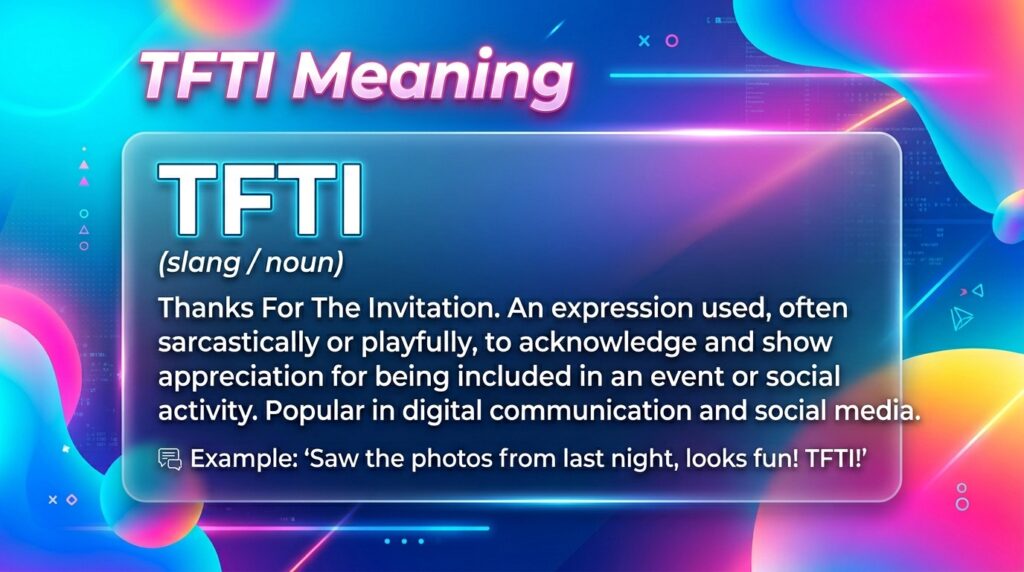
At its core, TFTI is not just slang—it’s an emotion in disguise.
People use it because:
- They want acknowledgment
- They feel left out socially
- They prefer humor over direct confrontation
- They want to express feelings lightly
It reflects how modern communication avoids direct emotional exposure. Instead of saying “I felt excluded,” people say “TFTI 😅.”
Short real-life scenario:
Imagine your friends post pictures from a hangout you didn’t know about. You feel a small sting of exclusion. Instead of confronting them, you comment “TFTI.” It softens the emotion but still delivers the message.
That’s the psychology behind it—safe expression through humor.
Usage in Different Contexts
Social Media
Used in comments, memes, and replies when someone feels left out or jokingly ignored.
Friends & Relationships
Very common among close friends where sarcasm is understood.
Work / Professional Settings
Rare and not recommended. It can sound unprofessional or confusing.
Casual vs Serious Tone
- Casual: Funny, light, teasing
- Serious: Can feel passive-aggressive or emotional
Context decides everything.
When NOT to Use It
Even though TFTI is common, it doesn’t fit everywhere.
Avoid using it:
- In formal emails or workplace chats
- With people who don’t understand slang
- During serious emotional discussions
- With elders or unfamiliar contacts
It can easily be misinterpreted as rude or sarcastic if the relationship is not close.
Common Misunderstandings
Many people misread TFTI because:
- They think it is always polite (it’s not)
- They don’t catch sarcasm in text
- They assume literal meaning only
- They miss emotional context
Another big confusion is tone. “TFTI” with a smiley 😄 feels playful, while “TFTI 😒” feels cold or annoyed.
Comparison Table
| Aspect | TFTI Meaning | Usage Intent | Example Intent | Comparison |
|---|---|---|---|---|
| What Does TFTI Mean | Thanks For The Invite | Express exclusion or sarcasm | “TFTI… I see how it is” | Different from formal gratitude |
| How to Use TFTI | Informal slang | Light teasing in chats | “TFTI lol next time invite me” | Not for professional use |
| Examples of TFTI | Chat reactions | Humor or disappointment | “TFTI 😭 I missed it” | Strong emotional hint |
| TFTI vs Other Slang | Compared to LOL/SMH | More emotional than LOL | TFTI shows exclusion, LOL shows laughter | TFTI is socially emotional |
Key Insight: TFTI is not just a phrase—it’s a social emotion wrapped in humor, often revealing more than the words themselves.
Variations / Types (8–10)
TFTI meaning in text
Used in messages to show playful disappointment about not being invited.
TFTI slang
Casual abbreviation expressing mild sarcasm.
TFTI abbreviation
Short form of “Thanks For The Invite.”
TFTI meaning chat
Used in conversations to react to exclusion.
TFTI meaning Instagram
Comment used on posts showing events you weren’t invited to.
TFTI meaning TikTok
Used in comments for joking about missing content or events.
TFTI meaning social media
General online slang for playful exclusion.
TFTI meaning funny tone
Used humorously among close friends.
TFTI meaning sarcastic
Used to lightly express annoyance.
TFTI meaning emotional
Used when someone genuinely feels left out.
How to Respond When Someone Uses It
Casual replies:
- “Next time you’re definitely invited 😄”
- “Oops, my bad!”
Funny replies:
- “You were on the invisible guest list 😂”
- “Security didn’t approve your entry 😭”
Mature replies:
- “Sorry, it was unplanned. We’ll include you next time.”
- “Didn’t mean to leave you out.”
Respectful replies:
- “I understand, I should’ve told you earlier.”
- “You’re always welcome, honestly.”
Regional & Cultural Usage
Western culture
Widely used in memes and casual texting, often humorous.
Asian culture
Used mostly among younger Gen Z users in online chats.
Middle Eastern culture
Less common but understood in social media contexts.
Global internet usage
Mostly universal among English-speaking internet users.
Generational differences
- Gen Z: Uses it frequently and casually
- Millennials: Understands but uses less often
Is It Safe for Kids?
Yes, TFTI is generally safe because it is not offensive or harmful. However, kids should understand that tone matters. It can sometimes sound sarcastic, so using it in the wrong situation might create misunderstandings.
FAQs
What does Tfti mean?
TFTI means “Thanks For The Invite,” often used sarcastically or playfully when someone feels left out of an event or plan.
What does TTFi stand for?
TTFi is not a widely standard slang, but it is usually a mistaken variation of TFTI. People often use it when they actually mean “Thanks For The Invite.”
What does FTW mean in texting?
FTW stands for “For The Win.” It is used to show strong support, excitement, or approval for something.
What does tty mean in slang?
TTY means “Talk To You.” It is often used in casual chats as a short way of saying goodbye or pausing a conversation.
What does TFTI mean in chat?
In chat, TFTI is used to express playful disappointment or sarcasm when someone is not invited somewhere.
Is TFTI rude?
Not usually. It depends on tone. Between friends it feels funny, but in serious situations it can sound passive-aggressive.
Can TFTI be used in Instagram comments?
Yes, people use it in Instagram comments when they see posts or stories from events they weren’t invited to.
What does FTW mean on social media?
On social media, FTW is used to hype something up or show excitement, like “Pizza FTW 🍕”.
What does TTY mean in texting apps?
TTY is used as a short goodbye, meaning “Talk To You,” usually followed by later or soon.
What is the emotional meaning of TFTI?
Emotionally, it often shows mild exclusion, humor, or playful jealousy rather than real anger.
Is TFTI used in professional chats?
No, it is informal slang and not suitable for workplace or formal communication.
What does FTW vs TFTI mean?
FTW shows excitement and support, while TFTI shows playful disappointment or sarcasm.
Conclusion
TFTI may look like a simple abbreviation, but it carries real emotional weight in digital conversations. It often expresses playful disappointment, humor, or subtle exclusion depending on context. Understanding its tone helps avoid misreading intentions in chats and social media. In modern communication, small slang terms like TFTI reflect how people mix emotion with humor. When used wisely, it strengthens friendly bonds. When misunderstood, it can create confusion. Context always decides its true meaning in every conversation.