If you have ever studied Spanish, watched a Spanish TV series, listened to a conversation from Spain, or used a language-learning app, you have probably encountered the word vosotros and wondered what it actually means.
Many English speakers become confused because there is no direct equivalent of vosotros in modern English. Some people assume it means “they,” while others think it is a formal way to say “you.” Both assumptions can lead to misunderstandings.
Understanding vosotros meaning is important because it helps you recognize who is being addressed in Spanish conversations, especially when communicating with people from Spain.
In this guide, you’ll learn exactly what vosotros means, where it comes from, how native speakers use it, common mistakes to avoid, and practical examples you can use confidently.
Vosotros Meaning – Quick Meaning
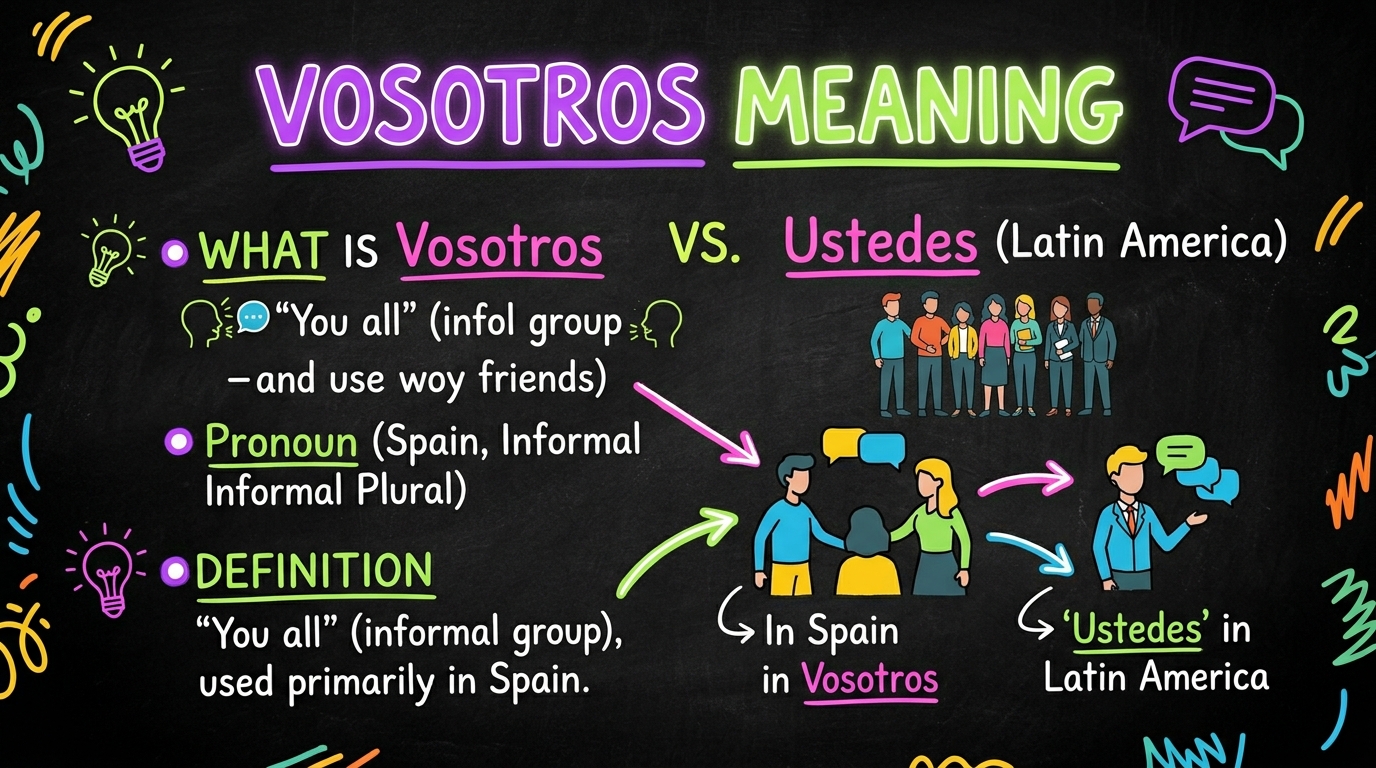
Vosotros is a Spanish pronoun that means:
“You all” or “all of you” when speaking informally to multiple people.
Key points:
- Used when talking to a group of friends, family members, classmates, or colleagues.
- Primarily used in Spain.
- Considered informal.
- Refers directly to the people being spoken to.
Quick Examples
“Vosotros sois muy amables.”
“You all are very kind.”
“¿Vosotros venís mañana?”
“Are you all coming tomorrow?”
“Vosotros podéis hacerlo.”
“You all can do it.”
Vosotros Meaning in English
In English, there is no separate word that perfectly matches vosotros.
English simply uses:
- You
- You all
- You guys
- Everyone
- All of you
For example:
| Spanish | English |
|---|---|
| Vosotros sois mis amigos. | You are my friends. |
| Vosotros tenéis razón. | You all are right. |
| Vosotros podéis entrar. | You guys can come in. |
Because English uses the same word “you” for both singular and plural situations, learners often struggle to understand why Spanish needs a separate word.
The purpose of vosotros is to clearly indicate that more than one person is being addressed.
Vosotros Meaning in Spanish
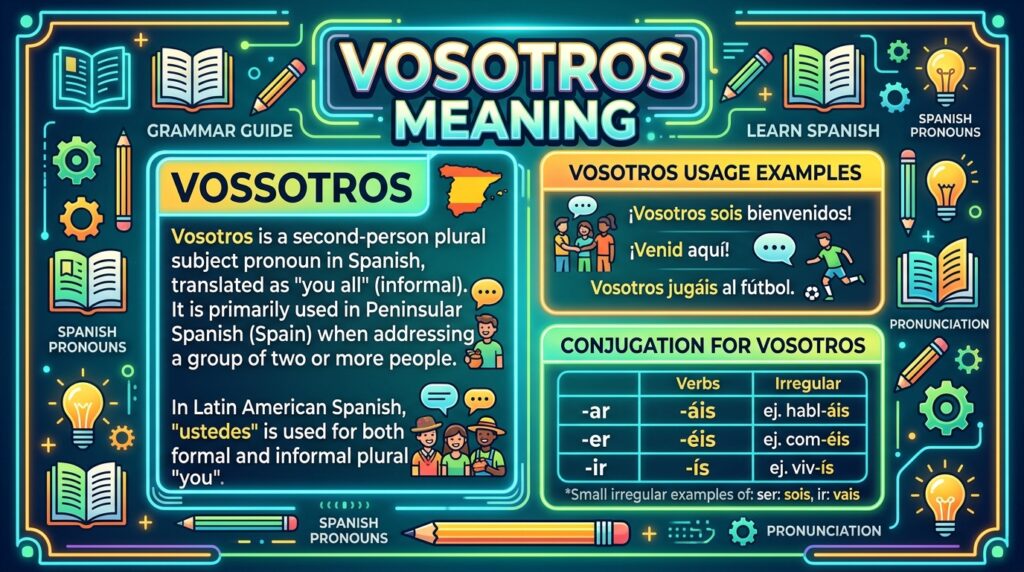
In Spanish grammar, vosotros is the second-person plural informal pronoun.
It is used when speaking directly to a group of people with whom you have a familiar or informal relationship.
Examples include:
- Friends
- Siblings
- Cousins
- Classmates
- Sports teammates
- Informal social groups
Spanish speakers in Spain regularly use vosotros in everyday conversations.
Example:
Vosotros sois increíbles.
Translation:
You all are amazing.
The feminine version is called vosotras, which we’ll discuss later.
Vosotros Meaning Bad
A common question online is whether vosotros has a bad meaning.
The answer is simple:
No, vosotros is not offensive, rude, insulting, or inappropriate.
It is a normal grammatical word used throughout Spain.
People sometimes become confused because:
- They hear unfamiliar verb forms.
- They mistake it for slang.
- They assume it has a hidden meaning.
In reality, vosotros is simply a pronoun, much like “you all” in English.
The tone depends entirely on the sentence around it, not the word itself.
Does Vosotros Mean They?
No.
This is one of the most common mistakes made by Spanish learners.
Vosotros
Means:
You all
The speaker is talking directly to the group.
Ellos / Ellas
Means:
They
The speaker is talking about a group.
Example:
Vosotros sois inteligentes.
“You all are intelligent.”
Ellos son inteligentes.
“They are intelligent.”
The difference is who receives the message.
Origin & Background
The history of vosotros goes back centuries.
Its roots can be traced to Latin, the language from which Spanish evolved.
The word developed from older expressions used to address multiple people respectfully.
Over time, Spanish grammar changed and simplified, eventually creating the modern form vosotros.
Cultural Influence
Spain preserved the use of vosotros, while many Latin American countries gradually stopped using it in everyday speech.
As a result:
- Spain uses vosotros frequently.
- Most of Latin America uses ustedes instead.
Social Media Impact
Platforms like:
- TikTok
- YouTube
- Twitch
have introduced more learners to authentic Spanish conversations.
Today, many people discover vosotros while watching Spanish influencers and content creators from Spain.
This exposure has increased interest in understanding regional language differences.
Vosotros Examples
Here are practical examples used by native speakers.
Everyday Examples
- Vosotros sois muy simpáticos.
- Vosotros tenéis mucha energía.
- Vosotros podéis ayudarme.
- Vosotros llegasteis temprano.
- Vosotros habláis español muy bien.
School Examples
- Vosotros debéis estudiar para el examen.
- Vosotros terminasteis la tarea.
Family Examples
- Vosotros siempre me apoyáis.
- Vosotros sois parte de mi vida.
Real-Life Conversations
WhatsApp Chat
Person A: ¿Vosotros vais a la fiesta esta noche?
Person B: Sí, todos vamos. Nos vemos allí.
Instagram DM
Person A: Vosotros hacéis los mejores videos.
Person B: ¡Muchas gracias! Significa mucho para nosotros.
TikTok Comments
Person A: Vosotros siempre encontráis los mejores lugares para viajar.
Person B: Gracias, intentamos compartir experiencias reales.
Text Message
Person A: ¿Vosotros podéis venir antes de las seis?
Person B: Claro, estaremos allí a las cinco.
Emotional & Psychological Meaning
Although vosotros is technically a grammar term, it carries a subtle social meaning.
It often creates:
- Inclusion
- Group identity
- Familiarity
- Warmth
- Connection
When someone says vosotros, they are directly addressing a group and acknowledging everyone present.
Imagine a teacher saying:
“Vosotros habéis trabajado muy duro.”
The sentence feels personal because the entire group is being recognized.
In my experience helping language learners, understanding vosotros often creates a breakthrough moment. Suddenly, Spanish conversations become easier to follow because learners can identify exactly who is being addressed.
What Is Vosotros Used For?
The primary purpose of vosotros is to address multiple people informally.
Common situations include:
- Speaking to friends
- Talking to classmates
- Addressing siblings
- Communicating with teammates
- Casual group discussions
It helps speakers clearly indicate that they are talking directly to several people rather than one person.
Usage in Different Contexts
Social Media
Spanish creators frequently use vosotros when speaking to followers.
Example:
“Vosotros sois la mejor comunidad.”
Friends & Relationships
Friends use it naturally in daily conversation.
Example:
“Vosotros siempre me hacéis reír.”
Work & Professional Settings
In Spain, informal workplaces may use vosotros among colleagues.
However, formal environments often prefer ustedes.
Casual vs Serious Tone
Casual:
“Vosotros podéis venir cuando queráis.”
Serious:
“Vosotros debéis seguir las instrucciones.”
The word itself remains neutral.
Vosotras Meaning
Vosotras is the feminine plural version of vosotros.
It is used when addressing a group composed entirely of women or girls.
Examples:
- Vosotras sois increíbles.
- Vosotras podéis hacerlo.
- Vosotras tenéis talento.
If the group includes at least one male, Spanish generally uses vosotros.
Vosotros Meaning Latin
The roots of vosotros can be traced back to Latin, the ancient language spoken throughout much of the Roman Empire.
Linguists believe it evolved from older plural forms used to address groups respectfully.
As Latin developed into Spanish, these forms gradually transformed into modern pronouns such as:
- Tú
- Usted
- Vosotros
- Ustedes
This historical evolution explains why Spanish grammar contains distinctions that English no longer has.
When NOT to Use It
Avoid using vosotros in certain situations.
In Most Latin American Countries
Many speakers rarely use it.
Using ustedes is usually more natural.
Formal Government Communication
Formal institutions often prefer ustedes.
Business Documents
Professional writing generally favors more formal language.
When Unsure About Regional Preferences
Using ustedes is usually the safer option.
Common Misunderstandings
Mistake 1: Thinking It Means “They”
Incorrect.
It means “you all.”
Mistake 2: Assuming It Is Offensive
It is completely normal and respectful.
Mistake 3: Believing It Is Used Everywhere
Its strongest presence is in Spain.
Mistake 4: Confusing It With Vosotras
Vosotras is specifically feminine.
Mistake 5: Thinking English Has an Exact Equivalent
English does not have a direct match.
Comparison Table
| Search Term | Definition Intent |
|---|---|
| What Does Vosotros Mean | Understand the basic definition |
| How to Use Vosotros | Learn correct grammar usage |
| Examples of Vosotros | See real-world sentences |
| Vosotros vs Ustedes | Understand regional differences |
| Vosotros vs Ellos | Distinguish “you all” from “they” |
| Vosotros vs Vosotras | Understand gender differences |
| Vosotros in Spain | Learn regional usage |
| Vosotros in Latin America | Understand alternative forms |
Key Insight
The most important thing to remember is that vosotros refers directly to a group being spoken to. It creates clarity, inclusion, and natural communication in Spanish, especially in Spain.
Variations / Types
Vosotros Meaning
Informal “you all” in Spanish.
Vosotros in Text
Used when messaging multiple people.
Vosotros Abbreviation
No standard abbreviation exists.
Vosotros Slang
Not slang; it is standard grammar.
Vosotros in Chat
Common in group chats among Spanish speakers.
Vosotras Meaning
Feminine plural version.
Vosotros in Spain
Used daily in conversation.
Vosotros in Latin America
Rarely used in many countries.
Vosotros Pronunciation
Pronounced roughly as “boh-SOH-tros.”
Vosotros Grammar Form
Second-person plural informal pronoun.
How to Respond When Someone Uses It
Casual Replies
- Claro.
- Sí, vamos.
- Estamos de acuerdo.
Funny Replies
- Solo si hay pizza.
- Depende del café.
- Estamos considerando la oferta.
Mature Replies
- Gracias por incluirnos.
- Lo tendremos en cuenta.
- Apreciamos tu opinión.
Respectful Replies
- Muchas gracias.
- Entendido.
- Estamos de acuerdo.
Regional & Cultural Usage
Western Culture
Often associated with Spanish language education and European Spanish.
Asian Culture
Usually encountered through language classes and online content.
Middle Eastern Culture
Common among Spanish learners and international students.
Global Internet Usage
Increasingly recognized through social media and streaming platforms.
Gen Z vs Millennials
Gen Z
- Learns it through TikTok and YouTube.
- Exposed to Spanish influencers.
Millennials
- More likely to encounter it through formal education.
- Often learn it through textbooks.
Is It Safe for Kids?
Yes.
Vosotros is a standard grammatical word with no offensive meaning.
Children learning Spanish may encounter it in:
- School lessons
- Educational videos
- Language-learning apps
- Children’s books
Parents generally do not need to worry about the term.
FAQs
What does vosotros mean in English?
It usually means “you all” or “all of you.”
Is vosotros formal or informal?
It is informal.
Is vosotros used in Mexico?
Generally no. Most speakers use ustedes instead.
Does vosotros mean they?
No. It means “you all.”
What is the feminine form of vosotros?
The feminine form is vosotras.
Why is vosotros important?
It helps identify when multiple people are being addressed.
Is vosotros still used today?
Yes, especially throughout Spain.
Conclusion
Understanding vosotros meaning becomes much easier once you realize it simply refers to “you all” in informal Spanish. While it may seem confusing at first, especially for English speakers, it plays an important role in everyday communication across Spain. Learning how and when to use vosotros helps you understand conversations more naturally, avoid common grammar mistakes, and connect more confidently with native speakers. The more authentic Spanish you hear, the more familiar and useful this important word will become.