If you’ve ever seen someone type “wagwan” in a chat or comment section and felt confused, you’re not alone. It looks simple, but it carries a whole cultural vibe behind it.
People search wagwan meaning because it appears everywhere—TikTok captions, Instagram DMs, rap lyrics, and casual texting. Yet, it doesn’t directly translate like normal English words. It feels more like a mood than a definition.
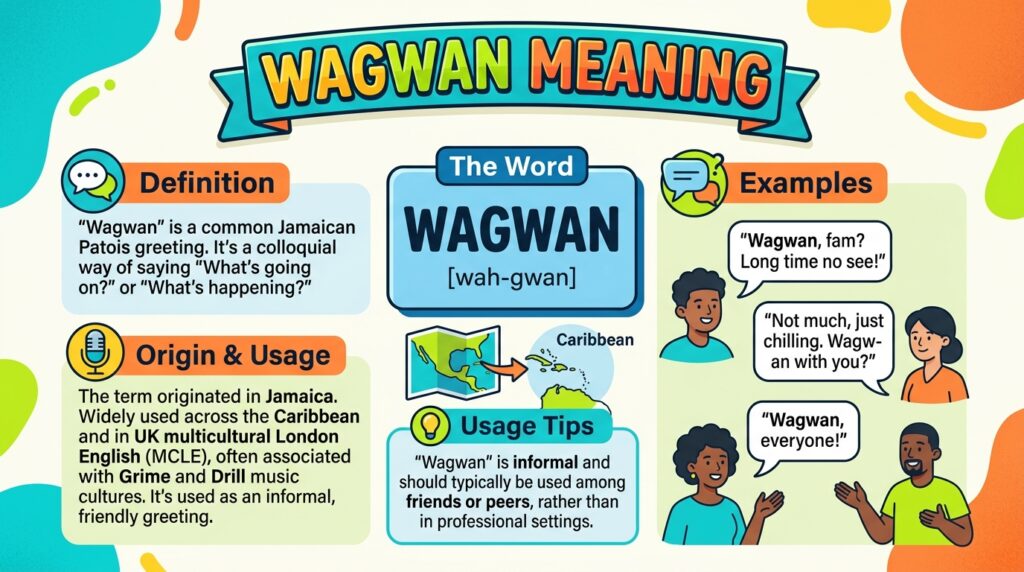
At its core, wagwan is a greeting, a question, and a cultural expression all in one. But the real meaning goes deeper than “what’s going on?” It reflects identity, friendliness, and modern street communication.
Understanding it properly helps you not only translate the word, but also feel the emotion behind it.
Wagwan Meaning – Quick Meaning
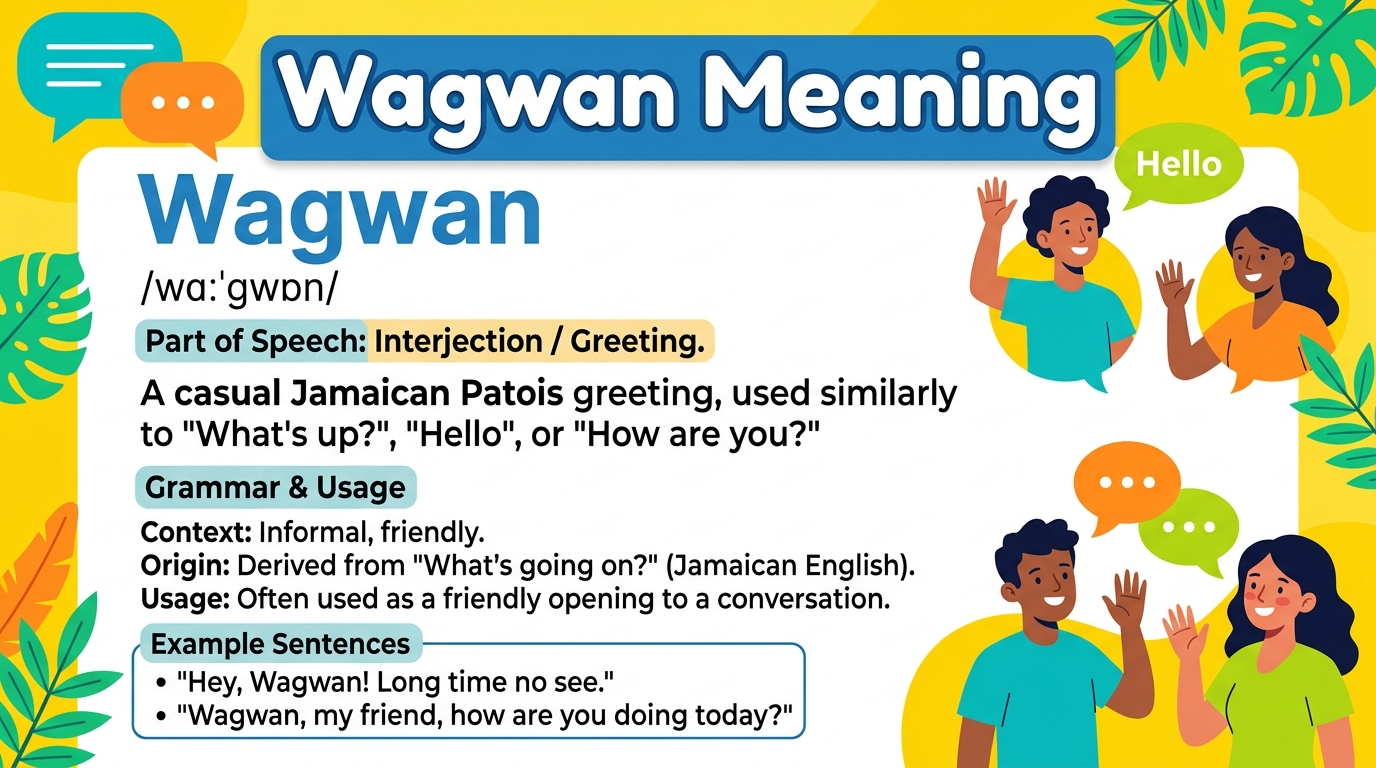
Wagwan is a slang greeting mainly meaning:
- “What’s going on?”
- “What’s happening?”
- “How are things?”
It is commonly used in informal conversations, especially in British urban slang.
Simple examples:
- “Wagwan bro?” → “What’s up, bro?”
- “Wagwan with you?” → “What’s happening with you?”
- “Yo, wagwan today?” → “What’s going on today?”
It is not formal English. It’s emotional, casual, and culturally expressive.
Origin & Background
The word wagwan comes from Jamaican Patois, a creole language influenced by English and African linguistic roots.
Originally, it was a shortened version of “what’s going on.” Over time, it became “wagwan” in spoken Caribbean culture.
When Caribbean communities migrated to the UK, especially in London, the phrase entered British street slang. It became popular in:
- Urban music (grime, rap, dancehall)
- Youth culture
- Social media trends
- Everyday informal greetings
Today, wagwan is not just Jamaican or British—it’s global internet slang. Even people who don’t understand its origin still use it because it sounds cool, friendly, and expressive.
Its evolution shows how language travels emotionally before it travels grammatically.
Wagwan Meaning in Urdu
In Urdu, wagwan can be understood as:
- “کیا ہو رہا ہے؟”
- “کیا چل رہا ہے؟”
- “کیا حال ہے؟”
But the emotional tone is closer to casual street greetings like:
- “او بھائی کیا حال ہے؟”
- “کیا scene ہے؟”
It is not a direct translation but a cultural equivalent. In Urdu-speaking chats, it carries the same relaxed and friendly vibe.
Wagwan Meaning in Chat
In online conversations, wagwan is used as a casual opener.
It replaces:
- “Hey”
- “What’s up”
- “How are you”
Common chat usage:
- “Wagwan bro 😂”
- “Wagwan? Long time no see”
- “Wagwan tonight?”
It usually signals friendliness, curiosity, or checking in. It can also be playful or humorous depending on context.
In texting culture, it works like a mood-setter more than a question expecting a detailed answer.
Wagwan Meaning and Reply
When someone says wagwan, they are not always expecting a long explanation. The reply depends on tone.
Possible replies:
- “All good, wagwan with you?”
- “Same old, you?”
- “Nothing much, just chilling”
- “Everything calm, what about you?”
Sometimes, the best reply is simply mirroring the energy:
- “Wagwan bro 😄”
The key is keeping it casual and natural. Overthinking it makes the conversation feel awkward.
Wagwan Meaning in English
In standard English, wagwan translates loosely to:
- “What’s going on?”
- “What is happening?”
- “What’s up?”
However, English doesn’t fully capture its cultural tone. In real usage, it is less of a question and more of a greeting.
So while grammar says it’s a question, communication says it’s a vibe.
Wagwan Meaning British Slang
In British slang, especially in London youth culture, wagwan is a common street greeting.
It is used to:
- Greet friends
- Start conversations
- Show familiarity
- Express casual curiosity
It is often associated with grime music, UK rap, and urban youth identity.
In British slang, it can even replace “hello” completely in informal settings:
- “Wagwan fam?”
It carries attitude, culture, and identity—not just meaning.
Wagwan Pronunciation
The pronunciation is simple:
“Wah-gwan”
Break it down:
- “Wa” → like “what” without the “t”
- “gwan” → rhymes with “gone”
It is usually spoken quickly in natural conversation:
- “Wagwan bro!”
- “Wagwan fam!”
The tone matters more than accuracy. It should sound relaxed, not formal.
Wagwan Meaning in Arabic
In Arabic, wagwan can be loosely interpreted as:
- “ماذا يحدث؟”
- “كيف الأمور؟”
But culturally, it is closer to informal greetings like:
- “شو الأخبار؟” (Shu al-akhbar?)
- “كيفك؟” (Kayfak?)
Again, it is not a literal translation. It carries emotional friendliness more than grammatical meaning.
Wagwan Reply
How you reply depends on relationship and mood.
Casual replies:
- “All good”
- “Chilling”
- “Same here”
Funny replies:
- “Surviving life 😂”
- “Trying to be rich lol”
- “Still confused like yesterday”
Mature replies:
- “Everything is fine, hope you’re well”
- “Doing good, thanks for asking”
Respectful replies:
- “I’m doing well, how about you?”
- “All is good on my side”
The best replies match the energy of the person who started it.
Real-Life Conversations (MANDATORY)
WhatsApp Chat:
Person A: Wagwan bro?
Person B: All good, just at home chilling. You?
Person A: Same here, boring day lol
Instagram DM:
Person A: Wagwan, haven’t seen you in ages 😄
Person B: True! Life’s been cr*zy.
Person A: We should catch up soon
TikTok Comment Section:
Person A: Wagwan everyone 😂
Person B: Wagwan fam, this video is fire
Person C: Facts, this hit different
Text Message:
Person A: Wagwan tonight?
Person B: Probably just staying in
Person A: Fair, same here
Emotional & Psychological Meaning
Wagwan is more than slang—it reflects emotional connection.
People use it because:
- It feels warm and friendly
- It reduces social distance
- It creates belonging
- It makes communication informal and safe
Psychologically, it removes pressure from conversation. Instead of asking a structured question like “How are you?”, it opens space for relaxed interaction.
In one real-life moment, a friend texting “wagwan” after months of silence doesn’t just ask a question—it quietly says, “I still acknowledge you.”
Usage in Different Contexts
- Social Media: Used in captions, comments, memes
- Friends & Relationships: Casual greeting or check-in
- Work/Professional: Not appropriate in formal settings
- Casual Tone: Very common and natural
- Serious Tone: Rarely used
It belongs to informal communication only.
When NOT to Use It
Avoid using wagwan in:
- Job interviews
- Formal emails
- Academic writing
- Serious professional meetings
It may sound unprofessional or confusing in formal environments.
Also, using it incorrectly in serious cultural contexts can feel forced or disrespectful.
Common Misunderstandings
Many people think:
- It means only “hello”
- It is only Jamaican slang
- It requires a complex reply
But in reality:
- It’s both a greeting and a mood
- It’s globally used now
- It often doesn’t need a serious answer
Tone matters more than definition.
Comparison Table
| Expression | What it means | How it is used | Example |
|---|---|---|---|
| Wagwan | What’s going on | Casual greeting | “Wagwan bro?” |
| Hello | Formal greeting | Neutral start | “Hello, how are you?” |
| What’s up | Casual check-in | Friendly chat | “What’s up man?” |
| How are you | Polite inquiry | Formal/casual | “How are you today?” |
Key Insight:
Wagwan is less about grammar and more about cultural energy. It replaces structured greetings with emotional connection.
Variations / Types
- Wagwan fam – greeting friends like family
- Wagwan bro – casual male friend greeting
- Wagwan girl – playful friendly check-in
- Wagwan tho – curious tone in chat
- Wagwan now – asking current situation
- Wagwan ting – slang for situation or person
- Wagwan in chat – group conversation opener
- Wagwan everywhere – meme-style usage
- Wagwan vibes – emotional or mood-based usage
- Wagwan lol – humorous casual greeting
How to Respond When Someone Uses It
- Casual: “All good, you?”
- Funny: “Just surviving 😂 what about you?”
- Mature: “Doing well, thanks. Hope you are too.”
- Respectful: “Everything is fine on my side, appreciate you asking.”
Regional & Cultural Usage
- Western Culture: Popular in UK street slang and global youth culture
- Asian Culture: Used mainly in social media, often without deep cultural roots
- Middle Eastern Culture: Understood through internet slang exposure
- Global Internet: Meme-driven and widely recognized
- Gen Z vs Millennials: Gen Z uses it more casually; millennials use it occasionally in online chats
Is It Safe for Kids?
Yes, it is generally safe.
It contains no offensive meaning. However, children should understand it is informal slang and not suitable for school or formal writing.
FAQs
What does wagwan mean in slang?
It means “what’s going on?” or “what’s up?” used as a casual greeting.
What does “licky licky” mean in Jamaican?
It is Jamaican slang often used in a suggestive or teasing way, generally referring to flirtatious or sexual behavior in a playful street context.
What is the meaning of Wagwun?
“Wagwun” is just a spelling variation of wagwan and means “what’s going on.”
Is wagwan roadman slang?
Yes, it is commonly used in UK roadman and urban street slang influenced by Jamaican Patois.
Is wagwan formal or informal?
It is strictly informal and used in casual conversations only.
Can wagwan be used in texting?
Yes, it is very common in chats like WhatsApp, Instagram, and Snapchat.
Is wagwan the same as what’s up?
Yes, both mean the same thing, but wagwan carries more cultural slang tone.
Where did wagwan originally come from?
It comes from Jamaican Patois and later became popular in UK street culture.
What tone does wagwan usually have?
It has a friendly, relaxed, and informal tone used to start conversations.
Is wagwan used globally now?
Yes, it is widely used on social media across different countries, especially among Gen Z.
Conclusion
Wagwan is more than a simple slang word—it is a cultural expression that connects people through casual energy and friendliness. It replaces formal greetings with a relaxed, emotional tone that feels natural in modern conversations. Whether used in chats, social media, or friendly meetups, it builds instant familiarity. Understanding wagwan helps you read between the lines of digital communication. It is not just about meaning, but about feeling included in a global, evolving language of connection and identity.