If you’ve ever heard the phrase “Feliz Navidad” during the holiday season, you’re not alone. From Christmas songs and greeting cards to social media posts and festive decorations, this cheerful expression appears everywhere in December.
Many people search for feliz navidad meaning because they hear it in the famous holiday song but aren’t sure what it actually means. Others want to know how to pronounce it, what language it comes from, or whether it’s appropriate to use in different cultures.
The good news is that the phrase is simple, joyful, and deeply connected to Christmas traditions around the world. Understanding its meaning can help you appreciate the cultural warmth behind one of the most recognized holiday greetings ever created.
Feliz Navidad Meaning – Quick Meaning
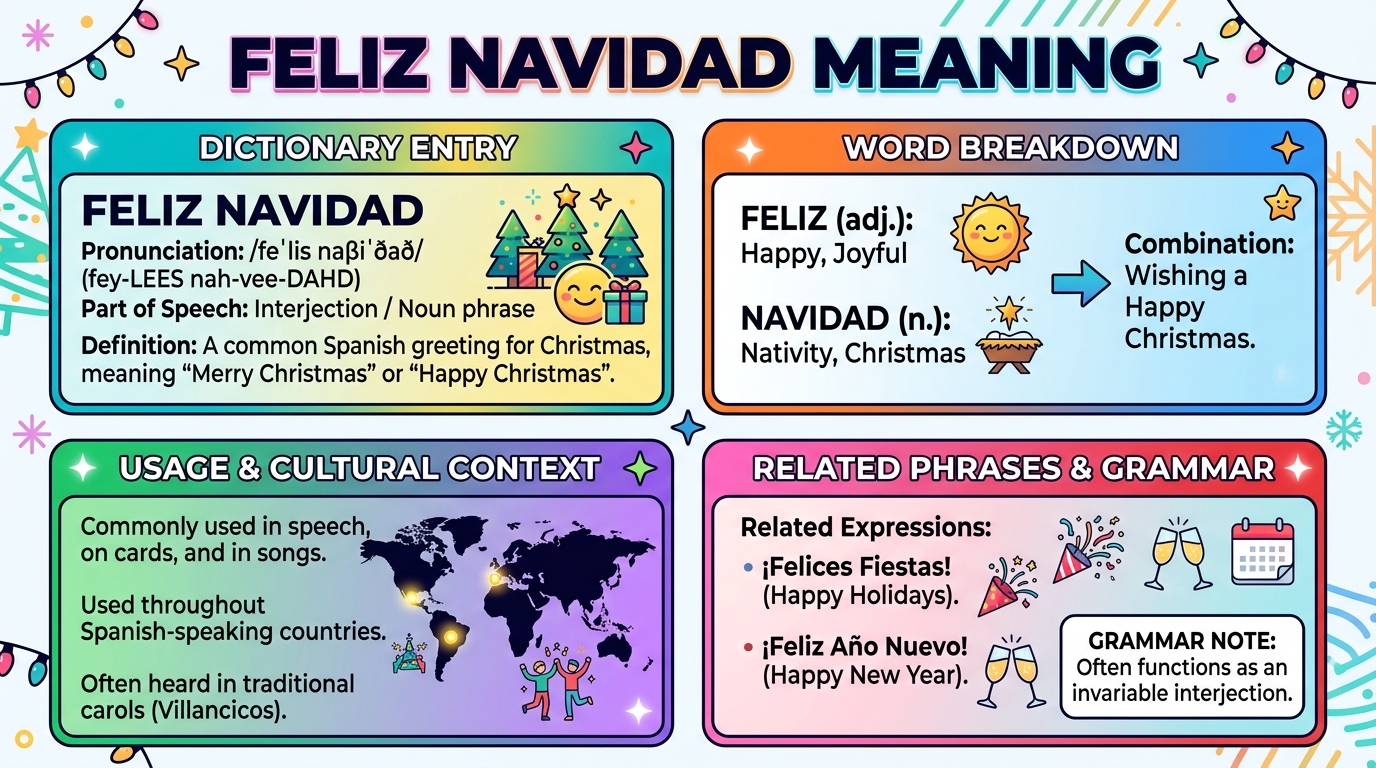
Feliz Navidad is a Spanish phrase that means:
“Merry Christmas”
The phrase is made up of two Spanish words:
- Feliz = Happy or Merry
- Navidad = Christmas
Together, they express a wish for a joyful and blessed Christmas celebration.
Simple Examples
“¡Feliz Navidad a ti y a tu familia!”
(Merry Christmas to you and your family!)
“Wishing everyone a Feliz Navidad filled with love.”
“Feliz Navidad! Hope your holidays are wonderful.”
The phrase carries feelings of happiness, warmth, togetherness, and celebration.
Origin & Background
The expression Feliz Navidad comes directly from the Spanish language and has been used for centuries throughout Spanish-speaking countries.
Christmas has long been one of the most important celebrations in many Spanish-speaking cultures. Families gather, share meals, exchange gifts, attend religious services, and spend time with loved ones. The greeting “Feliz Navidad” naturally became a way to spread goodwill during the season.
The phrase gained worldwide popularity after Puerto Rican singer and songwriter José Feliciano released the iconic Christmas song Feliz Navidad in 1970.
Because the song combines English and Spanish lyrics, it became accessible to millions of listeners across different cultures. Over time, the phrase evolved from a Spanish holiday greeting into a global symbol of Christmas cheer.
Today, people who don’t speak Spanish often use the phrase simply because it feels festive, welcoming, and universally understood.
Feliz Navidad Meaning in English
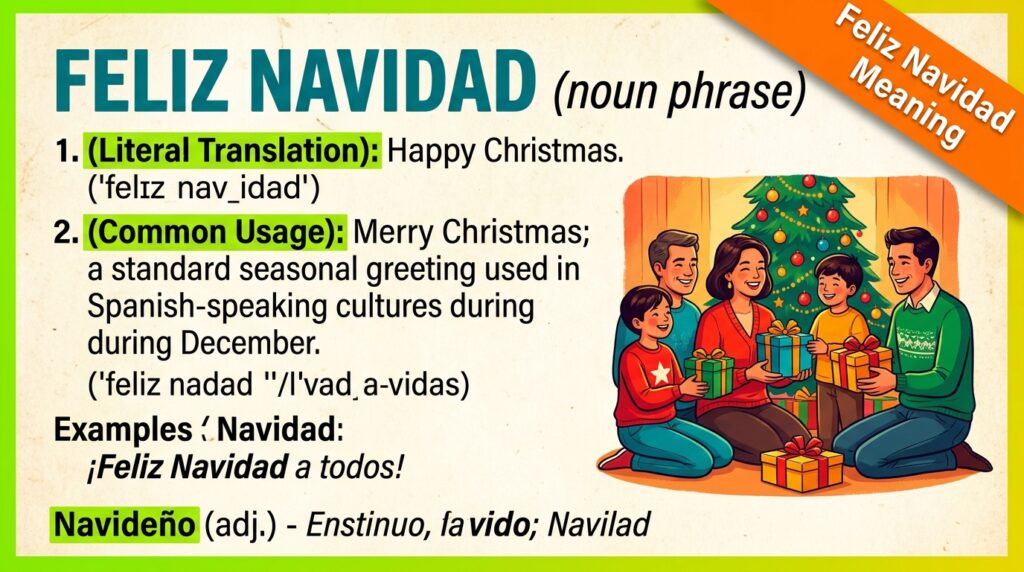
The direct English translation of Feliz Navidad is:
Merry Christmas
In some contexts, it can also be understood as:
- Happy Christmas
- Joyful Christmas
- Wishing you a happy Christmas
Although “Merry Christmas” is the most common translation, the emotional message remains the same: wishing happiness, peace, and celebration during the holiday season.
Feliz Navidad Meaning Song
Many people first encounter the phrase through the song “Feliz Navidad.”
The song repeats a simple holiday message:
“Feliz Navidad, Feliz Navidad, Feliz Navidad, próspero año y felicidad.”
This translates roughly to:
“Merry Christmas, Merry Christmas, Merry Christmas, a prosperous year and happiness.”
The song’s popularity comes from its simplicity. Even people who speak little or no Spanish can easily understand and sing along.
Its message focuses on joy, unity, goodwill, and holiday happiness rather than complex storytelling.
Feliz Navidad Language
Feliz Navidad is Spanish.
Spanish is one of the most widely spoken languages in the world, with hundreds of millions of native speakers across countries such as:
- Spain
- Mexico
- Argentina
- Colombia
- Puerto Rico
Because Spanish has a large global presence, many non-Spanish speakers recognize common holiday expressions like Feliz Navidad.
Feliz Navidad Lyrics in English
The most famous line translates as:
“Merry Christmas, Merry Christmas, Merry Christmas, prosperous year and happiness.”
The English section of the song says:
“I wanna wish you a Merry Christmas from the bottom of my heart.”
This combination of Spanish and English helped make the song internationally beloved and easy for audiences everywhere to enjoy.
Feliz Navidad Song
The song Feliz Navidad is one of the most played Christmas songs worldwide.
Reasons for its lasting popularity include:
- Easy lyrics
- Positive message
- Multicultural appeal
- Family-friendly theme
- Simple melody
More than five decades after its release, it continues to appear in holiday playlists, movies, stores, and Christmas celebrations around the world.
Real-Life Conversations
WhatsApp Chat
Person A: Feliz Navidad! Hope you’re having a wonderful day.
Person B: Thank you! Feliz Navidad to you too. Enjoy the holidays with your family.
Instagram DM
Person A: Your Christmas decorations look amazing!
Person B: Thank you! Feliz Navidad and happy holidays!
TikTok Comments
Person A: This Christmas recipe looks delicious.
Person B: Thanks! Feliz Navidad everyone!
Text Message
Person A: Merry Christmas from Canada!
Person B: Feliz Navidad! Sending warm wishes your way.
Emotional & Psychological Meaning
At its core, Feliz Navidad represents connection.
People use it to express goodwill, kindness, warmth, and appreciation. During a season that emphasizes family and togetherness, the phrase helps strengthen social bonds.
Psychologically, holiday greetings serve as reminders that people belong to a larger community. Even a simple message can create feelings of inclusion and happiness.
For example, imagine receiving a text saying “Feliz Navidad!” from an old friend you haven’t spoken to all year. The message may be short, but it instantly creates a sense of warmth and reconnection.
That emotional impact is one reason the phrase remains so powerful.
Usage in Different Contexts
Social Media
People use Feliz Navidad in:
- Instagram captions
- Facebook posts
- TikTok videos
- Holiday stories
- Christmas photos
Friends & Relationships
The phrase works naturally between friends, partners, relatives, and neighbors during the holiday season.
Work and Professional Settings
In many workplaces, “Feliz Navidad” can be used respectfully when communicating with Spanish-speaking colleagues or multicultural teams.
Casual vs Serious Tone
Casually, it feels cheerful and festive.
In more formal settings, it remains respectful and warm while maintaining professionalism.
When NOT to Use It
Although generally positive, there are situations where caution helps.
Religious Sensitivity
Not everyone celebrates Christmas. Using holiday-neutral greetings may sometimes be more appropriate.
Off-Season Usage
Using Feliz Navidad outside the Christmas season can create confusion.
Cultural Assumptions
Avoid assuming someone’s background or beliefs simply because they speak Spanish.
Professional Formality
Some highly formal business communications may require more neutral holiday language.
Common Misunderstandings
Thinking It Means Happy New Year
It specifically means Merry Christmas, not Happy New Year.
Assuming It’s Only for Spanish Speakers
People worldwide use and understand the phrase.
Believing It’s Only Religious
While Christmas has religious roots, many people use Feliz Navidad in a cultural or festive sense.
Confusing the Song with the Greeting
The song popularized the phrase, but the greeting existed long before the song.
Comparison Table
| Phrase | Meaning/Intent |
|---|---|
| What Does Feliz Navidad Mean | Understand the translation and significance |
| How to Use Feliz Navidad | Learn proper holiday usage |
| Examples of Feliz Navidad | See it in real conversations |
| Feliz Navidad vs Merry Christmas | Same message in different languages |
| Feliz Navidad vs Happy Holidays | Christmas-specific vs broader seasonal greeting |
Key Insight
The biggest takeaway is that Feliz Navidad and Merry Christmas communicate the same heartfelt wish. The choice often depends on language preference, cultural connection, or holiday tradition.
Variations & Types
Feliz Navidad Meaning
A Spanish greeting meaning Merry Christmas.
Feliz Navidad in Text
Used in messages to send holiday wishes.
Feliz Navidad Abbreviation
Some people simply write “FN” informally online.
Feliz Navidad Slang
Not slang itself, but often used playfully in festive conversations.
Feliz Navidad in Chat
A quick and friendly Christmas greeting.
Feliz Navidad Greeting
A traditional holiday expression.
Feliz Navidad Message
Used in cards, emails, and texts.
Feliz Navidad Caption
Popular for Christmas photos and social posts.
Feliz Navidad Wish
A warm expression of goodwill.
Feliz Navidad Holiday Phrase
One of the most recognized Christmas greetings globally.
How to Respond When Someone Uses It
Casual Replies
- Feliz Navidad to you too!
- Thanks, have a wonderful Christmas!
- Wishing you the same!
Funny Replies
- Feliz Navidad and extra cookies for everyone!
- Merry Christmas and zero fruitcake emergencies!
Mature Replies
- Thank you. Wishing you peace and happiness this holiday season.
- May your Christmas be filled with joy and good health.
Respectful Replies
- Thank you for your kind wishes.
- Warm holiday greetings to you and your family.
Feliz Navidad Meaning in French
The French equivalent of Feliz Navidad is:
Joyeux Noël
Both expressions mean Merry Christmas and are commonly used during the holiday season.
Feliz Navidad Pronunciation
The pronunciation is:
feh-LEES nah-vee-DAHD
Tips:
- Stress the second syllable of Feliz.
- Stress the final syllable of Navidad.
- Keep the pronunciation smooth and rhythmic.
Feliz Navidad Meaning Portuguese
In Portuguese, the equivalent greeting is:
Feliz Natal
Like the Spanish phrase, it means Merry Christmas and is widely used in countries such as Brazil and Portugal.
Regional & Cultural Usage
Western Culture
Often used alongside Merry Christmas, especially in multicultural communities.
Asian Culture
Frequently appears in Christmas marketing, music, and social media celebrations.
Middle Eastern Culture
Used mainly by Christian communities and international audiences celebrating Christmas.
Global Internet Usage
The phrase has become universally recognizable through music, memes, videos, and holiday content.
Gen Z vs Millennials
Gen Z often uses it in captions, reels, and holiday memes.
Millennials commonly use it in family messages, cards, and nostalgic holiday posts.
Is It Safe for Kids?
Yes.
Feliz Navidad is completely family-friendly and suitable for children. It simply means Merry Christmas and carries positive, festive intentions.
FAQs
What is the meaning of Feliz Navidad?
Feliz Navidad is a Spanish phrase that means “Merry Christmas” in English. It is commonly used to wish someone happiness and joy during the Christmas season.
What does “Navidad” literally mean?
The word “Navidad” literally means “Christmas” in Spanish. It refers to the celebration of the birth of Jesus Christ and the holiday season surrounding it.
Is Feliz Navidad Spanish or Mexican?
Feliz Navidad is Spanish, not exclusively Mexican. It is used across Spain, Mexico, and many other Spanish-speaking countries around the world.
Is it okay to say “Feliz Navidad”?
Yes, it is perfectly okay to say Feliz Navidad. The phrase is widely recognized and appreciated as a friendly and respectful Christmas greeting.
How do you pronounce Feliz Navidad?
Feliz Navidad is pronounced “feh-LEES nah-vee-DAHD.” The phrase has a smooth rhythm and is easy for non-Spanish speakers to learn.
Why is Feliz Navidad so popular?
The phrase became globally famous because of the classic Christmas song “Feliz Navidad” by José Feliciano. Its simple lyrics and joyful message made it a holiday favorite worldwide.
What language is Feliz Navidad in?
Feliz Navidad is written in Spanish, one of the most widely spoken languages in the world. It is commonly used during Christmas celebrations in many countries.
What is the English equivalent of Feliz Navidad?
The English equivalent of Feliz Navidad is “Merry Christmas.” Both greetings express the same wish for a joyful and happy Christmas season.
Can non-Spanish speakers use Feliz Navidad?
Yes, non-Spanish speakers can comfortably use Feliz Navidad. It is understood internationally and is often used to celebrate cultural diversity during the holidays.
Is Feliz Navidad only used at Christmas?
Yes, Feliz Navidad is specifically associated with Christmas. It is typically used during the holiday season and is not commonly used at other times of the year.
Conclusion
Understanding the feliz navidad meaning goes beyond a simple translation. It represents warmth, generosity, celebration, and the universal desire to share happiness during the Christmas season. Whether you hear it in a classic holiday song, receive it in a text message, or see it in a social media post, the phrase carries a message of goodwill that transcends language barriers. By knowing its meaning, pronunciation, and cultural significance, you can use it confidently and appreciate the spirit of connection it brings to people around the world.