Have you ever heard someone described as “atypical” and wondered whether it was positive, negative, medical, or something else entirely?
The word atypical appears in healthcare, psychology, education, workplace discussions, and everyday conversations. Yet many people misunderstand it because it sounds technical and often carries different meanings depending on the situation.
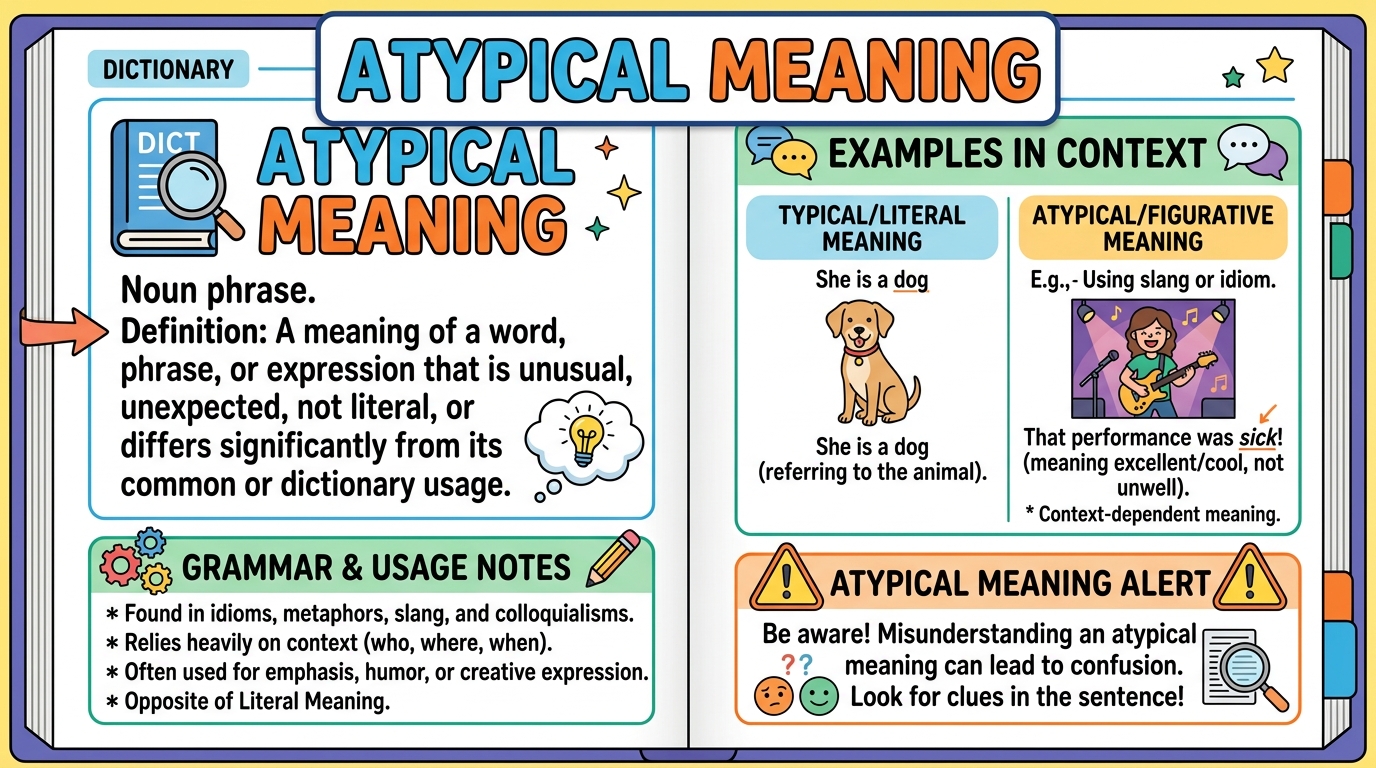
At its core, atypical simply means something does not follow the usual or expected pattern. It doesn’t automatically mean wrong, unhealthy, or problematic. In many cases, it simply highlights uniqueness, variation, or a difference from what is commonly seen.
In this guide, you’ll learn the complete meaning of atypical, how people use it in real conversations, its medical significance, its connection to autism, and why this simple word has become increasingly important in modern communication.
Atypical Meaning – Quick Meaning
Atypical meaning: Something that is different from what is normal, common, expected, or typical.
Simple Definition
Atypical describes a person, behavior, condition, event, or characteristic that does not match the standard pattern most people expect.
Key Points
- Different from the norm
- Unusual but not necessarily negative
- Commonly used in medicine and psychology
- Can describe people, symptoms, behaviors, or situations
Examples
“Her career path was atypical because she became a CEO at twenty-six.”
“The doctor noticed atypical symptoms during the examination.”
“His response to the situation was atypical compared to everyone else.”
Origin & Background
The word atypical comes from the Greek root typos, meaning pattern or model. The prefix a- means “not” or “without.”
Together, atypical literally means not fitting the usual pattern.
Historically, the term became popular in medicine and scientific research because professionals needed a neutral way to describe cases that differed from standard expectations.
Over time, the word expanded into psychology, education, business, and everyday language.
Social media has also influenced how people use atypical today. Many discussions around neurodiversity, mental health, learning differences, and personal identity use the term to describe experiences that don’t align with conventional expectations.
As online communities have become more accepting of individual differences, atypical is increasingly viewed as descriptive rather than judgmental.
Atypical Medical Meaning
In medicine, atypical refers to symptoms, conditions, or presentations that differ from what doctors normally expect.
For example, many illnesses have common warning signs. When a patient shows unusual signs instead, healthcare providers may describe them as atypical symptoms.
An atypical presentation can sometimes make diagnosis more challenging because it doesn’t match the textbook description of a disease.
Medical professionals use the term to communicate observations objectively rather than making assumptions.
Atypical Meaning Synonyms
Several words can carry meanings similar to atypical, depending on context.
- Unusual
- Uncommon
- Different
- Irregular
- Unique
- Exceptional
- Distinctive
- Nonstandard
- Abnormal (medical context only)
- Unconventional
Although these words overlap, atypical is often considered more neutral and less judgmental than terms like abnormal.
Atypical Meaning in English
In English, atypical functions primarily as an adjective.
It describes something that differs from what is usually expected.
Examples
- An atypical student learning style
- An atypical weather pattern
- An atypical business strategy
- An atypical reaction to medication
The word can appear in formal writing, academic discussions, professional reports, and casual conversations.
Atypical Disease Meaning
An atypical disease refers to a condition that appears differently from the standard version doctors usually encounter.
Sometimes patients experience unusual symptoms, delayed symptoms, or symptoms affecting unexpected parts of the body.
Healthcare providers may use terms such as:
- Atypical infection
- Atypical pneumonia
- Atypical depression
- Atypical disease presentation
The label helps doctors communicate that the condition doesn’t follow the most common clinical pattern.
Atypical Meaning Autism
In discussions about autism, atypical often relates to behaviors, communication styles, sensory processing, or developmental patterns that differ from the majority population.
Many professionals use the term when discussing neurodiversity because it provides a neutral description rather than a negative judgment.
For example, someone may have:
- Atypical communication preferences
- Atypical sensory responses
- Atypical social interaction patterns
Today, many advocates emphasize that atypical does not mean inferior. It simply reflects human diversity and different ways of experiencing the world.
Atypical Meaning Period
When discussing menstruation, an atypical period refers to a menstrual cycle that differs from a person’s usual pattern.
Examples include:
- Unusually heavy bleeding
- Unexpected spotting
- Changes in cycle length
- Significant timing differences
Doctors often investigate atypical menstrual patterns to determine whether lifestyle, hormonal, or medical factors may be involved.
Atypical Meaning and Examples
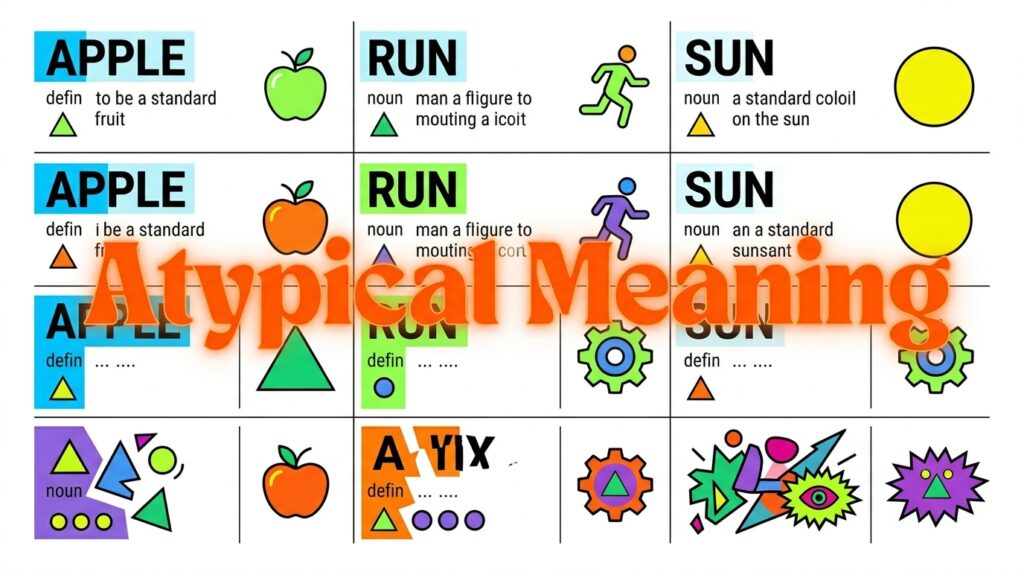
Understanding atypical becomes easier when viewed through everyday situations.
Example 1: Education
A student learns exceptionally well through visual demonstrations rather than traditional lectures.
This learning style may be considered atypical compared to classroom norms.
Example 2: Career
Someone becomes a successful entrepreneur without attending university.
Their path could be described as atypical.
Example 3: Health
A patient experiences shoulder pain instead of chest pain during a heart-related issue.
Doctors may call this an atypical symptom presentation.
Example 4: Social Behavior
A person prefers small, meaningful gatherings instead of large social events.
Their social preferences may be considered atypical within certain groups.
Real-Life Conversations
WhatsApp Conversation
Person A: Everyone at the office works the same schedule.
Person B: Mine is pretty atypical. I start early and finish by afternoon.
Instagram DM
Person A: Your travel story is wild.
Person B: Yeah, my route was definitely atypical. Most tourists never go there.
TikTok Comments
Person A: Is this symptom normal?
Person B: Not always. My doctor called it an atypical response.
Text Message
Person A: Why are you studying at midnight?
Person B: My routine is atypical, but it works for me.
Emotional & Psychological Meaning
Beyond dictionary definitions, atypical often carries emotional significance.
People frequently use the term when trying to explain experiences that feel different from the majority.
Sometimes the word brings relief because it avoids harsh labels. Instead of saying something is wrong, atypical simply acknowledges that it differs from common expectations.
In communication, atypical often reflects a growing cultural shift toward accepting individuality.
I once heard a university student describe her learning style as atypical after years of struggling in traditional classrooms. Once she understood that her brain processed information differently—not incorrectly—her confidence improved dramatically. That illustrates the emotional power behind the word.
Usage in Different Contexts
Social Media
People use atypical when discussing unique lifestyles, uncommon experiences, or personal identities.
Example:
“My career journey has been pretty atypical.”
Friends & Relationships
Friends may use the word to describe unusual habits or unexpected decisions.
Example:
“Your dating story is definitely atypical.”
Work & Professional Settings
Professionals often use atypical because it sounds objective and respectful.
Example:
“The customer showed an atypical purchasing pattern.”
Casual vs Serious Tone
In casual conversations, atypical can mean simply unusual.
In professional contexts, it often carries a more specific and analytical meaning.
When NOT to Use It
Avoid using atypical:
- As an insult
- To dismiss someone’s experience
- Without understanding cultural context
- When simpler language would be clearer
- In situations where people may misunderstand it as a medical diagnosis
Always consider whether your audience understands the term.
Common Misunderstandings
Atypical Means Bad
This is incorrect.
Atypical only means different from the usual pattern.
Atypical Means Rare
Not necessarily.
Something can be atypical without being extremely rare.
Atypical Equals Abnormal
While they sometimes overlap in medical settings, atypical is generally less negative and more neutral.
Atypical Only Applies to Health
The word applies to education, business, relationships, communication, behavior, and many other areas.
Comparison Table
| Search Intent | Meaning |
|---|---|
| What Does Atypical Mean | Understanding the definition and purpose of the word |
| How to Use Atypical | Learning correct usage in speech and writing |
| Examples of Atypical | Seeing real-life applications and situations |
| Atypical vs Typical | Comparing unusual patterns with standard expectations |
Key Insight
The most important thing to remember is that atypical describes difference, not deficiency. The word helps people discuss variation without automatically attaching negative judgments.
Variations / Types
Atypical Meaning
Different from the expected or standard pattern.
Atypical in Text
Used to describe unusual situations, behaviors, or responses.
Atypical Abbreviation
No widely accepted abbreviation exists in everyday communication.
Atypical Slang
The word itself is not slang but may appear in casual internet discussions.
Atypical in Chat
Often used when describing unique experiences or behaviors.
Atypical Medical Meaning
Symptoms or conditions that differ from common presentations.
Atypical Psychology Meaning
Behavioral or cognitive patterns outside typical expectations.
Atypical Development Meaning
Development that follows a different path than commonly expected.
Atypical Social Behavior Meaning
Interactions that differ from common social norms.
Atypical Communication Meaning
Communication styles that do not follow conventional patterns.
How to Respond When Someone Uses It
Casual Replies
- “That’s actually pretty interesting.”
- “Everyone has their own way of doing things.”
Funny Replies
- “Being typical sounds boring anyway.”
- “Congratulations on being one of a kind.”
Mature Replies
- “Different doesn’t mean wrong.”
- “I appreciate your perspective.”
Respectful Replies
- “Thank you for explaining that.”
- “That helps me understand your experience better.”
Regional & Cultural Usage
Western Culture
Atypical is often connected to individuality, uniqueness, and personal identity.
Asian Culture
The term may sometimes be viewed through the lens of social expectations and collective norms.
Middle Eastern Culture
Usage often depends on family, educational, and community contexts.
Global Internet Usage
Online communities frequently use atypical in discussions about neurodiversity, mental health, and personal experiences.
Gen Z vs Millennials
Gen Z often uses atypical as part of conversations about identity and self-expression.
Millennials commonly encounter it in professional, educational, and psychological discussions.
Is It Safe for Kids?
Yes. The word atypical is generally safe for children.
Parents and educators often use it to explain differences in learning styles, behavior, interests, or development without attaching negative labels. The key is ensuring children understand that atypical means different, not worse.
FAQs
What Does Being Atypical Mean?
Being atypical means having characteristics, behaviors, experiences, or traits that differ from what is commonly expected or considered typical. It simply indicates a variation from the norm and does not automatically imply something is good or bad.
What Is the Synonym of Atypical?
Common synonyms of atypical include unusual, uncommon, distinctive, irregular, unconventional, unique, and nonstandard. The best synonym depends on the context in which the word is being used.
What Is an Example of Atypical?
An example of atypical is a person who learns more effectively through hands-on activities rather than traditional classroom lectures. Their learning style differs from what is commonly expected but can still be highly effective.
Is Atypical Positive or Negative?
Atypical is generally a neutral word. It simply describes something that differs from the usual pattern. Depending on the situation, it can be viewed positively, negatively, or neither.
Can a Person Be Described as Atypical?
Yes, a person can be described as atypical if their behavior, personality, communication style, or life experiences differ from what is commonly expected. The term is descriptive rather than judgmental.
What Does Atypical Mean in Psychology?
In psychology, atypical refers to thoughts, emotions, or behaviors that differ from common psychological patterns. Professionals use the term to describe differences without necessarily labeling them as problematic.
What Does Atypical Mean in Healthcare?
In healthcare, atypical often refers to symptoms or conditions that do not present in the usual or expected way. This can sometimes make diagnosis more challenging for medical professionals.
Is Atypical the Same as Abnormal?
Not exactly. While both words describe something outside the norm, atypical is usually more neutral. Abnormal can sometimes carry a stronger negative implication depending on the context.
What Is the Difference Between Typical and Atypical?
Typical refers to something that follows a common or expected pattern, while atypical refers to something that differs from that pattern. Neither term automatically indicates quality or value.
Why Do People Use the Word Atypical?
People use the word atypical because it provides a respectful and objective way to describe differences. It helps explain variations in behavior, experiences, symptoms, or characteristics without making unfair judgments.
Conclusion
Understanding the atypical meaning helps us communicate with greater accuracy and empathy. The word does not automatically signal a problem, weakness, or disorder. Instead, it highlights differences from what is commonly expected. Whether used in medicine, education, psychology, or everyday conversations, atypical reminds us that human experiences rarely fit into perfect categories. The more we understand this term, the easier it becomes to appreciate diversity, recognize individual experiences, and speak about differences with confidence, respect, and understanding.