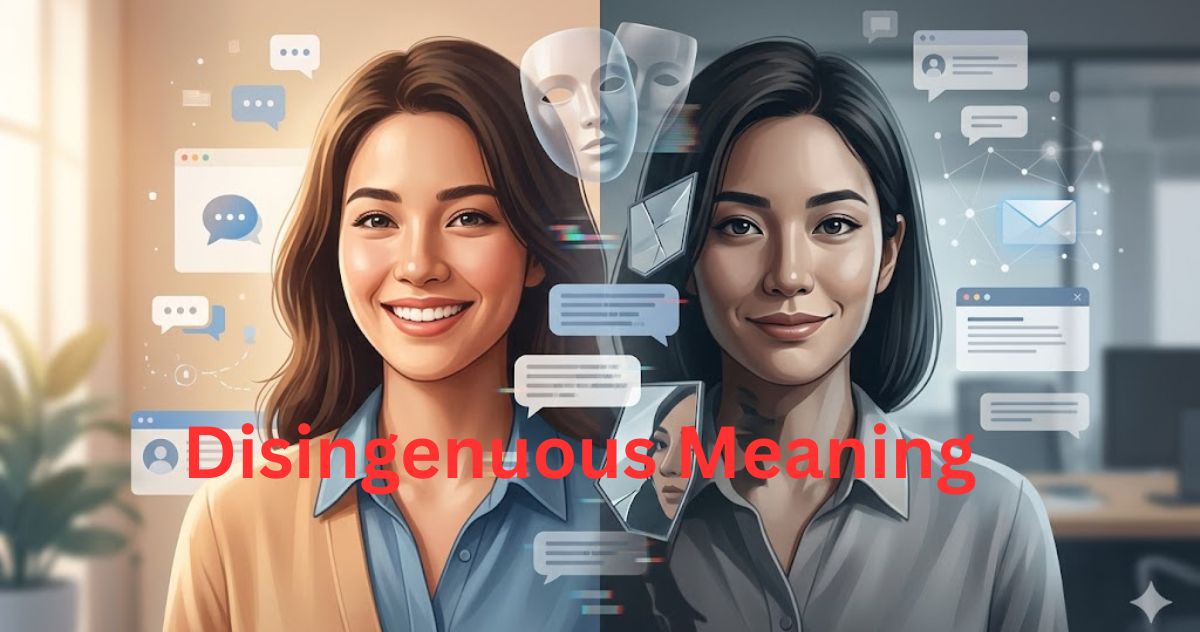
Some words feel simple at first glance but carry a deeper emotional weight once you understand how people actually use them in real life. “Disingenuous” is one of those words.
People search for this term when they feel confused about someone’s behavior—especially when words and actions don’t match. It often appears in situations where someone seems fake, misleading, or not fully honest, but in a subtle way that’s hard to prove directly.
Unlike outright lying, being disingenuous is more about half-truths, selective honesty, or pretending sincerity while hiding real intent. That’s why it often shows up in relationships, workplaces, social media arguments, and even casual conversations.
Understanding this word helps you read between the lines of communication and recognize when something feels “off” without being obvious.
Disingenuous Meaning – Quick Meaning
The word disingenuous means behaving in a way that is not sincere, honest, or straightforward, especially when someone pretends to be truthful but is actually hiding their real intention.
In simple terms:
- Saying something half-truthful to mislead others
- Pretending to be innocent while knowing more than you admit
- Acting fake or insincere in communication
Simple examples:
- “That apology felt disingenuous because he didn’t change his behavior.”
- “Her compliment sounded disingenuous, like she didn’t really mean it.”
- “It was a disingenuous explanation to avoid blame.”
Origin & Background
The word disingenuous comes from Latin roots where “genuinus” meant natural or sincere. Over time, the prefix “dis-” added the opposite meaning—something not genuine or not honest.
Historically, it wasn’t always a harsh insult. It originally described someone who was not frank or openly truthful in speech. But in modern communication, especially online, it has gained a stronger emotional tone.
On social media, people often use it to call out:
- Fake apologies
- Politically careful statements
- Manipulative communication
- Selective storytelling
In today’s digital world, where tone is hard to read, “disingenuous” has become a powerful label for subtle dishonesty.
Disingenuous Meaning in Urdu
In Urdu, disingenuous can be understood as:
“غیر مخلص / غیر سچا / دکھاوا کرنے والا”
It refers to someone who:
- ظاہر کچھ کرے لیکن اندر سے کچھ اور سوچے
- سچائی کو چھپائے یا آدھا سچ بولے
- بناوٹی یا غیر مخلص رویہ دکھائے
Example translations:
- “اس کی معذرت غیر مخلص لگ رہی تھی۔”
- “وہ بات کرتے ہوئے سچا نہیں تھا، بلکہ دکھاوا کر رہا تھا۔”
In everyday Urdu conversation, people often link it with “fake sincerity” or “dikhawa”.
Disingenuous Synonym
Some common synonyms include:
- Insincere
- Fake
- Dishonest (mild form)
- Hypocritical (stronger tone)
- Deceptive
- Pretentious
- Two-faced
- Untruthful
Each synonym carries slightly different emotional strength, but all revolve around lack of genuine intent.
Disingenuous Meaning in English
In English communication, disingenuous refers to behavior that appears honest but is actually misleading or not fully truthful.
It does NOT always mean lying directly. Instead, it often means:
- Leaving out important details
- Pretending not to know something
- Saying things strategically to avoid blame
It is commonly used in debates, workplace feedback, and emotional conversations.
Disingenuous in a Sentence
Here are some natural examples:
- “His disingenuous smile made everyone uncomfortable.”
- “That explanation felt disingenuous after what actually happened.”
- “She gave a disingenuous answer to avoid responsibility.”
- “The statement was polite but clearly disingenuous.”
Disingenuous Meaning in Chinese
In Chinese, disingenuous can be translated as:
不真诚 (bù zhēnchéng) – not sincere
虚伪 (xūwěi) – hypocritical / fake
不诚实 (bù chéngshí) – dishonest
Example:
- “他的道歉很虚伪。”
(His apology is disingenuous.)
Disingenuous Pronunciation
The pronunciation of disingenuous is:
/ˌdɪsɪnˈdʒenjuəs/
Simple breakdown:
- dis-in-JEN-you-us
It may look complicated, but once broken into parts, it becomes easier to pronounce smoothly in conversation.
Disingenuous Meaning and Examples
At its core, disingenuous reflects emotional dishonesty rather than factual lying.
Real-life examples:
- A friend says they are “fine” but clearly wants attention or help.
- A coworker praises your idea but later takes credit for it.
- A politician makes a statement that sounds honest but avoids key facts.
The emotional layer here is important—it’s not just about words, but intention behind words.
Disingenuous Meaning in Law
In legal or formal contexts, disingenuous is not a technical legal term, but it is often used in court arguments or legal writing to describe behavior that is misleading or not fully honest.
For example:
- A witness giving selective testimony may be described as disingenuous
- A lawyer may argue that the opposing party’s claim is disingenuous
In law, it is usually used to challenge credibility rather than define a crime.
Real-Life Conversations
WhatsApp Chat
Person A: “I didn’t mean anything bad in that message.”
Person B: “Honestly, that sounds disingenuous after what you said yesterday.”
Instagram DM
Person A: “I always support your content 😊”
Person B: “That feels a bit disingenuous considering you never like or share anything.”
TikTok Comment Section
User 1: “This apology video feels disingenuous.”
User 2: “Yeah, it looks more like damage control than real regret.”
Text Message
Person A: “I had no idea it would hurt you.”
Person B: “That sounds disingenuous because we already talked about it before.”
Emotional & Psychological Meaning
The word disingenuous is emotionally loaded. It often appears when trust is slightly broken but not completely destroyed.
People use it when they feel:
- Something doesn’t match emotionally
- Someone is pretending sincerity
- There is hidden intention behind polite words
Psychologically, it reflects our need for authenticity in communication. Humans naturally detect inconsistencies, even when they cannot fully explain them.
Short scenario:
You receive a heartfelt apology from someone who repeatedly hurt you before. The words sound right, but your instincts say something is off. You label it as disingenuous—not because you can prove it, but because the emotional pattern doesn’t feel real.
Usage in Different Contexts
- Social media: Used to call out fake posts, apologies, or PR statements
- Friends/relationships: Describes insincere apologies or compliments
- Workplace: Used in feedback or criticism of communication style
- Casual tone: Often used in debates or arguments to question honesty
When NOT to Use It
Avoid using disingenuous when:
- You are not sure about someone’s intention
- The situation is based on misunderstanding
- In formal respectful communication where tone matters
- When direct facts are missing
It can sound accusatory and may escalate conflict.
Common Misunderstandings
Many people confuse disingenuous with:
- Lying (not always true)
- Sarcasm (different tone)
- Shyness or awkwardness (not related)
The real meaning is about insincere intention, not just incorrect statements.
Comparison Table
| Term | Meaning Intent | Usage Intent | Example Intent | Comparison |
|---|---|---|---|---|
| Disingenuous | Not truly sincere | Subtle dishonesty | Fake apology | More subtle than lying |
| Insincere | Lacking honesty | Emotional fake tone | Forced compliment | Broader emotional use |
| Dishonest | Directly untruthful | Clear lying behavior | False claim | Stronger accusation |
| Hypocritical | Acting opposite to belief | Moral contradiction | Preaching but not acting | More value-based |
Key Insight:
Disingenuous is subtle—it hides behind politeness, while other terms are more direct and forceful.
Variations / Types
- Disingenuous meaning in text: Fake or selective honesty in messages
- Disingenuous slang: Used to call out fake behavior casually
- Disingenuous in chat: When someone sounds polite but not real
- Disingenuous tone: Soft but misleading communication style
- Disingenuous behavior: Acting sincere without true intent
- Disingenuous reply: Carefully crafted but not fully honest response
- Disingenuous comment: Social media remark that feels fake
- Disingenuous apology: Sorry without real change
- Disingenuous statement: Politically or socially filtered truth
- Disingenuous attitude: Pretending sincerity for appearance
How to Respond When Someone Uses It
Casual replies:
- “I didn’t mean it that way.”
- “Maybe you misunderstood me.”
Funny replies:
- “Wow, I should get an award for acting then!”
- “I promise I’m 100% authentic… most of the time 😄”
Mature replies:
- “I understand why it came across that way.”
- “Let me clarify my intention properly.”
Respectful replies:
- “I appreciate your honesty; I’ll explain better.”
- “Thanks for pointing that out, I’ll be more clear.”
Regional & Cultural Usage
- Western culture: Common in debates, media criticism, and politics
- Asian culture: Often used in indirect communication contexts
- Middle Eastern culture: Linked with sincerity and respect in speech
- Global internet: Popular in comment sections and online arguments
- Gen Z: Uses it casually for calling out fake vibes
- Millennials: Use it more formally or analytically
Is It Safe for Kids?
Yes, the word itself is safe, but it carries a critical tone. Children may misunderstand it as simple “lying,” so it should be explained carefully in context.
FAQs
What does it mean if someone is disingenuous?
If someone is disingenuous, it means they are not being fully honest or sincere. They may pretend to agree, care, or understand, but their real intention is different or hidden.
Does disingenuous mean lying?
Not exactly. Disingenuous is usually not a direct lie. It often means half-truths, selective honesty, or fake sincerity rather than openly false statements.
What is the synonym of disingenuous?
Common synonyms include: insincere, fake, hypocritical, deceptive, pretentious, and two-faced. Each carries a slightly different emotional strength.
Is disingenuous an insult?
Yes, it can be considered an insult depending on tone and context. It is used to criticize someone’s honesty or sincerity, but it is more formal than abusive.
What is the opposite of disingenuous?
The opposite is genuine, sincere, honest, or straightforward—someone who speaks and acts with true intention.
Can a disingenuous person change?
Yes, if the behavior is intentional, a person can become more honest and transparent by improving communication and self-awareness.
Where is disingenuous commonly used?
It is often used in social media, debates, workplace feedback, and relationships where sincerity is questioned.
Is disingenuous a formal word?
Yes, it is a formal English word, though it is also widely used in everyday online conversations and discussions.
What emotion does disingenuous behavior show?
It usually shows hidden intent, avoidance, or emotional masking—when someone is not fully expressing their real feelings.
Why do people act disingenuous?
People may act disingenuous to avoid conflict, protect themselves, gain advantage, or hide uncomfortable truths.
Conclusion
Disingenuous is more than just a vocabulary word—it reflects how humans sense honesty beyond spoken language. It describes moments when words feel polished but intentions feel unclear. In daily life, recognizing this term helps you understand subtle communication gaps in relationships, work, and social media. It teaches emotional awareness and critical thinking about sincerity. When used correctly, it becomes a powerful tool to interpret behavior, not just language, and respond with clarity and confidence in conversations.